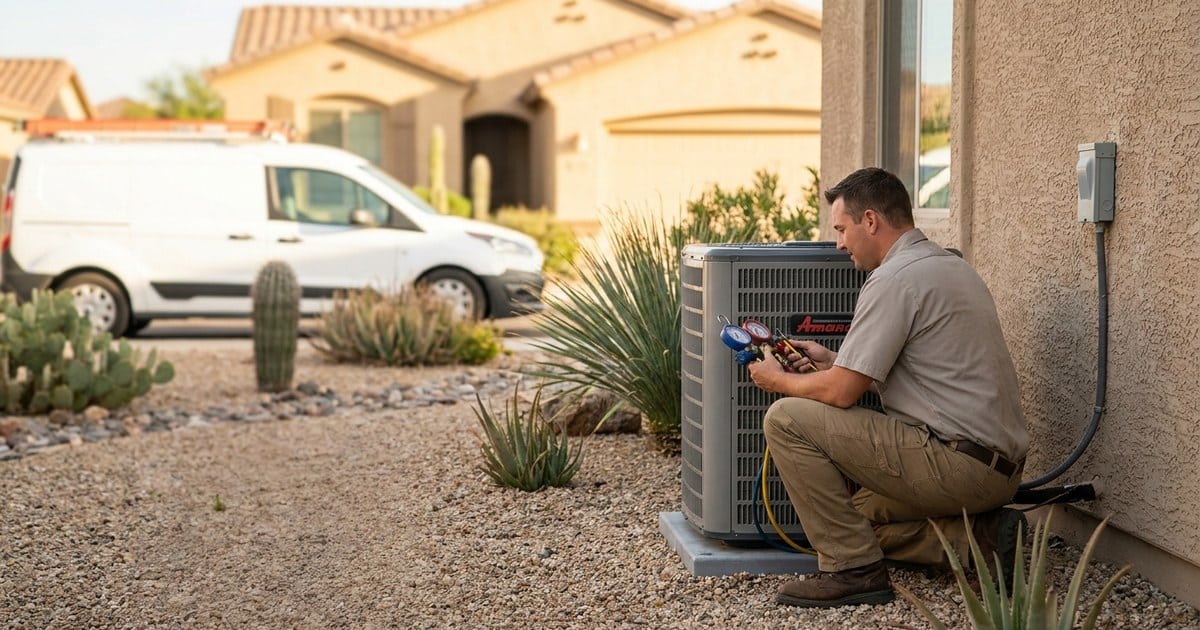
When your AC is running full blast but the air inside still feels sticky and uncomfortable during Arizona’s monsoon season, you’re not imagining things. The problem isn’t always your air conditioner: it’s how your system handles humidity when outdoor moisture levels spike.
In Arizona, your AC handles humidity most of the year, but during monsoon season (July through September), oversized or short-cycling systems fail to dehumidify properly. A whole-home dehumidifier works with your HVAC to remove excess moisture when your AC can’t keep up. Most homeowners don’t need one year-round; the solution depends on your system’s condition, sizing, and airflow design.
The question isn’t whether you’re uncomfortable. You already know you are. The real question is whether you need expensive new equipment, a simple system adjustment, or something in between. This guide walks through what actually causes indoor humidity problems in Arizona homes, when your HVAC system should handle it on its own, and when a whole-home dehumidifier makes sense versus wasting money on a Band-Aid fix.
Why Arizona Humidity Is Different (And Why Your AC Struggles During Monsoon Season)
Arizona’s climate is bone-dry most of the year. Phoenix design conditions run 110°F dry-bulb with a mean coincident wet-bulb around 71°F, according to ACCA Manual J load calculation standards. Your AC was sized for extreme heat, not moisture removal. That’s why most Valley homes have what would be considered oversized systems anywhere else: you need the cooling capacity to handle 115°F summer days.
But during monsoon season (July through mid-September), relative humidity can spike dramatically according to National Weather Service monsoon guidance. Suddenly, that same oversized AC becomes a problem. The system reaches your setpoint quickly, shuts off before completing a full cooling cycle, and never runs long enough to pull moisture out of the air. You get cold, clammy air instead of comfortable, dry cooling.
Short-cycling is the technical term. Your compressor cycles on and off rapidly because the cooling load is lower during monsoon season (it’s 95°F and humid instead of 110°F and dry). Each time the system shuts off early, it stops dehumidifying. The result: your home hits 75°F on the thermostat but feels like 78°F because the air is saturated with moisture.
Ductwork compounds the problem. If your ducts run through an unconditioned attic (where temperatures exceed 140°F in summer), even moderate duct leakage introduces humid outdoor air directly into your conditioned space faster than your AC can remove it, per Energy Star duct sealing guidance. Sealing those ducts often solves the humidity problem without any equipment changes. That’s why air duct installation and ductwork services have gained traction in the East Valley: homeowners are discovering they can bundle system optimization with installation or repair work and solve problems without replacing equipment. A duct inspection often reveals the real culprit before you spend thousands on new hardware.
The system that keeps you comfortable in June fails in August, not because it’s broken, but because it was never designed to run long cycles when outdoor temperatures drop and humidity spikes. Installation demand has surged in Gilbert, Mesa, Chandler, and Queen Creek precisely because homeowners want solutions that address both cooling capacity and moisture control in a single project.
How Modern HVAC Systems Handle Humidity (And When They Don’t)
Air conditioners remove moisture as a byproduct of cooling. As warm indoor air passes over the cold evaporator coil, water vapor condenses and drains away through the condensate line. This process (latent cooling) works well when your system runs long enough to actually condense moisture out of the air.
Three things kill that process. First, oversized equipment that short-cycles, as we just covered. The compressor never stays on long enough to dehumidify. Second, duct leakage that introduces humid outdoor air faster than the system can condition it. Third, thermostat settings that create rapid on-off cycling (setting the temp too low or leaving the fan on “on” instead of “auto” keeps air moving without dehumidifying).
Variable-capacity systems handle humidity better than single-stage units. A variable-speed compressor modulates output and runs at lower speeds for longer periods, which means more runtime at part-load conditions and better dehumidification. If your 10-year-old single-stage AC is struggling with monsoon humidity, upgrading to a variable-capacity system solves the problem at the root. You get cooling and dehumidification in one properly sized package.
The EPA's Indoor Air Quality briefing confirms that HVAC filtration and runtime directly impact moisture control and air quality outcomes. A system that runs longer removes more moisture, filters more air, and keeps your home more comfortable.
Here’s the honest answer most contractors won’t give you: if your AC is end-of-life or clearly oversized for your home, adding a dehumidifier is putting a $3,000 Band-Aid on a $10,000 problem. Fix the system first. If your AC is newer, properly sized, and well-maintained but you still see high humidity during monsoon season, then a whole-home dehumidifier becomes a legitimate add-on. A free on-site consultation identifies which scenario applies to your home. The goal is to recommend what you need, not upsell equipment you don’t.
Emergency repair situations often reveal this exact failure mode: homeowners call when their system won’t cool, and the diagnostic reveals an oversized unit that never ran properly to begin with. Addressing system sizing and airflow design before adding dehumidification equipment is the path to a real solution. Proper HVAC System Repairs & Upgrades can address root causes before you invest in standalone dehumidification equipment.
Managing Indoor Air Quality: How HVAC Systems Impact Your Health starts with a system that runs correctly, not one that’s fighting itself.
What a Whole-Home Dehumidifier Actually Does (And Who Needs One)
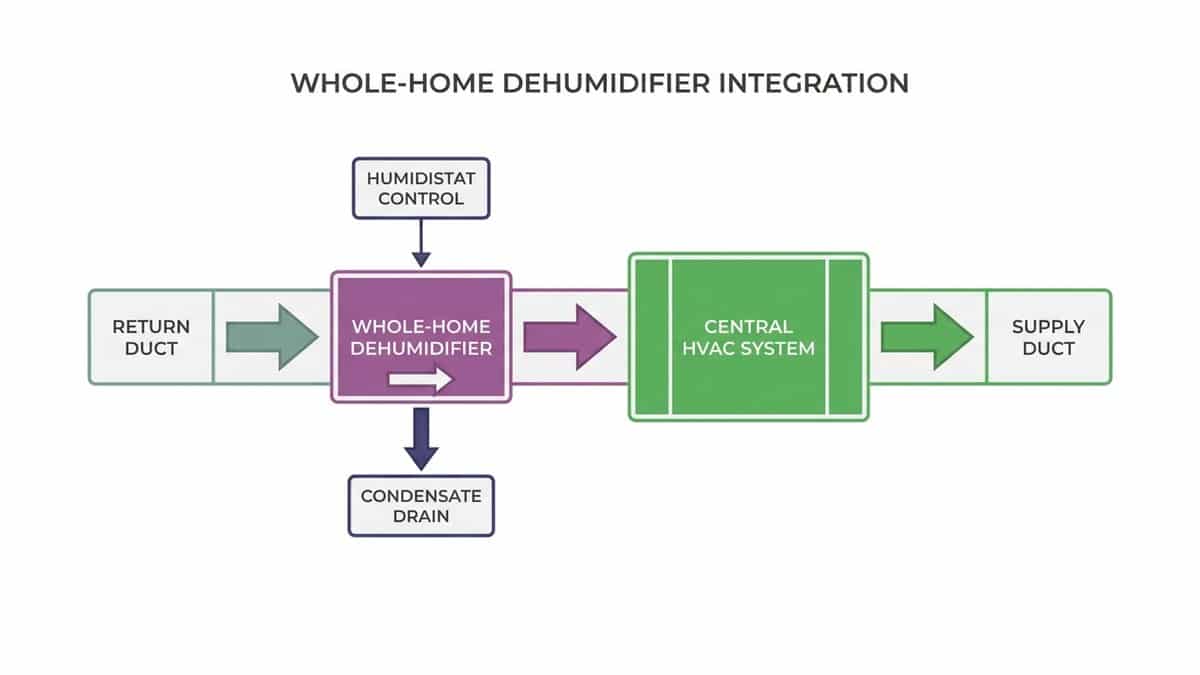
A whole-home dehumidifier integrates with your HVAC system and removes moisture independently of the cooling cycle. Unlike a portable unit you empty every 12 hours, a whole-home dehumidifier drains directly to your AC’s condensate line or an external drain. You set a target humidity level on a separate humidistat (typically in the range recommended by ASHRAE comfort standards), and the unit runs as needed to maintain that setpoint.
Capacity is measured in pints of moisture removed per day. A typical whole-home unit for a 2,000-square-foot Arizona home removes 70–90 pints per day, depending on the model and installation. The system pulls air from your return duct, dehumidifies it, and sends drier air back into the supply duct. It works alongside your AC, not instead of it.
Cost runs $1,500–$3,500 installed, depending on unit size, integration complexity, and whether your existing ductwork can accommodate the unit without modification. The dehumidifier adds to your monthly energy use because it’s another motor running, but it removes the load from your AC system (less compressor cycling to chase humidity).
Who actually needs one? Homeowners with properly sized, well-maintained AC systems who still experience high humidity during monsoon season. Homes with specific health needs (severe allergies, asthma, mold sensitivity) where maintaining appropriate relative humidity year-round makes a measurable difference in symptoms, per research on home environmental health. And homes where duct sealing, coil cleaning, and thermostat optimization have already been done but indoor humidity still exceeds comfort targets.
A portable dehumidifier is not the same thing. Portable units cover 500–1,000 square feet at best, run constantly, cost as much to operate as a small AC, and require daily maintenance. They’re a temporary fix for a basement or a single room, not a whole-home solution.
Indoor air quality upgrades often go hand-in-hand with dehumidification. For East Valley homeowners focused on IAQ improvements, a whole-home dehumidifier installation becomes part of a comprehensive strategy that includes filtration, ventilation, and moisture control. These services support both residential comfort and the health outcomes that matter most to families dealing with Valley dust and allergen loads.
The Real Culprits Behind Indoor Humidity Problems (And the Fixes That Don’t Require New Equipment)
Before you spend $3,000 on a whole-home dehumidifier, check for these four fixable problems that cause most Arizona humidity complaints.
Duct leakage. Significant duct leakage adds the equivalent of 0.5–1.0 ton of additional cooling demand, according to Energy Star duct performance research. That’s humid outdoor air pouring into your system faster than your AC can condition it. Sealing ducts costs $300–$800 depending on your home’s size and attic access. Based on Department of Energy efficiency standards, properly sealed ducts can improve cooling efficiency by 10–15% and often eliminate the humidity problem completely. The Ductwork Cleaning service includes a leakage inspection as standard because duct performance directly impacts both air quality and moisture control. As ductwork installation and sealing services gain traction, more East Valley homeowners are discovering that fixing the distribution system solves problems they thought required expensive equipment upgrades.
Thermostat programming. Setting your thermostat too low (68°F in summer) or leaving the fan on “on” instead of “auto” creates short-cycling and prevents dehumidification. Your AC cools the air to setpoint, shuts off, and the fan keeps blowing unconditioned air through the house. Switch the fan to “auto” and raise the setpoint to 74–76°F. The system will run longer cycles, remove more moisture, and feel more comfortable at a higher temperature with lower humidity. A Smart Thermostat Installation in Arizona upgrade can automate these settings and adapt to monsoon season conditions.
Dirty evaporator coil. A coil caked with dust can’t transfer heat efficiently, which reduces cooling capacity and dehumidification performance. Annual maintenance (coil cleaning, refrigerant check, condensate drain flush) costs $150–$250 and keeps your system running at design efficiency.
Air infiltration. Unsealed windows, doors, attic hatches, and wall penetrations let humid outdoor air into your home. Caulking and weatherstripping cost under $100 in materials and make a measurable difference during monsoon season, per EPA indoor air quality guidance.
These fixes cost a fraction of a new dehumidifier and often solve the problem completely. A free on-site consultation identifies the root cause before recommending any equipment purchase. The approach is straightforward: if you need a $500 duct sealing job, that’s the recommendation. If a $3,000 whole-home dehumidifier vs HVAC Arizona optimization is necessary, we’ll explain why. No automatic upsells to the most expensive option. Installation demand in Gilbert, Chandler, Mesa, Queen Creek, and San Tan Valley has surged precisely because homeowners want bundled solutions that address ductwork, system sizing, and IAQ in a single project rather than piecemeal fixes.
Decision Framework: Whole-Home Dehumidifier vs. HVAC Optimization
Here’s how to decide what your home actually needs.
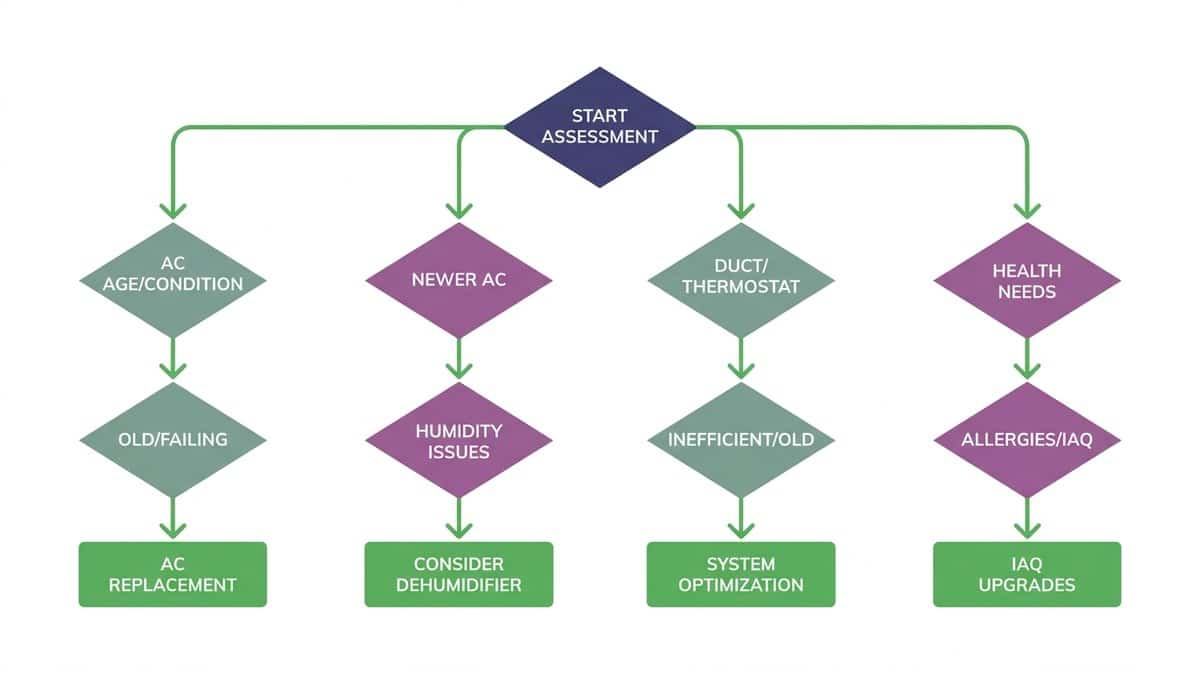
If your AC is 10+ years old, oversized for your home, or a single-stage unit: Replace or upgrade the system first. A properly sized variable-capacity AC solves humidity and efficiency in one step. You’ll spend $9,000–$20,000 on a new system, but you get lower energy bills, better comfort, and no need for a separate dehumidifier. Adding a dehumidifier to a failing AC is like putting new tires on a car with a blown engine.
If your AC is less than 5 years old, properly sized, and well-maintained, but you still see high humidity during monsoon season: A whole-home dehumidifier is a legitimate add-on. Your system is doing its job; it just needs help with the seasonal moisture spike.
If you have duct leakage, poor insulation, or thermostat issues: Fix those first. They’re cheaper than a dehumidifier and often eliminate the problem. Duct sealing, coil cleaning, and thermostat reprogramming together cost $300–$1,200. That’s less than half the cost of a dehumidifier and delivers faster ROI.
If you have severe allergies, asthma, or mold sensitivity: A whole-home dehumidifier plus IAQ upgrades (HEPA filtration, UV disinfection) may be necessary regardless of your AC’s performance. Maintaining appropriate humidity levels year-round reduces dust mites, mold spores, and allergen concentrations, per CDC ventilation and air cleanliness standards. This is a health decision, not just a comfort decision. HVAC Air Purification: Reduce Allergens, Dust & Contaminants strategies work best when humidity is controlled at source.
System replacement and installation services include a free load calculation and duct inspection before recommending any equipment. If your system needs replacement, you’ll hear it straight. If it just needs optimization, that’s the answer. The Indoor Air Quality in Arizona approach starts with diagnosing the root cause, not selling the most expensive solution. Residential HVAC services in the East Valley succeed when they prioritize honest diagnostics and trust-building over transactional equipment sales. That’s the foundation for long-term client relationships and referral-driven growth among review-sensitive homeowners who value transparency.
Cost Comparison: What You’ll Actually Pay (And What You Get for It)
Here’s what each option costs and what you get in return.
Whole-home dehumidifier installed: $1,500–$3,500, depending on capacity and integration complexity. Adds ongoing energy cost (the unit runs independently of your AC). Solves the humidity problem if your AC is already working correctly. No cooling efficiency improvement.
HVAC system optimization (duct sealing, coil cleaning, thermostat upgrade): $300–$1,200. Based on Energy Star duct sealing benefits documentation, properly sealed ductwork can improve cooling efficiency by 10–15%, which reduces energy bills and often eliminates humidity problems without new equipment. Fastest ROI of any option.
AC system replacement (properly sized, variable-capacity): $9,000–$20,000. Solves humidity and efficiency in one step. Modern variable-capacity systems run longer at part-load, which means better dehumidification during monsoon season. Eligible for financing through GoodLeap and JB Warranties, making the monthly cost comparable to ongoing portable dehumidifier energy bills.
Portable dehumidifier (for comparison): $200–$400 upfront, but ineffective for whole-home coverage, high ongoing energy cost, and constant manual maintenance. Not a real solution for a 2,000-square-foot home.
The right investment depends on your system’s condition. A whole-home dehumidifier makes sense when your AC is new and properly sized. It’s a waste of money if your AC is oversized, end-of-life, or leaking half its capacity through unsealed ducts.
The Services v2 page breaks down what’s included in each service tier. Financing options make a properly sized system replacement accessible for most East Valley families. The monthly payment on an $11,000 system replacement through GoodLeap often runs less than the energy cost of running a failing AC plus a portable dehumidifier. System replacement and installation projects have become the most efficient path to long-term comfort and efficiency for homeowners who’ve been patching an aging system with temporary fixes.
When to Call a Pro (And What to Ask Before You Commit)
Call for a diagnostic if you’re experiencing any of these during monsoon season: AC running but air feels sticky, visible condensation on windows, musty odors in closets or bathrooms, or allergy symptoms worsening indoors. Also call if you’ve tried a portable dehumidifier and it’s not solving the problem.
Here’s what to ask the contractor before you commit:
“Will you do a duct leakage test and inspect my system before recommending a dehumidifier?” If the answer is no, find a different contractor. The root cause might be a $500 duct seal, not a $3,000 equipment add-on.
“Is my AC properly sized for my home’s cooling load?” Ask to see the Manual J load calculation. If they can’t produce one or say “we just match the old system’s tonnage,” walk away. Proper sizing is the foundation of humidity control.
“What’s the difference in cost between optimizing my current system and adding a dehumidifier?” A transparent contractor will give you both options and explain which makes sense for your situation. If they only quote the expensive option, they’re upselling.
A free on-site consultation answers all three questions. Bill is on the job, you get a duct inspection and load assessment as part of the visit, and the recommendation is based on what your home actually needs (a whole-home dehumidifier vs HVAC Arizona system upgrade, or just a settings adjustment). That’s the residential HVAC service approach that’s earned an A+ BBB rating across 3,000+ installs in the East Valley. Local HVAC contractors succeed when they build trust with homeowners who value honest diagnostics over high-pressure sales tactics.
If your AC is failing completely (no cooling, compressor won’t start, refrigerant leak), 24/7 emergency service and same-day availability are available. But for humidity problems, the diagnostic comes first. Get the right answer before you spend money on the wrong fix. That diagnostic-first approach is exactly what drives the install estimates and service bookings needed to support sustainable revenue growth through organic search and referral channels.
Schedule your free consultation now or call 602-619-3609.
The Bottom Line: Fix the Root Cause First
Arizona AC systems handle humidity most of the year, but monsoon season exposes the weaknesses: oversized equipment that short-cycles, duct leakage that introduces humid outdoor air, and thermostat settings that prevent proper dehumidification. A whole-home dehumidifier is a precision tool for homes where the HVAC system is already performing correctly but needs help with seasonal moisture spikes. It’s not a substitute for a properly sized AC or sealed ductwork.
Fix the root cause first. That might be a $500 duct sealing job, a $200 thermostat upgrade, or a $10,000 system replacement. The right answer depends on your system’s age, condition, and sizing. Don’t let a contractor sell you a dehumidifier when your AC is the real problem.
JLM is owner-led, A+ BBB rated, and based right here in the East Valley. We’ve completed 3,000+ installs for families who needed honest answers, not automatic upsells. Bill is on the job, and we’ll give you a straightforward recommendation based on what your home actually needs.