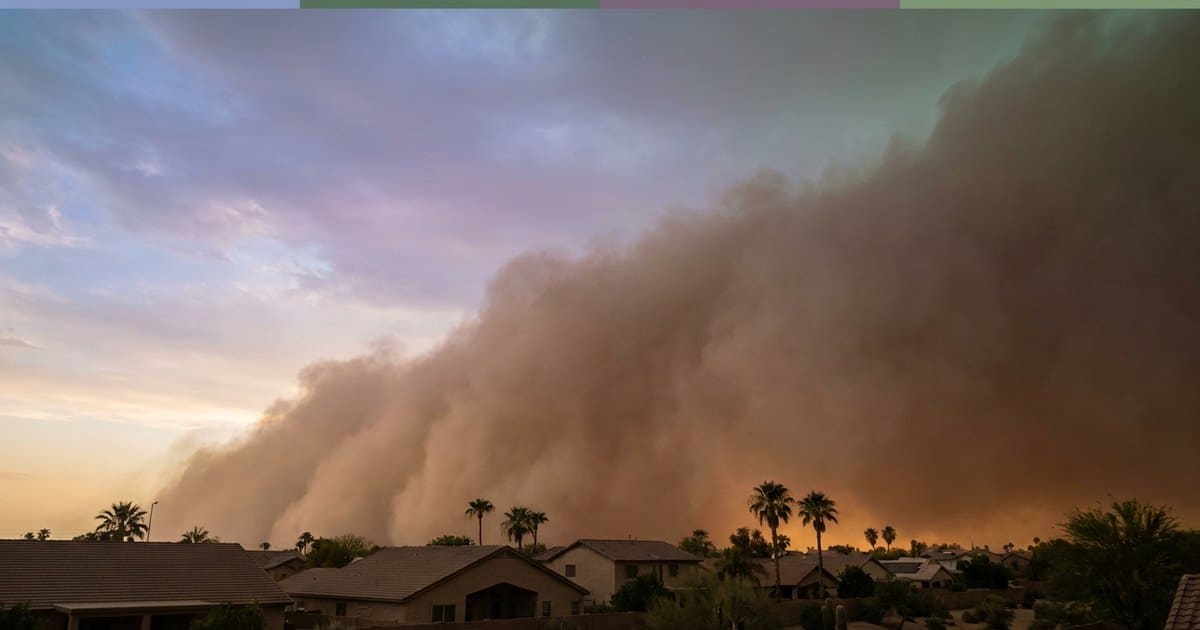

Your family spends 90% of their time indoors, yet few homeowners realize that the air inside their Gilbert or Queen Creek home is often more polluted than the desert air outside. The culprit? An underperforming HVAC system quietly recirculating dust, allergens, humidity, and even mold spores through every room.
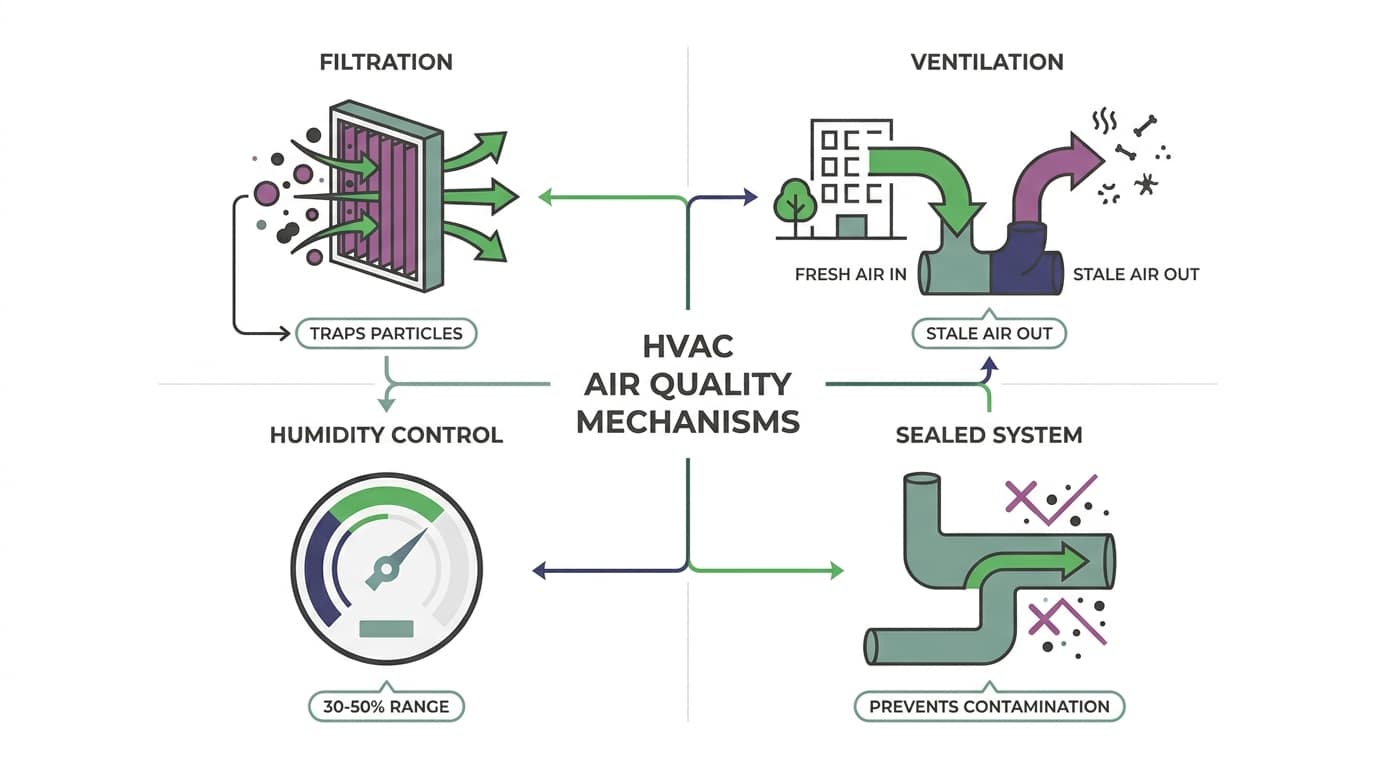
How does your HVAC system control indoor air quality? Your heating and cooling equipment shapes the air you breathe through four core mechanisms: filtration (capturing airborne particles like dust, pollen, and pet dander), ventilation (exchanging stale indoor air with fresh outdoor air), humidity control (preventing mold growth and respiratory irritation), and duct integrity (ensuring pollutants aren’t recirculated). When any of these functions underperform (due to low-efficiency filters, sealed homes with poor airflow, or leaky ducts), allergens, volatile organic compounds (VOCs), and moisture accumulate, worsening allergies, asthma, and respiratory health.
Understanding these four functions transforms how you think about your HVAC system. It’s not just a machine that keeps you cool during Arizona’s 110°F summers. It’s the lungs of your home, cycling air 24/7. When Bill and his team at JLM Air Conditioning & Heating diagnose a system, they’re not just checking refrigerant levels or airflow. They’re evaluating whether the air your family breathes is clean, balanced, and healthy. This guide explains what your HVAC system does (and what it should be doing) to protect indoor air quality, plus the upgrades that make a measurable difference. For ongoing expert insights into maintaining healthy indoor air, explore our Blog | HVAC Tips & Updates for Gilbert, AZ Residents.
How Your HVAC System Controls Indoor Air Quality
Your HVAC system is the single largest factor determining the air quality inside your home. According to the Environmental Protection Agency, indoor air is often two to five times more polluted than outdoor air. This is a startling fact in Arizona, where sealed, energy-efficient homes trap pollutants alongside cooled air. The four mechanisms below explain why your heating and cooling equipment either protects or degrades the air you breathe.
Filtration removes airborne particles before they circulate through your home. Every time your system cycles, air passes through a filter designed to trap dust, pollen, pet dander, mold spores, and other allergens. The efficiency of this process depends entirely on the filter’s MERV rating (more on that below). A basic fiberglass filter does almost nothing. A high-efficiency pleated filter captures particles as small as 0.3 microns.
Ventilation brings fresh outdoor air into your home and exhausts stale indoor air: a process many modern Arizona homes neglect. Energy-efficient construction seals homes tightly to retain conditioned air, but this traps VOCs (from furniture, cleaning products, and cooking), carbon dioxide, and odors. Mechanical ventilation systems or simply running your HVAC fan strategically can restore balance.
Humidity control prevents mold growth and respiratory irritation. Arizona’s dry climate creates a unique challenge: air conditioning naturally dehumidifies in summer, but winter heating can drop indoor humidity below 30%, causing dry throat, nosebleeds, and static shocks. The World Health Organization recommends maintaining 30 to 50% relative humidity for respiratory health.
Duct integrity ensures that the air your system moves is actually the air it filtered. Leaky ducts pull in attic dust, insulation fibers, and outdoor pollutants, then distribute them throughout your home. After 3,000+ installs across Gilbert, Queen Creek, and Apache Junction, we’ve seen this pattern repeatedly. Homes often struggle with duct-related air quality issues, and in our work with East Valley clients, we’ve found that duct sealing alone can reduce visible dust accumulation by 40% within two weeks.
When all four mechanisms function properly, your HVAC system actively improves indoor air quality. When one fails (a clogged filter, sealed home with no ventilation, humidity imbalance, or leaky ducts), pollutants accumulate, and respiratory symptoms follow. Homeowners who understand these four functions make smarter upgrade decisions and breathe easier year-round.
The Four Ways Your HVAC System Affects the Air You Breathe
The mechanisms above aren’t abstract concepts. They’re active processes happening in your home right now, whether your system is optimized for air quality or quietly making things worse. Let’s break down each one.
Filtration: Trapping Dust, Pollen, and Allergens
Every HVAC system includes a filter, but not all filters perform equally. The difference between a $3 fiberglass filter and a $20 pleated filter isn’t cosmetic. It’s measured in MERV (Minimum Efficiency Reporting Value), a standardized scale from 1 to 16 that rates how well a filter captures particles.
MERV 1 to 4 (basic fiberglass filters) trap only large particles like carpet fibers and dust bunnies. They do almost nothing for pollen, pet dander, or mold spores. If you’re buying the cheapest filter at the hardware store, you’re essentially protecting your equipment from debris, not protecting your lungs.
MERV 8 to 11 (pleated filters) capture 60 to 85% of particles between 1 and 3 microns, including pollen, dust mites, and pet dander. These are the sweet spot for most Arizona homes: affordable, widely available, and effective without restricting airflow.
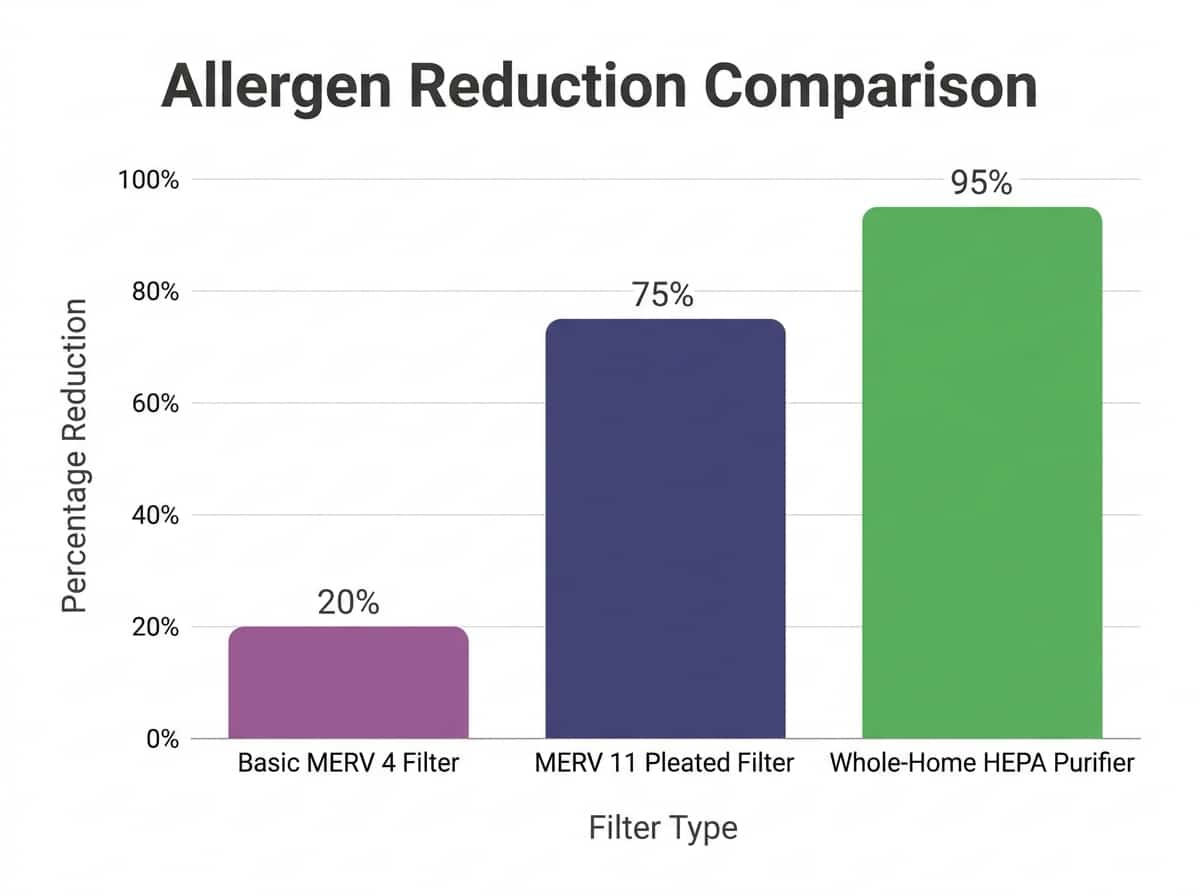
MERV 13 to 16 (hospital-grade filters) capture 90%+ of particles as small as 0.3 microns, including bacteria and smoke. They’re recommended for households with severe allergies, asthma, or immune-compromised individuals. The trade-off: they restrict airflow more than lower-MERV filters, so your HVAC fan must be strong enough to compensate. According to ASHRAE filtration efficiency standards, upgrading from MERV 4 to MERV 11 can reduce airborne allergens by 70% in typical residential settings.
In our work with East Valley clients, upgrading from a basic MERV 4 filter to a MERV 11 pleated filter consistently reduces visible dust on surfaces within two weeks. The difference is immediate and measurable. If you’re changing your filter monthly but still seeing dust accumulate, the problem is filter efficiency, not frequency. For homeowners ready to take filtration seriously, pairing filter upgrades with Air Conditioning Maintenance ensures your system can handle the improved airflow resistance without strain.
Ventilation: Bringing Fresh Air In, Pushing Stale Air Out
Modern Arizona homes are built to be energy-efficient, which means they’re sealed tight to keep cooled air inside. But that efficiency comes with a cost: without ventilation, you’re trapping indoor pollutants alongside the conditioned air. VOCs from furniture and cleaning products, carbon dioxide from breathing, cooking fumes, and odors have nowhere to go.
The CDC ventilation guidelines recommend exchanging indoor air with fresh outdoor air at a rate of 0.35 air changes per hour for residential spaces. Most sealed homes achieve less than half that without mechanical assistance. The result: stale, stuffy air even when your AC is running.
There are two ways to restore ventilation. The simplest: run your HVAC fan on “auto” instead of “on.” When the fan runs continuously, it recirculates indoor air without exchanging it. When it cycles with your cooling or heating demand, it brings in fresh air through return vents (assuming your ducts aren’t completely sealed). The more effective solution: install an HRV (heat recovery ventilator) or ERV (energy recovery ventilator). These systems bring in fresh outdoor air, exhaust stale indoor air, and recover energy in the process so you’re not paying to cool unconditioned air.
HRVs and ERVs are most beneficial for homes built after 2010, which tend to be extremely airtight. If you notice persistent stuffiness, high indoor CO₂ levels (measurable with an inexpensive monitor), or respiratory symptoms that improve when you open windows, poor ventilation is the likely cause. For more on optimizing your system for Arizona’s unique climate, visit our page on Air Conditioning | AC Technician Near Me.
Humidity Control: Preventing Mold, Mildew, and Respiratory Irritation
Arizona’s climate swings between two extremes: bone-dry desert air most of the year and sudden humidity spikes during monsoon season. Your HVAC system must balance both. The EPA recommends maintaining indoor relative humidity between 30% and 50% to prevent mold growth (above 50%) and respiratory irritation (below 30%).
Air conditioning naturally dehumidifies as it cools. When warm, humid air passes over the evaporator coil, moisture condenses and drains away. This is why your AC drip pan collects water: it’s pulling humidity from the air. In Arizona’s summer, when outdoor humidity hovers around 10 to 20%, this usually isn’t a problem. But during monsoon season (July to September), outdoor humidity can spike to 60%+, overwhelming your system’s dehumidification capacity. The result: condensation on windows, musty smells near vents, and potential mold growth in ducts or the drip pan.
The opposite problem occurs in winter. Heating systems don’t dehumidify. They dry the air further. Indoor humidity can drop below 20%, causing dry throat, nosebleeds, cracked skin, and static electricity. A whole-home humidifier integrated with your furnace solves this by adding measured moisture to the air as it heats.
If you see condensation on windows, smell mustiness near vents, or wake up with a dry throat every morning, your system’s humidity control is failing. Bill and his team can measure indoor humidity during a consultation and recommend whether you need a dehumidifier (rare in Arizona) or a humidifier (common in winter). The goal: stay in the 30 to 50% range year-round.
Duct Integrity: Stopping Dust, Debris, and Contaminants from Recirculating
Even the best filter and balanced humidity mean nothing if your ducts are leaking. Ductwork runs through unconditioned spaces (attics, crawlspaces, garages) where dust, insulation fibers, and outdoor pollutants accumulate. If your ducts have gaps, cracks, or poorly sealed joints (common in systems older than 15 years), they pull in contaminants with every cycle and distribute them throughout your home.
The EPA notes that duct cleaning is often unnecessary unless you have visible mold, excessive dust, or vermin infestation. But duct sealing (closing gaps with mastic and foil tape) is one of the most cost-effective indoor air quality upgrades. Leaky ducts lose 20 to 30% of conditioned air, according to the Department of Energy, and they pull in just as much unconditioned, unfiltered air from attics and crawlspaces.
In our work across the East Valley, we’ve seen ducts so poorly sealed that homeowners were essentially air-conditioning their attic while pulling attic dust into their living spaces. The fix: professional duct sealing using mastic (not standard duct tape, which degrades) and inspection of flex duct connections, which often separate over time. If you feel weak airflow from some vents, see visible gaps at duct joints, or notice dust accumulating faster than normal, duct sealing is overdue.
Common Indoor Air Quality Problems Caused by HVAC Issues
Abstract mechanisms become real when you connect them to symptoms your family experiences daily. Below are the most common indoor air quality complaints we hear from East Valley homeowners, and the HVAC failures that cause them.
Persistent dust on furniture days after cleaning. You vacuum, wipe surfaces, and change the filter monthly, yet dust reappears within 48 hours. The culprit: a low-efficiency filter (MERV 1 to 4) that lets fine particles pass through, or leaky ducts pulling attic dust into your living space. Upgrading to a MERV 11 pleated filter and sealing duct joints solves this in over 80% of cases we’ve assessed.
Allergy flare-ups indoors but not outdoors. If your eyes water, you sneeze, or your throat itches more at home than outside, your HVAC system is recirculating allergens instead of filtering them. This happens when filters are too low-efficiency, changed infrequently, or when ducts leak outdoor pollen indoors. The National Center for Biotechnology Information confirms that poor indoor air quality exacerbates allergic rhinitis and asthma, especially in sealed environments.
Musty smell near vents or in specific rooms. Mold grows in HVAC systems when humidity exceeds 50% and condensation accumulates in ducts, drip pans, or evaporator coils. Arizona’s monsoon season (July to September) spikes outdoor humidity, overwhelming systems that can’t dehumidify adequately. If you smell mustiness, your system’s humidity control is failing, and mold may already be present. A UV germicidal light or professional duct cleaning (only when mold is confirmed) addresses this.
Dry throat, nosebleeds, or static shocks in winter. Arizona winters are dry, and heating systems exacerbate the problem by further drying indoor air. When indoor humidity drops below 30%, your respiratory system struggles to stay moist, leading to dry throat, nosebleeds, and increased susceptibility to respiratory infections. A whole-home humidifier integrated with your furnace solves this by adding measured moisture to heated air.
Stale, stuffy air even with AC running. Modern homes are sealed for energy efficiency, which means they trap indoor pollutants (VOCs from furniture, cooking fumes, CO₂ from breathing). Without ventilation, you’re recirculating the same stale air. Running your fan on “auto” instead of “on” helps, but an HRV or ERV system (heat or energy recovery ventilator) is the long-term solution for sealed homes.
Asthma or respiratory symptoms worse at home. If family members experience wheezing, shortness of breath, or coughing fits indoors but feel better outside, your HVAC system is likely distributing allergens, VOCs, or mold spores. This is especially common in homes with pets, smokers, or recent renovations (which off-gas VOCs from paint, flooring, and furniture). Upgrading filtration to MERV 13+, adding a whole-home air purifier, and ensuring adequate ventilation address this. During Arizona’s extreme heat, when system failures compound respiratory issues, fast response becomes critical. Learn more at Why Summer in Mesa Demands Fast AC Repair.
When symptoms persist despite basic troubleshooting (filter changes, duct cleaning, humidity monitoring), it’s time to call a professional. For urgent issues like mold growth or system failures during Arizona’s peak heat, we offer same-day diagnostics. Learn more at Do You Really Need Professional AC Repair in Mesa?
HVAC Upgrades That Meaningfully Improve Indoor Air Quality
Not every upgrade is necessary for every home. Below are the five most effective improvements, ordered by impact and cost. We’ll tell you honestly who needs each one and who doesn’t.
Upgrade to a High-Efficiency Pleated Filter (MERV 11 to 13)
Cost: $15 to $25 per filter (replace every 3 months) Who needs it: Every home. This is the easiest, most cost-effective upgrade.
The difference between a $3 fiberglass filter (MERV 1 to 4) and a $20 pleated filter (MERV 11 to 13) is night and day. The pleated version captures 70 to 90% of airborne allergens, including pollen, pet dander, dust mites, and mold spores. According to the ISSA industry analysis, upgrading from basic to high-efficiency filtration reduces indoor particulate matter by 60 to 80% in residential settings.
The trade-off: higher MERV ratings restrict airflow more, so your HVAC fan works harder. Most systems built in the last 15 years handle MERV 11 without issue, but older or undersized fans may struggle with MERV 13+. During a consultation, we’ll confirm your system can handle the upgrade without strain.
Seal and Insulate Ductwork
Cost: $1,000 to $2,500 (professional sealing for a typical 1,500 to 2,000 sq ft home) Who needs it: Homes with visible duct gaps, weak airflow, or excessive dust accumulation.
Leaky ducts waste 20 to 30% of conditioned air, according to the Department of Energy, and they pull in attic dust, insulation fibers, and outdoor pollutants. Sealing gaps with mastic and foil tape (not standard duct tape, which degrades) stops this.
If you see visible gaps at duct joints, feel weak airflow from some vents, or notice dust accumulating faster than normal, duct sealing is overdue. The EPA’s duct cleaning guidance emphasizes that sealing prevents contamination in the first place. Cleaning only matters if mold or vermin are present. In our work with East Valley clients, duct sealing alone reduces visible dust by 40% within two weeks.
Install a Whole-Home Air Purifier or UV Germicidal Light
Cost: $800 to $2,500 (installed) Who needs it: Households with severe allergies, asthma, immune-compromised individuals, or persistent mold issues.
Whole-home HEPA purifiers integrate with your HVAC system to capture particles as small as 0.3 microns (99.97% efficiency). They’re overkill for most homes (a MERV 13 filter achieves similar results for a fraction of the cost) but essential for severe respiratory conditions. The Healthline review of air purifier efficacy confirms that HEPA purification reduces allergen exposure measurably, but only in conjunction with source control (cleaning, ventilation, humidity management).
UV-C germicidal lights kill bacteria, mold, and viruses in your HVAC system by irradiating the evaporator coil and ductwork. The CDC’s guidance on UV germicidal irradiation confirms efficacy for mold-prone systems or immune-compromised households. We’ll tell you if your filter upgrade is sufficient. You don’t need a $2,000 purifier unless your symptoms warrant it.
Add Mechanical Ventilation (HRV or ERV)
Cost: $1,500 to $3,000 (installed) Who needs it: Newer, tightly sealed homes (built after 2010) with persistent stuffiness or high indoor CO₂.
HRVs (heat recovery ventilators) and ERVs (energy recovery ventilators) bring in fresh outdoor air, exhaust stale indoor air, and recover energy in the process so you’re not paying to cool unconditioned air. According to archived CDC ventilation recommendations, mechanical ventilation is the most reliable way to achieve 0.35 air changes per hour in sealed homes.
This upgrade is overkill for older, leakier homes (pre-2000 construction), which naturally exchange air through cracks and gaps. But if your home was built after 2010 and you notice stale air, high indoor CO₂, or respiratory symptoms that improve when you open windows, mechanical ventilation is worth exploring. For smaller, specialized cooling solutions that maintain controlled ventilation, explore Garage AC Options That Don’t Overwhelm Small Spaces.
Upgrade to a Smart Thermostat with Air Quality Monitoring
Cost: $200 to $400 (installed) Who needs it: Tech-forward homeowners who want real-time IAQ data.
Some smart thermostats (Ecobee, Honeywell) monitor indoor humidity, VOCs, or PM2.5 and adjust ventilation or filtration automatically. The ABI Research forecast projects 672 million smart thermostats shipped by 2030, driven by demand for automated climate and air quality control.
This is a “nice-to-have” for homeowners who want data-driven optimization, not a must-have unless you’re already upgrading your thermostat. For homeowners planning seasonal prep, explore The Smart Way to Prep AC for Gilbert’s Hot Summer for context on thermostat optimization.
When to Test Your Indoor Air Quality (and What to Look For)
You don’t need a $500 lab test to know your filter is clogged or your ducts are leaking. Basic visual inspection and symptom tracking reveal most issues. But if symptoms persist after basic upgrades (filter change, duct sealing, humidity monitoring), testing helps pinpoint hidden problems.
DIY test kits measure radon, mold spores, VOCs, and PM2.5. They cost $30 to $150 and deliver results in 3 to 7 days. Radon testing is critical for Arizona basements (less common here, but relevant for some East Valley homes). VOC testing is useful after renovations, when new furniture or flooring off-gases chemicals. PM2.5 monitors (available for $50 to $200) track fine particulate matter in real time, helping you correlate spikes with cooking, cleaning, or outdoor dust storms.
Professional HVAC assessments go deeper. At JLM, a consultation includes visual duct inspection, filter assessment, humidity measurement, and airflow checks. We’ll tell you if your ducts are leaking, your filter is undersized, or your system can’t handle a higher MERV rating. The EPA recommends testing after water damage, persistent respiratory symptoms, or renovation projects that introduce new materials.
You don’t need testing to act on obvious issues. A musty smell near vents means mold is likely present. Persistent dust means your filter or ducts are failing. But if you’ve upgraded filtration, sealed ducts, and balanced humidity yet still experience symptoms, testing identifies what you can’t see: hidden mold, radon infiltration, or elevated VOCs from sources you haven’t controlled. For homes exploring alternative cooling technologies that minimize ductwork and associated air quality concerns, learn about How Mini Split Installation Works from Start to Finish.
Bill and his team live in the East Valley and understand Arizona-specific IAQ challenges: dust storms coating outdoor coils, monsoon humidity spiking indoor mold risk, and 110°F heat requiring sealed homes that trap pollutants. We’ll walk through your system and tell you honestly what will help and what won’t. No upsells, no pressure. For ongoing support and expert advice, visit our HVAC Services in the East Valley, AZ page.
Maintaining Your HVAC System to Protect Indoor Air Quality Year-Round
Upgrades improve air quality, but only if the system stays functional. Seasonal maintenance prevents small issues from degrading the air you breathe.
Spring tune-up (March to April): Clean evaporator coils, check refrigerant levels, inspect ductwork for leaks, replace or upgrade filter, test airflow from all vents, and measure indoor humidity. Spring prep ensures your system handles Arizona’s 110°F summer without strain. With 3,000+ installs across Gilbert, Queen Creek, and Apache Junction, we’ve learned that catching refrigerant leaks or coil buildup in spring prevents mid-summer breakdowns that compromise IAQ. For timing guidance, read Is Spring Too Early to Plan for Arizona AC Tune-Up?
Fall tune-up (September to October): Inspect heat exchanger (for furnaces), clean burners, test ignition, replace filter, check duct seals, and verify humidity control settings for winter. Fall prep ensures safe, efficient heating and addresses the humidity drop that causes dry throat and nosebleeds.
Monthly homeowner tasks: Check filter (replace if visibly dirty or every 1 to 3 months depending on MERV rating), clean vent covers, monitor humidity (keep between 30 to 50%), and inspect outdoor unit for debris after dust storms.
Our A+ BBB rating and 3,000+ installs reflect long-term system reliability, not just installation quality. We’re your neighbors in Gilbert and Queen Creek. When we inspect your system, we’re protecting the same air our families breathe. Seasonal tune-up plans give you priority scheduling and catch small issues before they degrade your air quality. For comprehensive ongoing care, explore our HVAC System | AC Technician Near Me resources.
Your HVAC System Is the Lungs of Your Home: Make Sure It’s Healthy
Indoor air quality isn’t an abstract concept. It’s the air your family breathes 24/7, shaped by four mechanisms your HVAC system controls: filtration, ventilation, humidity, and duct integrity. When any of these underperforms, allergens, VOCs, and moisture accumulate, worsening allergies, asthma, and respiratory health.
The good news: you don’t need a complete system overhaul to breathe easier. For most East Valley homes, upgrading to a MERV 11 pleated filter and sealing leaky ducts solves 80% of IAQ complaints. Add a whole-home purifier or UV light only if symptoms warrant it. Add mechanical ventilation only if your sealed home traps pollutants. Every home is different. No one-size-fits-all solution. For homeowners considering more efficient cooling options, explore Mini Split Installation in Gilbert AZ: What to Know First to understand how ductless systems eliminate common duct-related air quality concerns.
After 20+ years in Gilbert, Bill and his team have seen how desert dust and monsoon moisture create unique indoor air quality challenges. We’ll walk through your system, explain what’s affecting your air, and recommend upgrades that fit your home and budget. No hidden fees, no pressure. Just honest advice from your East Valley neighbors.
Ready to breathe easier at home? Call us at 602-619-3609 to speak with Bill’s team directly. We’ll assess your system, measure humidity, inspect ducts, and tell you exactly what will help. Same-day service available for urgent issues. Your comfort is our mission. Visit our Air Conditioning Maintenance page to learn more about our comprehensive care plans, or explore our full range of HVAC Services in the East Valley, AZ.
Contact JLM Air Conditioning & Heating: Phone: 602-619-3609 Service areas: Gilbert, Queen Creek, Apache Junction, Mesa, and the East Valley
Written by the team at JLM Air Conditioning & Heating. Bill and his technicians have completed 3,000+ installations across the East Valley and maintain an A+ BBB rating. We live in the communities we serve and treat every home like our own.