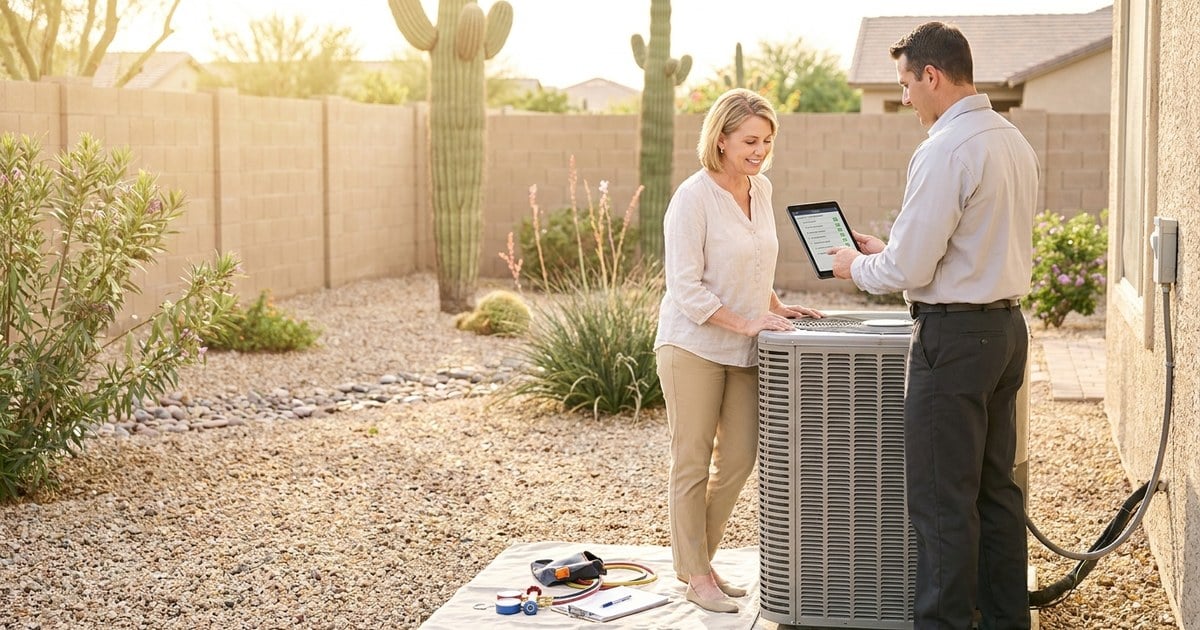
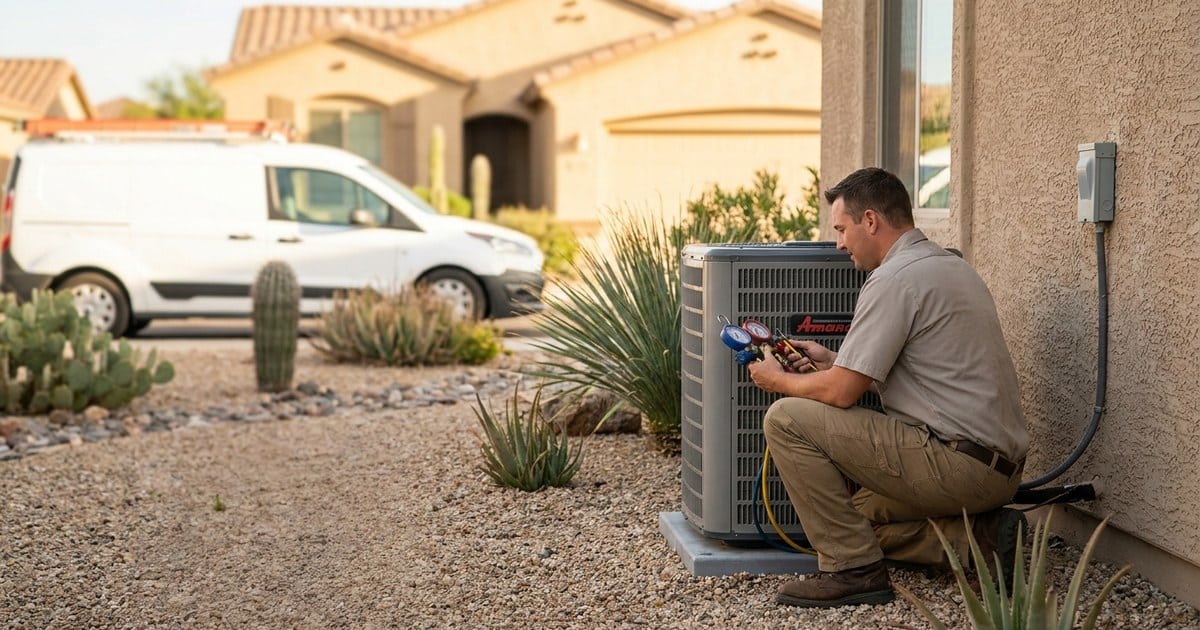
Residential HVAC services in the East Valley cover AC and heating repair, system replacement and installation, and seasonal maintenance for single-family homes. A local, owner-led contractor like JLM Air Conditioning & Heating serves Mesa, Chandler, Gilbert, Queen Creek, San Tan Valley and Apache Junction with free on-site estimates, upfront quotes, and 24/7 emergency service.
It is a long afternoon in the East Valley. The house is getting warmer by the hour, and the AC that ran fine yesterday is blowing air that feels barely cool. You pick up your phone and search “residential HVAC services East Valley” or “home heating and cooling near me.” Every listing looks the same, and every company says “local.” How do you know which one actually is?
This guide answers that question. It covers what residential HVAC services include and how to tell a truly local HVAC service from a call center. It also explains what our climate does to your equipment, and what to expect on cost, financing and maintenance. Along the way you will see how JLM works, from the way we scope a job to the way we write up a quote.
We wrote it for homeowners in Mesa, Chandler, Gilbert, Queen Creek, San Tan Valley and Apache Junction. If your system is down right now, jump to the emergency section below. Otherwise, read on and use it to shortlist the right team.
What are East Valley residential HVAC services?
Residential HVAC services include AC and heating repair, full system replacement, new installation, and seasonal maintenance. In the East Valley, the cooling side matters most, because systems run hard for much of the year. A good contractor also assesses your home and recommends only what it needs.
That definition is short on purpose. What matters is how a contractor delivers each piece. At JLM, the residential work has five parts: diagnostics and repair, replacement with Amana equipment, thermostat setup and system testing, maintenance, and 24/7 emergency service.
Our approach is the same across all five. We fix what is needed, say plainly what is optional, and put the price in front of you before work starts. That is what we mean by owner-led and community-proven. To see how it plays out on a service call, read what owner-led repair looks like in practice.
Repair
Most calls start here. A technician diagnoses the problem, explains it in everyday terms, and quotes the fix. Diagnosis matters because a “warm air” complaint can come from many causes: a failed part, a dirty coil, restricted airflow, or a refrigerant problem. Guessing wastes your money. Testing the system is how we avoid replacing parts that were never the problem.
Our repair and upgrade work covers the failures common in Valley homes. When an upgrade makes sense, we tell you why. When it does not, we tell you that too.
Replacement and installation
When a system is worn out, or repairs keep stacking up, replacing it can cost less over time than another fix. We install Amana equipment, and in our work with East Valley homeowners we have completed more than 3,000 lifetime installs. A standard installation takes one to two days.
Before that, we offer a free on-site consultation and energy assessment. The system we recommend should fit your home, not a generic spec sheet. Thermostat setup and system testing are part of the job, so you end the day with a system that has been tested, not just switched on.
Maintenance
Maintenance is the quiet part of HVAC, and it prevents the most trouble. A spring check before summer and a fall check before heating season catch small problems early. We cover the details in the maintenance section below.
Emergency and same-day service
Does JLM offer same-day and emergency AC repair? Yes. JLM runs a 24/7 emergency line and offers same-day availability for urgent issues across the East Valley. Call 602-619-3609 and the team will tell you honestly what timing is possible for your address.
We do not promise a specific arrival time over the phone. It depends on the day, the distance, and what is already on the schedule. We would rather give you the truth than a number we cannot keep.
Takeaway: Residential HVAC is five jobs handled by one team: diagnose, repair, replace, maintain, and pick up the phone when it matters.
What makes an HVAC contractor truly local?
A truly local contractor lives in your community, answers to a named owner, and shows up in person. You can reach the decision-maker directly, get a price in writing before work starts, and still find the company years later if something needs fixing.
Anyone can print “local” on a van. So we use a simple test. We call it the Neighbor Test: five questions you can ask about any contractor in one evening of looking. It works on us too. It makes “your neighborhood, our specialty” something you can check, not just a slogan.
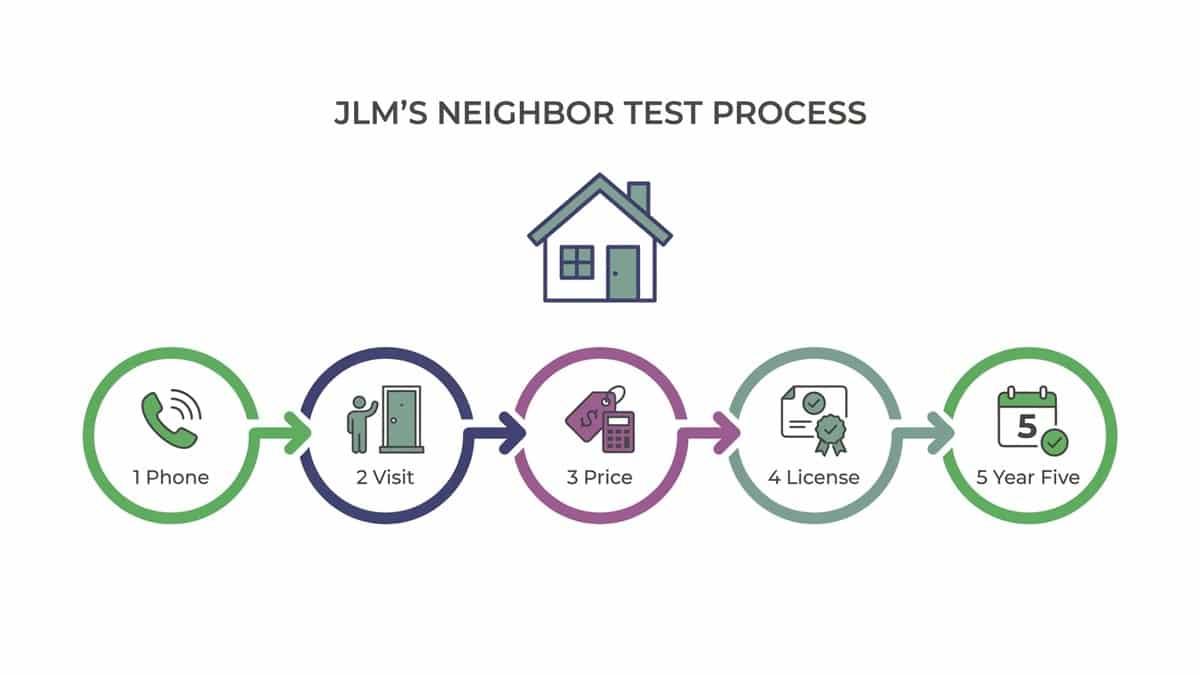
1. Who answers the phone?
A local company puts a person on the line who knows the schedule and can make a decision. Ask yourself whether you are reaching a dispatcher in another state or the team that will do the work. JLM is based here in the East Valley, and our emergency number is 602-619-3609, answered around the clock.
2. Who shows up?
At JLM, Bill, the owner, is licensed and works jobs alongside the team. He is not just a name on a letterhead. There are no franchise layers between your question and the person who can answer it. The team is trained and has several technicians, which matters when your home needs attention quickly.
3. Who puts the price in writing?
A company with a local reputation to protect gives you the number before the work begins. We start with a free on-site consultation, then give you an upfront quote. No hidden fees, no surprise add-ons halfway through the job.
4. Who is licensed and accountable?
Ask for the license number and look it up. Read recent reviews, and check the BBB profile. JLM holds an A+ BBB rating, and we would rather you verify it than take our word for it. For a longer checklist, see the red flags and green lights to look for in a contractor.
5. Who will still be here in year five?
Your system will need a tune-up, a part, or a question answered long after the install. A local, family-owned company is easy to find later because its reputation lives in the same neighborhoods as its customers. Our growth is referral-driven, and we offer a referral discount because we would like neighbors to keep telling neighbors.
The “is a small shop big enough?” question
It is a fair worry. Will an owner-led company show up fast and stand behind the work? Here is what we can point to. We have a multi-technician team, an A+ BBB rating, more than 3,000 lifetime installs, and a 24/7 emergency line. Small does not have to mean thin. It means the person who sold you the job is close enough to the work to care how it turns out.
Takeaway: “Local” is something you can test, and the five questions of the Neighbor Test take one evening to answer.
How does East Valley heat shape your system?
Valley systems work harder and longer than systems in milder places. A long cooling season means more run time, more wear, and more chances for small problems to become breakdowns. Dust and heat add stress, and in a home with weak airflow, a system can struggle long before it fails.
Here is what that looks like in practice. These are general patterns, not a promise about your particular home.
Long run times. Your AC may run for much of the year. Parts like capacitors, fan motors and contactors wear with use, so a system that runs more hours ages faster than the same model in a cooler climate.
Dust and airflow. Dust builds up on filters and coils. A clogged filter restricts airflow, and restricted airflow is one of the most common reasons a coil gets too cold and ices over. Changing filters on schedule is the cheapest thing a homeowner can do.
Frozen coils. If you find ice on the indoor unit or refrigerant lines, turn the system off and let it thaw. Running it can damage the compressor. Low airflow and low refrigerant are common causes, but a technician should confirm which one it is. Our write-up on what to do when your AC freezes up walks through the steps for Mesa homeowners, and it applies across the Valley.
Monsoon storms. Wind and storm debris can clog outdoor units, and power surges can stress electronics. Keep a clear space around your condenser and check it after a big storm.
Servicing an AC is skilled work. The U.S. Bureau of Labor Statistics profiles HVAC mechanics and installers as a trade learned through technical training or an apprenticeship. That is one reason a proper diagnostic visit is worth paying a trained technician for. The same goes for refrigerant work, which has its own rules, covered below.
Efficiency matters here too. The U.S. Department of Energy’s guidance on purchasing efficient residential central air conditioners explains that a unit’s efficiency affects what you pay in utility bills over its life. When your system runs most of the year, even a modest efficiency gain adds up. That is one reason we run an energy assessment before we recommend a replacement.
We also do not want to scare anyone. In this heat, a dead AC is more than an inconvenience, especially with children, older relatives or pets at home. But the answer is calm, early maintenance and a trusted number to call, not panic.
Takeaway: The Valley’s long cooling season makes airflow, filters and efficiency the three things worth watching.
Where does JLM work in the East Valley?
JLM serves Mesa, Chandler, Gilbert, Queen Creek, San Tan Valley and Apache Junction. Our residential HVAC services East Valley homeowners ask for most, repair, replacement and maintenance, are available in each. For the full list of towns and services, see the full list of East Valley towns and services we cover.
Here is what homeowners in each town tend to ask us about. We keep it simple, because we would rather be accurate than flashy.
Mesa
Mesa homeowners often reach out when an AC stops cooling or ices up. Freeze-ups are a good example of a problem where fast, honest diagnosis saves money, which is why we wrote the Mesa freeze-up guide above.
Chandler
Chandler calls cover the full range, from a failing part to a system that has reached the end of its life. We look at the system’s condition, its repair history, and the likely cost of the next repair before we say whether to fix or replace.
Gilbert
Gilbert homeowners search for AC repair and installation, and those are the jobs we do. If your Gilbert home has an older system with repeated repairs, ask for a free on-site estimate before you decide.
Queen Creek
Queen Creek is one of the places where we see steady interest in new AC installation. Homes here vary in age and size, so we measure and assess each one rather than guess at what it needs.
San Tan Valley
San Tan Valley sits south of Queen Creek, and we serve it with the same repair, replacement and maintenance work. The same Neighbor Test applies: a local team, a written price, and a person who answers.
Apache Junction
Apache Junction is at the eastern edge of the Valley, and installation work there has been growing for us. Homeowners ask about replacing aging systems and adding maintenance before summer.
If your home sits outside these towns, call and ask before you assume. We would rather tell you straight whether we cover your address than leave you waiting.
Takeaway: We serve six East Valley communities, and we are honest about where our service area ends.
How do I find a trusted HVAC contractor?
Check the Arizona contractor license, read recent reviews and the BBB profile, and ask for an itemized quote before any work begins. Honest contractors explain what must be fixed now versus what can wait, and they never charge for surprises you were not told about.
That is the short version. Here is the longer one, in the order we would do it.
Start with the license. In Arizona, contractors are licensed through the Arizona Registrar of Contractors, which lets you look up a license and its status. To see what good consumer guidance on licensing looks like, California’s contractor board publishes a clear example in its consumer resources. The board is in California, so it does not apply here, but the habit it teaches carries over: verify the license before you hire. For a step-by-step approach in our area, see a step-by-step guide to vetting a licensed HVAC company.
Ask about refrigerant certification. Federal rules require technicians who handle refrigerants to be certified under Section 608 of the Clean Air Act, as described by the U.S. Environmental Protection Agency. It is a simple credibility check. A professional will not mind the question.
Read reviews with a sharp eye. Look at recent ones, not just the average. Look for details like “explained the problem” and “price matched the quote.” Check the BBB profile, too. JLM holds an A+ rating, and we welcome you to look.
Get an itemized quote. This is where honesty becomes visible. Compare the two examples below.
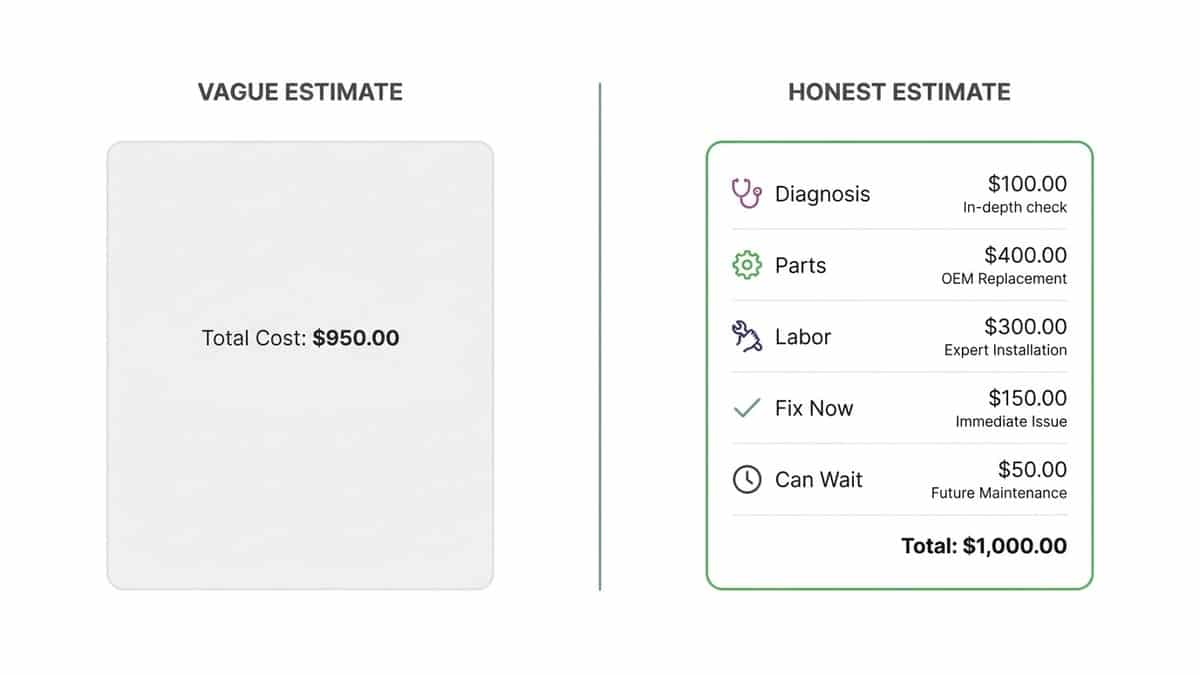
A vague estimate gives you one total and a hurry-up tone. An honest estimate separates diagnosis, parts and labor. It also marks what must be fixed now and what can wait. If a contractor cannot or will not do that, treat it as a sign.
Know the red flags. Be wary of pressure to decide on the spot, a price that changes after work begins, no written quote, or an unwillingness to show a license. We describe the pricing traps in more detail in the cost section below.
Takeaway: An honest contractor shows you the license, the reviews, and a clear written quote, and welcomes every one of those checks.
What do AC repair and replacement cost?
Cost depends on the repair, system size, home size, and ductwork. JLM gives a free on-site estimate with the price before work begins. Financing options are available for replacements, so a new system does not have to be paid for all at once.
We do not print dollar ranges here, because a number without a look at your home would mislead you. What we can do is explain what moves the price, so a quote makes sense when you see it.
What drives a repair quote. The part that failed, how hard it is to reach, and whether other components are also worn. A quick fix and a compressor job are very different bills. A good technician explains which one you have.
What drives a replacement quote. System size, the equipment you choose, your home’s size, and the condition of your ductwork. Right-sizing matters: a unit that is too big or too small performs poorly and wears out sooner. The ENERGY STAR Heating and Cooling Guide, 2009 explains how sizing and ductwork affect performance. It is an older document, so we use it only for those evergreen basics, not for current prices. For a closer look at the numbers a homeowner can expect to compare, see what a replacement typically costs.
How a hidden fee shows up. It is usually a line that was not in the first number: a “trip charge,” a “disposal fee,” or a part that was “not included.” Our guide on how hidden fees show up in a quote lists the common ones. Ask before work begins: “Is this the total I will pay?”
Repair or replace? We do not use a single rule of thumb, because every home differs. We look at the system’s condition, its repair history, and what the next repair is likely to cost. If repair is the smarter choice, we say so.
Financing. Replacing a system is a big decision, and it does not have to hit your savings all at once. We offer financing options for replacements. For the details, read about payment and financing options for a new system. Check the terms on that page, and ask us any questions before you commit.
In our work with East Valley homeowners, the free on-site consultation and energy assessment is where most of the confusion clears up. You get to see the system, the options, and the price in one visit, with no pressure to decide that day.
Takeaway: Ask for a free on-site estimate, make sure the total is in writing, and look at financing before you assume a new system is out of reach.
How often should you schedule HVAC maintenance?
Most homes benefit from a professional tune-up at least once a year. In a cooling-heavy climate, a spring check before summer and a fall check before heating season catches small problems early and lowers the odds of a mid-summer breakdown.
Think of it the way you think about car service. You do not wait for the engine to quit. Maintenance costs less than an emergency, and it lets a technician see your system when nothing is on fire.
What a good tune-up covers. JLM’s maintenance plan includes a spring and fall tune-up and a 50-point inspection. It also covers coil and blower cleaning, drain service, a filtration check, priority scheduling, and repair discounts for members. Cleaning the coil and blower helps airflow. A clear drain line helps prevent water problems. A filtration check keeps dust from building up where it hurts. Call us for current plan details.
Why it matters for refrigerant. Older systems and refrigerant rules are linked. The EPA’s page on purchasing and repairing home air conditioners and heat pumps explains how refrigerant phase-outs can affect repair decisions on older equipment. A tune-up gives your technician a chance to spot leaks and wear early. That way you can plan a repair or replacement on your schedule, not during a heat wave.
Who gets the most from it. Existing customers who keep up with seasonal visits tend to have fewer surprises. They also have a technician who already knows their system. That is one place where a family-owned shop works differently from a rotating franchise crew. See how a family-owned shop runs differently day to day for more.
Between visits. Change filters on schedule, keep the outdoor unit clear of debris, and watch for odd sounds, weak airflow or ice. If something looks wrong, call before it becomes a breakdown.
Takeaway: Two tune-ups a year, one in spring and one in fall, are the simplest way to keep an East Valley system running through the summer.
What happens when you call JLM?
Calling a contractor should not feel like a gamble. Here is what to expect.
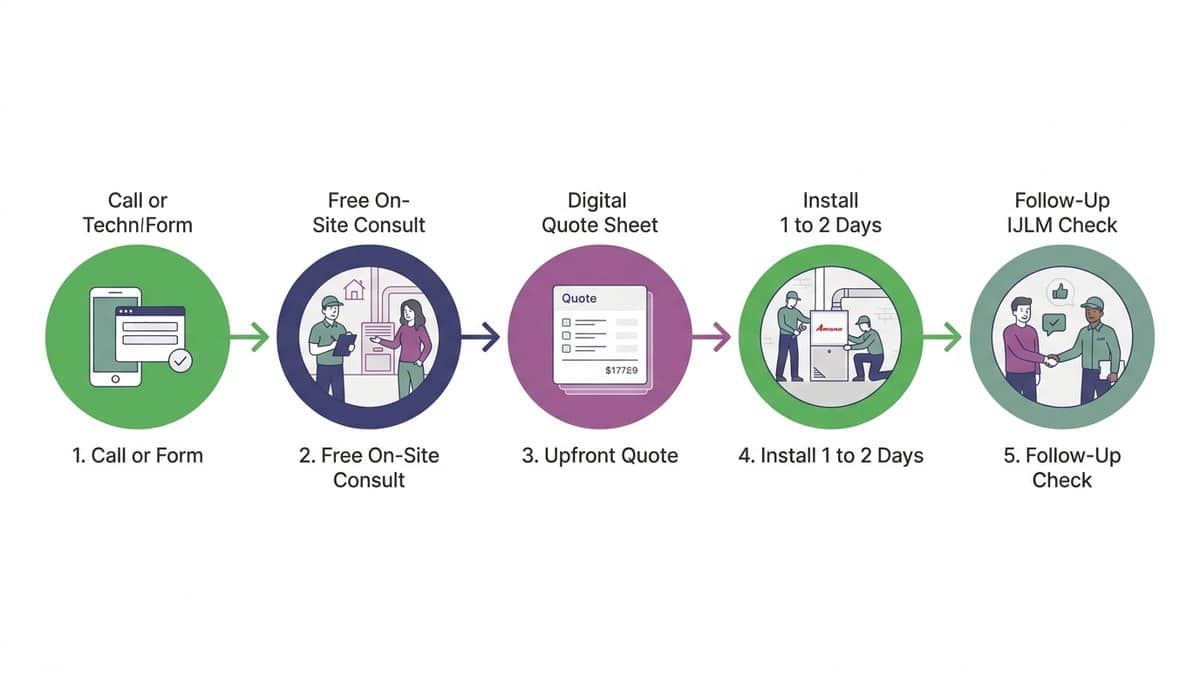
- You call or send a form. Tell us what is happening. If it is an emergency, say so. Call now: 602-619-3609.
- We visit for a free on-site consultation. We look at the system and your home, and we listen to what you have noticed.
- You get an upfront quote. The price is in front of you before any work begins.
- We do the work. A standard installation takes one to two days. Repairs are usually shorter.
- We follow up. We check that you are satisfied, and we can enroll you in a maintenance plan if you would like one.
That is the whole process. If you are comparing us with a larger company, see why choose JLM over large franchises for what changes when the owner is on the job.
Takeaway: One call starts a simple path: consult, quote, work, follow-up.
The Neighbor Test, in short
Here is the whole guide in two lines. Ask who answers, who shows up, who puts the price in writing, who is licensed, and who will be here in year five. Then pick the team that passes all five.
We built JLM to pass. If your AC is struggling, your bills are climbing, or a neighbor told you to call us, we would be glad to hear from you. Whether you need repair, a replacement quote, or a maintenance plan, we offer residential HVAC services East Valley homeowners can check for themselves, starting with a free on-site estimate. You can also browse our full list of residential services before you call.
Ready to talk? Call JLM now at 602-619-3609 and ask for your free on-site estimate.