
By JLM
Your install quote says “10-year warranty.” Do you know what it actually pays for?
What is included in HVAC warranty coverage? Most HVAC warranties cover defective parts, not labor. A typical manufacturer warranty covers the compressor and other major components for 5 to 10 years, often only after registration. Labor, refrigerant, filters, and damage from poor maintenance usually are not included. Labor coverage comes from your installer or a separate service plan.
[CITATION_NEEDED: current Amana warranty page confirming typical parts-warranty term and registration window for the “5 to 10 years” and registration language above]
Quotes make this hard. One says “10-year warranty.” Another says “full coverage.” Neither tells you who pays when a part fails in the middle of a July heat wave. That gap is why we wrote this guide. Across 3,000+ installs in the East Valley, we’ve seen the same surprise again and again. Homeowners know about the factory’s promise and miss the other two layers. Below, we cover what’s covered, what isn’t, how to file a claim, and how to judge a protection plan. If you’re also pricing a replacement, our breakdown of what a new furnace and air conditioner can cost is a good companion read.
One plain note before we start. Warranty terms vary by manufacturer, model, and install date. Always check your own certificate against what you read here.
What Is Included in HVAC Warranty Coverage?
Most HVAC warranties cover defective factory parts, such as the compressor, coil, and other major components, usually for a set number of years from the install date. Many carry longer terms when you register the equipment. They typically replace the failed part. They usually do not pay for the labor to install it.
Think of HVAC warranty coverage included in your paperwork as a parts promise. The factory is saying its equipment was built without defects. If a covered part fails inside the term, the manufacturer supplies a replacement. That is the whole deal.
The parts most often named in a warranty are the big, expensive ones: the compressor, the evaporator and condenser coils, the fan motors, and the control board. Smaller items, and anything labeled a “consumable,” tend to get shorter terms or no coverage at all. Read the parts list on your certificate. It is often shorter than the sales pitch suggested.
The clock matters too. Warranty terms generally start on the install date, not the day you noticed a problem. Many manufacturers also offer longer terms only if you register the equipment within a set window after installation. Registration usually takes a few minutes online, and skipping it can cut your coverage. Confirm the exact window for your brand on the manufacturer’s own page.
We keep this section brand-neutral on purpose. For brand specifics, see the next sections. For a full picture of what goes into a new system, including sizing and financing, read our guide to AC installation in Gilbert: Amana systems, sizing and financing options explained. Whether you live in Gilbert, Queen Creek, or Mesa, the same warranty logic applies. The East Valley’s long, hot cooling season puts real hours on a compressor, so knowing what your AC installation paperwork promises is worth the effort.
If an aging system has you comparing repair against a system upgrade, ENERGY STAR Home Savings (2026) is a useful place to see what certified, efficient equipment looks like before you decide.
The takeaway: a warranty is mostly a promise about parts, so find out exactly which parts, for how long, and whether you had to register.
Manufacturer, Parts, or Labor Warranty: What Differs?
A manufacturer warranty is the factory’s promise that its equipment is free of defects, and it usually pays for replacement parts. A labor warranty comes from the installer and covers the work to fix or replace them. An extended plan or service contract is a separate product that can add labor, longer terms, or both.
Here’s the framework we use with homeowners. A warranty isn’t one promise. It’s a stack of three, and each one has a different owner.
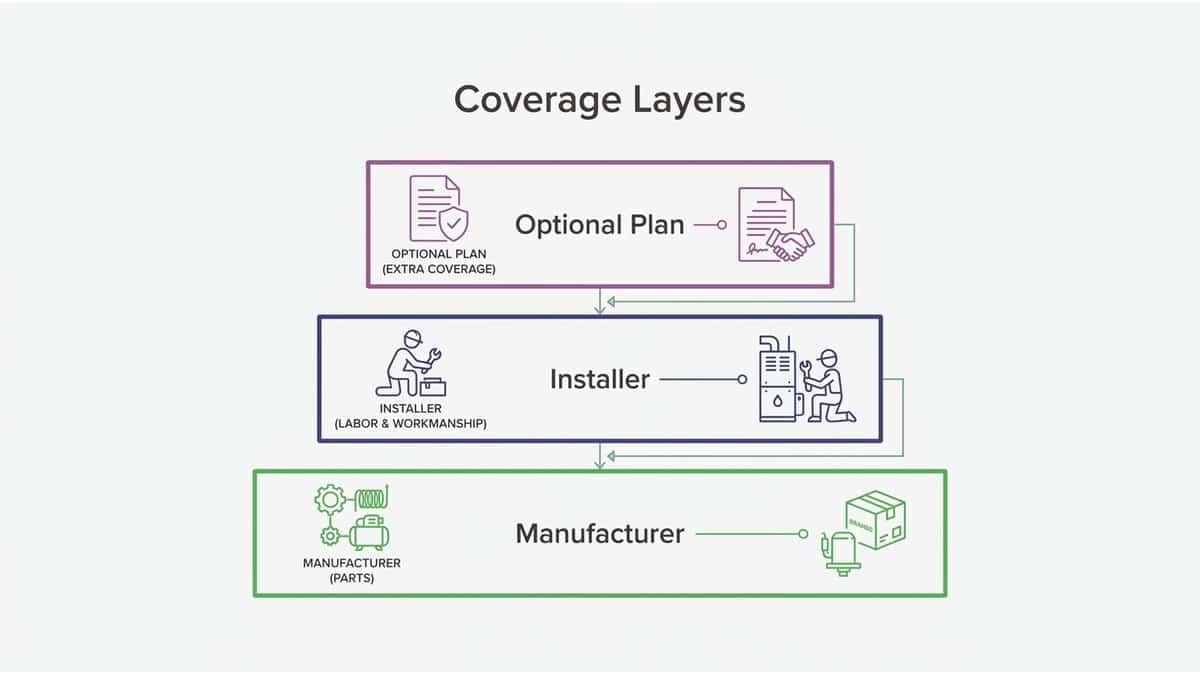
| Layer | Who backs it | Usually covers | Usually doesn’t | Where to find it |
|---|---|---|---|---|
| 1. Manufacturer warranty | The equipment maker | Defective parts (compressor, coil, motor, control board) for a set term | Labor, refrigerant, filters, damage from misuse | Warranty certificate, manufacturer’s website |
| 2. Installer (labor) warranty | The contractor who installed your system | Work to repair or replace parts, plus installation errors | Defects in the factory equipment itself (that’s layer 1) | Your install contract or invoice |
| 3. Optional plan or service contract | A plan provider or contractor | Whatever the contract states: labor, longer terms, or both | Anything in its exclusions, often with payout caps | The contract itself |
The installer’s workmanship warranty
Layer 2 is the one homeowners forget. If a refrigerant line was brazed badly or a unit was set wrong, the factory isn’t to blame. Your installer is. Ask any installer, us included, to put labor terms in writing before you sign. If a quote says “10-year warranty” without saying whose, ask.
Extended warranties and service contracts
Layer 3 is a product you buy. A service contract is not the same thing as a manufacturer warranty, and the difference matters. A manufacturer warranty comes with the equipment. A service contract is a separate agreement with its own terms, exclusions, and fees. [CITATION_NEEDED: FTC guidance on the difference between a warranty and a service contract under the Magnuson-Moss Warranty Act]
For homeowners we see in the East Valley, this stack is what builds confidence. A family-owned company with the owner on the job has a stake in how layer 2 plays out. You’re not calling a call center when something goes wrong. If you want to see how our process works from the first visit onward, start with how our HVAC replacement and installation process works.
One more thing: while you’re weighing a system upgrade, check which equipment qualifies for ENERGY STAR Home Savings (2026) and ask how that equipment’s warranty differs.
The takeaway: before you sign, ask who backs each of the three layers, because only one of them comes from the factory.
What Does an HVAC Warranty Not Cover?
HVAC warranties generally exclude labor, refrigerant, routine maintenance items like filters, and damage from improper installation, lack of maintenance, or outside causes such as power surges or storms. Normal wear and tear after the term ends is also excluded. Always check the exclusions page of your certificate.
We believe in no surprises, and that applies to paperwork as much as pricing. So here are the bills people don’t see coming.
Labor. This is the big one. The factory sends a part. Someone still has to diagnose the failure, remove the old part, install the new one, and test the system. Unless your installer’s labor warranty or a service plan covers that, you’re paying for it.
Refrigerant. If a repair means recovering and recharging the system, refrigerant is typically a separate cost. Refrigerant rules and pricing have shifted as the industry moves away from older types. [CITATION_NEEDED: U.S. EPA page on the HFC phasedown / AIM Act and refrigerant transition, with current date]
Filters and consumables. Filters, belts, and similar items are routine upkeep, not defects.
Outside causes. Power surges, storm damage, flooding, and pests are generally excluded because they aren’t factory defects. Some exclusion lists are longer than others, so read yours.
Wear after the term ends. A warranty has an end date. A well-kept system often outlives it. Our guide to how long HVAC systems last in Arizona explains why the desert’s heat makes this gap more common here than in milder climates.
Brand matters here too. Warranty terms and parts coverage differ from maker to maker. For a comparison focused on one premium line we install, read Amana HVAC systems vs. competitors: reliability, warranty and performance in Arizona.
When the warranty runs out before the system does, you face a real decision: repair or upgrade. ENERGY STAR Home Savings (2026) is a helpful reference on certified equipment if the answer is a new system.
The takeaway: labor and refrigerant are where uncovered costs hide, so ask about them before a failure, not after.
What Can Void or Shorten Your HVAC Warranty?
Skipped registration, installation by an unlicensed contractor, missing maintenance records, unauthorized modifications, and non-approved replacement parts are common reasons a claim is denied or a term is shortened. Many manufacturers extend coverage only if you register within a set window after installation.
Most of these are avoidable. Here are the three that matter most.
Registration: the five-minute task that matters
Many manufacturers give you a longer parts term if you register the new equipment. The window can be short. Ask your installer whether they register for you, and get the confirmation email or number in writing. If nobody registers, assume nobody did. Keep that confirmation with your paperwork.
Maintenance records: what you actually need to keep
Many homeowners fear that one missed tune-up means a denied claim. The reality has more nuance. Federal warranty law generally limits a manufacturer’s ability to deny coverage just because you used a different service provider. [CITATION_NEEDED: FTC Magnuson-Moss Warranty Act guidance on tying warranty coverage to brand-name parts or services] A claim can still be denied if the failure traces back to neglect, like a clogged coil from years of dirty filters. Records are your proof that you took care of the system.
That’s where preventive care pays off. Our AC maintenance plans for East Valley homes include a 50-point inspection and a system health report. That report doubles as a dated service record you can hand to a claims reviewer. Maintenance protects your investment, and the paper trail protects your claim.
Installation and parts
A warranty assumes a correct, licensed installation. Poor installation can void coverage, and it often causes the failure in the first place. Unauthorized modifications and non-approved replacement parts raise the same risk. For installation standards that tie install quality to long-term results, [CITATION_NEEDED: ACCA quality installation standards]. Confirm any contractor’s license on the Arizona Registrar of Contractors site before work begins. [CITATION_NEEDED: Arizona Registrar of Contractors license lookup and workmanship rules]
When maintenance can no longer keep an older system healthy, a system upgrade becomes the practical route. ENERGY STAR Home Savings (2026) shows what efficient, certified equipment looks like.
The takeaway: register early, keep dated service records, and use a licensed installer, and most voided-claim horror stories won’t apply to you.
How Do You File an HVAC Warranty Claim?
Find your warranty certificate and proof of purchase, call your installer or a licensed HVAC contractor to diagnose the failure, and give them your model and serial numbers. The contractor typically submits the claim to the manufacturer, who approves and ships the replacement part. Keep every invoice and service record.
This is the part homeowners dread, mostly because of the paperwork and the heat. It’s more manageable with a plan.
Step-by-step claim process
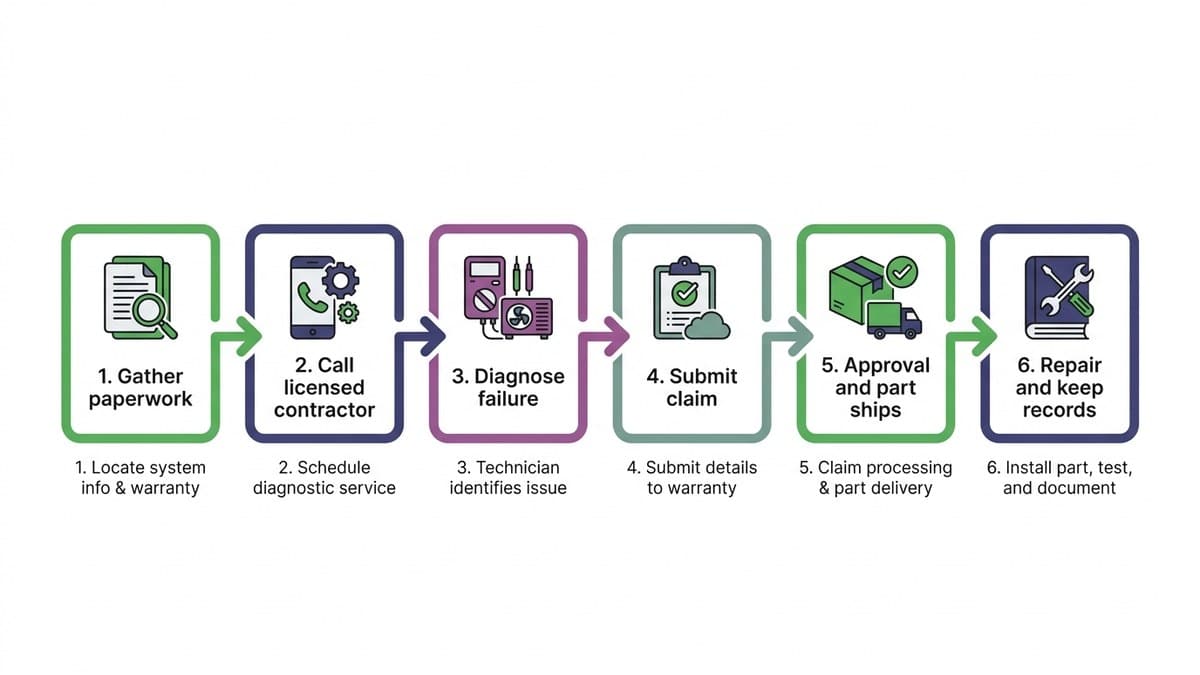
- Gather your paperwork. Find the warranty certificate, proof of purchase, and registration confirmation.
- Call your installer or a licensed HVAC contractor. Don’t open the equipment yourself.
- Share your model and serial numbers. They’re on the unit’s data plate.
- Let the contractor diagnose the failure. Ask upfront who pays for the diagnostic visit and the labor.
- The contractor typically submits the claim. The manufacturer reviews it, approves it, and ships the replacement part.
- Keep every invoice and service record. You’ll want them for any later claim.
If your AC is down in extreme heat, get cooling restored first and sort out the claim in parallel. We offer 24/7 emergency service and same-day availability, because nobody should wait on paperwork while their home hits triple digits. See our full list of HVAC services for what we handle. Not sure where your own paperwork stands? Call us at 602-619-3609 and talk to a local team.
What to have ready (claim-ready file)
Keep these in one folder, paper or digital:
- Warranty certificate
- Proof of install (invoice or contract with the install date)
- Registration confirmation
- Maintenance and service records
- Model and serial numbers (a photo of the data plate works)
This claim-ready file is the single best habit we can suggest. It turns a stressful week into a phone call. Our owner-led team believes in accessible, direct communication, and a clean file makes that conversation faster.
If a claim is denied or stalls
Ask for the denial reason in writing. Check it against your certificate’s terms and your registration record. If the issue is workmanship, your installer’s labor warranty comes into play. For unresolved disputes with a contractor, the Arizona Registrar of Contractors has a complaint process. [CITATION_NEEDED: Arizona ROC complaint process] The Better Business Bureau also publishes guidance on filing complaints. [CITATION_NEEDED: BBB tips on warranties, service contracts, and complaint filing]
If repair costs keep stacking up on an older unit, weigh them against a replacement. ENERGY STAR Home Savings (2026) can help you see what an efficient system upgrade looks like.
The takeaway: a claim goes smoothly when your paperwork is ready and your contractor knows the process, so build the file before you need it.
Is an Extended HVAC Warranty Worth It?
It can be worth it if the plan covers labor and the parts most likely to fail, and if you plan to keep the home past the factory term. It is usually not worth it when it duplicates coverage you already have, caps payouts low, or excludes the repairs you worry about.
We won’t push a plan on you. Our job is to tell you when it’s worth it and when to skip it. Here are four questions to ask about any plan:
- What’s covered? Ask for the list of covered components, in writing.
- Who pays labor? If the plan covers parts only, it adds little beyond the factory warranty.
- What are the caps, deductibles, or service fees? A low payout cap can make a plan nearly useless against a big repair.
- Can you choose your contractor? Some plans assign one. Know that before you buy.
[CITATION_NEEDED: Consumer Reports guidance on extended warranty and service contract value]
When a plan makes sense
A plan can make sense if you’ll stay in the home well past the factory term, the plan clearly covers labor, and the exclusions don’t gut the coverage. A homeowner who wants predictable costs may also value it. Our East Valley customers often fall into this camp when they’ve just paid for a new system and don’t want a surprise bill later.
When to skip it
Skip it if the plan only repeats what the manufacturer already covers, if payouts are capped low, or if the exclusions list the repairs you most worry about. Skip it if you’re selling in a few years. No pressure, ever.
Maintenance plan vs. warranty vs. service contract
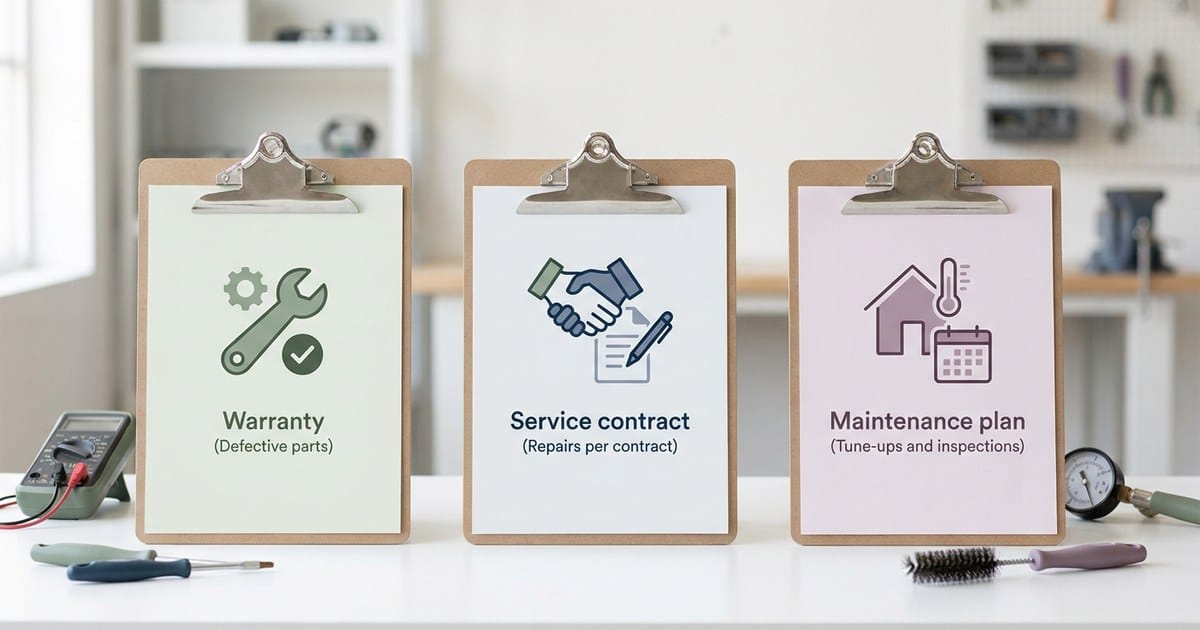
These are three different things. A warranty covers defects. A service contract covers repairs as written in the contract. A maintenance plan isn’t insurance at all. It’s preventive care that helps your system run well and lets you protect your investment. Our guide to extending your AC life with professional maintenance plans explains how routine care supports a longer system life.
If you’re weighing a big repair on an older unit against replacing it, try our repair vs. replace calculator and $5,000 break-even decision point. It helps you see when spending on repairs stops making sense. If replacement wins, ENERGY STAR Home Savings (2026) is a good place to check certified options.
The takeaway: buy a plan only if it covers labor and the repairs you actually fear, and remember that a maintenance plan is care, not insurance.
7 Questions Before You Sign an AC Quote
Before signing an AC installation quote, ask seven things: who backs the warranty, how long labor is covered, who registers the equipment, how claims are handled, what’s excluded, whether coverage transfers, and who you call when something breaks. Written answers beat verbal promises.
This is the checklist we’d hand a neighbor. Use it on any quote, ours included.
- Who backs the warranty, and for how long? “10-year” means little until you know whether the factory or the installer is promising it.
- How long is labor covered, and in writing? Get the installer’s labor term on paper.
- Who registers the equipment, and when? Ask for the confirmation.
- How are claims handled? Who calls the manufacturer, and what do you pay for diagnostics or labor?
- What’s excluded? Ask for the exclusions page before you sign.
- Does coverage transfer if you sell? This can matter for resale.
- Who do I call when something fails? You want a real person who knows your system, not a call center.
That last question is why homeowners choose an owner-led, community-proven company. Our owner is on the job, and you can reach us directly. We offer free consultations and on-site estimates, and you know the cost before work begins. If you’re comparing pricing, see AC installation in Gilbert: premium Amana systems with transparent pricing. When you’re ready for the next step, schedule heating and cooling service with our team.
The takeaway: a quote you can answer all seven questions about is a quote you can trust.
Bottom Line: Three Layers, One Claim-Ready File
Your protection comes in three layers: the factory’s parts promise, your installer’s labor and workmanship promise, and any plan you add. Build one claim-ready file, register your equipment, and keep your service records. Then a covered failure becomes a phone call instead of a crisis.
Questions about your own install quote or warranty paperwork? Call and talk to a local team that will give you straight answers.