Your AC stopped blowing cold air at 3 PM on a 112°F Tuesday in Gilbert. You’re sweating, anxious, and Googling repair costs while the house heats up like an oven. You’ve heard horror stories about surprise $8,000 bills and pushy techs who upsell every service call. You need clarity: what will this actually cost, and how do you avoid getting ripped off?
Here’s the honest answer. In Arizona, AC repair costs range from $150 for minor fixes like capacitor replacements to $3,500+ for major repairs like compressor replacements. Most homeowners pay $300–$800 for common repairs (refrigerant recharge, thermostat, contactor). The final price depends on the part, labor complexity, your system’s age, and whether you need emergency service during peak summer heat.
How Much Does AC Repair Cost in Arizona? (Quick Answer)
Below is what East Valley homeowners typically pay for common AC repairs. These ranges reflect 2025 pricing for parts, labor, and diagnostic fees in Gilbert, Queen Creek, Mesa, and Apache Junction.
| Repair Type | Typical Cost Range (AZ) | |—————–|—————————-| | Capacitor replacement | $150–$400 | | Refrigerant recharge (per lb, R-410A) | $75–$150/lb + labor | | Thermostat replacement | $150–$500 | | Contactor replacement | $150–$300 | | Fan motor replacement | $300–$600 | | Compressor replacement | $1,500–$3,500 | | Evaporator coil replacement | $900–$2,500 | | Condenser unit replacement | $1,500–$4,000 |
The actual cost you pay depends on your system’s make, model, age, the complexity of the repair, and whether you need same-day emergency service. How to Choose Between AC Repair & Replacement: A Homeowner’s Guide can help you decide when repair makes sense and when replacement is smarter.
What Affects AC Repair Costs in Arizona?
A failing AC system can increase energy bills by 20–30% as it works harder to maintain temperature, according to Energy.gov’s residential AC purchasing guide. Understanding the variables behind repair pricing helps you budget accurately and avoid surprises when the technician shows up.
Part Costs vs. Labor Costs
AC repair bills break down into two buckets: the part itself and the labor to install it. A capacitor might cost the contractor $20–$40 wholesale, but you’ll pay $150–$400 installed. That markup covers the technician’s time, diagnostic work, truck roll, insurance, licensing, and the guarantee that backs the repair.
Labor rates in Arizona run $100–$200 per hour for licensed HVAC technicians, according to Bureau of Labor Statistics wage data. A simple capacitor swap takes 30–60 minutes. A compressor replacement requires 4–8 hours of labor, refrigerant recovery and recharge, vacuum testing, and leak checks. The complexity of the job drives the final bill more than the part cost alone.
Most reputable companies (including JLM) charge a flat diagnostic fee ($75–$150) that’s waived if you proceed with the repair. This fee covers the time to troubleshoot the issue, test components, and provide a written estimate.
System Age and Availability of Parts
Older AC systems (15+ years) often require obsolete parts that are no longer stocked by distributors. If your 20-year-old Trane condenser needs a proprietary control board that’s been discontinued, the contractor may need to source it from a salvage yard or custom-fabricate a solution. That adds time and cost.
Most residential AC systems last 15–20 years with proper maintenance. Once a unit crosses the 15-year mark, repair costs climb because parts become scarce and labor becomes more complex. If your system is approaching end-of-life and a major component fails, replacement often makes more financial sense than repair. For guidance on system lifespan and when to replace, visit our HVAC System resources.
EPA-certified technicians are required for refrigerant handling, so always verify certification when choosing a contractor. Licensed, insured techs carry the training and tools to diagnose aging systems correctly.
Refrigerant Type (R-22 vs. R-410A)
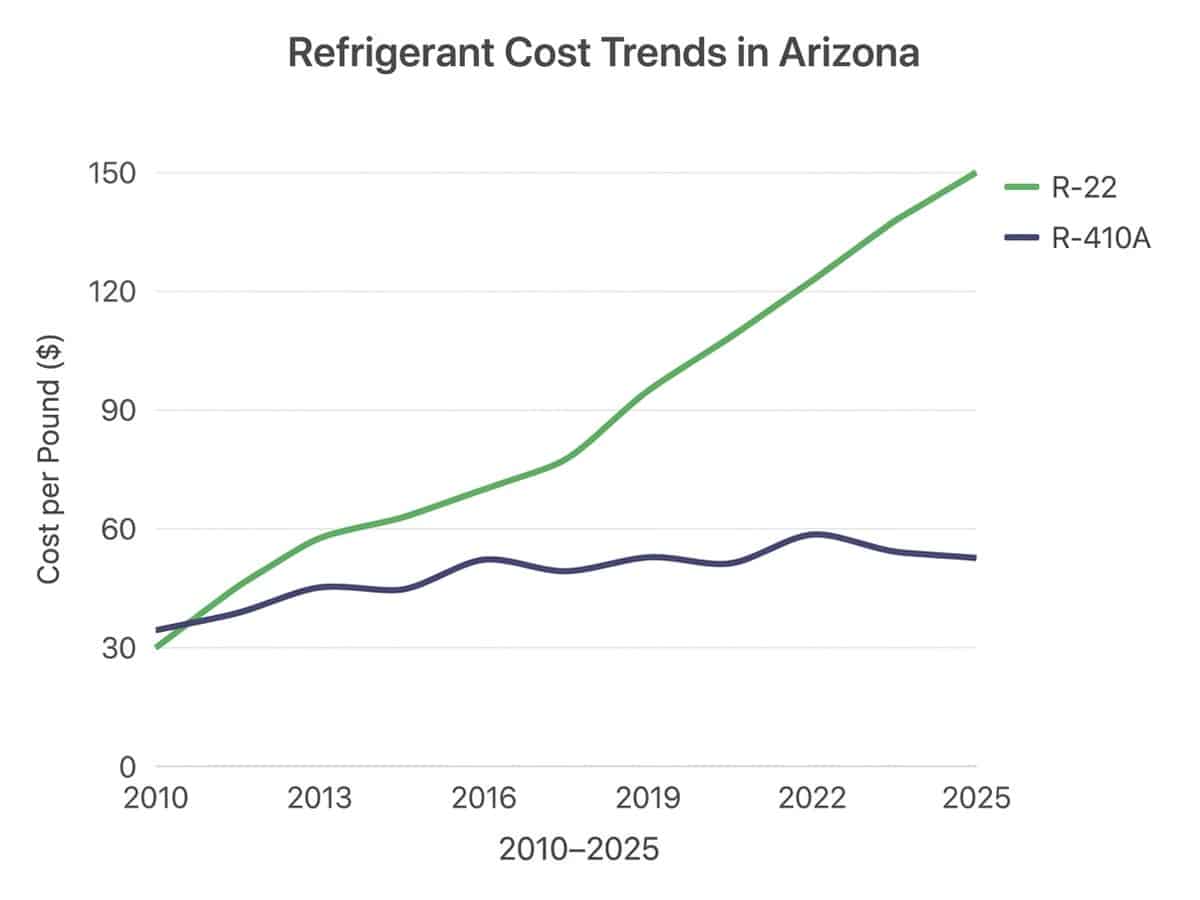
If your AC was installed before 2010, it likely uses R-22 refrigerant (Freon). R-22 was phased out under the EPA Clean Air Act due to its ozone-depleting properties, and production ceased in 2020. The remaining supply is limited and expensive: $100–$150 per pound in 2025, compared to $30–$60 per pound for R-410A (the current standard refrigerant in newer systems).
A full R-22 recharge for a 3-ton system can require 6–10 pounds of refrigerant, pushing the cost to $600–$1,500 for refrigerant alone. When an older R-22 system develops a refrigerant leak, replacement becomes more cost-effective than repeated recharges. The EPA’s purchasing and repair guide explains refrigerant regulations and replacement timelines in detail.
Systems using R-410A (standard since 2010) cost less to recharge because the refrigerant is widely available and cheaper. Labor to locate and repair a leak still applies, but the refrigerant cost itself won’t break the budget.
Common AC Repairs in Arizona and What They Cost
Why Summer in Mesa Demands Fast AC Repair explains why Arizona’s extreme heat makes minor issues escalate quickly. Below are the repairs JLM sees most often during peak cooling season, along with typical cost ranges and what each repair involves.
Capacitor Replacement ($150–$400)
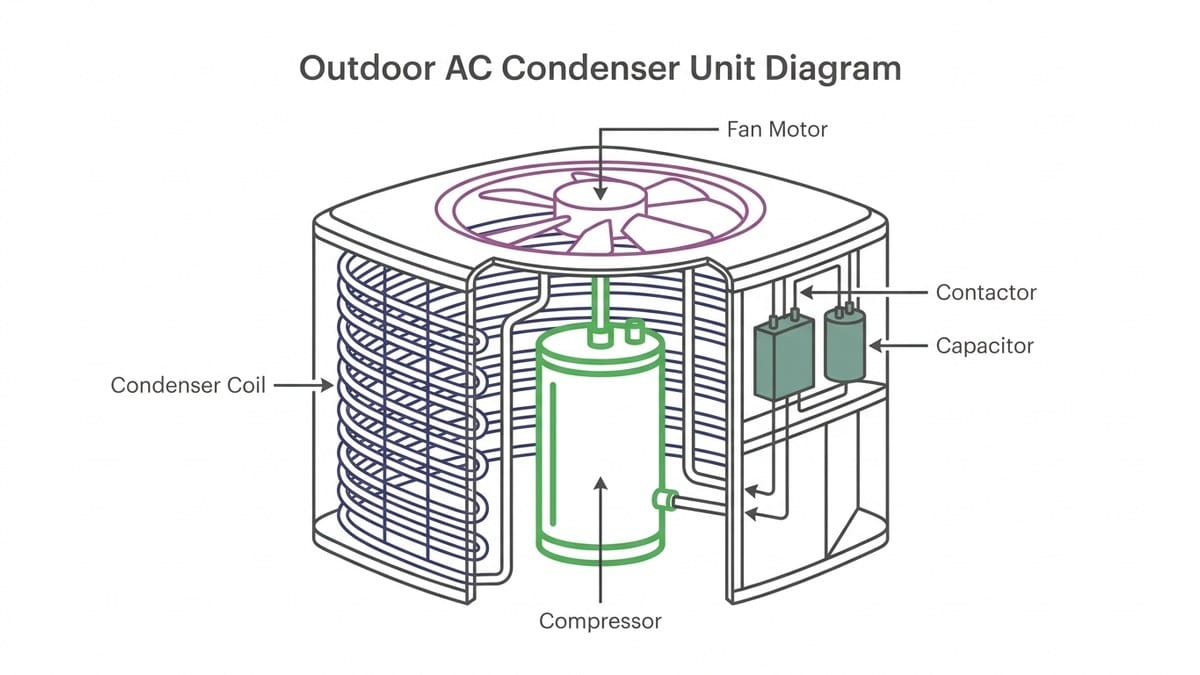
The capacitor is a small cylindrical component that stores and releases electrical energy to start the compressor and fan motors. Arizona’s extreme heat stresses capacitors, causing them to fail more frequently than in cooler climates.
Symptoms: Your outdoor unit hums or buzzes but won’t start. The compressor tries to engage but can’t. You may hear a clicking sound from the contactor attempting to close the circuit.
What the repair involves: The technician shuts off power, discharges the old capacitor, removes it, installs a new one, and tests the system. Total time: 30–60 minutes. Parts cost $20–$50; labor and service call fees bring the total to $150–$400.
This is one of the most common summer emergency calls in Arizona. Because it’s a quick fix and parts are stocked on most service trucks, same-day resolution is typical.
Refrigerant Recharge ($300–$800)
A refrigerant recharge adds refrigerant to restore cooling capacity. If your AC is blowing warm air and the refrigerant level is low, a recharge may solve the problem temporarily. However, refrigerant doesn’t evaporate on its own: a low charge indicates a leak somewhere in the system.
Symptoms: Weak airflow, ice buildup on the refrigerant lines or evaporator coil, rising energy bills, and warm air from the vents.
What the repair involves: The technician uses gauges to measure refrigerant pressure, adds refrigerant to the manufacturer-specified level, and tests cooling performance. If a leak is suspected, they’ll use UV dye or electronic leak detectors to locate it. Leak repair adds $200–$1,500 depending on the location (evaporator coil leaks are labor-intensive; outdoor line-set leaks are simpler).
Under EPA refrigerant regulations, technicians must recover and recycle refrigerant properly. Never hire an unlicensed contractor who offers to “top off” your system without checking for leaks or recovering old refrigerant.
Cost for a recharge alone: $300–$800 (depending on refrigerant type and pounds needed). Add leak repair and the total can reach $500–$2,300.
Thermostat Replacement ($150–$500)
A malfunctioning thermostat can cause short-cycling, inconsistent temperatures, or prevent the AC from turning on at all. Replacing a basic mechanical thermostat with a programmable or smart model can cut your cooling bills by allowing you to set schedules and monitor usage remotely.
Symptoms: The AC won’t turn on, cycles on and off constantly, or the displayed temperature doesn’t match the actual room temperature.
What the repair involves: The technician removes the old thermostat, checks wiring compatibility, installs the new unit, and programs it to your preferences. For smart thermostats (Nest, Ecobee, Honeywell), they’ll connect it to your Wi-Fi and verify app control.
Basic thermostat replacement: $150–$250. Smart thermostat installation: $300–$500. Upgrading to a programmable thermostat can cut your cooling bills: learn more in our guide on AC Replacement Cost: Understanding Your Options & Financing.
If you’re prepping for summer, The Smart Way to Prep AC for Gilbert’s Hot Summer covers thermostat calibration and other preventive steps.
Contactor Replacement ($150–$300)
The contactor is a relay switch that controls power flow to the compressor and condenser fan. It’s located inside the outdoor unit and endures thousands of on/off cycles each season. Arizona’s heat accelerates wear, causing contacts to pit, corrode, or weld shut.
Symptoms: The outdoor unit won’t start, or it stays running continuously (contacts welded closed). You may hear a loud clicking or buzzing sound when the thermostat calls for cooling.
What the repair involves: The technician shuts off power, removes the electrical panel on the condenser, disconnects wiring from the old contactor, installs a new one, reconnects wiring, and tests the system. Time: 30–60 minutes.
Parts cost $30–$80; labor and service call fees bring the total to $150–$300. This is another same-day repair for most contractors who stock contactors on the truck.
Blower Motor or Fan Motor Replacement ($300–$600)
Your AC has two motors: the indoor blower motor (circulates air through the ductwork) and the outdoor condenser fan motor (pulls air across the condenser coils to dissipate heat). Either can fail due to bearing wear, electrical issues, or overheating.
Symptoms (blower motor): Weak airflow from vents, no airflow at all, or loud screeching/grinding noises from the indoor unit.
Symptoms (condenser fan motor): The outdoor unit runs but the fan doesn’t spin, or the unit overheats and shuts down on the high-pressure safety switch.
What the repair involves: The technician removes the old motor, installs a new one, reconnects electrical wiring and capacitor leads, and tests airflow and cooling. Blower motor replacement is more labor-intensive because it requires accessing the air handler inside the attic or closet. Condenser fan motor replacement is quicker (outdoor unit access is easier).
Blower motor replacement: $400–$600. Condenser fan motor replacement: $300–$500. Add $100–$200 if the capacitor also needs replacement (common when a motor fails).
Compressor Replacement ($1,500–$3,500)
The compressor is the heart of your AC system. It pressurizes refrigerant and pumps it through the refrigeration cycle. Compressor failure is often a death sentence for older systems because the part itself is expensive and labor is intensive (4–8 hours).
Symptoms: The outdoor unit runs but doesn’t cool, or the unit won’t start at all. You may hear a grinding, clicking, or rattling noise from the compressor. The circuit breaker may trip repeatedly.
What the repair involves: The technician recovers refrigerant, disconnects electrical and refrigerant lines, removes the old compressor, installs a new one, pressure-tests the system for leaks, evacuates moisture with a vacuum pump, recharges refrigerant to spec, and tests cooling performance.
Compressor replacement cost: $1,500–$3,500 depending on system size (tons), refrigerant type, and accessibility. For a system older than 10 years, this repair often doesn’t make financial sense. When compressor replacement costs approach 50% of a new system, replacement is smarter (see “When Repair Doesn’t Make Sense” below).
Evaporator Coil Replacement ($900–$2,500)
The evaporator coil sits inside the indoor air handler and absorbs heat from the air. Coils can develop leaks due to corrosion, formicaldehyde off-gassing from building materials (formicorr), or vibration stress. Accessing the coil requires opening the air handler cabinet and sometimes cutting into the ductwork.
Symptoms: Refrigerant leak (same symptoms as “Refrigerant Recharge” above), ice buildup on the coil, reduced cooling capacity.
What the repair involves: The technician recovers refrigerant, removes the air handler cabinet panels, disconnects refrigerant lines, lifts out the old coil, installs a new one, reconnects lines, pressure-tests for leaks, evacuates the system, recharges refrigerant, and tests airflow and cooling.
Labor is intensive: 4–6 hours. Cost: $900–$2,500 depending on coil size and system configuration (horizontal air handlers in attics are harder to access than vertical closet units).
If the evaporator coil and the outdoor condenser are both aging (10+ years), replacing the entire system is often more cost-effective than replacing the coil alone.
Condenser Unit Replacement ($1,500–$4,000)
The condenser unit (outdoor unit) houses the compressor, condenser fan motor, condenser coil, and electrical components. If multiple components fail simultaneously (compressor + fan motor + coil corrosion), replacing the entire outdoor unit can be cheaper than repairing each part individually.
When this makes sense: Your compressor failed, the condenser coil is corroded and leaking, and the fan motor is on its last legs. Repairing all three would cost $3,000+. Replacing just the outdoor unit costs $1,500–$4,000 and gives you a new compressor, coil, fan, and warranty.
Important: Replacing only the outdoor unit while keeping an old indoor evaporator coil is a mismatched system and voids most manufacturer warranties. For optimal efficiency and warranty coverage, the indoor and outdoor units should be replaced together. This crosses into full system replacement territory, which is covered in our AC Replacement Cost guide.
According to the ENERGY STAR Heating & Cooling Guide, mismatched systems lose 10–30% efficiency and may not qualify for utility rebates.
Emergency Repairs vs. Scheduled Service: How Timing Impacts Price
Arizona’s peak cooling season runs May through September. During this window, demand for AC repair spikes, and after-hours or same-day emergency calls command a premium. Expect to pay 20–50% more for emergency service compared to a scheduled weekday appointment.
Example: A capacitor replacement during normal business hours (Monday–Friday, 8 AM–5 PM) might cost $200. The same repair at 9 PM on a Saturday in July could run $300–$350 due to overtime labor rates and emergency call-out fees.
JLM offers 24/7 emergency service because Arizona heat doesn’t wait for business hours. We don’t gouge on emergency pricing: our after-hours fee is transparent and disclosed up front. Many franchise companies charge $150–$300 just to roll the truck after 5 PM, before any repair work begins.
First-party insight: We’ve completed 3,000+ HVAC installs and repairs across the East Valley. In our experience, over 60% of summer emergency calls are resolved the same day with parts we stock on the truck (capacitors, contactors, and thermostats). If you call before noon and the part is in stock, there’s a strong chance your AC is running again by dinnertime.
When to schedule vs. when to call for emergency service:
- Schedule a repair if your AC is limping along (weak cooling, occasional cycling issues) and the temperature is manageable. You’ll save 20–50% compared to emergency pricing.
- Call for emergency service if the AC is completely out, the indoor temperature is climbing above 85°F, or you have vulnerable household members (elderly, infants, health conditions). Comfort and safety outweigh the premium.
How to Avoid Overpaying for AC Repair
Transparency and education are your best defenses against inflated pricing and unnecessary upsells. Here’s how to vet contractors and protect your budget.
Get Multiple Quotes (But Don’t Delay in Peak Heat)
In normal circumstances, getting 2–3 quotes for a major repair is smart. It gives you a price range and helps you identify outliers (a $1,000 capacitor replacement is a red flag; a $150 quote for a compressor replacement is too good to be true).
The Arizona caveat: When it’s 110°F and your AC is out, waiting 2–3 days for multiple quotes isn’t realistic. Your priority is restoring comfort quickly. In this scenario, choose a contractor with strong reviews, transparent pricing, and a published service guarantee. Call, get a diagnostic appointment scheduled, and ask for a written estimate before any work begins.
If the first quote feels off (high-pressure upsell to a full replacement, vague pricing, refusal to itemize parts and labor), get a second opinion. But don’t let the perfect be the enemy of the good: a reputable local company with an A+ BBB rating and hundreds of 5-star reviews is a safer bet than the cheapest quote from an unknown contractor.
For guidance on what questions to ask, see Do You Really Need Professional AC Repair in Mesa?
Ask for a Written Estimate Before Work Begins
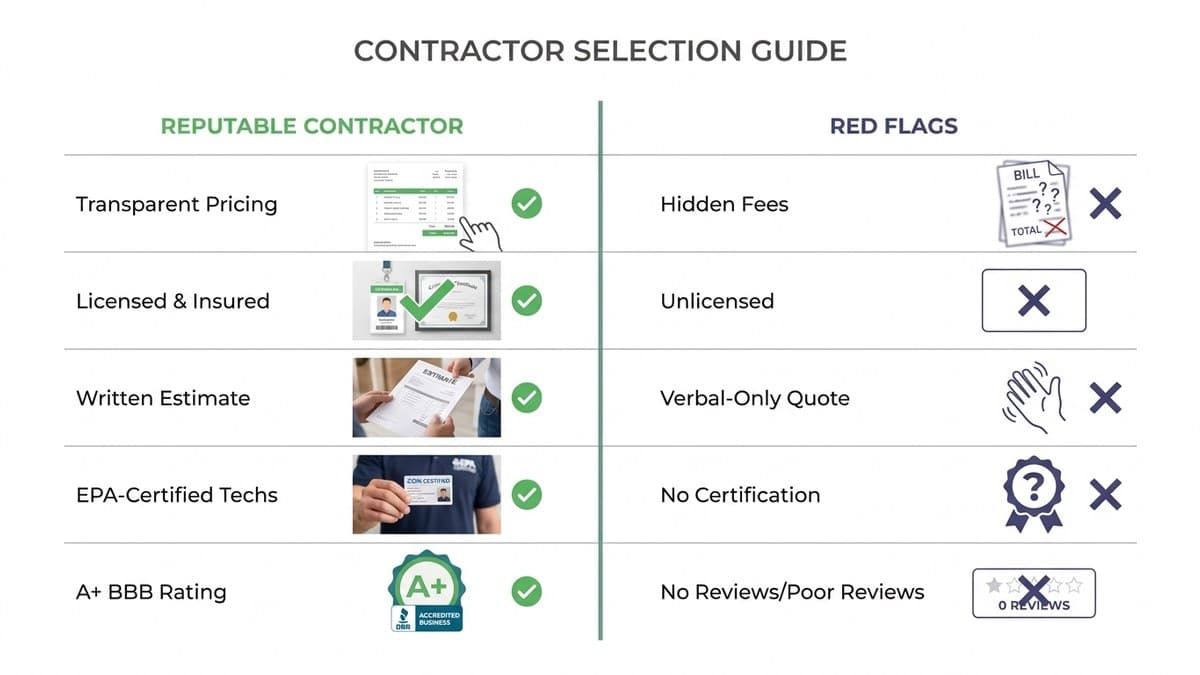
Licensed contractors are required to provide transparent pricing. The California Contractors State License Board consumer guide outlines consumer protection standards that reputable contractors follow across states, requiring them to give you a written estimate that itemizes parts, labor, diagnostic fees, and any additional charges before starting work.
What a legitimate estimate includes:
- Part description and cost (e.g., “Compressor, 3-ton R-410A: $1,200”)
- Labor hours and rate (e.g., “6 hours @ $125/hour: $750”)
- Refrigerant type and quantity (e.g., “R-410A, 8 lbs @ $60/lb: $480”)
- Diagnostic or service call fee (often waived if you proceed with the repair)
- Total cost, including tax
- Warranty terms for parts and labor
Red flags:
- Vague line items like “repairs: $2,500” with no breakdown
- Pressure to decide immediately (“This price is only good for the next hour”)
- Refusal to put the estimate in writing
- Upselling a full system replacement before diagnosing the actual issue
JLM provides a transparent written estimate before any work begins. You’ll know the cost up front, and there are no hidden fees or surprise charges when the job is done.
Verify Licensing, Insurance, and Reviews
Arizona requires HVAC contractors to hold a valid contractor’s license (residential or commercial HVAC classification). You can verify a contractor’s license status through the Arizona Registrar of Contractors (ROC).
What to verify:
- ROC license: Active and in good standing, with no disciplinary actions or unresolved complaints.
- Insurance: General liability and workers’ compensation. If a technician is injured on your property and the company isn’t insured, you could be liable.
- EPA Section 608 certification: Required for any technician who handles refrigerant. Ask to see certification before they open your system.
- BBB rating and online reviews: A+ BBB rating, 4.5+ stars on Google, and a track record of resolving complaints are strong trust signals.
JLM holds an active Arizona ROC license, carries full insurance, and maintains an A+ BBB rating. All our technicians are EPA-certified for refrigerant handling. You can verify our credentials before we ever roll the truck.
For more on why choosing a family-owned company over a franchise matters, read AC Companies Near Me: Why Choose JLM Over Large Franchises.
When Repair Doesn’t Make Sense: The $5,000 Rule
ENERGY STAR and HVAC industry standards recommend the “50% rule” for repair-vs-replace decisions: if the repair cost exceeds 50% of the replacement cost and the system is 10+ years old, replacement is the smarter financial move.
Example: Your 12-year-old AC needs a compressor replacement that will cost $2,800. A new high-efficiency system costs $6,000 installed. The repair is 47% of replacement cost, and your system is past the midpoint of its expected lifespan (15–20 years). In this scenario, replacement makes more sense: you’ll get a new system with a 10-year warranty, higher efficiency (lower energy bills), and no risk of another major failure in 2–3 years.
When to repair:
- The system is less than 10 years old
- The repair cost is under 30% of replacement cost
- The system has been well-maintained and you expect 5+ more years of service
- You’re on a tight budget and need a short-term fix (but plan for replacement within 2–3 years)
When to replace:
- The system is 15+ years old
- Multiple major components have failed or are failing (compressor + coil + blower motor)
- Repair costs exceed 50% of replacement cost
- You’re using R-22 refrigerant and facing a $1,500+ recharge
- Energy bills have spiked 20–30% due to declining efficiency
For a full breakdown of repair vs. replacement math, read How to Choose Between AC Repair & Replacement: A Homeowner’s Guide. If replacement is the right path, our guide on AC Replacement Cost: Understanding Your Options & Financing covers financing and budgeting strategies.
The ENERGY STAR Heating & Cooling Guide offers additional replacement cost benchmarks and energy savings calculators to help you model the payback period for a new system.
For homeowners with unique installation needs, Garage AC Options That Don’t Overwhelm Small Spaces explores ductless mini-split options that can supplement or replace aging central systems. If you’re considering a mini-split approach, How Mini Split Installation Works from Start to Finish and Mini Split Installation in Gilbert AZ: What to Know First provide detailed installation walkthroughs and local considerations.
What You Can Expect When You Call JLM for a Repair
JLM is a family-owned HVAC company serving Gilbert, Queen Creek, Mesa, and Apache Junction. Bill and his team live in the East Valley and take personal accountability for every job. Here’s what the service experience looks like when you call us.
Step 1: Transparent diagnostic and estimate. We charge a flat $100 diagnostic fee (waived if you proceed with the repair). The technician will troubleshoot the issue, test components, and provide a written estimate that itemizes parts, labor, and total cost. You’ll know the price before we start work.
Step 2: Same-day service availability (for common repairs). We stock capacitors, contactors, thermostats, and refrigerant on the truck. If your repair involves a stocked part and you call before noon, we can often complete the job the same day. For major repairs (compressor, coil replacement), we’ll order the part and schedule installation within 1–3 business days.
Step 3: Quality parts and professional installation. We use professional-grade parts (Amana, Goodman, Honeywell, Copeland) backed by manufacturer warranties. All installations meet or exceed manufacturer specs and Arizona building codes. Under EPA refrigerant regulations, we recover and recycle refrigerant properly and provide documentation of refrigerant handling.
Step 4: Post-repair testing and guarantee. Before we leave, we’ll test cooling performance, verify refrigerant charge, check airflow at the vents, and walk you through what we did. Every repair is backed by a parts and labor warranty (terms vary by part; ask your technician for specifics).
First-party data: We’ve completed 3,000+ HVAC installs and repairs across the East Valley. In our experience, over 60% of summer emergency calls are resolved the same day with parts we stock on the truck (capacitors, contactors, and thermostats). Our A+ BBB rating and hundreds of 5-star Google reviews reflect our commitment to transparency and quality.
For more insights on air conditioning maintenance and troubleshooting, browse our Air Conditioning category or explore the full Blog for HVAC tips and updates tailored to Gilbert, AZ residents.
Conclusion
Arizona AC repair costs range from $150 for a simple capacitor swap to $3,500+ for a compressor replacement. Most East Valley homeowners pay $300–$800 for the common repairs that keep systems running through peak summer heat. The final price depends on the part, labor complexity, your system’s age, refrigerant type, and whether you need emergency service.
Understanding what drives pricing, asking for written estimates, and choosing a licensed, insured contractor with strong reviews are your best defenses against overpaying. And when repair costs approach 50% of replacement cost on a system that’s 10+ years old, it’s time to have the replacement conversation.
JLM Air Conditioning & Heating is here to help. We’ll give you honest guidance on whether repair makes sense or replacement is smarter, and we’ll stand behind the work with transparent pricing and a satisfaction guarantee.
Need AC repair in Gilbert, Queen Creek, or the East Valley? Don’t wait in the heat. Call JLM Air Conditioning & Heating now for a transparent estimate and same-day service.