
Emergency AC repair in Arizona typically costs $400–$800+ per visit, with premium charges for after-hours or weekend dispatch and parts replacement under time pressure. Preventive maintenance plans run $150–$300 per year and include seasonal tune-ups, priority scheduling, and early detection of wear, catching issues before they trigger a breakdown. Over a system’s 12–15 year lifespan, regular maintenance can save homeowners $2,000–$4,000 in avoided emergency calls, extend equipment life by 3–5 years, and reduce energy bills by 10–15%. The upfront cost of prevention is predictable; the cost of an emergency is not.
For East Valley homeowners running AC systems year-round, the question isn’t if you’ll need service. It’s when, and under what circumstances. Scheduling a spring tune-up in March costs far less than calling for help when your compressor fails on a 115-degree Saturday afternoon in July. The math is simple, but the decision feels murky when you’re weighing a guaranteed expense today against a hypothetical emergency tomorrow. Why Summer in Mesa Demands Fast AC Repair explains how Arizona’s extreme heat accelerates system failures.
This comparison breaks down the real costs of both paths (reactive emergency repair vs. proactive maintenance) using actual East Valley job data, industry benchmarks, and transparent pricing. You’ll see what drives emergency repair costs higher, what preventive maintenance actually includes, and how the numbers add up over five years. By the end, you’ll know which path protects your comfort and budget.
What Counts as an “Emergency” AC Repair? (And What Doesn’t)
An emergency AC repair means your system has failed completely or poses an immediate safety risk during extreme heat. Total system shutdown when outdoor temperatures hit 110°F or higher qualifies. So does a refrigerant leak (which reduces cooling capacity and can damage the compressor), an electrical fault that trips your breaker repeatedly, or a burning smell from the unit. These scenarios demand same-day or after-hours dispatch because the health risk to your family is real, especially for young children, elderly residents, or anyone with respiratory conditions.
According to emergency HVAC service guidelines, total system shutdown, refrigerant leaks, and burning smells all warrant immediate emergency dispatch. These aren’t minor inconveniences; they’re failure modes that escalate fast in Arizona heat.
What doesn’t count as an emergency: unusual noises from the unit but still blowing cool air, inconsistent temperatures between rooms, higher-than-normal energy bills, or a thermostat that’s slow to respond. These are signs your system is struggling, but they don’t require after-hours emergency rates. You can schedule a standard diagnostic appointment during business hours and avoid the premium charges. Understanding this distinction saves you money and helps you assess whether you really need professional AC repair right now or can wait 24–48 hours for a scheduled visit.
When You Should Call for Same-Day Emergency Service
Call immediately if your AC stops cooling entirely during a heat wave, if you smell burning or see smoke from the outdoor unit, or if your breaker trips every time the system starts. Refrigerant hissing or ice buildup on the refrigerant lines also qualifies. Both signal a leak that will destroy your compressor if left unaddressed. According to research on emergency HVAC failures, waiting even 24 hours in these cases can turn a $600 repair into a $3,500 compressor replacement.
When You Can Schedule a Standard Repair Appointment
If the system is still cooling but making grinding or squealing noises, or if one room runs warmer than the others, schedule a diagnostic visit within a few days. The same applies to rising energy bills without an obvious cause, or a thermostat that’s unresponsive but doesn’t affect cooling. These issues need attention (they’re early warnings) but they don’t justify emergency rates.
The Real Cost of Emergency AC Repair in the East Valley
Emergency AC repair in Gilbert, Mesa, and Queen Creek typically costs between $400 and $800 for a service call, diagnostics, and straightforward part replacement like a capacitor or contactor. That figure climbs quickly when the failure involves a compressor ($1,200–$2,500), a blower motor ($450–$900), or an evaporator coil leak ($1,000–$1,800). Add after-hours or weekend dispatch (common when systems fail during peak-use periods) and you’re looking at an additional $100–$300 premium.
Why do emergency calls cost more? Time pressure eliminates the ability to shop for parts at wholesale prices or schedule the work during regular hours. Technicians working nights, weekends, or holidays earn overtime, and that labor cost passes to you. Parts availability becomes a bottleneck: if your compressor fails on Sunday, the replacement may need to be sourced from a distributor charging retail markup instead of the contractor’s usual vendor. Diagnostic urgency also plays a role. When a family is sweating through 115-degree indoor temperatures, the technician must troubleshoot fast, which means less time for cost optimization.
According to industry data on repair pricing, AC systems older than 10–12 years are at significantly higher risk of catastrophic failure, especially in high-use climates like Arizona. If your system is in that age range, the question isn’t whether you’ll face an emergency repair. It’s when, and how much you’ll pay under time pressure.
Base Service Call + Diagnostics
A standard emergency service call starts at $150–$250 just to dispatch a technician and diagnose the problem. That fee covers travel, equipment, and the first hour of labor. If the issue is minor (a tripped breaker, a clogged condensate drain), you might escape with just the service call cost. If the diagnosis reveals a failed component, the service call fee often rolls into the total repair cost, but you’re still paying for parts and labor on top.
Parts Replacement Under Pressure (Compressor, Capacitor, Blower Motor)
A failed capacitor runs $150–$300 installed during an emergency call (vs. $100–$200 during a scheduled visit). A blower motor replacement costs $450–$900 in emergency conditions. Compressor failure (the costliest single repair) ranges from $1,200 to $2,500 depending on tonnage and refrigerant type. In each case, the emergency premium comes from sourcing parts retail instead of wholesale, and from technician overtime rates. For comprehensive air conditioning services and transparent pricing, working with a local, owner-led contractor eliminates the call-center markup you’d pay with a franchise.
After-Hours and Weekend Premiums
Most HVAC contractors charge a $100–$300 premium for service calls outside regular business hours (weeknights after 6 p.m., weekends, holidays). This premium is separate from the base service call and labor. It’s purely a scheduling surcharge. During Arizona’s peak summer months (June through August), emergency call volume spikes so high that even customers willing to pay the premium may wait 48–72 hours for a technician. That delay turns a costly repair into a health hazard.
What Preventive Maintenance Actually Includes (And What It Costs)
A preventive maintenance plan for a residential AC system in Arizona typically costs $150–$300 per year and includes two visits: a spring tune-up before cooling season and a fall heating system check. Each visit follows a structured checklist: coil cleaning, refrigerant level verification, electrical connection inspection, drain line service, filter replacement or cleaning, thermostat calibration, and blower motor lubrication. The technician tests amp draw on the compressor and blower, checks capacitor health, inspects ductwork for leaks, and runs the system through a full cooling cycle to confirm performance.
According to ASHRAE maintenance standards, biannual HVAC inspections (spring and fall) maintain peak performance and catch wear before failure. This isn’t upselling. It’s the industry-standard maintenance schedule designed to extend equipment life and prevent breakdowns. The spring visit focuses on cooling components (refrigerant, condenser coil, capacitors), while the fall visit addresses heating elements, gas connections, and heat exchanger integrity if you have a furnace.
What this service catches: refrigerant leaks before they damage the compressor, capacitors degrading toward failure, dirty coils that reduce efficiency by 10–15%, clogged drain lines that cause water damage, and loose electrical connections that trip breakers or start fires. JLM’s spring tune-up and fall inspection process targets these common failure points before they escalate, using a detailed checklist that ensures nothing gets overlooked. After each visit, you receive a written report showing exactly what was inspected, what’s healthy, and what needs attention in the next 6–12 months.
The Spring Tune-Up Checklist
The spring visit happens in March or April, before temperatures hit triple digits. The technician cleans the outdoor condenser coil (removing dust, cottonwood seeds, and debris that block airflow), checks refrigerant charge and adds refrigerant if needed, tests the capacitor and contactor, lubricates the blower motor, clears the condensate drain, and replaces or cleans the air filter. They also inspect ductwork for leaks or disconnections, verify thermostat calibration, and measure airflow at the registers. Total visit time: 60–90 minutes. This single visit can prevent 70–80% of summer breakdowns by catching issues while they’re still small.
The Fall Heating System Check
The fall visit (October or November) shifts focus to heating components. For heat pump systems, the technician reverses the refrigerant flow and tests heating mode performance. For gas furnaces, they inspect the heat exchanger for cracks, test the igniter and flame sensor, check gas pressure, and verify carbon monoxide levels. They also clean or replace the filter, lubricate the blower motor, and test the safety switches. Even if you rarely use heat in Arizona, this visit ensures your system is ready when overnight temperatures drop into the 40s or 50s.
Annual Plan Pricing vs. One-Time Service Call Rates
An annual maintenance plan at JLM costs approximately $200–$250 per year and includes both the spring and fall visits, priority scheduling during peak season, and a discount on any repairs needed throughout the year. Compare that to paying for two standalone tune-up visits at $150–$200 each (total: $300–$400), with no priority scheduling and no repair discount. The plan also includes a 10–15% discount on parts and labor if a repair is needed, which can save $50–$150 on a single service call. Over five years, the savings compound: $1,000–$1,250 in maintenance plan costs vs. $1,500–$2,000 in one-off tune-up visits, plus the avoided emergency repair costs we’ll quantify next.
According to research on the importance of regular HVAC maintenance, regular tune-ups reduce the likelihood of emergency failures by 60–70%, which translates directly to lower total cost of ownership.
The Hidden Costs of Skipping Maintenance (Energy, Lifespan, Downtime)
The invoice from an emergency repair shows one cost. The hidden costs of skipping maintenance show up in your monthly energy bills, the shortened lifespan of your equipment, and the inconvenience (or health risk) of waiting 48–72 hours for a repair during a summer heat wave. These secondary costs often exceed the emergency repair itself over the life of the system.
Dirty coils and clogged filters force your AC to work harder to achieve the same cooling, increasing energy consumption by 10–15%. On a typical East Valley home with $200/month summer cooling bills, that’s a $20–$30 monthly penalty: $240–$360 wasted per year. According to Federal energy management guidance, well-maintained HVAC systems use 10–15% less energy than neglected units, which means every year you skip maintenance costs you the equivalent of one or two months’ worth of electricity.
Beyond energy waste, deferred maintenance shortens equipment life. A well-maintained AC system in Arizona lasts 12–15 years. A neglected system fails at 8–10 years, forcing a $6,000–$12,000 replacement several years early. That’s $2,000–$4,000 in lost value: the cost of the system amortized over the years you didn’t get to use it. Compressor failure is the most common mode of premature death, and it’s almost always preceded by low refrigerant (from an undetected leak), dirty coils (from skipped cleanings), or capacitor failure (from missed inspections).
How Dirty Coils and Clogged Filters Drain Your Wallet
Arizona’s dust, pollen, and cottonwood seeds coat your outdoor condenser coil every spring. A coil caked in debris blocks airflow, forcing the compressor to run longer and hotter to achieve the same cooling. According to NADCA’s energy study, HVAC cleaning improves airflow and efficiency, reducing energy waste. The same principle applies to your indoor air filter: a clogged filter restricts airflow, raises static pressure, and makes the blower motor work harder. Over a year, that inefficiency costs you $200–$400 in wasted electricity, enough to pay for two maintenance visits.
In desert climates, HVAC filters need replacement every 30–60 days due to dust load, not the 90-day schedule common in humid regions. Skipping this simple task compounds the energy penalty and accelerates wear on the blower motor.
Shortened Equipment Lifespan = Earlier Replacement Cost
A $10,000 AC system that lasts 15 years costs you $667 per year. The same system failing at 10 years costs $1,000 per year: a $333 annual penalty. Multiply that across the five years you lost, and you’ve wasted $1,665 in lost equipment value. Add the inconvenience of an unexpected replacement (no time to shop for rebates or compare bids) and the stress of financing a major expense on short notice, and the true cost of skipping maintenance becomes clear.
The Cost of Waiting 48–72 Hours for a Repair in 115°F Heat
During Arizona’s peak cooling season (late June through August), HVAC contractors are booked solid. An emergency call placed on a Saturday morning may not get a technician onsite until Monday afternoon: 48 to 72 hours of indoor temperatures climbing past 95°F. For families with young children, elderly members, or anyone with respiratory conditions, that delay isn’t just uncomfortable; it’s a health risk. Hotels, portable AC units, or temporary relocation to a friend’s house all add costs that don’t show up on the repair invoice.
JLM’s maintenance plan customers get priority scheduling, which typically means same-day or next-day service even during peak season. That alone justifies the $200–$250 annual plan cost for most homeowners.
A Side-by-Side Comparison: Emergency-Only vs. Maintenance Plan Over 5 Years
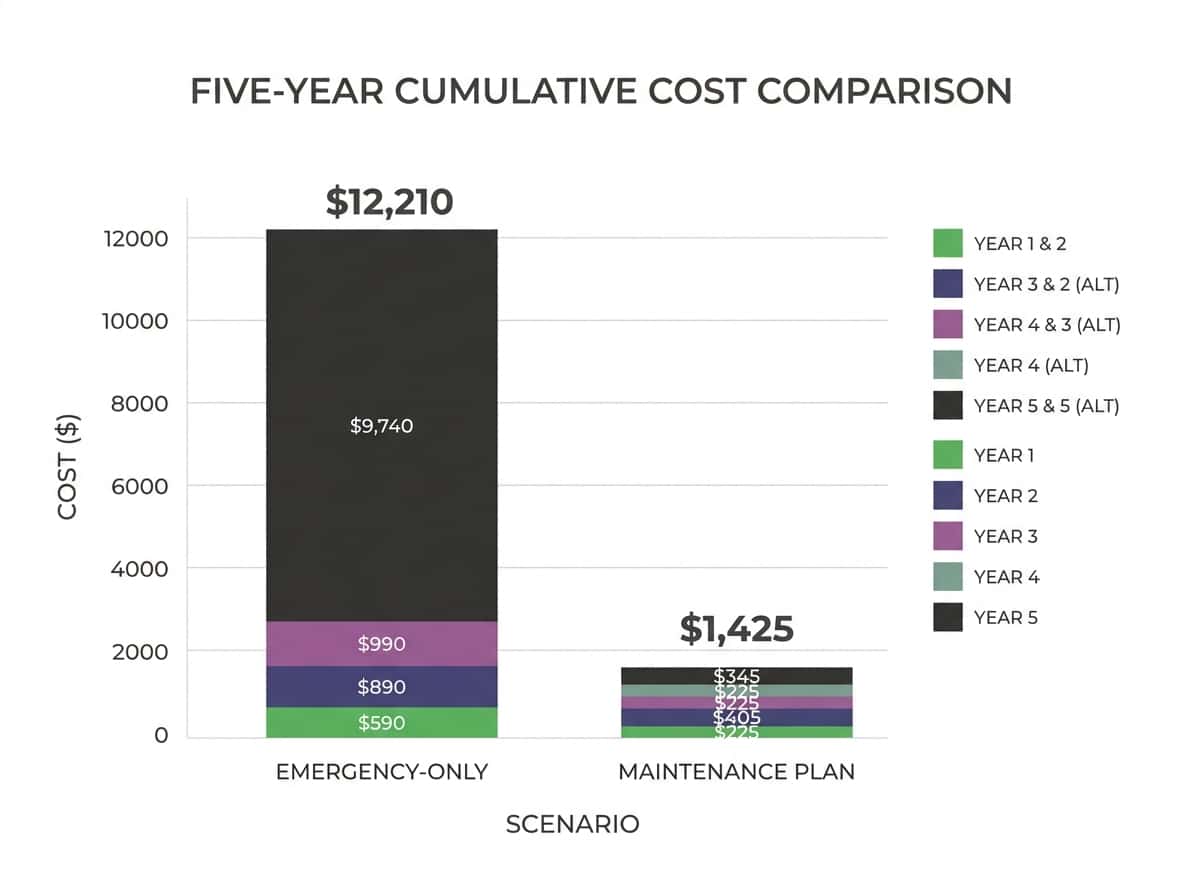
Let’s walk through the real numbers for two East Valley homeowners over a five-year period. Both own 3-ton AC systems that are 8 years old at the start of this comparison. Both run their systems from April through October (roughly 210 days per year) and pay $200/month in peak summer cooling costs.
Homeowner A skips preventive maintenance and pays only when something breaks. Homeowner B enrolls in an annual maintenance plan at $225/year.
Homeowner A (Emergency-Only Path):
- Year 1: No service needed. Cost: $0.
- Year 2: Capacitor fails in July. Emergency call on Sunday: $350 (service call + part + weekend premium). Energy waste from dirty coils: $240. Total: $590.
- Year 3: Refrigerant leak detected after cooling performance drops. Emergency repair: $650 (leak repair + refrigerant recharge). Energy waste: $240. Total: $890.
- Year 4: Blower motor fails in June. Emergency replacement: $750. Energy waste: $240. Total: $990.
- Year 5: Compressor fails due to accumulated wear. Replacement quote: $2,200. Homeowner opts for full system replacement instead: $9,500. Energy waste: $240. Total: $9,740.
Five-year total for Homeowner A: $0 + $590 + $890 + $990 + $9,740 = $12,210.
Homeowner B (Maintenance Plan Path):
- Year 1: Maintenance plan: $225. Coil cleaning, filter replacement, capacitor tested (healthy). Energy waste: $0 (system running at peak efficiency). Total: $225.
- Year 2: Maintenance plan: $225. Technician detects early-stage refrigerant leak during spring tune-up, repairs before it damages compressor: $180 (discounted rate for plan members). Energy waste: $0. Total: $405.
- Year 3: Maintenance plan: $225. Blower motor bearings show early wear; technician lubricates and extends motor life by 2 years. Energy waste: $0. Total: $225.
- Year 4: Maintenance plan: $225. No issues detected. System running efficiently. Total: $225.
- Year 5: Maintenance plan: $225. Capacitor replaced during spring tune-up before it fails (preventive replacement at discounted rate): $120. Energy waste: $0. Total: $345.
Five-year total for Homeowner B: $225 + $405 + $225 + $225 + $345 = $1,425.
Savings for Homeowner B: $12,210 – $1,425 = $10,785 over five years. That figure includes avoided emergency calls, eliminated energy waste, and extended equipment life (Homeowner B’s system is still running at the end of Year 5, while Homeowner A had to replace the entire system).
This comparison uses conservative estimates. According to UK research on HVAC maintenance and energy savings, proper HVAC maintenance demonstrably reduces energy consumption and prevents costly emergency repairs. In reality, Homeowner A’s emergency repair costs could run higher if parts aren’t available or if the compressor failure happens during a holiday weekend. Homeowner B’s maintenance plan also includes priority scheduling, which eliminates the 48–72 hour wait time and the cost of temporary cooling solutions.
The math is clear: preventive maintenance costs less than emergency-only repair, even before you factor in comfort, convenience, and peace of mind. Planning your AC tune-up in spring locks in the lowest cost and the best availability before the summer rush.
When Emergency Repair Is the Right Call (Even with a Maintenance Plan)
Preventive maintenance reduces the likelihood of breakdowns, but it doesn’t eliminate all failures. Freak events happen: lightning strikes fry circuit boards, monsoon floods damage electrical components, or a compressor bearing fails despite clean coils and proper refrigerant charge. In these cases, emergency repair is unavoidable, even if you’ve followed the maintenance schedule perfectly.
This is where JLM’s maintenance plan structure shows its value. Plan members get priority scheduling (same-day or next-day service, even during peak season) and a 10–15% discount on parts and labor. So when an emergency does occur, you’re not waiting three days for a technician or paying full retail rates for parts. You’re also working with a contractor who has your service history on file and knows your system’s maintenance record, which speeds diagnosis and reduces troubleshooting time.
Emergency repair is also the right call when you inherit a neglected system: buying a home with an 8-year-old AC that hasn’t been serviced, for example. In that case, schedule a comprehensive diagnostic visit (not an emergency call) to assess the system’s health, then decide whether to invest in repairs or plan for replacement.
The key distinction: emergency repair is a reactive response to an unexpected failure. Preventive maintenance is a proactive strategy to minimize those failures. Both have a place in responsible homeownership, but the second pays for itself many times over.
How to Decide: Questions to Ask Before Your Next Arizona Summer
Not every homeowner needs a maintenance plan immediately. If your system is brand new (under 2 years old) and still under manufacturer warranty, you might defer annual tune-ups until Year 3. If you’re planning to sell your home within the next 12 months, the ROI of a maintenance plan may not justify the cost. But for most East Valley residents running 5+ year old systems year-round, the decision comes down to a few diagnostic questions:
1. How old is your AC system? Systems older than 8 years enter the high-risk zone for component failure. If yours is 10+ years old, a maintenance plan is insurance against costly emergency repairs during the system’s final years.
2. When was your last professional tune-up? If it’s been more than 18 months, your coils are dirty, your refrigerant charge is likely low, and your capacitor may be degrading. Schedule a tune-up before summer to avoid a breakdown.
3. Have you noticed higher energy bills or inconsistent cooling? Both are early warning signs of system stress. A maintenance visit can diagnose the cause (dirty coils, low refrigerant, duct leaks) before it becomes an emergency. HVAC System topics cover common warning signs in detail.
4. Do you have a service history with a trusted local contractor? Maintenance plans work best when you build a relationship with one contractor who knows your system. If you’ve been calling different companies for every repair, you’re missing the continuity that makes preventive care effective.
5. Can you handle a $600–$800 emergency repair on short notice? If not, a $200–$250 annual maintenance plan spreads the cost predictably and reduces the likelihood of that emergency.
6. Do you have young children, elderly family members, or respiratory conditions in your home? If so, the health risk of a 48–72 hour AC outage during a heat wave justifies the cost of priority scheduling and preventive care.
7. Are you planning to stay in your home for the next 3–5 years? If yes, the cumulative savings of a maintenance plan (avoided emergency calls, lower energy bills, extended equipment life) pay back the upfront cost within 18–24 months.
Arizona’s desert climate and year-round cooling demand accelerate HVAC wear faster than most of the country. Prepping your AC for Gilbert’s hot summer means addressing small issues in March or April, not waiting until July when every contractor is booked solid.
Alternative Cooling Solutions for Specific Spaces
Not every room or structure in your home requires a full central AC system. Garages, workshops, and converted spaces often benefit from targeted cooling solutions that cost less to install and operate. Garage AC options for small spaces explore ductless mini-split systems and portable units designed for specific zones.
Mini-split systems deliver efficient, quiet cooling without ductwork and work especially well for additions, sunrooms, or detached structures. How mini split installation works walks through the process from sizing to startup, while mini split installation in Gilbert addresses local permitting and placement considerations specific to East Valley homes.
These zoned solutions can also reduce strain on your central system, lowering overall energy costs and extending equipment life across your entire cooling infrastructure.
Routine Maintenance Protects Your Investment
Regular maintenance doesn’t just prevent emergencies. It protects one of your home’s most important systems from premature failure. Air Conditioning Maintenance services ensure your equipment operates at peak efficiency, catching small issues before they become expensive problems. This proactive approach extends your system’s lifespan and keeps your energy bills predictable throughout Arizona’s brutal summer months.
Staying Informed About HVAC Care
Understanding your cooling system and how to maintain it doesn’t require an HVAC license. JLM’s blog covers seasonal maintenance tips, efficiency upgrades, and troubleshooting guides for East Valley homeowners. Topics range from filter selection for desert dust to recognizing early warning signs of compressor failure.
Regular readers gain the knowledge to make informed decisions about when to DIY simple tasks (filter changes, thermostat batteries) and when to call a professional. That discernment saves money and prevents small oversights from becoming expensive emergencies.
For comprehensive HVAC services in the East Valley, JLM offers transparent pricing, same-day service, and the local expertise that comes from 3,000+ installations across Gilbert, Mesa, and Queen Creek.
Conclusion
Emergency AC repair costs more (often double or triple the price of preventive maintenance) because you’re paying for urgency, after-hours labor, and parts sourced under time pressure. Over five years, an emergency-only approach to HVAC care can cost $10,000+ more than a proactive maintenance plan, once you factor in wasted energy, shortened equipment life, and the inconvenience of multi-day outages during Arizona heat waves.
JLM Air Conditioning & Heating’s maintenance plans start at $200–$250 per year and include spring and fall tune-ups, priority scheduling, and discounted repair rates. That’s transparent, predictable cost: no surprises, no pressure, no hidden fees. Bill is on the job, accessible by phone, and invested in building long-term relationships with East Valley families. With 3,000+ installs, an A+ BBB rating, and 24/7 emergency availability, JLM delivers the quality and reliability that corporate franchises promise but rarely deliver.
Whether you’re ready to schedule a spring tune-up or facing an emergency breakdown today, JLM is here to help.