When your AC breaks down in 110°F Arizona heat, the stakes are high. You need cool air fast, but you also need to make the right financial decision. Choose AC repair if your system is under 10 years old, the repair costs less than 50% of replacement, and you’re not facing frequent breakdowns. Replace your system if it’s 12+ years old, uses outdated refrigerant (R-22), costs more than $3,000 to repair, or has declining efficiency that’s spiking your energy bills.
This guide walks you through the five factors that determine whether to fix your AC or invest in a new system. Our Air Conditioning | AC Technician Near Me page covers the full range of repair and installation services we offer across Gilbert, Mesa, Queen Creek, and Apache Junction. You’ll learn the real costs, the hidden risks of waiting, and what to expect from a contractor who puts your comfort ahead of commission. By the end, you’ll have a clear framework for making the right call: no pressure, just honest guidance.
When AC Repair Makes Sense: The Core Criteria
Repair is the financially sound choice when three conditions align. Your system is young, the repair cost is reasonable relative to replacement, and you’re not stuck in a cycle of constant breakdowns. Here’s how to evaluate each factor.
System Age and Expected Lifespan
Well-maintained air conditioning systems in Arizona last 12 to 15 years on average. The brutal summer heat and heavy seasonal use compress lifespan compared to milder climates. However, preventive maintenance can push a quality system past the 15-year mark.
If your system is in the first half of its expected life (under 7 years), repair almost always makes sense. A $600 fan motor replacement on a 5-year-old unit buys you another 8 to 10 years of reliable service. If your system is past 12 years, you’re in the replacement zone. Even a modest repair on a 14-year-old system is a short-term fix on aging equipment. Other components are nearing failure.
Our HVAC System | AC Technician Near Me resource library covers how to assess your system’s age and condition if you’re unsure where you stand.
Repair Cost as a Percentage of Replacement
The industry standard is the 50% rule. If the repair costs more than half the price of a new system, replace. Here’s the math. A complete AC replacement for a typical 1,800-square-foot East Valley home runs $10,000 to $12,000 installed. Half of $11,000 is $5,500. That’s your threshold.
A $400 capacitor replacement? Repair. A $900 compressor motor? Repair. A $6,000 condenser coil replacement? Replace. When the repair bill approaches or exceeds the 50% mark, you’re investing thousands in a system that still has an aging evaporator coil, worn electrical contacts, and a blower motor with years of wear. You’re not buying a new system’s lifespan. You’re buying 18 to 24 months before the next component fails.
If you’re evaluating a repair estimate during peak season and need clarity on whether the cost makes sense, Why Summer in Mesa Demands Fast AC Repair explains why acting quickly can prevent emergency service premiums.
Repair Frequency Over the Last 2 to 3 Years
Track your service history. If you’ve had three or more breakdowns in the last 24 months, cumulative repair costs and declining reliability signal it’s time to replace. Add up what you’ve spent: $800 for a refrigerant leak in 2024, $650 for a blower motor in 2023, $450 for a capacitor in 2022. That’s $1,900 in repairs on a system that’s still limping along.
When repair costs exceed $2,000 over two years on a system that’s 10+ years old, you’re throwing good money after bad. Each fix buys you a few months of uptime, but the underlying reality is that all components are aging together. The next breakdown is already in the queue.
For homeowners wondering when DIY fixes make sense versus calling a professional, Do You Really Need Professional AC Repair in Mesa? walks through the diagnostic signs that require licensed expertise.
When AC Replacement Is the Smarter Investment
Replacement becomes the clear choice when you’re facing red flags that signal systemic decline. Outdated refrigerant, major component failure, efficiency loss that’s spiking energy bills, or chronic breakdowns all point to replacement. According to industry data on HVAC service trends, homeowners who replace 12+ year-old systems save an average of 20 to 30% on cooling costs in the first year. This comes from improved SEER efficiency and reduced repair frequency.
In our 3,000+ installations across the East Valley, we’ve found that customers who upgrade aging systems report better comfort. They also see lower utility bills and gain peace of mind knowing they won’t face a July breakdown when temperatures hit 115°F.
Your System Uses R-22 Refrigerant (Phased Out by EPA)
If your AC requires a refrigerant recharge and it uses R-22 (commonly called Freon), replacement is the smarter long-term move. The EPA phased out R-22 production in 2020 due to ozone depletion concerns. As of 2024, R-22 refrigerant costs $150+ per pound compared to $50 per pound for R-410A, the modern refrigerant used in new systems.
Recharging an R-22 system is a band-aid. The refrigerant supply is finite, prices will continue to climb, and you’re still operating an aging system designed around obsolete technology. Replacing with a modern R-410A system gives you 12 to 15 years of reliable, affordable service with readily available refrigerant.
Major Component Failure (Compressor, Condenser Coil, Evaporator Coil)
Compressor or coil replacement costs $2,000 to $4,000+ in parts and labor. This represents 40 to 60% of a new system’s price. If the unit is 10+ years old, that investment doesn’t buy you a new lifespan. You still have an aging air handler, electrical contacts with a decade of wear, and ductwork that may need sealing or balancing.
Major component failures on systems past their midpoint lifespan often trigger a cascade of secondary issues within 12 to 18 months. Replacement gives you a full manufacturer warranty (typically 10 years on parts, 5 to 10 years on labor), modern efficiency, and a fresh start with zero deferred maintenance.
Our Air Conditioning Maintenance program helps extend system life and catch early signs of major component wear before they escalate to emergency failures.
Energy Bills Climbing Despite Normal Usage
HVAC systems lose 1 to 2 SEER efficiency points per decade of operation. This happens as internal components wear and refrigerant charge drifts. If your summer electric bills have increased 15 to 25% over the last two to three years with no change in usage patterns, your AC is working harder to deliver less cooling.
A modern 16-SEER or 18-SEER system can cut cooling costs by 20 to 30% compared to a 10-year-old 13-SEER unit. Upgrading from a 13-SEER to a 16-SEER system pays for itself in energy savings over 5 to 7 years in hot climates like Arizona. After that, the savings go straight to your pocket.
For homeowners planning ahead, Is Spring Too Early to Plan for Arizona AC Tune-Up? explains how off-season maintenance and efficiency assessments can help you decide whether to repair or replace before the summer rush.
The Real Cost of Waiting Too Long to Replace
Delaying replacement on a system that’s past its prime carries hidden costs beyond the next repair bill. Emergency breakdowns during peak season (June through August) cost 25 to 50% more than off-season service due to demand surges.
A compressor failure in July means you’re competing with hundreds of other East Valley homeowners for same-day service. Emergency calls command premium rates, and parts availability tightens when every contractor in the valley is maxed out. If you wait until the system fails catastrophically on a 112°F afternoon, you’re paying top dollar for rushed service instead of planning the replacement on your timeline.
Beyond cost, there’s comfort and safety. Arizona heat isn’t just uncomfortable. It’s a health risk for young children, elderly family members, and anyone with respiratory conditions. A system limping through the summer with declining performance means higher indoor temperatures, humidity spikes, and disrupted sleep.
Secondary damage adds up, too. Refrigerant leaks can freeze evaporator coils, which then drip condensation into your ductwork and drywall. Water damage from AC failures can run $500 to $2,000+ in drywall and flooring repairs. These costs aren’t covered by your HVAC warranty.
Planning ahead gives you control. You schedule the installation during a mild week in April or October, you compare bids from multiple contractors, and you avoid the emergency-service premium. If you’re evaluating whether your system can make it through one more summer, The Smart Way to Prep AC for Gilbert’s Hot Summer provides a seasonal prep checklist. This can reveal whether you’re looking at minor tune-ups or systemic decline.
How to Make the Decision: A Step-by-Step Framework
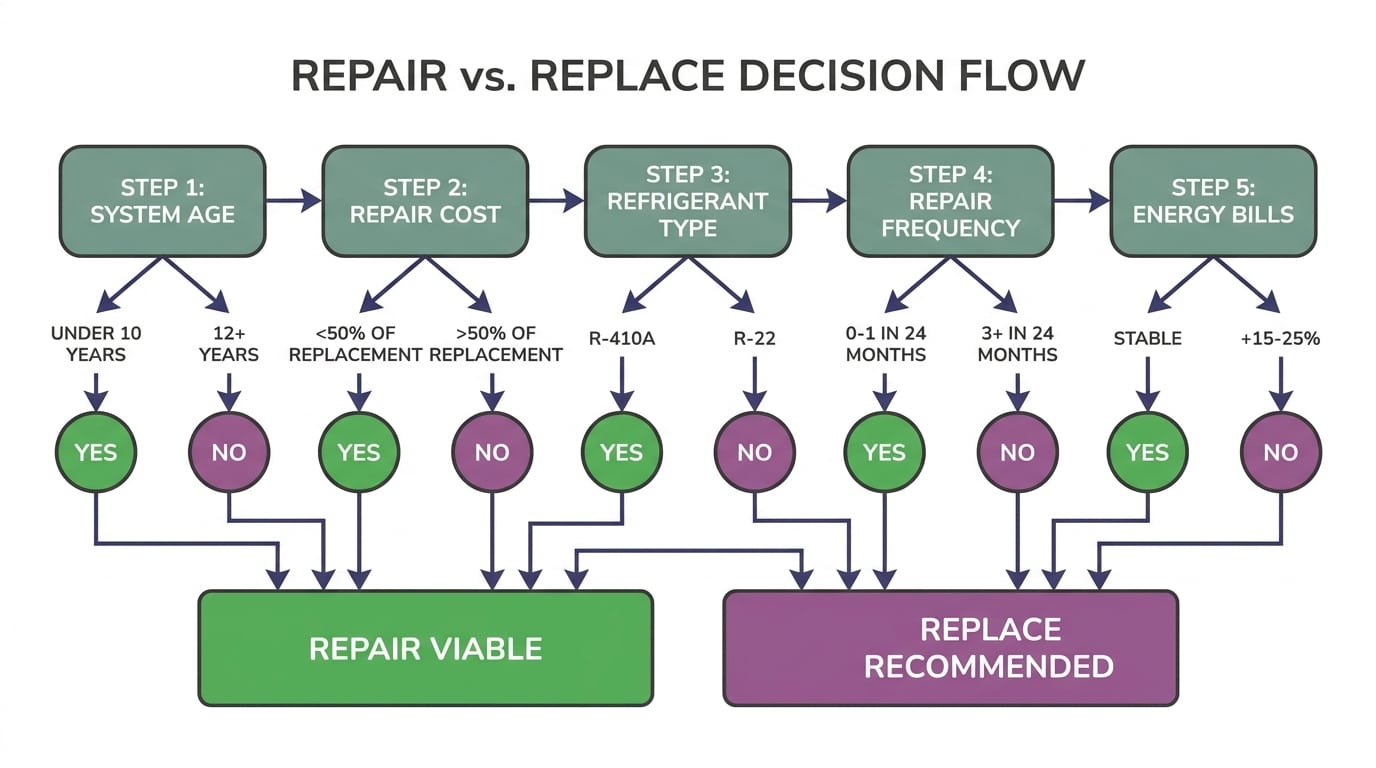
Use this five-question framework to evaluate your specific situation. Each question yields a “repair” or “replace” signal. If you score three or more “replace” signals, investing in a new system is the smarter financial and comfort decision.
Question 1: How old is your system? Under 10 years = lean repair. 12+ years = lean replace. Systems in the 10 to 12 year zone depend on the answers to the remaining questions.
Question 2: What’s the repair cost as a percentage of replacement? Under 50% = repair viable. Over 50% = replace. Use $11,000 as your baseline replacement cost for a typical East Valley home. This makes $5,500 your threshold.
Question 3: What refrigerant does your system use? R-410A (or newer) = repair viable. R-22 = replace. Check the label on your outdoor condenser unit or ask your technician during the service call.
Question 4: How many repairs have you made in the last 24 months? 0 to 1 repair = system is stable, repair makes sense. 3+ repairs = chronic decline, replace. Track total spend. If you’ve invested $2,000+ in repairs over two years, you’re subsidizing an aging system.
Question 5: Are your energy bills climbing despite normal usage? Stable or modest increase (<10%) = repair viable. 15 to 25%+ increase = efficiency loss, replace. Pull your utility bills from the last three summers and compare June through August totals.
Scorecard: 3+ “replace” signals = time to invest in a new system. The cumulative evidence (age, cost, efficiency decline, repair frequency) shows that repair is a short-term fix on a system in terminal decline. 2 or fewer “replace” signals = repair makes sense. You’re likely dealing with a fixable issue on a system that still has useful life remaining.
This framework removes guesswork. It’s not about gut feeling or fear of spending money. It’s about evaluating objective data (system age, repair history, refrigerant type, cost thresholds) and making the financially rational choice.
What to Expect from a Transparent HVAC Contractor
An honest contractor doesn’t pressure you into a decision. They provide the information you need to choose what’s right for your home and budget. Here’s what a transparent AC repair versus replacement consultation looks like.
On-site assessment: A licensed technician inspects your system, tests refrigerant levels, checks electrical components, and measures airflow. They ask about your repair history, energy bills, and how long you plan to stay in the home. This isn’t a 10-minute glance at the outdoor unit. It’s a full diagnostic.
Side-by-side cost comparison: The contractor presents both options with real numbers. Repair: $1,200 for a new compressor motor, includes labor and refrigerant top-off, 90-day warranty on the repair. Replacement: $11,500 for a 16-SEER Amana system, includes installation, 10-year parts warranty, 5-year labor warranty, projected $400/year savings on cooling costs. You see the upfront cost, the warranty coverage, and the long-term value of each path.
Understanding commercial HVAC compliance and regulatory requirements can also inform residential decisions. Many quality standards and certification expectations apply across both sectors. ACCA quality standards require contractors to provide written estimates with itemized costs and warranty terms. If your contractor hands you a vague “repair or replace” verbal quote with no breakdown, that’s a red flag.
No upselling: A reputable contractor tells you what’s needed, not what’s most profitable for them. If your 8-year-old system needs a $700 capacitor replacement and it’s in otherwise good condition, a transparent contractor recommends repair. If your 14-year-old R-22 system needs a $4,000 compressor and the refrigerant is $150/lb, they’ll explain why replacement makes financial sense. The final decision is yours.
Credentials and references: Look for NATE certification (North American Technician Excellence), manufacturer training credentials, and an A+ BBB rating. Technicians who complete EPA-certified refrigerant handling training demonstrate a commitment to professional standards that protects your investment. JLM Air Conditioning & Heating has completed 3,000+ installations across the East Valley, holds an A+ BBB rating, and is owner-operated. Bill and the JLM team are on the job, not passing your project to subcontractors.
When you call JLM, you’re not routed to a call center. You’re talking to Bill or a licensed technician who’s worked on thousands of systems in Gilbert, Mesa, Queen Creek, and Apache Junction. You get straight answers, not corporate scripts.
For homeowners evaluating contractors across the East Valley, our HVAC Services in the East Valley, AZ page outlines our full range of repair, installation, and maintenance capabilities.
Conclusion: Making the Right Choice for Your Home
Choosing between AC repair and replacement comes down to five factors. System age, repair cost as a percentage of replacement, refrigerant type, repair frequency, and energy efficiency trends all matter. There’s no one-size-fits-all answer. Understanding HVAC regulations and industry standards helps you evaluate contractor recommendations and make informed decisions. A $600 repair on a 7-year-old system makes sense. A $3,500 repair on a 14-year-old R-22 system doesn’t.
Use the decision framework in this guide to evaluate your specific situation. If you score three or more “replace” signals, investing in a new system gives you better comfort, lower energy bills, and peace of mind. For homeowners tracking emerging HVAC trends and new technologies in 2024, replacement offers access to smart thermostats, variable-speed compressors, and improved efficiency that older systems can’t match. If repair is the right call, make sure you’re working with a contractor who provides transparent pricing, real warranties, and honest guidance.
If you’re weighing repair versus replacement and want an on-site assessment with no pressure and straightforward options, Bill and the JLM team are here to help. We’ll walk you through both paths with real numbers, explain what’s needed (and what’s optional), and let you decide what’s right for your home and budget. Meeting HVAC system certifications and quality standards ensures you receive professional service backed by industry best practices.
Ready to make an informed decision? Call JLM Air Conditioning & Heating today at (602) 619-3609 to schedule your free consultation. We’ll provide a complete diagnostic assessment, a side-by-side cost comparison, and honest recommendations based on your system’s condition and your long-term comfort goals. No pressure, no upselling—just the information you need to choose wisely.
For more HVAC maintenance tips, decision guides, and East Valley homeowner resources, explore our Blog | HVAC Tips & Updates for Gilbert, AZ Residents.