
What does an AC maintenance plan cover, and is it worth the cost for Arizona homeowners?
An AC maintenance plan covers scheduled seasonal tune-ups (typically spring and fall), priority service scheduling, discounts on repairs, and system inspections that catch problems before they become expensive breakdowns. For East Valley homeowners, a plan reduces emergency repair risk, extends system lifespan by 5–10 years, and lowers cooling costs by maintaining peak efficiency. This matters especially when your AC runs 6+ months a year in 110°F heat.
If you’ve faced a summer breakdown or watched your electric bill climb every June, you already know what reactive HVAC maintenance costs. The sweat equity of waiting three days for an emergency repair. The $800 compressor replacement that arrives mid-July. The question every homeowner asks after the check clears: “Could I have prevented this?”
The answer is usually yes. Regular professional maintenance prevents most emergency failures and keeps your system running at peak efficiency. But not all AC maintenance plans East Valley providers offer deliver equal value. Some are thinly veiled upsell vehicles designed to lock you into high-pressure sales calls. Others cover so little you’re better off paying per visit.
This guide walks you through what an HVAC maintenance plan coverage actually includes, how to evaluate any provider’s offering, and when the investment pays for itself. We’ll show you the real math, the inspection checklist, and the red flags to watch for. By the end, you’ll know whether a plan makes sense for your home and how to choose one that protects your comfort without padding a company’s bottom line.
Why East Valley Homeowners Need a Maintenance Plan (Not Just Annual Service)
The math of reactive repairs versus preventive AC care cost isn’t abstract. It shows up every summer in service calls, electric bills, and system lifespans. Arizona heat doesn’t negotiate. When your AC runs 180+ days a year in 100°F+ temperatures, every component works harder than it was designed to in milder climates. Dust storms coat coils. Thermal expansion stresses connections. Refrigerant levels drift. A system that might cruise through 15 years in Seattle barely makes it to 10 in Gilbert without regular professional attention.
The cost difference is real. How to Tell If You Need an AC Maintenance Service Soon explains the early warning signs most homeowners miss until failure happens. By then, a $150 tune-up has become a $600 repair. According to a 2024 NADCA energy study, HVAC systems with regular professional cleaning and maintenance showed efficiency improvements of 12% and airflow gains of 15%. These gains disappear fast when dust and debris accumulate unchecked.
The cost of reactive repair vs. preventive care (real numbers)
Emergency AC repair in the East Valley averages $400–$800 for common failures (capacitors, contactors, fan motors). Compressor replacement runs $1,200–$2,500. Refrigerant leaks start at $300 just for diagnosis and minor fixes. AC maintenance plans East Valley providers typically charge $200–$350 annually depending on coverage. If your plan prevents one moderate failure every two years, you’re ahead financially before counting efficiency savings.
According to the U.S. Department of Energy, air conditioning accounts for 12% of residential energy expenditure nationwide, but in hot climates like Arizona, that share climbs to 20–30%. A system running below peak efficiency (common when coils are dirty and filters are clogged) adds significant costs to your annual cooling bill. Regular maintenance keeps efficiency high and bills predictable.
What 6+ months of 100°F+ operation does to your system
When outdoor temperatures stay above 95°F for extended periods, your compressor runs near-constant duty cycles. That sustained load accelerates wear on electrical components, degrades refrigerant charge accuracy, and bakes dust into evaporator coils. Energy Star recommends annual professional maintenance to maintain efficiency ratings and warranty compliance. In Arizona, bi-annual service (spring and fall) is the standard that keeps systems healthy through the brutal summer months.
How Often Does a Mini Split Need Maintenance in Mesa? covers the frequency question for ductless systems, but the principle applies to all AC equipment: more runtime equals more maintenance. The East Valley climate isn’t forgiving. Systems here need professional attention twice as often as the national average to deliver the same lifespan.
What an AC Maintenance Plan Actually Includes (And What It Doesn’t)
HVAC maintenance plan coverage bundles specific services into predictable annual or bi-annual visits. You’re not buying unlimited repairs. You’re buying scheduled preventive care plus perks that reduce the cost and hassle of unexpected breakdowns. Understanding exactly what’s covered (and what isn’t) helps you evaluate whether a plan fits your needs.
Core components of a typical residential maintenance plan:
- Seasonal tune-ups: Two visits per year (spring and fall) for comprehensive system inspection and service.
- Priority scheduling: Members get first access to appointment slots, especially during peak summer demand.
- Repair discounts: Members typically receive percentage-based discounts off parts and labor for any repair work needed outside the tune-up visits.
- System health reports: Written documentation of findings, photos of problem areas, and recommended actions.
- 24/7 emergency line access: Direct phone access to dispatch for after-hours breakdowns.
Check out our full Maintenance resources for detailed guides on every aspect of HVAC care.
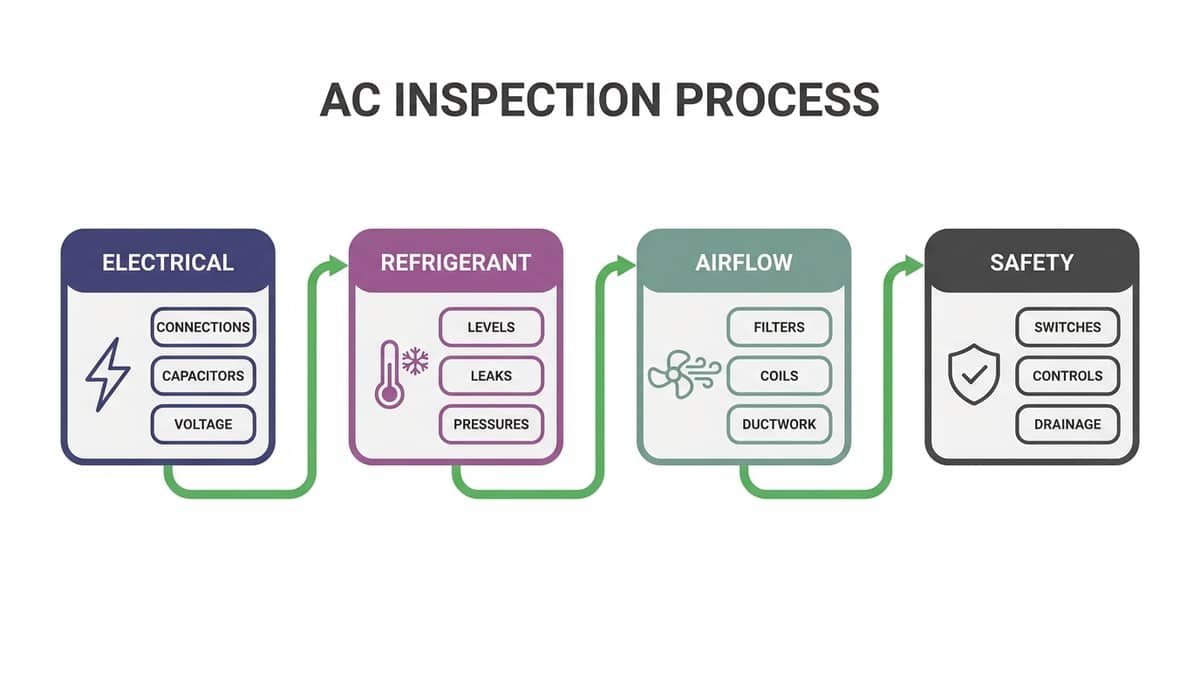
Seasonal tune-up checklist (50-point inspection breakdown)
A professional tune-up goes far beyond changing the filter. Here’s what federal facility HVAC maintenance schedules recommend for bi-annual inspections in extreme climates like Arizona:
Electrical system:
- Test capacitor voltage and microfarad ratings
- Inspect contactor condition and voltage drop
- Check wire connections for corrosion or looseness
- Measure amp draw on compressor and blower motor
- Test thermostat calibration and cycle timing
Refrigerant circuit:
- Check refrigerant charge using superheat/subcool method
- Inspect for leaks at connections and service valves
- Test high and low pressure readings against spec
- Verify proper liquid line temperature
Airflow and heat exchange:
- Clean evaporator and condenser coils (both indoor and outdoor)
- Inspect blower wheel and housing for dust buildup
- Measure static pressure across filter and coils
- Check duct connections for leaks
- Verify proper airflow CFM at registers
Drainage and condensate:
- Clear condensate drain line and pan
- Test drain float switch operation
- Inspect drain pan for rust or damage
Safety and controls:
- Test high-pressure cutout switch
- Verify proper compressor start sequence
- Check for proper belt tension (if applicable)
- Inspect outdoor unit for debris or damage
Seasonal HVAC Maintenance Spring Summer Fall Winter Checklist walks through timing considerations for each service.
Priority service and repair discounts explained
When your AC fails on a 110°F afternoon, you don’t want to join the three-day waiting list. Priority scheduling means plan members move to the front of the queue. During peak summer months (June through August), that difference can mean same-day service instead of waiting until Monday.
The repair discount structure varies by provider. Some offer flat-rate discounts on labor and parts. Others use tiered models where higher-level plans include larger discounts. A few providers waive diagnostic fees for members. How Often Should You Get Your Ac Serviced Maintenance Schedule Guide explains how frequent service affects long-term repair needs.
What’s NOT covered (and why that’s okay)
Maintenance plans cover preventive service and inspections. They don’t cover the cost of parts or major repairs. If your compressor fails, you still pay for the replacement compressor. If refrigerant needs to be added, you pay for the refrigerant. The plan gets you the discounted rate and priority service, but it’s not insurance against component failure.
This structure makes sense. A plan that covered all repairs would cost substantially more annually to account for the risk of major failures. The current model keeps costs reasonable while delivering the value that matters most: preventing failures through regular care and reducing costs when repairs are needed.
Full system replacement isn’t covered either. If your 18-year-old AC finally gives up, the plan doesn’t pay for a new installation. But the tune-up visits give you advance warning. No surprises, no emergency replacements in July when prices and wait times peak.
The Three Big Benefits: Comfort, Cost Savings, and Lifespan Extension
Three measurable outcomes justify maintenance plan benefits: lower energy bills, fewer emergency repairs, and longer system life. Each benefit compounds over time. A system that runs efficiently costs less to operate, breaks down less often, and lasts years longer than one that’s neglected.
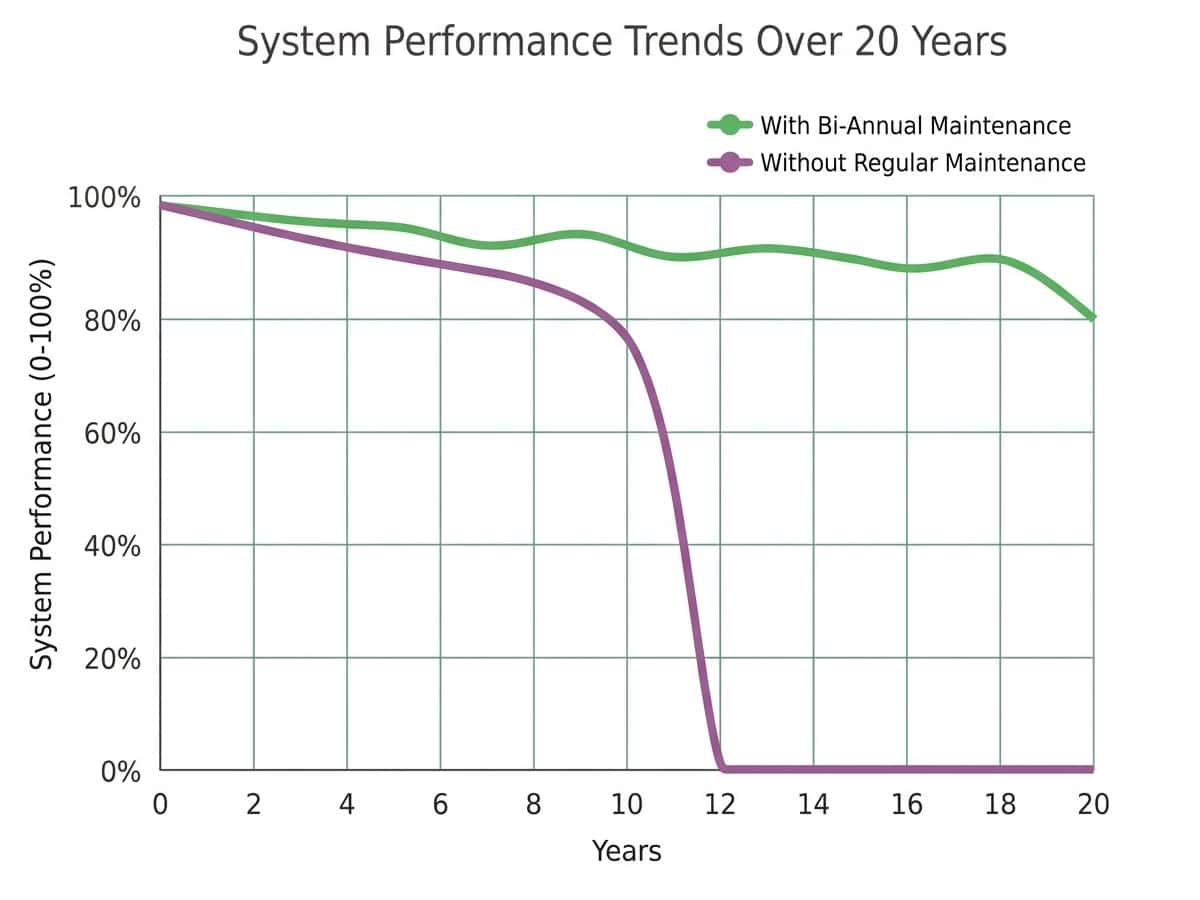
In our work with 3,000+ East Valley installs, we’ve seen systems with bi-annual maintenance last 15–20 years versus 10–12 years without regular care. That difference saves homeowners thousands in premature replacement costs. The math isn’t theoretical. It shows up in customer records, warranty claims, and replacement timelines.
Extending Your AC Life With Professional Maintenance Plans dives deeper into the lifespan connection, but the core principle is simple: equipment maintained within manufacturer specs operates closer to design life. Equipment that drifts out of spec fails earlier.
Lower energy bills through peak efficiency
When coils are clean, refrigerant charge is correct, and airflow is optimized, your AC delivers rated efficiency. When any of those factors degrade, efficiency drops. According to the U.S. Department of Energy, dirty filters can reduce an air conditioner’s efficiency by 5 to 15 percent. Additional factors like dirty coils, low refrigerant, and restricted airflow compound these losses.
For a typical 2,000-square-foot home in Gilbert with summer cooling costs around $200/month, efficiency losses translate directly to higher bills. Maintaining peak performance through regular professional service prevents this waste and keeps costs predictable across the cooling season.
Smart Heat Pump Maintenance For Energy Savings explains how the same principles apply to heat pump systems, which are gaining popularity in new East Valley construction.
Avoiding expensive emergency breakdowns
The NADCA study found that regular maintenance improved system reliability by catching small problems before they cascaded into failures. A loose electrical connection discovered during a tune-up takes five minutes to tighten. Left alone, it arcs, damages the contactor, and eventually takes out the compressor. A simple fix becomes an expensive repair.
Priority scheduling matters most when breakdowns happen. During a July heat wave, non-plan customers often wait 48–72 hours for service. Plan members get same-day or next-day slots. That’s the difference between one uncomfortable night and three days in a hotel.
Adding 5–10 years to your system’s lifespan
Industry data consistently shows that professionally maintained HVAC systems last significantly longer than neglected ones. The federal facility maintenance protocols referenced earlier cite lifespan extension as a primary justification for bi-annual service requirements in demanding climates.
The average AC replacement in the East Valley costs $5,000–$8,000 depending on size, efficiency rating, and installation complexity. Delaying that replacement by several years through proper maintenance delivers substantial long-term savings. The net present value calculation is straightforward: preventive AC care cost pays for itself many times over.
How to Evaluate a Maintenance Plan (What to Ask Before You Sign Up)
Not all AC maintenance plans East Valley companies offer deliver equal value. Some are genuinely designed to prevent failures and save money. Others exist primarily to lock customers into high-margin service contracts with hidden fees and aggressive upselling. Knowing what to ask (and what answers to watch for) protects you from the bad actors.
Use these questions as a framework when comparing providers:
- How many visits per year, and what’s included in each visit? (One visit is rarely enough for Arizona. Two is standard.)
- Is there a detailed inspection checklist I can see before I sign up? (If they won’t show you, they’re hiding something.)
- What’s the repair discount percentage, and does it apply to both parts and labor? (Some plans discount only labor, which is the smaller cost.)
- Can I cancel anytime, or am I locked in? (Annual contracts are fine. Multi-year locks are a red flag.)
- Who performs the actual work: the owner, licensed techs, or subcontractors? (Quality control matters.)
- What’s the guaranteed response time for priority service? (Vague promises mean nothing in July.)
- Are there any diagnostic fees, trip charges, or other add-ons? (Transparent pricing includes all costs upfront.)
Heating Maintenance & Tune-Up covers similar evaluation criteria for heating system plans, which some providers bundle with AC coverage for year-round value.
Annual vs. bi-annual plans (which makes sense for Arizona)
National HVAC providers often push annual plans (one tune-up per year, typically in spring). That schedule works in temperate climates where AC runs three months and heating runs four. In Arizona, your AC operates six to eight months under extreme load. One annual visit leaves your system unchecked through the entire cooling season.
Bi-annual plans (spring and fall service) align with Arizona realities. The spring visit prepares your system for summer. The fall visit catches problems that developed during heavy use and ensures your heating side is ready for winter. Federal facility standards specify bi-annual inspection frequencies for extreme climates precisely because equipment stress accelerates wear.
Red flags: vague pricing, no inspection checklist, upsell pressure
Walk away from providers who:
- Won’t give you a detailed inspection checklist before you sign up
- Quote prices “starting at” without specifying what’s included
- Pressure you to enroll during an emergency repair visit
- Bundle plan enrollment with equipment upgrades you didn’t request
- Require multi-year contracts with early termination penalties
- Use high-pressure sales tactics or limited-time-only offers
Legitimate providers publish their service checklist, quote flat annual fees, and let you decide without pressure. A Guide to the Essential AC Maintenance Checklist shows what a thorough inspection looks like. If a provider won’t match that level of detail, they’re not doing the work.
Questions to ask any HVAC company offering a plan
Beyond the seven questions listed above, ask these provider-specific items:
- How long have you been in business locally? (New franchises vanish. Established companies stick around.)
- Can I see reviews from other East Valley customers? (Google, BBB, and Yelp tell the real story.)
- Do you service all brands, or only equipment you installed? (Some providers refuse to touch competitors’ installs.)
- What happens if I move or sell my home? (Transferable plans add value. Non-transferable ones trap you.)
- Are your technicians licensed and background-checked? (Arizona requires licensing. Verify it.)
What JLM’s Maintenance Plan Covers (And Why We Built It This Way)
We designed our HVAC maintenance plan coverage around what actually prevents failures in the East Valley climate. No corporate upsell scripts. No franchise-mandated service limits. Just the inspections and service work that keep systems running through 110°F summers and deliver measurable savings on energy bills.
Our plan structure includes:
- Two comprehensive tune-ups per year (spring and fall)
- 50-point inspection covering electrical, refrigerant, airflow, drainage, and safety systems
- Priority scheduling with same-day availability for existing plan members
- Discount on repair labor and parts for members
- Direct access to Bill and the team (no call center, no phone trees)
- Written system health report after every visit with photos and recommendations
- 24/7 emergency line for after-hours breakdowns
We’re owner-led, not franchise-operated. Bill personally oversees service work and remains accessible to customers. No corporate layers. No high-pressure sales quotas. Our A+ BBB rating and track record with 3,000+ East Valley installations back up what we promise.
Spring and fall tune-up: what we check and why
Our 50-point inspection follows the manufacturer-recommended service intervals and federal facility maintenance protocols adapted for residential systems. Every check on the list serves a specific purpose: prevent a failure mode, maintain efficiency, or verify safe operation.
Spring tune-up (pre-summer preparation):
- Clean outdoor coil (removes dust from spring winds and prepares for summer heat)
- Test refrigerant charge and adjust if needed (prevents compressor damage from incorrect levels)
- Inspect electrical connections and measure voltage (catches loose wires before they arc)
- Verify proper airflow and static pressure (ensures system can handle peak cooling loads)
- Clear condensate drain (prevents overflow and water damage during high-humidity monsoon season)
Fall tune-up (post-summer assessment and heating prep):
- Inspect compressor for wear or damage from summer workload
- Check blower motor bearings and belt condition
- Test heating elements or heat exchanger (ensures winter readiness)
- Measure efficiency and compare to baseline (identifies degradation trends)
- Update system health report and recommend repairs if needed
HVAC Preventative Maintenance: Tips & Guide offers additional insights into the preventive care philosophy that guides our service approach.
Priority scheduling and repair discount structure
Plan members get first access to our daily schedule. During peak season (June through August), that typically means same-day service for breakdowns called in before noon. Non-members often wait 48–72 hours during heat waves because demand exceeds capacity.
Our member discount applies to both labor and parts for any repair needed outside the scheduled tune-ups. Over the life of your system, these savings add up to more than the annual plan cost.
Direct access to Bill and the team (no call center)
When you call JLM, you reach our local dispatch. Bill personally answers calls outside office hours for plan members with emergencies. No phone trees. No overseas call centers. No “your call is important to us” loops.
That direct access matters when you need answers fast. You’re not explaining your problem to three different people before someone qualified shows up. You talk to the person who will actually do the work or dispatch the tech who will.
When a Maintenance Plan Pays for Itself (Real-World Math)
The ROI calculation is straightforward. Compare the annual plan cost against the costs you avoid. Here’s a conservative estimate for a typical East Valley home:
Costs avoided through preventive care:
- One prevented emergency repair (averages in the hundreds)
- Efficiency savings on summer electric bill (maintaining peak performance)
- Avoided diagnostic fee for repair work (typically waived for members)
That’s a conservative estimate. If you avoid a major failure (compressor, condenser fan motor, full refrigerant recharge), the single-year savings increase substantially. Over a 10-year system lifespan, the compounding maintenance plan benefits (fewer repairs, lower energy costs, extended equipment life) deliver significant return on the plan investment.
The calculation shifts if you’re in a newer home with a system under manufacturer warranty. New equipment (less than 3 years old) rarely needs repairs, so the primary value is efficiency maintenance and warranty compliance. After year three, failure risk climbs every year, and the plan value increases accordingly.
Common Misconceptions About Maintenance Plans (What Homeowners Get Wrong)
“I can do this myself with a garden hose and a new filter.”
You can clean the outdoor coil with a hose and change the filter yourself. You can’t check refrigerant charge, test electrical connections under load, measure static pressure, calibrate the thermostat, or inspect the heat exchanger safely without training and tools. DIY maintenance handles surface-level cleaning. Professional service addresses the mechanical, electrical, and refrigerant systems that actually cause failures.
“Maintenance plans are just upsell schemes.”
Some are. That’s why the evaluation framework in the previous section matters. Legitimate plans exist to prevent failures and retain long-term customers through value delivery. Shady plans exist to create upsell opportunities. The difference shows in the pricing transparency, inspection detail, and customer reviews.
“My system is new, so I don’t need a plan yet.”
New systems need maintenance to stay within manufacturer warranty requirements. Most warranties require annual professional service. Skipping it voids coverage. Even if your system is reliable (and most are for the first 3–5 years), the tune-ups establish a baseline for future comparison and catch installation defects before they cause damage.
“All plans are the same; I should just pick the cheapest one.”
AC maintenance plans East Valley providers offer vary dramatically in service frequency, inspection thoroughness, response time guarantees, and provider quality. The cheapest plan often delivers the least value. Compare what’s included, who performs the work, and what existing customers report. A lower-cost annual plan that sends unlicensed techs who skip half the checklist costs more in the long run than a comprehensive plan that prevents failures.
Smart Boiler Maintenance Tips: Easy Guide demonstrates the same principle for boiler systems: comprehensive professional care beats cheap shortcuts every time.
How to Get Started (And What Happens Next)
Enrolling in a maintenance plan takes one phone call. Here’s the process:
- Call for a free consultation. We’ll ask about your system age, brand, and any current performance concerns.
- Schedule a system assessment. We’ll inspect your equipment and identify any immediate needs.
- Review plan options. We’ll explain what’s included, show you the inspection checklist, and answer questions.
- Select your plan and schedule the first tune-up. Most customers choose bi-annual service. We’ll lock in your spring and fall visit dates.
- Receive your member card and priority service access. You’re enrolled. The next time you need service, you move to the front of the line.
We don’t pressure. We don’t upsell. We explain what your system needs, what’s optional, and what can wait. You decide whether the plan fits your budget and priorities. Our job is to deliver honest information and quality service. Your job is to choose what makes sense for your home.
For more information about our complete range of AC maintenance plans East Valley services and how they protect your investment, explore our comprehensive AC maintenance resources or read our guide on preventive HVAC maintenance best practices. Our seasonal maintenance checklist provides detailed timing guidance, while our AC service frequency guide helps you understand optimal service intervals for Arizona conditions.
Ready to protect your comfort and save on cooling costs?
Call now: 602-619-3609 to schedule your free consultation and learn how JLM’s maintenance plan keeps your East Valley home cool all year.
By JLM