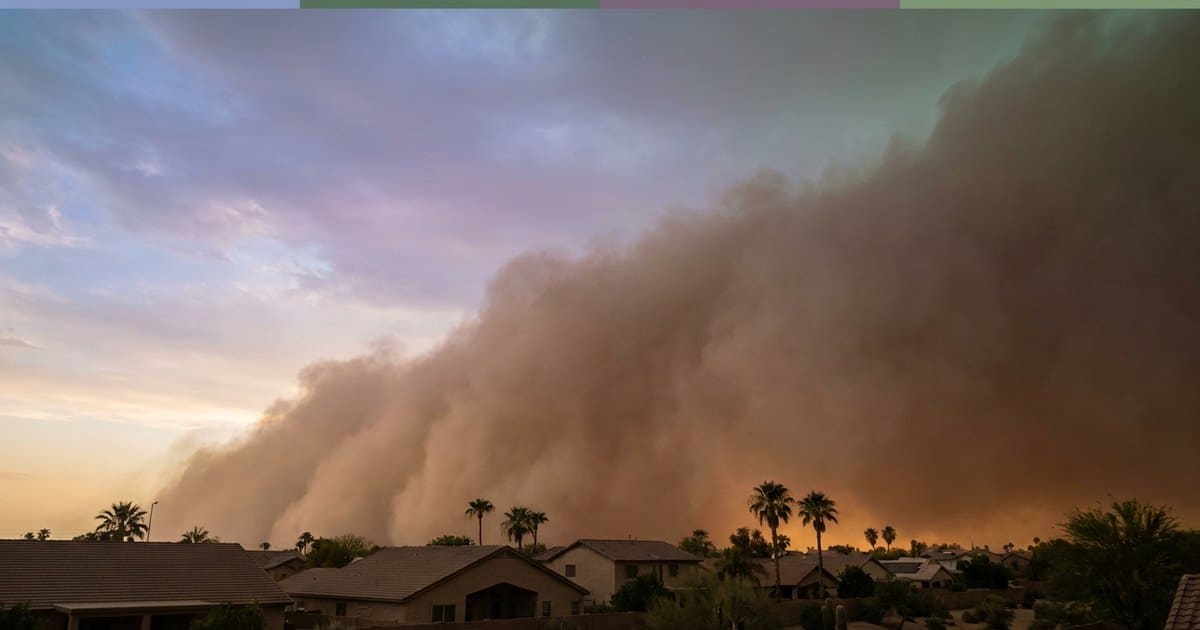
Arizona summers hit 110°F for weeks straight. Your AC runs nonstop. Winter nights drop to freezing, and your furnace kicks on every evening. This constant seasonal load stresses your HVAC system harder than equipment in moderate climates. Skip maintenance, and you’re gambling on a mid-July breakdown when every technician in the East Valley is booked solid. Proactive seasonal care prevents these emergencies and keeps your system running efficiently year-round. Understanding why summer in Mesa demands fast AC repair illustrates how preventive steps protect you from emergency situations.
What is seasonal HVAC maintenance? Seasonal HVAC maintenance is a year-round inspection and tune-up schedule that keeps your air conditioner and furnace running efficiently, prevents unexpected breakdowns, and extends equipment life. It includes filter replacement, coil cleaning, refrigerant checks, electrical diagnostics, and blower calibration: tasks split between simple DIY steps and professional technician service performed before each cooling and heating season.
Here’s what to check in each season to keep your system running strong and avoid emergency repair bills. This guide walks through the exact tasks homeowners can handle themselves and the critical tune-ups that require a trained technician. Follow this checklist, and you’ll protect your comfort, lower your energy bills, and get years more reliable performance from your equipment.
Why Seasonal HVAC Maintenance Matters in Arizona
Arizona’s extreme seasonal swings stress HVAC systems harder than equipment in moderate climates. Your air conditioner runs continuously through 110°F summer days, often logging 3,000+ hours of operation between May and September. Your furnace cycles nightly through winter months when overnight temperatures drop to freezing. This constant load accelerates wear on every component: compressors, blowers, heat exchangers, electrical connections, and refrigerant lines.
Skipping maintenance carries real costs. Dirty filters and clogged coils force your system to work harder, which drives up energy bills by 15 to 20 percent according to Energy.gov data on cooling efficiency. Neglected systems fail years earlier than maintained equipment, and emergency repairs during peak season (when demand is highest and availability is lowest) cost significantly more than preventive tune-ups. ACEEE research on residential HVAC shows that systems receiving biannual professional maintenance consistently run more efficiently and generate fewer emergency service calls than equipment serviced only when problems arise.
JLM Air Conditioning & Heating has completed over 3,000 installations and hundreds of seasonal tune-ups across Gilbert, Queen Creek, Mesa, and Apache Junction. In our East Valley work, we’ve observed that systems receiving biannual professional maintenance (spring before cooling season, fall before heating season) consistently run 15 to 20 percent more efficiently than neglected systems. We also see significantly fewer emergency calls from maintenance plan members during peak summer months. The stakes are simple: preventive care protects your investment, keeps your family comfortable, and saves money compared to reactive emergency repairs.
Regular maintenance isn’t busywork or an upsell. It’s the difference between reliable performance and a system that fails when you need it most. Arizona’s climate makes seasonal maintenance a necessity, not an option.
Spring HVAC Maintenance Checklist (Before Cooling Season)
Spring maintenance prepares your air conditioner for Arizona’s brutal summer heat. Complete these tasks in March or April, before temperatures climb above 100°F and technician availability drops. The checklist splits into two categories: DIY tasks you can handle yourself and professional tune-up work that requires specialized training and equipment. Learn more about the smart way to prep AC for Gilbert’s hot summer for additional preparation strategies.
DIY Tasks You Can Handle
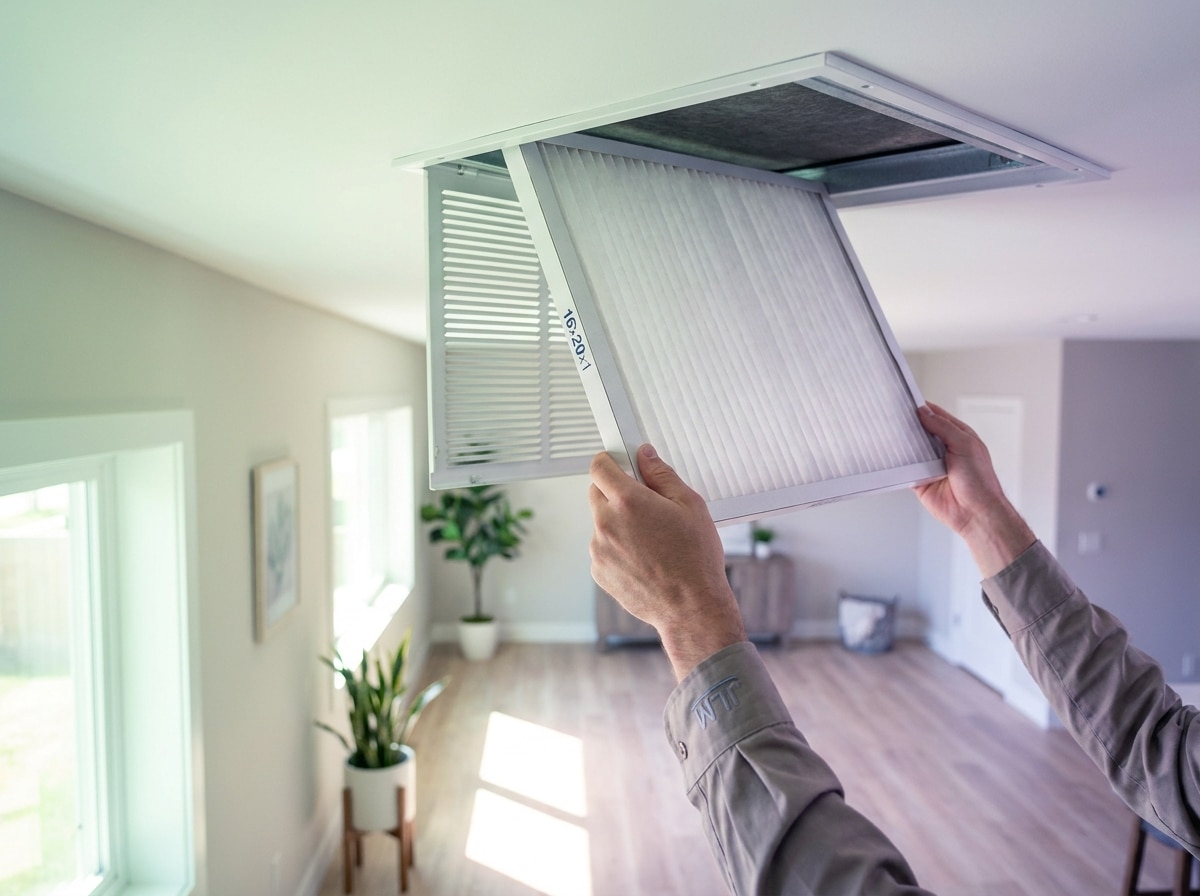
Replace your air filter first. Arizona’s desert dust clogs filters faster than humid climates. A standard filter lasts 30 to 90 days in moderate conditions, but Arizona’s dust load often requires monthly replacement during heavy-use months. Pull out the old filter, note the size printed on the frame, and install a new filter with the airflow arrow pointing toward the blower. Safe filter replacement means ensuring the filter fits snugly in the slot with no gaps that allow unfiltered air to bypass.
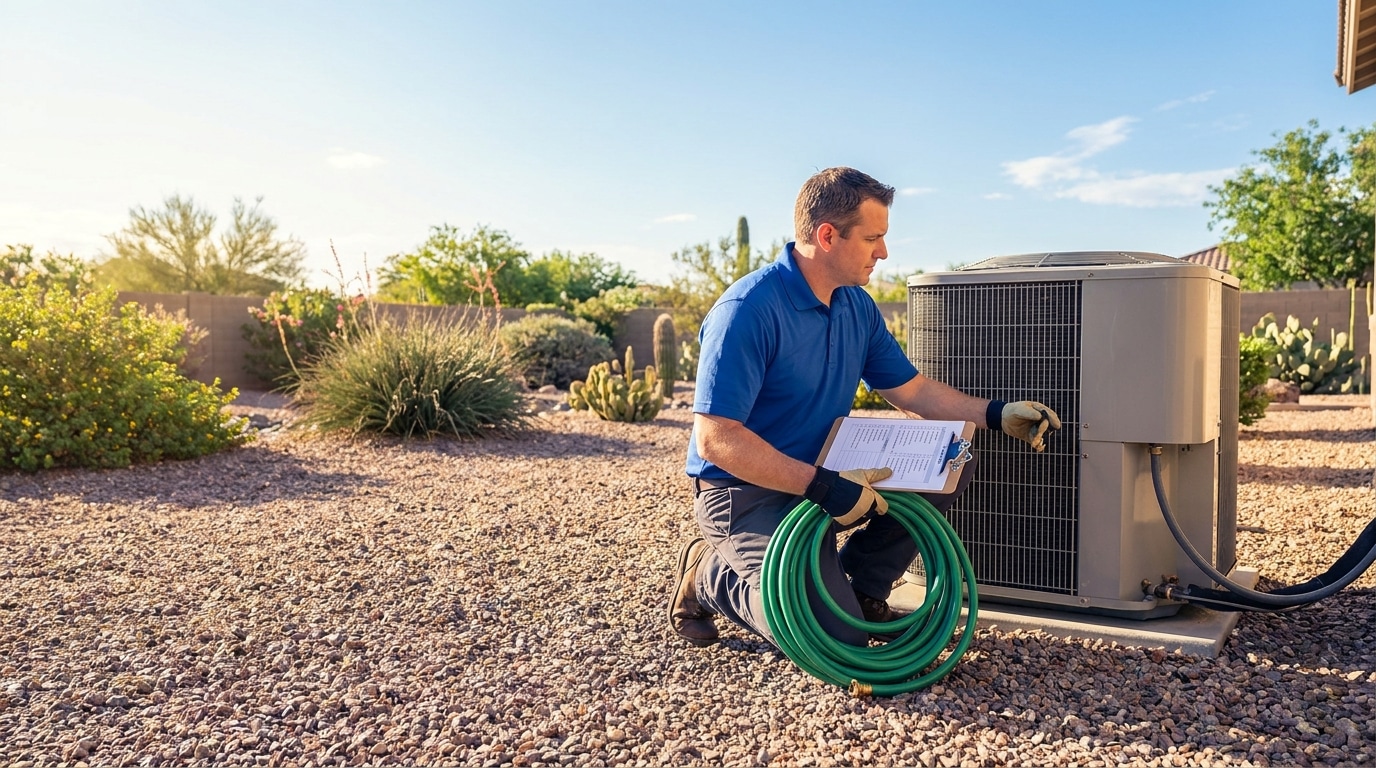
Clear debris from your outdoor condenser unit next. Turn off power at the disconnect box, then remove leaves, dust, landscaping clippings, and any overgrowth within two feet of the unit. Use a garden hose to gently rinse the condenser coils from inside out (spray from the interior toward the exterior fins). Don’t use a pressure washer, which can bend the delicate aluminum fins.
Test your thermostat for accurate temperature reading and responsive mode switching. Set the thermostat to cooling mode, lower the target temperature below current room temp, and listen for the system to start. If the thermostat display is dim or unresponsive, replace the batteries. Check that vents throughout your home are open and unobstructed by furniture or rugs.
Visual inspection catches obvious problems before they escalate. Look for ice buildup on refrigerant lines (indicates airflow restriction or low refrigerant), listen for unusual noises (grinding, squealing, or banging), and check the condensate drain pan for standing water or mold growth. Any of these symptoms means you need a technician before running the system heavily.
Professional Tune-Up Tasks (Schedule Before May)
Refrigerant level checks and leak tests require EPA certification and specialized gauges. Low refrigerant reduces cooling capacity, forces your compressor to work harder, and eventually causes expensive compressor failure. A technician measures refrigerant pressure, compares it to manufacturer specs, and tests connections for leaks using electronic detectors or soap solution.
Electrical connection inspection prevents mid-summer failures. Heat and vibration loosen wire connections over time. A technician inspects all electrical terminals, tightens connections, measures voltage and amperage at the compressor and blower, and tests capacitors (the components that start motors and keep them running). Failing capacitors are the number one cause of summer AC breakdowns we respond to in Gilbert and Queen Creek.
Condensate drain cleaning prevents water damage and system shutdowns. Your AC removes humidity from indoor air, and that moisture drains through a small pipe. Desert dust, algae, and debris clog the drain over time. A technician flushes the drain line, clears the trap, and tests flow to ensure water exits properly. Clogged drains cause the safety float switch to shut down your system, leaving you without cooling until the blockage is cleared.
Blower motor and belt inspection ensures efficient airflow. The blower moves conditioned air through your ducts. A technician inspects the motor bearings, checks belt tension and wear (on belt-driven units), measures airflow at registers, and adjusts fan speed if needed. Poor airflow reduces comfort and wastes energy even when the compressor runs perfectly.
Coil cleaning improves heat transfer efficiency. Both the evaporator coil (inside) and condenser coil (outside) accumulate dust and grime that insulates the metal and blocks heat exchange. Professional coil cleaning uses specialized brushes and coil cleaner to remove buildup without damaging fins. Clean coils mean your system cools faster and uses less electricity.
System performance testing under load verifies everything works correctly. A technician runs your AC through a full cooling cycle, measures temperature drop across the coils, checks airflow at multiple vents, and monitors electrical draw. This catches problems that only appear when the system operates under real-world conditions.
Spring tune-ups prevent the majority of summer breakdowns we respond to in the East Valley. Scheduling before the heat hits means you get priority availability and avoid the mid-June rush when everyone’s AC fails at once.
Summer HVAC Maintenance: What to Monitor During Peak Season
Summer is not the time for major tune-ups (you should have completed that in spring). It is the time to monitor performance and catch small issues before they become emergency repairs. Peak cooling season puts maximum stress on your equipment, and small problems escalate quickly when your AC runs 12 hours or more daily.
Check your air filter every 30 days during heavy-use months. Arizona dust combined with constant blower operation clogs filters faster in summer than any other season. A clogged filter restricts airflow, which reduces cooling capacity, forces your blower to work harder, and can freeze your evaporator coil. Mark your calendar for monthly filter checks from May through September. If you have pets, allergies, or run your system constantly, check every two weeks.
Monitor airflow at your vents weekly. Weak airflow from registers means your system is struggling. Causes include clogged filters, failing blower motors, duct leaks, or refrigerant issues. If airflow drops noticeably, check your filter first. If the filter is clean and airflow is still weak, call a technician before the problem escalates.
Listen for unusual noises every time your system cycles. Grinding, squealing, or banging sounds indicate mechanical problems: failing bearings, loose blower wheels, or debris in the fan. Catching these early prevents catastrophic failures that leave you without cooling when temperatures peak.
Watch for ice buildup on refrigerant lines or the outdoor unit. Ice means your system has an airflow restriction (clogged filter, blocked coils, failing blower) or low refrigerant. Either way, continuing to run the system risks compressor damage. Turn off your AC, let the ice melt completely, and call a technician before restarting.
Pay attention to thermostat behavior and cooling performance. If your system runs constantly but never reaches the set temperature, or if it short-cycles (turns on and off every few minutes), you have a problem. Common causes include refrigerant leaks, failing compressors, oversized or undersized equipment, or thermostat calibration issues.
Monitor your energy bills for unexpected spikes. A sudden 20 to 30 percent increase in electricity cost (compared to the same month last year) signals inefficiency. Dirty coils, low refrigerant, failing motors, or duct leaks force your system to use more power while delivering less cooling. According to Energy.gov, poorly maintained systems can increase cooling costs by 15 to 30 percent compared to well-maintained equipment.
Summer maintenance is mostly vigilance and quick filter swaps. The heavy lifting happened in spring. Your job now is to catch problems early, keep filters clean, and call a technician before a small issue becomes an expensive emergency.
Fall HVAC Maintenance Checklist (Before Heating Season)
Fall maintenance prepares your furnace for Arizona’s winter heating season. While our winters are milder than northern climates, furnaces still run nightly November through February when overnight temperatures drop to freezing. A breakdown during a 35°F morning is miserable, and mid-winter repairs cost more than preventive fall tune-ups. Complete these tasks in October or early November before you need heat.
DIY Fall Tasks
Replace your air filter after the heavy summer dust accumulation. Even if you swapped filters regularly through cooling season, post-summer buildup justifies a fresh start before heating season. The same filter serves both your AC and furnace, so a clean filter in October means better furnace performance all winter.
Test your furnace before you need it. Switch your thermostat to heat mode, raise the target temperature above current room temp, and confirm warm air flows from your vents within a few minutes. Listen for smooth ignition and consistent blower operation. A musty odor when the furnace first fires is normal (dust burning off heat exchangers), but a gas smell is an emergency. If you smell gas, turn off the furnace at the breaker, open windows, leave the house, and call your utility company and a technician immediately.
Inspect vents and registers for blockages. Summer furniture rearrangement or seasonal decor often blocks heating vents. Walk through your home and ensure every register is open and unobstructed by rugs, furniture, or storage boxes. Blocked vents waste energy and create uneven heating.
Check your thermostat batteries if your unit uses them. Many thermostats die mid-winter because batteries fail in cold temperatures. Replace batteries annually in fall even if the display still works. Test the thermostat’s heat mode to confirm it triggers the furnace correctly.
Professional Fall Tune-Up Tasks
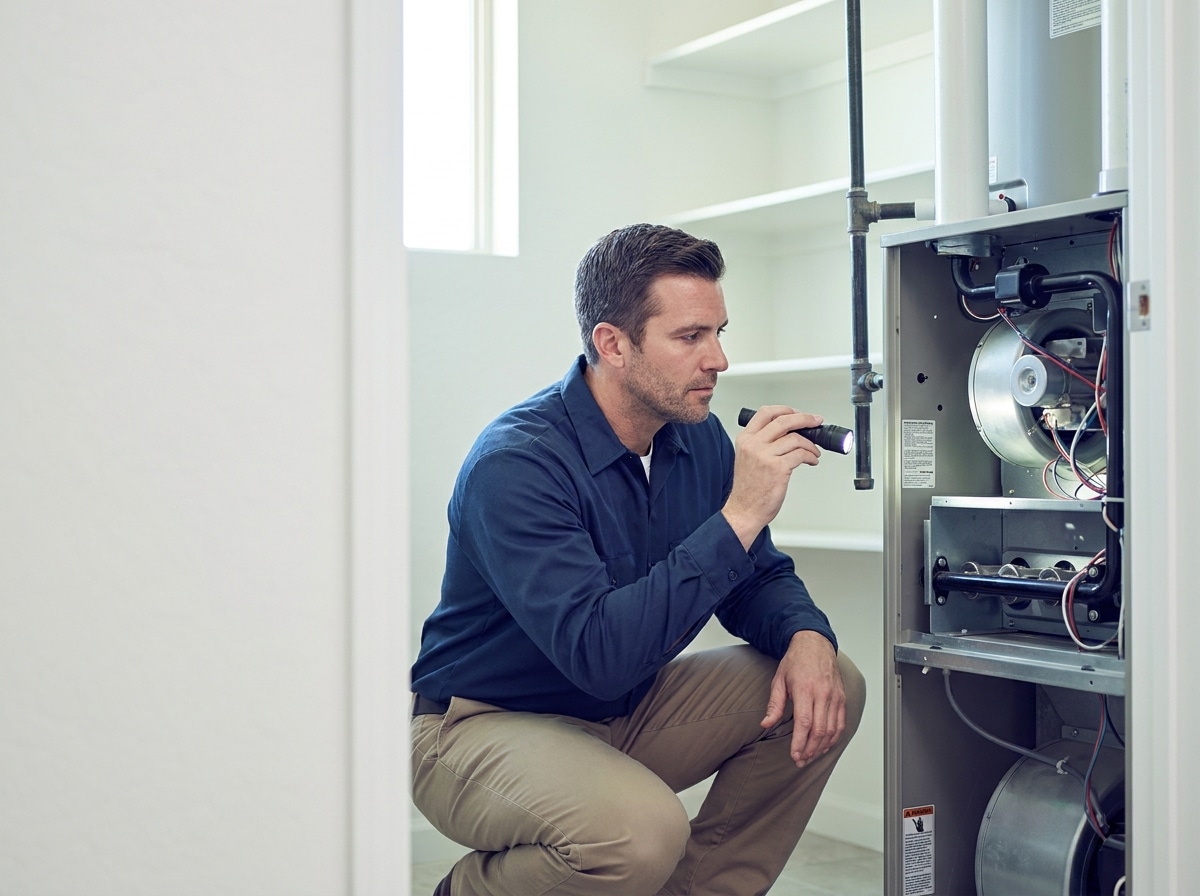
Heat exchanger inspection is the most critical fall maintenance task. Your heat exchanger transfers heat from burning gas to the air that circulates through your home, while keeping combustion gases isolated in the exhaust path. Cracks in the heat exchanger allow carbon monoxide to leak into your home’s air supply, which is deadly. ASHRAE furnace maintenance standards require annual heat exchanger inspection. A technician uses cameras, mirrors, and combustion analyzers to detect cracks or corrosion that aren’t visible from outside the furnace.
Burner cleaning and flame sensor calibration ensure efficient, reliable ignition. Dust and oxidation on burners create uneven flames, incomplete combustion, and higher gas bills. A technician removes burners, cleans them with a wire brush, inspects the flame sensor, and tests flame quality. Properly calibrated burners produce steady blue flames and complete combustion with minimal waste.
Ignition system testing verifies reliable startup. Modern furnaces use electronic ignition (hot surface igniters or spark igniters), while older models use standing pilot lights. A technician tests the ignition sequence, measures electrical resistance across igniter elements, and confirms the system lights within the manufacturer’s specified time. Failing igniters cause no-heat emergencies and require replacement before winter.
Blower motor and belt checks ensure consistent airflow. The same blower that moves cool air in summer moves warm air in winter. A technician inspects motor bearings, checks belt tension and wear on belt-driven units, measures amp draw, and adjusts fan speed for heating mode if needed. Blower failures are inconvenient in summer but dangerous in winter (your furnace can overheat and shut down if airflow stops).
Airflow and duct inspection detects leaks that waste energy. Duct leaks are harder to spot in fall than spring (you can’t feel hot air escaping from ducts in your attic when it’s 70°F outside), but they waste just as much energy. A technician inspects accessible ductwork, seals visible leaks, and measures airflow at registers to confirm balanced distribution.
Carbon monoxide testing is non-negotiable for gas furnaces. A technician uses a combustion analyzer to measure CO levels in exhaust gases and tests for CO leaks in living spaces. Even trace amounts of carbon monoxide are dangerous. Annual CO testing protects your family’s safety and ensures your furnace vents properly.
Fall tune-ups are less urgent in Arizona than spring AC prep, but skipping them leads to mid-winter failures that are harder to diagnose and more expensive to repair. A November inspection means your system is ready before the first freeze, and you avoid the holiday-week service rush when technicians are booked solid. If you need guidance on whether to handle repairs yourself, read do you really need professional AC repair in Mesa for insights that apply to both cooling and heating seasons.
Winter Monitoring: What to Watch When Your Furnace Runs
Winter maintenance is mostly passive monitoring, similar to summer AC vigilance. Your furnace shouldn’t require major service if you completed fall tune-ups, but problems occasionally surface mid-season. Here’s what to watch from November through February.
Check your filter monthly even in winter. Furnace blowers move the same volume of air as AC blowers, so filters still accumulate dust. A clogged filter in winter restricts airflow, which can overheat your furnace and trigger safety shutdowns. Monthly filter checks prevent forced-air failures and keep your heating efficient.
Listen for unusual noises every time your furnace cycles. Banging at startup often indicates delayed ignition (gas builds up before igniting, causing a small explosion). Squealing or screeching suggests blower motor bearing failure. Rumbling after burners shut off can mean a cracked heat exchanger (the rumbling is air moving through cracks). Any persistent unusual noise warrants a technician visit before the problem escalates.
Monitor thermostat accuracy and heating performance. If some rooms stay cold while others overheat, you likely have duct leaks, blocked vents, or an undersized return. If your furnace runs constantly but never reaches the set temperature, check your filter first, then call a technician to diagnose airflow, ignition, or heat exchanger issues.
Watch for uneven heating across your home. Consistent temperature differences (master bedroom always 5° colder than living room) indicate duct design problems or zoning issues that maintenance can’t fix, but sudden changes in heating patterns suggest new problems: blocked vents, failing blower, or duct leaks that developed over summer.
Pay attention to odors when your furnace runs. A musty smell when the furnace first fires in fall is normal (dust burning off). A persistent burning smell, electrical odor, or gas smell is not normal. Turn off your furnace and call a technician immediately if you smell gas or burning plastic. These are safety issues, not maintenance concerns.
Check pilot lights on older furnaces weekly if your system uses a standing pilot. The flame should be steady and blue. A yellow or flickering flame indicates incomplete combustion or a dirty burner, which produces carbon monoxide. If your pilot light repeatedly goes out, you have a thermocouple problem or gas supply issue that requires professional repair.
Mid-season furnace failures are less common than summer AC breakdowns, but they’re more uncomfortable (35°F mornings without heat are brutal) and often tied to safety concerns (carbon monoxide, gas leaks). Catching problems early protects your family and prevents damage to your furnace.
DIY Maintenance vs. Professional Service: What’s Worth Your Time
Homeowners often wonder which maintenance tasks they can handle themselves and which require a technician. The answer comes down to three factors: safety, specialized equipment, and complexity. Some tasks are genuinely DIY-friendly and save money. Others require EPA certification, specialized tools, or safety training. Attempting them yourself risks equipment damage, voided warranties, or safety hazards.
You can safely handle filter replacement, outdoor unit cleaning, thermostat testing, and visual inspections. These tasks require no special tools beyond a garden hose and a screwdriver. They also deliver real value: clean filters improve efficiency and airflow, debris-free outdoor units cool better, and catching obvious problems (ice, leaks, unusual noises) early prevents expensive failures. Monthly filter swaps and seasonal outdoor unit cleaning are high-ROI tasks that keep your system healthier between professional tune-ups.
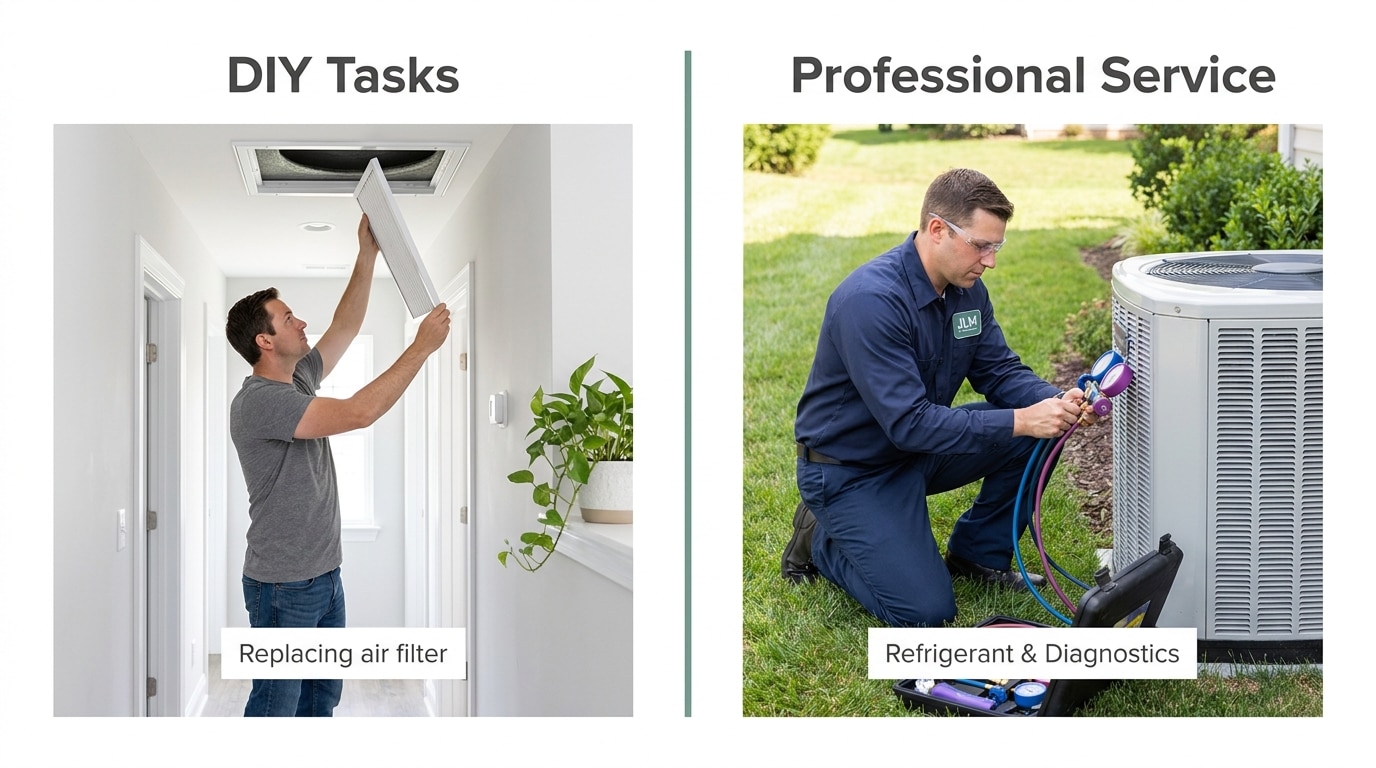
Professional service is non-negotiable for refrigerant handling, electrical diagnostics, heat exchanger inspection, and blower calibration. According to ACCA filtration standards, refrigerant work requires EPA Section 608 certification because improper handling damages the environment and your equipment. Refrigerant leaks aren’t obvious without electronic detectors and pressure gauges. Adding refrigerant without finding and fixing the leak wastes money and leaves you with the same problem weeks later. Technicians have the gauges, certification, and training to measure refrigerant accurately, detect leaks, and recharge systems correctly.
Electrical diagnostics require multimeters, amp clamps, and knowledge of HVAC electrical systems. Testing capacitors, contactors, and compressor windings involves working with high voltage. A mistake can destroy components, injure you, or create fire hazards. Technicians are trained to work safely with electrical systems, interpret voltage and amperage readings, and diagnose failures without causing secondary damage.
Heat exchanger inspection requires cameras, mirrors, and combustion analyzers to detect cracks that leak carbon monoxide. Visual inspection from outside the furnace misses most cracks. This isn’t a DIY task; it’s a life-safety inspection that prevents poisoning. Annual heat exchanger inspection is the reason you hire a technician for fall furnace tune-ups, not something you can replicate with a flashlight and good intentions.
Blower calibration and airflow balancing require airflow measurement tools (manometers, anemometers) and knowledge of duct design. Adjusting blower speed without measuring airflow can reduce efficiency, create comfort problems, or damage your system by starving it of air or overworking the motor. Technicians measure airflow at multiple points, calculate total CFM, compare it to equipment specs, and adjust fan speed to match your home’s actual needs.
The line between DIY and professional service is clear: if a task requires specialized tools, EPA certification, or carries safety risks (refrigerant, high voltage, carbon monoxide), hire a technician. If the task is simple, safe, and uses household tools, handle it yourself. Doing your part (filters, cleaning, monitoring) keeps your system healthy between professional tune-ups and demonstrates to your technician that you care about your equipment. According to filter maintenance best practices, regular filter replacement is the single highest-ROI task homeowners can perform, preventing the majority of airflow and indoor air quality problems we diagnose in service calls.
Professional tune-ups twice a year handle the tasks that prevent expensive failures: refrigerant checks, electrical diagnostics, component inspections, and safety testing. That’s where the real breakdown prevention happens. Your job is the maintenance between those visits: filters, cleaning, and catching problems early so your technician can fix them before they escalate.
How Maintenance Plans Work (and Whether You Need One)
Maintenance plans are structured service agreements that deliver biannual professional tune-ups, priority scheduling, and often discounts on repairs. The question isn’t whether maintenance is valuable (it is), but whether a plan delivers better value than scheduling tune-ups individually.
Here’s what’s typically included in an HVAC maintenance plan: two tune-ups per year (spring AC service, fall furnace service), priority scheduling when you need emergency repairs, discounts on repair labor or parts (usually 10 to 20 percent off standard rates), and sometimes perks like extended warranties or free filter replacements. The exact inclusions vary by company, so read the terms before signing.
The ROI comes from three sources. First, biannual tune-ups catch problems early when repairs are cheap (a $150 capacitor replacement beats a $2,500 compressor failure). Second, priority scheduling means you jump the queue during peak-season emergencies when everyone else waits days for service. Third, repair discounts add up over the life of your system, especially as equipment ages and requires more frequent service.
We offer maintenance plans because we see the data: customers who schedule biannual service have dramatically fewer emergency calls and get three to five more years of reliable performance from their equipment. It’s not a profit center for us; it’s a proven way to protect your investment and avoid the stress of mid-summer breakdowns when every technician in the East Valley is booked solid. ASHRAE research on preventive maintenance confirms that scheduled service intervals extend equipment life and reduce total cost of ownership compared to reactive repair-only approaches.
Do you need a maintenance plan? If you’re diligent about scheduling spring and fall tune-ups on your own, and you’re comfortable calling for service each time, you can skip the plan and book individual visits. You’ll pay slightly more per visit (no plan discount), and you won’t get priority scheduling, but you’ll still get the core benefit: professional inspection and tune-up twice a year. If you’re considering whether to schedule spring tune-ups early, planning ahead makes a significant difference in availability and cost.
A plan makes sense if you want scheduling convenience (we call you when it’s time for service), cost predictability (fixed annual cost vs. variable per-visit charges), and priority access during emergencies. It’s also smart if your equipment is aging (10 years or older) and you want to maximize its remaining lifespan. Plans ensure you don’t forget or procrastinate on seasonal tune-ups, which is the number one reason systems fail prematurely.
The skepticism about maintenance plans usually centers on fear of upsells or unnecessary services. Legitimate plans focus on preventive inspections and tune-ups, not pushing replacements you don’t need. At JLM, we tell you what’s needed and what’s optional. If your system is running well, we’ll say so. If we find a problem, we’ll explain what’s broken, why it matters, and what happens if you delay the repair. You decide. No pressure, no fear tactics. Our plans are structured around actual system needs based on your equipment age, usage patterns, and Arizona’s climate demands, not corporate sales quotas.
Seasonal HVAC Maintenance FAQs
How often should I change my HVAC filter in Arizona? Check your filter monthly during heavy-use months (May through September for AC, November through February for heating). Replace it when it looks dirty or every 30 to 60 days, whichever comes first. Arizona’s desert dust clogs filters faster than humid climates. Homes with pets, allergies, or constant system operation may need filter changes every two to four weeks during peak season.
What’s the difference between a tune-up and a repair? A tune-up is preventive maintenance: inspection, cleaning, testing, and calibration performed when your system works correctly. The goal is to catch small issues before they become failures. A repair fixes a broken component after your system stops working or performs poorly. Tune-ups are scheduled; repairs are reactive. Regular tune-ups reduce the frequency and cost of repairs by preventing most failures.
Can I skip fall furnace maintenance if I had a spring AC tune-up? No. Spring AC tune-ups inspect cooling-specific components: refrigerant, condenser, evaporator. Fall furnace tune-ups inspect heating-specific components: heat exchanger, burners, ignition, combustion. Many components serve both systems (blower, filter, ducts), but the safety-critical heating components (heat exchanger, carbon monoxide testing) are only checked in fall. Skipping fall service leaves you vulnerable to mid-winter breakdowns and safety hazards like CO leaks.
How much does a seasonal HVAC tune-up cost? Individual tune-ups typically cost $100 to $200 depending on system type and included services. Maintenance plans (two tune-ups per year plus perks) usually run $200 to $400 annually. The investment pays for itself by preventing emergency repairs that cost $300 to $2,500 depending on the failed component. Energy Star data shows that well-maintained systems also use 10 to 15 percent less energy, which lowers monthly utility bills enough to offset tune-up costs within a year or two.
What happens if I skip maintenance for a year or two? Your system will likely still run, but efficiency drops, breakdowns become more frequent, and component life shortens. Skipping maintenance for one to two years typically results in: dirty coils that reduce cooling capacity by 10 to 20 percent, clogged filters that restrict airflow and freeze evaporator coils, undetected refrigerant leaks that damage compressors, loose electrical connections that fail under load, and undiagnosed heat exchanger cracks that leak carbon monoxide. Most emergency repairs we perform trace back to deferred or skipped maintenance. Catching up with a comprehensive tune-up after a gap restores performance, but you can’t recover the wasted energy or the shortened equipment life that occurred during the neglect period.
Protect Your Comfort with Year-Round Maintenance
Seasonal HVAC maintenance isn’t a mystery or a burden. It’s a simple, structured plan that protects your investment, keeps your family comfortable, and prevents expensive breakdowns when you can least afford them. Arizona’s extreme climate makes maintenance a necessity, not an option. Follow this four-season checklist, handle the DIY tasks you’re comfortable with, and schedule professional tune-ups before each cooling and heating season. The ROI is clear: lower energy bills, fewer emergency repairs, longer equipment life, and peace of mind knowing your system won’t fail when temperatures spike to 110°F or drop to freezing.
You now have a clear roadmap: spring AC prep in March or April, summer monitoring for filter changes and warning signs, fall furnace inspection in October or November, and winter vigilance for safety and performance. Some tasks are genuinely homeowner-friendly (filters, cleaning, monitoring), and others require the specialized training and equipment that only a licensed technician brings (refrigerant checks, electrical diagnostics, heat exchanger inspection). Know the difference, respect the line, and you’ll maximize your system’s performance while minimizing risk. For specialized solutions in smaller spaces, consider reading about garage AC options that don’t overwhelm small spaces or explore how mini split installation works for zone-specific control.
Whether you need a spring AC tune-up, a fall furnace inspection, or a full-year maintenance plan, JLM Air Conditioning & Heating delivers transparent service from a family-owned team that lives and works in the East Valley. We’ve completed over 3,000 installations and hundreds of seasonal tune-ups for neighbors like you across Gilbert, Queen Creek, Mesa, and Apache Junction. We tell you what’s needed and what’s optional. No pressure, no upsells, no corporate quotas. Just honest advice and quality work from an owner-on-the-job who stakes his reputation on every service call. To explore more information about broader system topics, visit our HVAC System resources or browse Air Conditioning articles for cooling-specific guidance.
Call today to schedule your seasonal maintenance and keep your system running strong. Protect your comfort and your budget before the next season hits. For more information about our services, visit our Air Conditioning Maintenance page or explore East Valley HVAC Services. You can also learn more about preparing for seasonal challenges in our guides on how to prep your AC for Gilbert’s hot summer and mini split installation options. For ongoing tips and updates about HVAC care in Arizona, check out our HVAC Tips & Updates blog. If you’re facing an emergency during peak summer heat, our fast AC repair services are available when you need them most.