
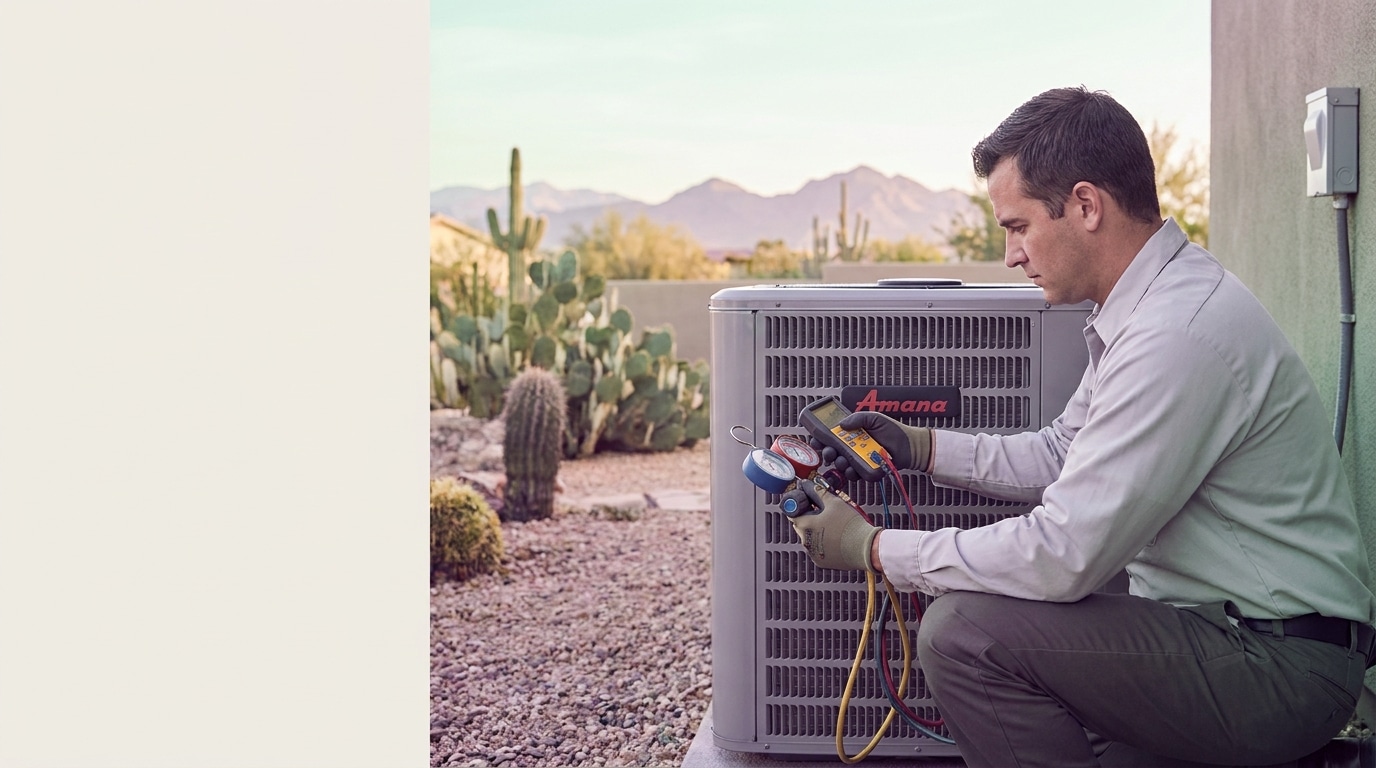
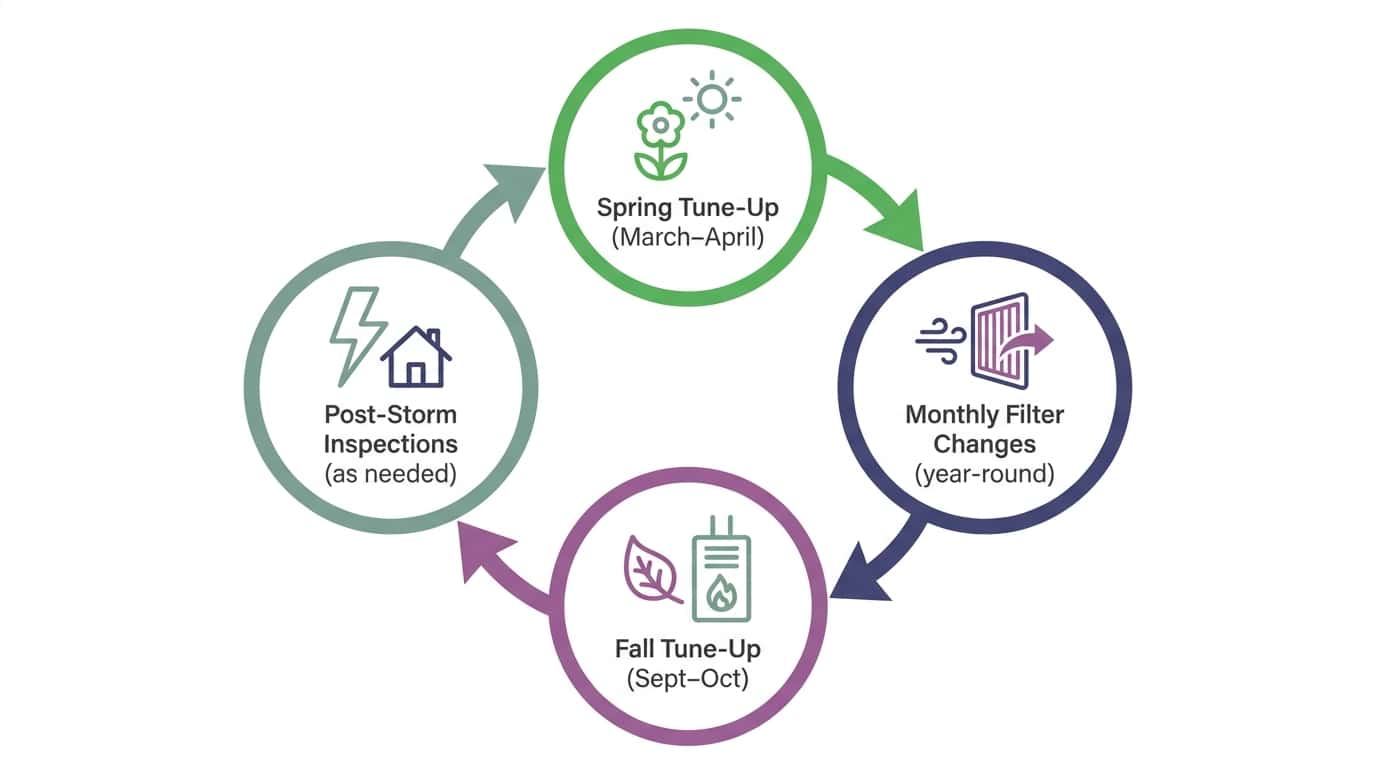
Most HVAC systems need professional servicing twice a year: once in spring before cooling season and once in fall before heating season. In Arizona’s extreme desert climate, you should also change your air filter every 30–60 days and schedule additional inspections if your system runs year-round. Preventive maintenance catches small issues before they become expensive emergency repairs and extends equipment lifespan by 40% or more.
When temperatures hit 115°F in the East Valley, your AC isn’t optional. It’s life-sustaining equipment. Yet most homeowners don’t think about their HVAC system until it stops working on the hottest day of July. By then, what could have been a $200 capacitor replacement becomes a $2,500 compressor failure, and you’re waiting days for parts while your family sweats through triple-digit heat.
This guide answers the most common question we hear at JLM Air Conditioning & Heating: how often should you actually service your AC? We’ll break down the seasonal, annual, and emergency timeline for Arizona homeowners, explain what happens during each type of maintenance visit, and show you the simple monthly tasks that protect your investment between professional tune-ups.
Why Arizona’s Climate Demands a Different Maintenance Schedule
The East Valley’s extreme climate puts stress on your HVAC system that homeowners in moderate climates never experience. When outdoor temperatures stay above 100°F for months at a time, your AC runs nearly continuously from May through October. That’s 2,000+ hours of operation per year, compared to 500–700 hours in a temperate region.
Add Arizona’s unique environmental challenges: dust storms that coat your condenser coils in fine particulate matter, monsoon season debris that clogs drainage systems, and year-round operation that prevents your system from getting the seasonal rest other climates provide. According to ASHRAE’s HVAC maintenance standards, equipment operating in dusty, high-heat environments requires more frequent inspection and cleaning than the national baseline.
This is why the standard “once-a-year tune-up” guidance from manufacturers doesn’t protect Arizona homeowners. Your compressor, condenser coils, and blower motor work harder and accumulate debris faster than systems in Phoenix’s northern counterparts. According to Streamline Air’s research on HVAC filter performance, dust storms can reduce filter effectiveness by 40% in a single event, which is why waiting 90 days to change your filter leaves your system struggling to breathe.
The financial stakes are real. In our work with East Valley homeowners across Gilbert, Mesa, and Queen Creek, 60% of emergency repair calls in July come from systems that skipped their spring tune-up. What could have been caught early (refrigerant drip, capacitor degradation, loose electrical connections) cascades into a complete failure when the system is under maximum load.
The Baseline: Twice-a-Year Professional Tune-Ups
The industry-standard maintenance schedule (supported by ASHRAE and federal facility guidelines from FedCenter) calls for professional servicing twice a year. Spring service prepares your cooling system for the summer heat load. Fall service ensures your heating system (furnace or heat pump) is ready for winter operation and gives your AC a post-season inspection.
This isn’t a revenue tactic. It’s preventive care that catches problems when they’re small and affordable. During a professional tune-up, a licensed technician performs a 50-point inspection that includes coil cleaning, refrigerant level checks, electrical connection testing, blower motor lubrication, drain line service, and thermostat calibration.
Here’s what happens during each visit.
What Happens During a Spring (Pre-Cooling) Tune-Up
Spring maintenance, ideally scheduled in March or early April, focuses on your cooling system. Your technician will clean the condenser coils (the outdoor unit), which accumulate dust, pollen, and debris over the winter months. Dirty coils force your compressor to work harder, spiking energy bills and shortening equipment lifespan.
The refrigerant level gets checked and adjusted if needed. Low refrigerant means weak cooling performance and ice buildup on the lines: a warning sign that your system is struggling. The capacitor (the component that starts your compressor and blower motor) gets tested; capacitors degrade over time and often fail at the start of cooling season when the system kicks into high gear.
Your technician will also inspect the outdoor unit for physical damage, clear debris from around the condenser, check the blower motor and indoor coil, test the thermostat calibration, and service the condensate drain line. Clogged drains cause water damage and indoor humidity problems, especially during monsoon season. According to Synecore’s HVAC maintenance study, a pre-season tune-up reduces energy consumption by 15–25% compared to neglected systems, which means the service pays for itself in lower utility bills over the summer.
East Valley residents preparing for Gilbert’s hot summer know that spring service isn’t optional when temperatures routinely exceed 110°F.
What Happens During a Fall (Pre-Heating) Tune-Up
Fall maintenance, scheduled in September or October, shifts focus to your heating system. If you have a gas furnace, your technician will inspect the heat exchanger for cracks (a safety issue that can leak carbon monoxide), test the ignition system, and clean the burner assembly.
For heat pumps, the reversing valve gets checked, and the outdoor unit gets another cleaning after months of summer operation. The thermostat calibration is re-verified, ductwork is inspected for leaks that waste heated or cooled air, and the blower motor gets lubricated.
Many East Valley homeowners skip fall service because they assume heating maintenance doesn’t matter in Arizona. That’s a mistake. October through March still requires HVAC operation, and a failing heat exchanger or ignition system discovered in December means an emergency repair bill when parts availability is tight. Fall service also gives your AC a post-season inspection, catching wear that developed over the summer before it becomes a problem next spring.
Monthly & Seasonal Tasks You Can (and Should) Do Yourself
Professional tune-ups twice a year form the foundation, but simple monthly and seasonal tasks extend the time between service visits and protect your system from avoidable damage.
How Often to Change Your AC Filter in Arizona (and Why)
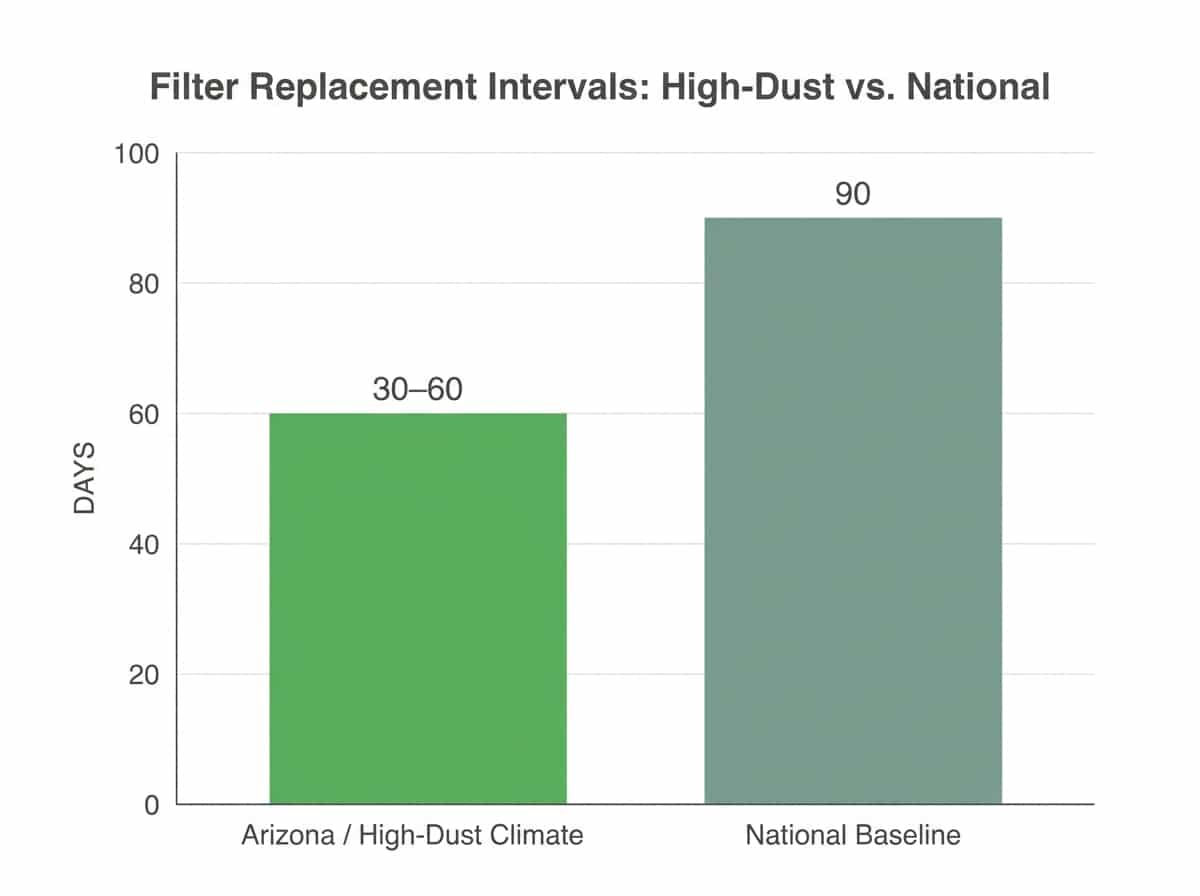
The single most important DIY maintenance task is changing your air filter. National guidance recommends every 90 days. That doesn’t work in Arizona.
Dust storms, pollen season, and year-round operation clog filters faster. According to ASHRAE’s filtration FAQ, a clogged filter reduces airflow by up to 50%, forcing your blower motor to work harder and your system to run longer to reach the set temperature. That drives up energy bills and accelerates wear on mechanical components.
For standard 1-inch pleated filters in the East Valley, change them every 30–60 days. Check your filter monthly (a 30-second visual inspection). If it looks gray or dirty, replace it. If you have pets, reduce the interval to 30 days. After a dust storm, check immediately. The ACCA filtration guide recommends shorter intervals in high-dust environments to maintain system efficiency and indoor air quality.
Upgrading to a 4-inch or 5-inch media filter extends the replacement interval to 6–12 months, but the upfront cost is higher and requires professional installation. For most homeowners, the monthly 1-inch filter swap is the practical choice.
Clearing Your Outdoor Condenser Unit After Dust Storms
After monsoon storms or high winds, walk outside and visually inspect your condenser unit. Remove leaves, branches, and debris within two feet of the unit. Check the condenser fins (the thin metal slats on the sides of the outdoor unit) for damage. Bent fins block airflow, reducing cooling capacity.
Don’t spray the unit with a garden hose. High-pressure water bends the fins and pushes debris deeper into the coil. If the coils look caked with dust, schedule professional cleaning during your next tune-up. Blocked airflow forces the compressor to work harder, shortening its lifespan and spiking energy consumption. According to the American Council for an Energy-Efficient Economy (ACEEE), a dirty condenser can reduce system efficiency by 20% or more.
Homeowners who maintain their air conditioning systems year-round experience fewer breakdowns during Arizona’s brutal summer months.
When to Schedule an Extra Inspection (Warning Signs)
Even with regular maintenance, systems can fail. Knowing the warning signs lets you call for service before a small problem becomes a catastrophic breakdown.
Schedule an inspection immediately if you notice:
- Weak airflow from vents (indicates a clogged filter, failing blower motor, or ductwork leak)
- Warm air blowing when the thermostat is set to cool (points to refrigerant leak, compressor failure, or thermostat malfunction)
- Unusual noises (grinding, squealing, or rattling sounds mean loose components, worn belts, or motor failure)
- Ice on refrigerant lines (a sign of low refrigerant or restricted airflow; your system is working too hard)
- Spiking energy bills (a 20–30% increase without explanation usually means your system is losing efficiency)
- Short cycling (the system turns on and off every few minutes instead of running full cycles, indicating a thermostat issue, refrigerant problem, or oversized equipment)
If you see any of these symptoms, don’t wait for your next scheduled tune-up. Understanding when summer in Mesa demands fast AC repair can save you from a complete system failure during peak heat.
When you notice these warning signs, professional AC repair in Mesa can prevent a minor issue from becoming an expensive emergency.
The Cost of Skipping Preventive Maintenance
Homeowners skip maintenance for one of two reasons: they forget, or they assume nothing is wrong if the system is still cooling. Both are expensive mistakes.
According to NADCA’s groundbreaking energy study, neglected HVAC systems lose 15–25% efficiency within the first year. That means your energy bills climb even though your comfort stays the same. Over a 12-month period, the efficiency loss costs the average East Valley household $300–$500 in wasted electricity, according to baseline data from Energy.gov.
The bigger financial hit comes from repair cost escalation. A $200 capacitor replacement caught during a spring tune-up becomes a $2,500 compressor failure if the capacitor dies under load in July. A dirty evaporator coil caught early requires a $150 cleaning; neglect it for three years, and you’re looking at a $1,200 coil replacement plus labor.
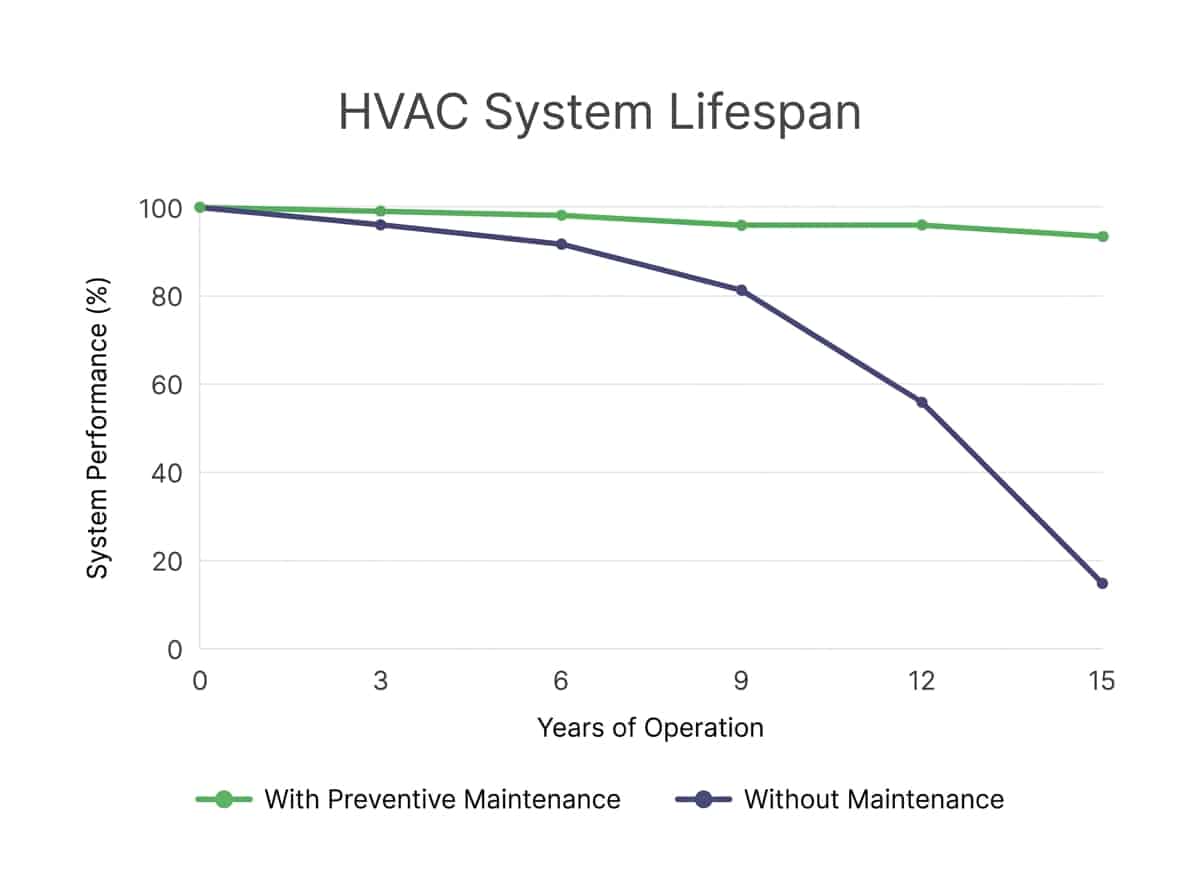
Research on HVAC maintenance from Breathing Clean shows that preventive care extends equipment lifespan by 40% or more. The average HVAC system is designed to last 15 years with proper maintenance. Without it, most systems fail at 8–10 years. That means you’re replacing your $8,000–$12,000 system five years early, losing $3,000–$5,000 in remaining useful life.
In our work with East Valley homeowners, we’ve tracked this pattern: customers on annual maintenance plans report 20–30% lower summer energy bills and experience 70% fewer emergency repair calls compared to homeowners who skip preventive service. The ROI is clear. According to Energy Star’s HVAC efficiency guidance, a well-maintained system saves $200–$400 per year in energy costs alone, which more than covers the cost of two tune-ups.
Residents across the region who invest in air conditioning maintenance consistently avoid the costly breakdowns that hit neglected systems every summer.
What a Real Maintenance Plan Includes (and What to Avoid)
Not all maintenance plans deliver value. Some are revenue traps disguised as preventive care, locking you into multi-year contracts with penalties and nickel-and-diming you for every additional service.
A legitimate maintenance plan, aligned with ACCA quality standards, should include:
- Two comprehensive tune-ups per year (spring and fall) with a documented inspection checklist
- Priority scheduling (you get first availability during peak season, not a two-week wait in July)
- Discounts on repairs (typically 10–15% off parts and labor for plan members)
- No hidden fees (the plan price is the plan price; you’re not charged extra for coil cleaning or refrigerant checks that should be part of the standard service)
- System health reporting (a written report after each visit showing what was checked, what was found, and what (if anything) needs attention)
- No long-term lock-in (you can cancel after the current year without penalties)
Avoid plans that charge separately for “add-ons” like coil cleaning or drain service (those are baseline maintenance tasks, not extras), require multi-year commitments, or lack transparent pricing.
At JLM, our maintenance plan includes spring and fall tune-ups, priority scheduling, discount on repairs, and a detailed inspection report after every visit. No surprises, no upsells. You know exactly what you’re getting.
How to Choose the Right Maintenance Schedule for Your Home
The twice-a-year baseline applies to most homes, but household variables can shift your schedule. Here’s how to tailor the timeline.
System age: If your AC is 10+ years old, consider adding a mid-summer inspection (June or July) to catch wear before it fails during peak load. Older systems have higher failure rates, and catching a problem early saves you from an emergency repair during the hottest week of the year.
Usage pattern: If you run your AC year-round (some East Valley homes never turn it off, even in winter), you’re putting 3,000+ hours per year on your system instead of the typical 2,000. That accelerates wear and justifies a third annual inspection.
Home size and ductwork condition: Larger homes (2,500+ sq ft) with complex duct runs accumulate debris faster and experience more airflow loss from leaks. If your ductwork is older or poorly sealed, schedule an annual duct inspection in addition to your spring/fall tune-ups.
Pets: Dogs and cats shed dander and fur that clogs filters in weeks instead of months. If you have two or more pets, change your filter every 30 days and consider upgrading to a higher MERV-rated filter or a whole-home air cleaner to reduce the load on your HVAC system.
Desert landscaping proximity: If your condenser unit sits within 10 feet of gravel, rock landscaping, or xeriscaping, you’ll get more dust infiltration. Add a post-monsoon inspection to your schedule and clean the outdoor unit more frequently.
For homes with mini-split systems, the maintenance cadence is slightly different. Mini splits have washable filters you clean monthly and require annual professional service for refrigerant checks and outdoor unit cleaning. Homeowners considering mini split installation in Gilbert should understand these maintenance requirements upfront.
If you’re unsure which schedule fits your home, call us at 602-619-3609. We’ll assess your system age, usage pattern, and household variables and recommend a custom plan (no obligation, no sales pressure).
What JLM Checks During Every Maintenance Visit
Transparency matters. When you schedule a tune-up with JLM, here’s exactly what happens.
We perform a 50-point inspection covering both your indoor and outdoor equipment. The outdoor unit (condenser) gets a coil cleaning to remove dust and debris, a refrigerant level check to ensure optimal cooling performance, and a capacitor test to catch early degradation. We inspect the compressor for unusual wear, check electrical connections for corrosion or looseness, and test the contactor (the switch that powers the compressor).
Inside, we inspect the evaporator coil for dust buildup, lubricate the blower motor, check the blower wheel for debris, and test airflow at the vents. The air filter gets inspected (we’ll recommend replacement if needed, but we don’t sell you a filter every visit if yours is still clean). The condensate drain line gets cleared to prevent clogs and water damage.
For the thermostat, we calibrate it to ensure it’s reading temperature accurately and cycling the system correctly. We test the safety controls (pressure switches, limit switches) to confirm the system shuts down if something goes wrong.
You get a written report at the end of the visit showing what was checked, what passed, and what (if anything) needs attention. If we find an issue, we explain what it is, why it matters, and what it will cost to fix. No pressure, no scare tactics. You decide whether to proceed.
This level of detail is what separates a real maintenance visit from a “check the box” service call. It’s also why our customers stay on maintenance plans year after year. Our team regularly shares maintenance tips and industry updates on our HVAC blog, helping homeowners stay informed about best practices.
Our team provides comprehensive HVAC services in the East Valley, AZ with the same transparency and accountability on every service call.
Conclusion
Your AC is the most expensive and most critical piece of equipment in your East Valley home. Protecting it doesn’t require guesswork or trust in a salesperson’s pitch. It requires a simple, proven maintenance schedule: professional tune-ups twice a year (spring and fall), monthly filter changes, and seasonal inspections after dust storms or high winds.
The ROI is measurable: 15–25% lower energy bills, 70% fewer emergency repairs, and 5–7 additional years of equipment lifespan. In our work with 3,000+ East Valley homeowners, the pattern is consistent. Customers who invest $300–$400 per year in preventive care avoid the $2,000–$6,000 emergency repair bills that hit neglected systems every summer.
At JLM Air Conditioning & Heating, we’re not a corporate franchise pushing unnecessary services. Bill and the team live in Gilbert, Mesa, and Queen Creek (the same communities we serve). When you call, you’re talking to the owner or a licensed technician who’s accountable for the work. That’s why we’ve earned an A+ BBB rating and why 70% of our business comes from referrals.
Keep your AC running strong through Arizona’s toughest heat. Call JLM Air Conditioning & Heating now at 602-619-3609 to schedule your seasonal tune-up or ask about our maintenance plan.
— By JLM