
What is the SEER rating energy savings ROI? A higher SEER rating saves money because the unit uses less electricity for the same cooling. SEER is cooling output per unit of electricity (U.S. Department of Energy), so by that formula a 10 to 16 SEER jump cuts cooling electricity about 37 percent (1 minus 10/16). In Arizona, payback is measured in years, not months, and each extra SEER point saves less than the last.
Is a high SEER AC worth the extra money in an East Valley summer? Sometimes yes, and sometimes no. The honest answer depends on four things: how many hours your system runs, what you pay per kilowatt-hour, how healthy your ducts are, and how much extra the higher tier costs. If you are not sure you should replace at all, start with our AC repair vs. replace calculator.
You can run the SEER rating energy savings ROI math yourself before any salesperson visits. If you are pricing a replacement, our breakdown of new furnace and air conditioner cost shows the dollar ranges. This guide gives you the formula, a worked example, and a short checklist.
We wrote it to help you make the right decision on a replacement, the same way we sit down with homeowners across Mesa, Chandler, Gilbert, Queen Creek, and San Tan Valley after 3,000+ installs. Every figure here is arithmetic we ran ourselves from the formulas shown, and every assumption is labeled as an example.
What do SEER and SEER2 mean?
SEER (Seasonal Energy Efficiency Ratio) is cooling output divided by the electricity used over a typical season. Higher means more efficient. Since 2023, new systems carry a SEER2 rating, which uses a tougher test. SEER2 numbers run a little lower than old SEER numbers for the same equipment, so compare like with like.
At JLM, we are family-owned and owner-led, and many homeowners look us up by name before they ever call. So we try to make that first read useful: we explain each term once and then use it the same way every time. Here is the short glossary:
- SEER: the older seasonal cooling efficiency rating. You will still see it on units installed before 2023.
- SEER2: the updated rating on new equipment. It is tested under conditions that better match real ductwork.
- EER2: efficiency at a hot, fixed outdoor temperature. In Arizona, this number matters almost as much as SEER2.
- HSPF2: the heating-side rating for heat pumps. It does not affect your cooling bill.
Federal minimums are higher in the Southwest than in northern states. That means the cheapest new unit you can legally buy here is already more efficient than many older systems. The U.S. Department of Energy’s central air conditioning guide explains the rating system, and your model’s certified rating sheet shows the exact numbers for the unit you are pricing.
The biggest mistake we see in quote comparisons is mixing scales. One quote says “16 SEER” and another says “15.2 SEER2.” Those may be nearly the same machine. Ask every installer for the SEER2 and EER2 on the model’s certified rating sheet, not just the brochure headline.
For a plain-language look at how efficient equipment keeps summer bills in check, read High Efficiency Air Conditioning: Comfort Without the Utility Bill Shock. It covers high SEER air conditioner efficiency without the sales pitch.
Once you have a model number, ENERGY STAR Home Savings, 2026 is a good place to confirm which certified upgrades and resources apply to your home.
Takeaway: Compare SEER2 to SEER2 and always ask for EER2, or two quotes will look more different than they are.
What is the SEER rating energy savings ROI?
Because SEER is cooling per unit of electricity, savings equal 1 minus (old SEER divided by new SEER). Worked through, a 10 to 16 SEER jump saves 37.5 percent of cooling electricity (1 minus 10/16), and a 14 to 16 jump saves 12.5 percent (1 minus 14/16). Arizona homes run AC for many hours, so the dollar savings are real, but payback depends on price, rate, and hours.
The table below is pure arithmetic from that formula, using the SEER definition in the Department of Energy’s central air conditioning guide. It is our own calculation, not a measured result or a marketing claim, and it applies to cooling electricity only, not your whole bill. Your own SEER rating energy savings ROI will land somewhere on this curve.
| Upgrade | Cooling electricity saved |
|---|---|
| 10 to 14 | 28.6% |
| 10 to 16 | 37.5% |
| 10 to 18 | 44.4% |
| 14 to 16 | 12.5% |
| 14 to 18 | 22.2% |
| 14 to 20 | 30.0% |
| 16 to 20 | 20.0% |
Method: 1 minus (old SEER / new SEER), calculated by JLM. Real-world results run lower when ducts, sizing, or installation quality are poor.
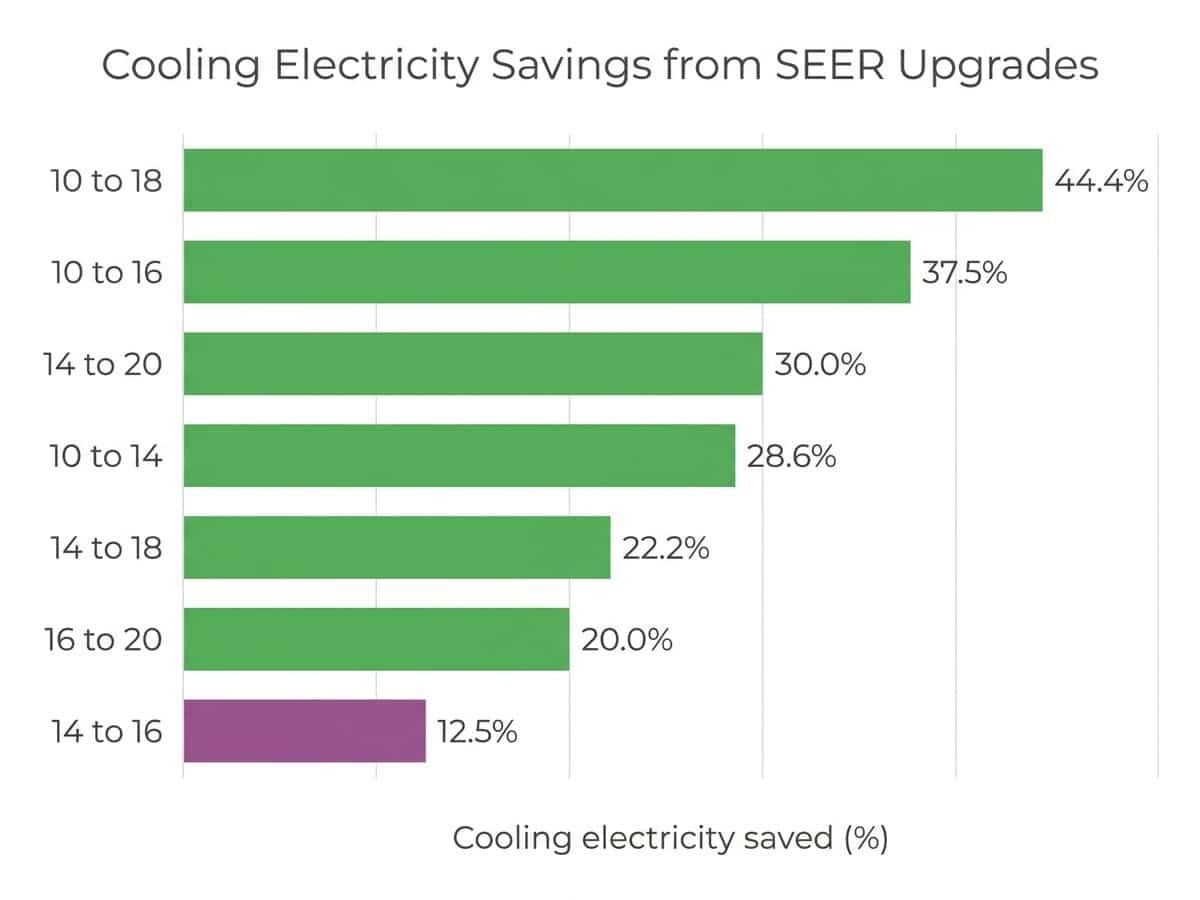
Look at the pattern. Going from 10 to 14 saves almost as much as going from 14 to 20. The big wins come from leaving a very old system behind. After that, every step costs more and saves less.
Why Arizona changes the dollars
A percent saved is worth more when the system runs more hours. Arizona’s long, hot cooling season means each saved percent turns into more kilowatt-hours than it would in a mild climate. That is why the SEER rating energy savings ROI often looks better here than the national average suggests.
Your rate plan matters too. Both SRP and APS offer residential plans with different on-peak and off-peak prices, so a saved kilowatt-hour at 5 p.m. can be worth more than one saved at midnight. Check each utility’s current plans before you plug a rate into the formula.
When we talk about system replacement and installation with a homeowner, the goal is simple: help them make the right decision. So we frame ROI honestly. We do not promise a dramatic drop in your bill, because the real figure depends on your house. For other ways to trim cooling costs while you decide, see how to save on your HVAC bill this summer.
If your goal is real AC efficiency cost savings, ask what the upgrade costs per dollar saved. That is the number that matters. A system upgrade can be worthwhile on efficiency alone, as long as the premium is small enough for the savings to cover it.
Takeaway: The first few SEER points save the most, so the ROI conversation is really about how far you are climbing from where you start.
How do you calculate high SEER payback?
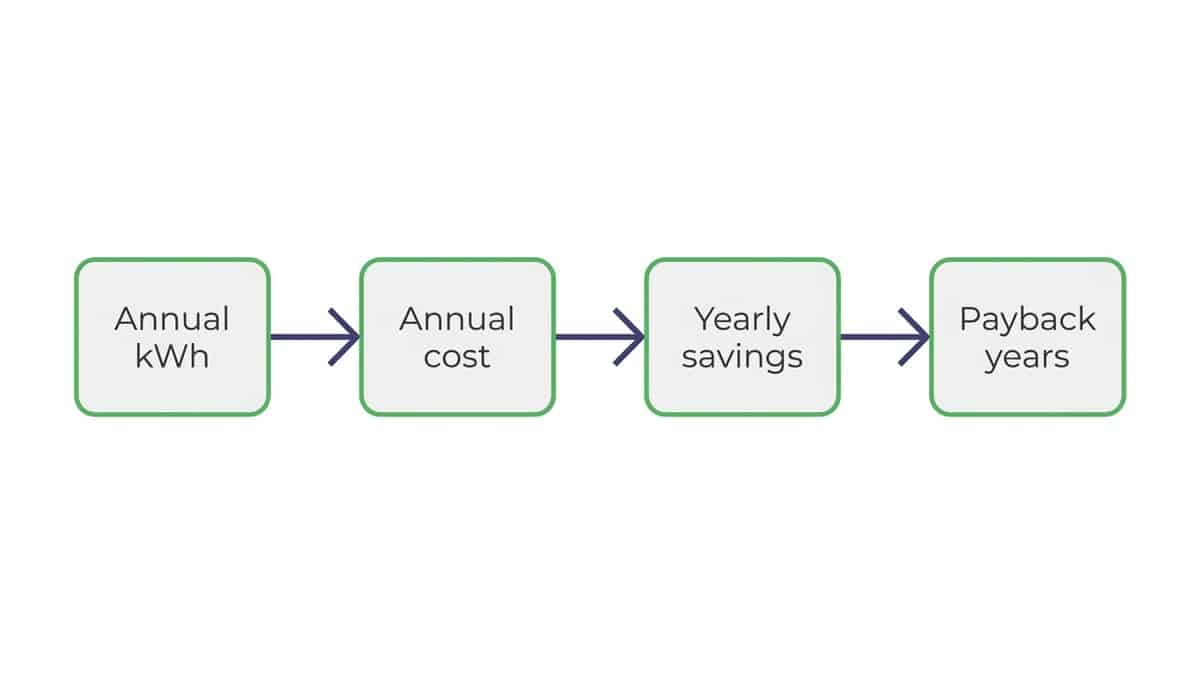
Estimate annual cooling kWh as tons x 12,000 x full-load hours / (SEER x 1,000). Multiply by your electric rate. Subtract the new cost from the old for yearly savings. Divide the extra equipment cost by yearly savings to get payback in years.
That is the whole SEER rating calculator, and it is the core of the SEER rating energy savings ROI question. We share it openly because customers should know the cost and the logic before any work begins. The free on-site energy assessment is where we measure your real inputs: house size, airflow, duct condition, and run hours. More homeowners are comparing replacement options carefully before they call, and we are glad of it. This section gets you ready for that conversation and for making the right decision on your system replacement and installation.
The five inputs
| Input | Where to find it | Example value (example only) |
|---|---|---|
| Tons of cooling | Nameplate on your outdoor unit | 3 tons |
| Full-load cooling hours per year | Estimate from your utility bills or an assessment | 2,500 hours |
| Electric rate per kWh | Your utility bill | $0.14 per kWh |
| Old SEER (or SEER2) | Nameplate or model lookup | 10 |
| New SEER2 and extra equipment cost | Your written quote | 16, plus the price gap over the baseline unit |
The hours and rate above are placeholders so the arithmetic is easy to follow. Replace them with your own numbers. For your rate, nothing beats the price per kWh printed on your own utility bill.
The formula, step by step
- Annual kWh = tons x 12,000 x hours / (SEER x 1,000).
- Annual cost = annual kWh x your rate.
- Yearly savings = old annual cost minus new annual cost.
- Payback in years = extra equipment cost / yearly savings.
If a quote uses SEER2, run the new unit with SEER2 and keep the old unit on its original SEER. If you want to be conservative, shave a little off the old unit’s SEER to reflect age. Real systems drift below their label.
Worked example (example only)
Take a 3-ton system, 2,500 hours, and $0.14 per kWh.
| Old 10 SEER | New 16 SEER | |
|---|---|---|
| Annual cooling kWh | 9,000 | 5,625 |
| Annual cooling cost | $1,260 | $788 |
| Yearly savings | about $470 |
Now the payback step. Suppose the 16 SEER2 model costs $800 more than a baseline 14 SEER2 replacement. Those two units would use about 5,625 and 6,429 kWh, so the yearly saving is about $112. Payback is $800 divided by $112, or about 7.1 years. The premium is illustrative, so use your own quote.
The key point: if your old unit has already failed, compare tiers against each other, not against the dead unit. You are buying a system either way. The question is whether the next efficiency step earns back its premium.
How to run it with your own bill
Pull twelve months of usage from your utility account. Look at your summer months against your spring and fall months. The extra summer kilowatt-hours are a rough proxy for cooling. Divide by your rate and compare with the formula’s output. If the two are close, your inputs are sound. For habits that trim your summer usage before you replace anything, see Energy Efficiency & Your HVAC Bill: How to Save This Summer.
A second part of our work matters here: indoor air quality, ductwork, and smart upgrades that help you get more from your system. A leaky duct run can erase part of what a new unit promises. Ductwork installation is one of the pages homeowners use most on our site, and it pairs naturally with a system replacement, which is why more East Valley homeowners are asking about both together. If your old system is also repair-prone, our repair versus replacement decision framework helps you weigh it.
Before you finalize, check a model’s listing and rebate options at ENERGY STAR Home Savings, 2026. It helps confirm the system upgrade you are pricing is actually certified.
Takeaway: Five inputs and four steps give you a payback number you can check against any quote.
Is a higher SEER always worth it?
No. Savings shrink with each SEER step while price rises. Moving from 14 to 16 SEER often pays back, but a jump from 16 to 20 can take well over a decade to recover the added cost. The best value is usually a mid-high tier, sized and installed correctly.
Here is the same 3-ton example, stepping up one tier at a time. The price premiums are placeholders to show the shape of the curve. Swap in the gaps from your own quotes.
| Step | Extra kWh saved per year | Yearly savings at $0.14 | Example premium | Payback |
|---|---|---|---|---|
| 14 to 16 | about 804 | about $112 | $800 | about 7.1 years |
| 16 to 18 | 625 | about $88 | $1,500 | about 17.1 years |
| 18 to 20 | 500 | $70 | $2,000 | about 28.6 years |
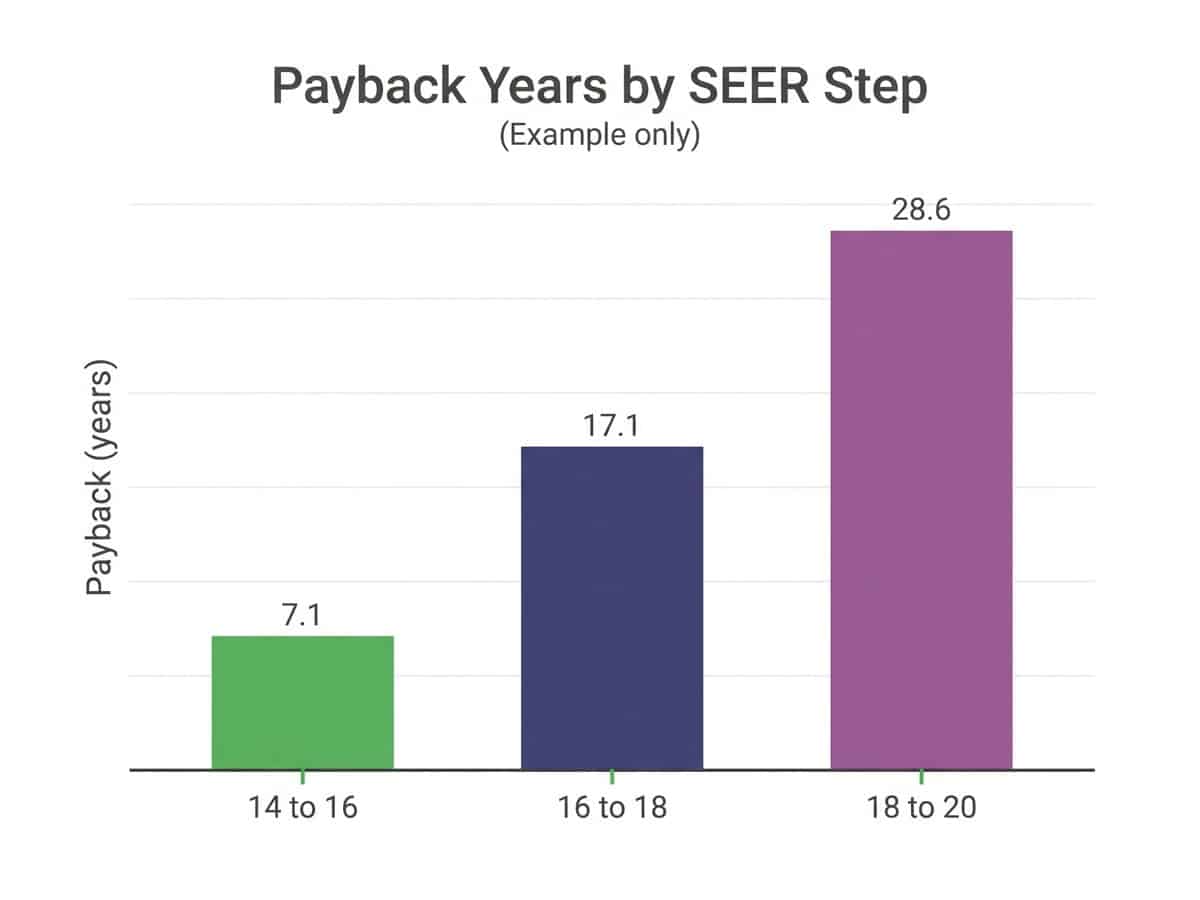
The shape is what matters. Each step saves fewer kilowatt-hours, yet the premium usually climbs. High SEER air conditioner efficiency is real, but the SEER rating energy savings ROI flattens fast. A well-sized, well-installed 16 SEER often beats a poorly installed 20 SEER, because the installation decides how much of the label you actually get. That is where most AC efficiency cost savings are won or lost.
That is also why we do not push the top tier. Premium Amana equipment is available across efficiency levels, and we recommend by home and budget, not by the biggest number. If you want to see which efficient options fit your house, start with Energy Efficient HVAC Systems: Lower Your Bills This Summer.
Timing changes the pressure. When a system dies in July, the temptation is to accept whatever tier is quoted fastest. If you are in that spot, ask for HVAC system repairs and upgrades quoted side by side, with the numbers written down. A transparent estimate lets you decide calmly, even when your house is hot, and it is the difference between a repair you needed and an upgrade you were talked into.
Certification is a useful filter, not a verdict. It confirms an upgrade qualifies, but it cannot tell you whether the extra tier suits your hours and your ducts.
Takeaway: Pay for efficiency up to the point where each extra step stops earning its premium back, and not a dollar beyond it.
Why won’t SEER predict my Arizona bill?
SEER is tested at a mild 82°F outdoor temperature, but Arizona afternoons run much hotter, so EER2 (high-heat efficiency) matters too. Leaky ducts, oversizing, poor airflow, and a weak installation can erase the efficiency on the label.
SEER tests at 82°F, Phoenix runs hotter
The seasonal rating averages performance across milder conditions. The Department of Energy’s central air conditioning guide describes how these ratings work. Your system does its hardest work during the hottest afternoon hours, when the outdoor coil is fighting 100°F-plus air. Efficiency at that point is what EER2 describes. Two units with the same SEER2 can have different EER2 numbers, so ask for both.
Ducts can waste what the unit saves
Efficient equipment pushes cooled air into your ducts. If those ducts leak, collapse, or run through a hot attic with poor insulation, part of that cooled air never reaches the room. That is why we pay as much attention to indoor air quality, ductwork, and smart upgrades as to the equipment itself: it is how you get more from the system you own. In our experience, duct condition is the input homeowners most often overlook when they compare quotes.
Ductwork and installation also go together. Homeowners searching for air duct installation or installing ductwork are often replacing a system at the same time, and bundling the two means one visit and one plan. If your ducts are original and uneven, treat them as part of the efficiency project, not an afterthought.
Sizing: bigger is not better
An oversized unit cools quickly, shuts off, and restarts again and again. That short cycling wastes energy, wears parts, and leaves humidity and hot spots behind. Proper sizing starts with a load calculation of your home, not a rule of thumb. Our guide to AC system sizing in Arizona with a Manual J load calculation explains why oversizing wastes money.
Installation quality and airflow
Restricted airflow from dirty filters, clogged coils, or undersized returns lowers real-world efficiency. In the worst cases, it freezes the coil. If you have seen ice on your lines, see Quick Solutions When Your AC Freezes Up in Mesa before you assume the unit is the problem.
We install things right the first time, because a label only counts when the system around it is sound. When you plan an upgrade, pair the equipment rating with a duct and airflow check on the house side.
Takeaway: Think of SEER2 as the engine rating and your ducts, sizing, and installation as the road conditions. The SEER rating energy savings ROI only shows up when the road is clear.
When should you replace a working AC?
Rarely on efficiency alone. Replacement pays best when the old system is 12 or more years old, sits at about 10 SEER or lower, and repair bills are stacking up. If your system is newer and running well, tune-ups and duct fixes usually return more per dollar than a new unit.
Use this quick checklist:
- Age: Is the system past its typical service life of 12 to 15 years?
- Old SEER: Is the label at or below roughly 10? The jump to a modern unit is then large.
- Repair history: Have you paid for two or more significant repairs in recent summers?
- Refrigerant: Does the unit use an older refrigerant that is costly to service?
- Comfort: Do you have hot rooms, loud operation, or humidity problems that repairs do not fix?
If you checked most of these, replacement deserves a real look. If you checked one or two, keep what you have and address the cheaper problems first.
Here is our honest “don’t replace yet” list:
- The system is under about ten years old and cools well.
- Your bill rose because of a rate change or more hours at home, not equipment decline.
- A clogged filter, dirty coil, or leaky duct is the actual problem.
- You plan to move within a year or two, so you will not stay long enough to collect the savings.
Quote the repair and the replacement side by side, and let the numbers decide. The repair vs. replace calculator linked at the top of this guide helps you find your break-even point. We would rather tell you to keep a good unit than sell one you do not need.
Takeaway: Efficiency alone rarely justifies replacing a healthy system, but age, repairs, and comfort problems together often do.
How do incentives and financing change payback?
Rebates and financing change the math in two ways. A rebate lowers the net premium, which shortens payback and improves your SEER rating energy savings ROI. Financing spreads the cost over time, which changes your monthly cash flow but not your total cost. Neither should push you into a tier you do not need.
Start with utility programs. SRP and APS have offered AC-related rebates, and programs change. Check current offers and eligibility on each utility’s site before you decide.
For equipment resources, use ENERGY STAR Home Savings, 2026. Be careful with federal credits. The rules for the home-improvement credit have changed, and you should not count on one without checking current guidance on the IRS Energy Efficient Home Improvement Credit page.
Financing options are available, and a consultation can explain them. We do not quote rates or terms in an article, because they depend on your situation. Think in total cost of ownership: purchase price plus a dozen or more years of electric bills, repairs, and filters. For a realistic picture of the purchase side, see HVAC System Cost: What to Expect When Replacing Your System.
Many of our customers come through referrals and read reviews before they call. We know that is how trust gets built, and it is why we treat every local HVAC service call the same way. We are family-owned, the owner is on the job, and we hold an A+ BBB rating. That is also why we put the formula in your hands before the estimate. When a system fails and you need a fast answer, the same transparency applies to repairs and upgrades.
The free on-site consultation and install estimate turn the example numbers into yours. You can also browse our full range of HVAC services.
Takeaway: Count rebates and financing in your payback math, but never let them choose the tier for you.
Your next step: get your real numbers
You now have everything you need to test any quote:
- The formula: annual kWh = tons x 12,000 x hours / (SEER x 1,000), then rate, savings, and payback.
- The diminishing-returns rule: early SEER points save the most, and each later step costs more per dollar saved.
- The checklist: check SEER2 and EER2, then ducts, then sizing, then installation quality.
The numbers in this guide are examples. Your house, your hours, and your rate decide your real SEER rating energy savings ROI. If you want those checked by people who live in the East Valley and answer to you directly, schedule a free on-site assessment with our East Valley team.
Prefer to talk it through? Call JLM and we will run your real payback numbers with you, with no pressure and no upsell.
Call JLM at 602-619-3609 to book your free on-site assessment
By JLM Air Conditioning & Heating