
You’re holding a $1,200 repair estimate for your 12-year-old air conditioner, and the technician is waiting for an answer. Should you fix it one more time or bite the bullet and replace the whole system? The $5,000 Rule tells you when to replace instead of repair: multiply the repair estimate by your AC unit’s age in years. If the result exceeds $5,000, replacement is the smarter financial move. For example, a $600 repair on a 10-year-old system equals $6,000, which crosses the threshold (time to replace). A $400 fix on a 7-year-old unit equals $2,800, still under (repair and monitor). This formula accounts for diminishing reliability and rising energy waste as systems age past their 12-15 year design life.
At JLM Air Conditioning & Heating, we walk you through this calculation before recommending a path forward. No pressure, no hidden agenda: just honest numbers so you can make the right decision for your home and budget. Our comprehensive HVAC services include both repair and replacement options tailored to East Valley homeowners.
Why the “$5,000 Rule” Works (and When It Doesn’t)
The $5,000 Rule isn’t arbitrary. It’s a widely recognized industry heuristic that balances repair cost against remaining system lifespan and efficiency loss. HVAC contractors across the country use this formula because it captures the real economics of aging equipment: as systems pass 10 years, major component failures become more frequent, parts get harder to source, and energy waste compounds.
Here’s the logic. A residential air conditioner has a design life of 12 to 15 years, per guidance from the Air Conditioning Contractors of America (ACCA). When you’re at year 10 and facing a $500 repair, you’re buying perhaps two to three more summers of operation. Those summers come with higher energy bills, declining comfort (longer runtimes, uneven temperatures), and increased breakdown risk. The $5,000 threshold puts a dollar figure on that tradeoff: if the repair cost multiplied by age exceeds $5,000, you’re throwing good money after bad.
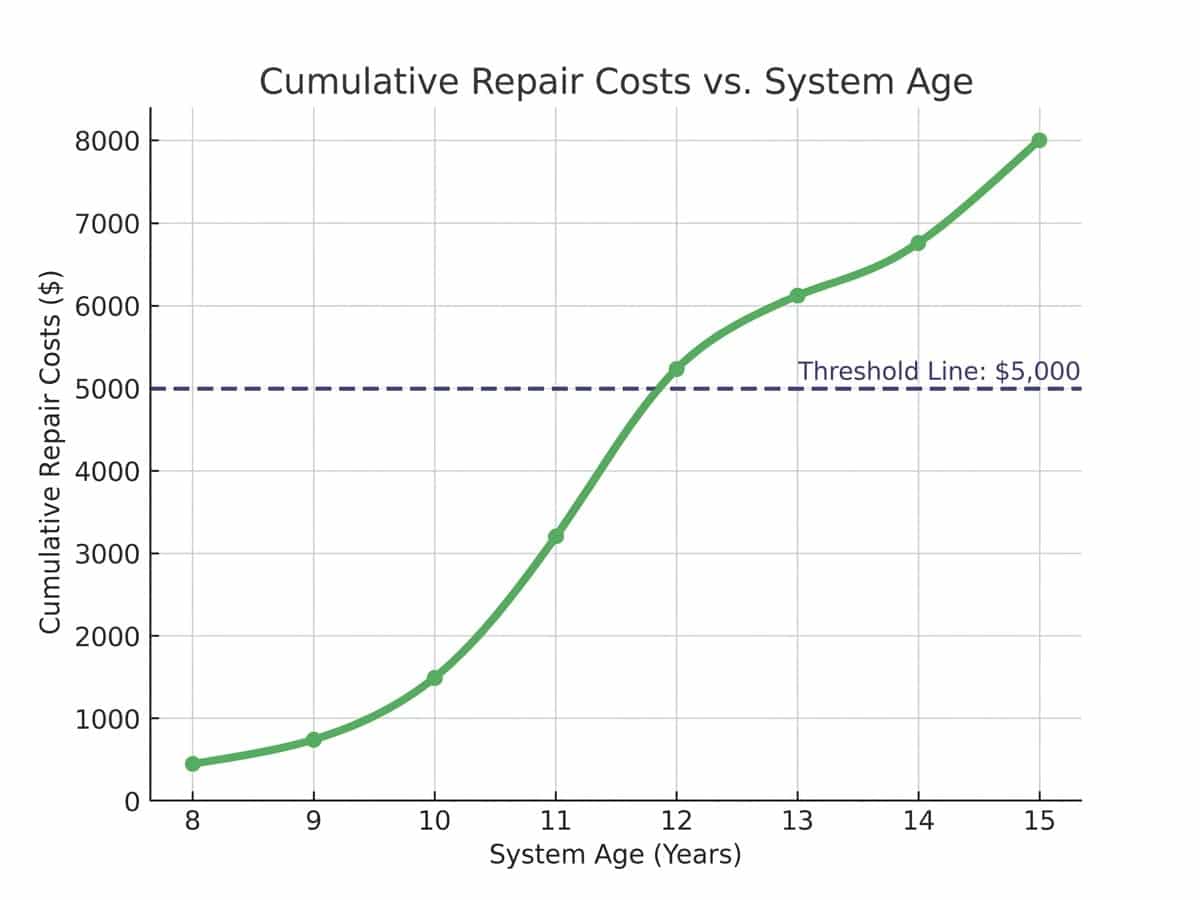
The formula does have exceptions. If your unit is still under warranty, the repair may cost you nothing or very little (in which case the age multiplier doesn’t apply). Similarly, if the system has failed twice in the past 12 months, that’s a reliability red flag regardless of what the $5,000 Rule says. At that point you’re not just repairing a component; you’re managing a cascade of age-related failures.
We’ve installed more than 3,000 systems across the East Valley, and we’ve seen both sides of this decision hundreds of times. Our A+ BBB rating reflects a simple commitment: we show you the math, explain what it means for your specific situation, and let you decide. If repair makes sense, we’ll fix it right. If replacement is the smarter move, we’ll explain why and give you a transparent estimate with no hidden fees.
When a customer chooses to repair an aging system, we recommend enrolling in our preventive maintenance plan: a 50-point inspection that catches the next failure before it happens. That way, if you do cross the threshold six months from now, you’re not caught off guard in the middle of a July heatwave.
How to Calculate Your Break-Even Point in 3 Steps
Let’s make this concrete. Grab your repair estimate and follow these three steps.
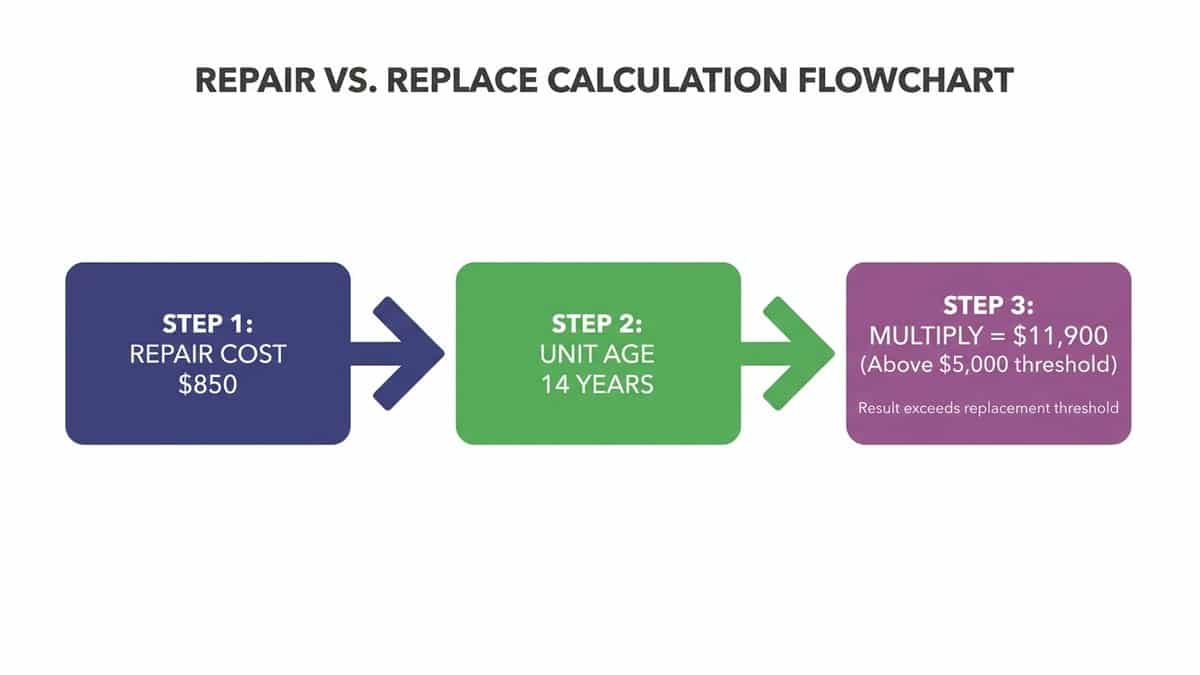
Step 1: Write down the repair cost. This is the total dollar amount the technician quoted (parts plus labor). For example: $850 for a compressor replacement.
Step 2: Write down your AC unit’s age in years. If you don’t know the exact age, check the manufacturer label on the outdoor condenser unit. It will have a serial number that encodes the production date. Most HVAC manufacturers use a two-digit year code in the first four characters. If the label says your unit was made in 2012, it’s 14 years old in 2026.
Step 3: Multiply repair cost by age. $850 × 14 years = $11,900. That’s well above $5,000. The formula says replace.
Now let’s run a second scenario: $400 capacitor replacement on an 8-year-old system. $400 × 8 = $3,200. Under $5,000. Repair is the right call for now, assuming this is the first major issue and the unit has been well maintained.
The second variable to factor in is efficiency loss. A system installed in 2011 likely runs at 10 SEER (Seasonal Energy Efficiency Ratio). Today’s high-efficiency models start at 16 SEER. In Phoenix-area summers where air conditioning runs five to six months at high load, older systems can waste $40 to $60 per month compared to modern units. That’s $240 to $360 per cooling season. Over three years, you’ve spent an extra $720 to $1,080 just on electricity while the old system limps along.
Consumer Reports estimates that the most common major AC repairs (compressor, condenser coil, evaporator coil) fall in the $800 to $1,500 range depending on refrigerant type and system size. If your repair estimate lands in that band and your system is 10+ years old, you’re almost certainly crossing the $5,000 threshold.
Here’s where JLM’s free on-site consultation makes the decision clearer. We’ll assess your current system’s actual efficiency (not just the nameplate SEER), show you what a modern Amana replacement would cost, and run a side-by-side energy comparison. You’ll see exactly how much the old system is costing you to operate versus what a new high-efficiency install would save each month. That turns the abstract $5,000 formula into a concrete ROI picture.
When Age Alone Says “Replace” (Even If Repair Cost Is Low)
What if the math passes the $5,000 Rule but your system is 14 years old? A $300 capacitor replacement on a 14-year-old unit equals $4,200 (technically under the threshold). Should you repair it?
Not necessarily. At 12 to 15 years, you’re at the outer edge of the design life window. The American Society of Heating, Refrigerating and Air-Conditioning Engineers (ASHRAE) puts median equipment lifespan at 15 years with proper maintenance. Beyond that, you’re in borrowed time. The risk isn’t just that the capacitor failed today. It’s that the compressor or evaporator coil will fail six months from now, and then you’re facing a second $1,000+ repair on a system that’s already past its expected retirement date.
Parts availability becomes another issue. Older systems (especially those running R-22 refrigerant, which was phased out in 2020) face supply constraints. If your 15-year-old condenser needs a specialized part that’s no longer manufactured, the repair may not even be possible. At that point replacement isn’t optional. Understanding how central air installation works can help you prepare for the transition when that time comes.
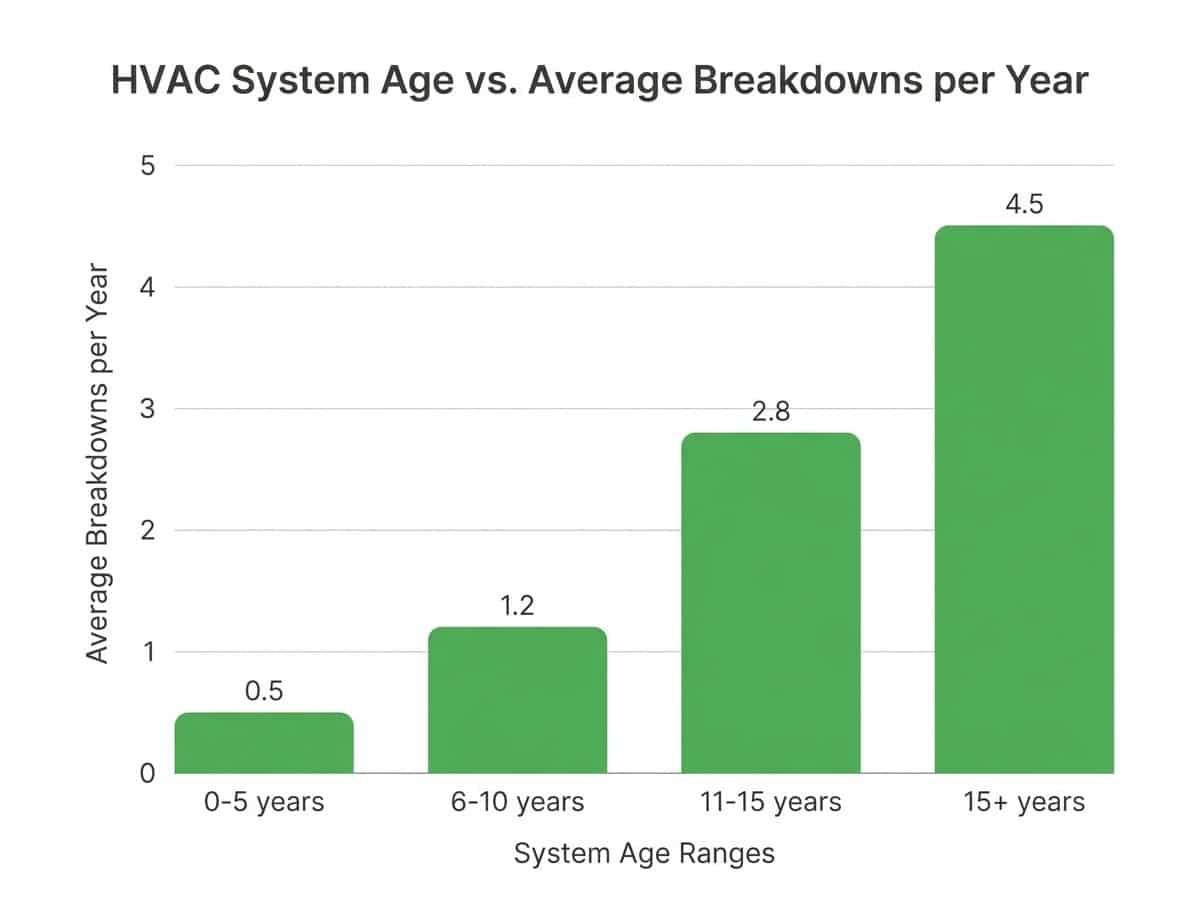
If you choose to repair an aging system, we strongly recommend enrolling in our preventive maintenance plan. The 50-point inspection catches issues before they become failures: a refrigerant leak, a worn contactor, a clogged drain line. That gives you visibility into the system’s true condition so you can plan the replacement on your timeline instead of in an emergency. JLM offers 24/7 emergency service, but we’d rather help you avoid the emergency altogether.
For customers in Gilbert, Queen Creek, Mesa, Chandler, and the broader East Valley, the desert climate accelerates wear. Systems here run harder and longer than equipment in milder regions. A 12-year-old AC in Arizona has logged more operating hours than a 15-year-old system in a temperate state. Factor that into your decision: the design-life clock runs faster here.
The Hidden Costs of Keeping an Old System Running
The $5,000 Rule captures the direct repair cost, but it doesn’t account for the soft costs of keeping an aging system limping along. Let’s add those up.
Energy waste. We mentioned the efficiency gap earlier. A 10 SEER system wastes $50 per month compared to a modern 16 SEER unit during peak summer operation. Over 36 months, that’s $1,800 in excess energy bills. Money that could have gone toward financing a new system. ENERGY STAR data confirms that high-efficiency replacements pay for themselves over time through lower utility costs, often within five to seven years depending on local electricity rates and system runtime.
Declining comfort. Older systems lose cooling capacity as components wear. The compressor runs longer to reach the thermostat setpoint. Airflow drops as the blower motor weakens. Refrigerant charge drifts as seals age. The result: uneven temperatures across rooms, higher humidity, and that stuffy feeling even when the system is running. You’re paying for air conditioning that doesn’t actually keep you comfortable.
Repair cascade risk. The first major repair on an aging system is rarely the last. Once a compressor fails, it puts stress on the condenser fan motor. A refrigerant leak can damage the evaporator coil. Each repair buys you six to twelve months, but you’re often back in the same spot facing another estimate.
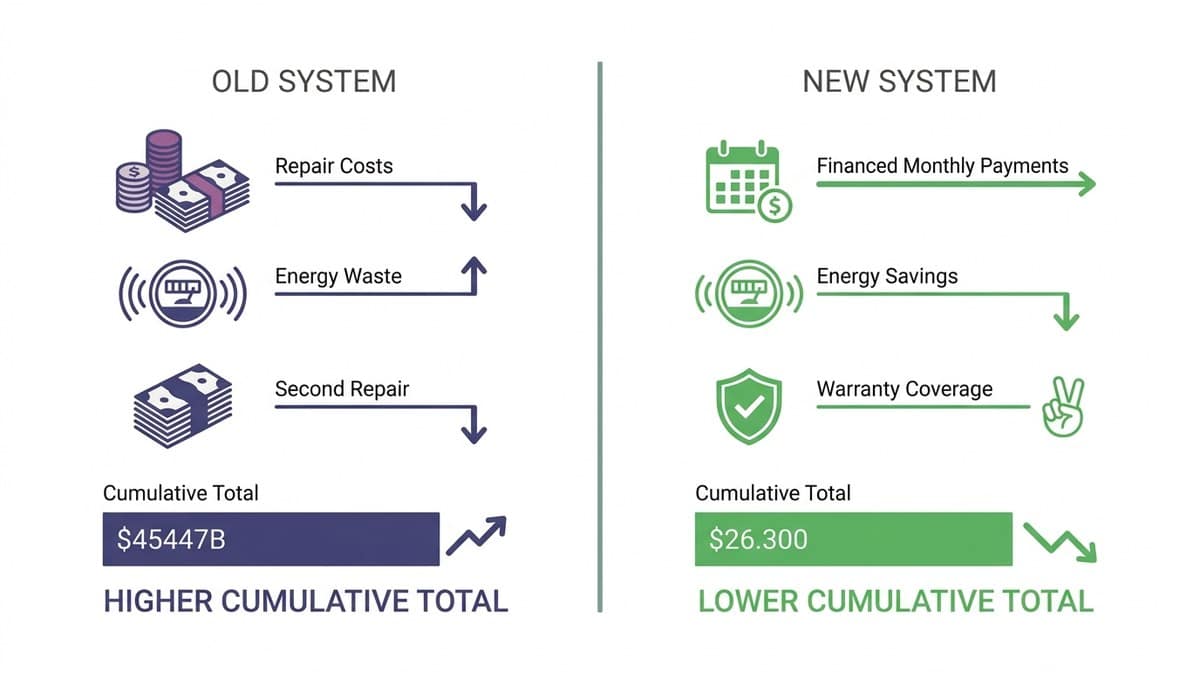
Let’s run a real three-year total cost of ownership comparison. You have a 12-year-old system. Repair estimate today: $1,200. Energy waste (vs. new high-efficiency unit): $600/year. Likelihood of a second major repair within 24 months: high. Total three-year cost if you repair: $1,200 initial repair + $1,800 energy waste + $1,000 second repair = $4,000, and you still have a 15-year-old system at the end.
Now the replacement scenario. A new Amana high-efficiency system costs approximately $11,000 installed (this varies by home size, ductwork condition, and equipment selection). Financed through GoodLeap or JB Warranties, that breaks down to manageable monthly payments over 36 months. You eliminate the energy waste, you get a 10-year parts warranty and 1-year labor warranty, and you have modern comfort features (variable-speed blower, smart thermostat compatibility). Three-year cost: financing payments minus energy savings. Often the net difference is smaller than customers expect, and you end the period with a system that has another 12 years of life ahead instead of one that’s already overdue for retirement.
When you replace, you also unlock value-adds that repair never includes. Ductwork inspection and sealing to fix leaks that waste 20 to 30 percent of conditioned air. Smart thermostat installation so you can control the system remotely and optimize runtime. Even mini split options for targeted cooling in problem areas (a hot garage, a converted sunroom) that your central system struggles to reach. These upgrades improve comfort and efficiency in ways a simple compressor swap never will.
What to Ask Your HVAC Contractor Before You Decide
Whether you’re getting a second opinion or vetting the original estimate, ask these five questions to ensure you’re getting an honest assessment.
1. What is my system’s age, and how many times has it been repaired in the past three years? A contractor who doesn’t ask about repair history isn’t giving you the full picture. If you’ve had two or three service calls in 24 months, that’s a reliability red flag the $5,000 Rule doesn’t capture.
2. What is the SEER rating of my current system versus a modern replacement, and how much would I save on energy? A contractor who can’t (or won’t) quantify the efficiency gap is either uninformed or hoping you won’t notice you’re wasting $50/month. Ask for a side-by-side energy-cost projection.
3. Are parts readily available for this repair, and is my system still under any warranty coverage? If the unit runs R-22 refrigerant or uses discontinued components, repair may not be viable long-term. If warranty coverage applies, that changes the cost equation entirely.
4. Can you show me a three-year total cost comparison: repair + energy waste + likely second repair versus replacement with financing? An honest contractor will run this math with you. If they won’t, that’s a red flag. At JLM, Bill reviews every estimate personally and walks you through the numbers (no hidden fees, no pressure).
5. What financing options do you offer, and what are the monthly payment terms? Replacement becomes more accessible when you can spread the cost over 24 to 36 months. Ask about approval criteria, interest rates, and whether there are deferred-payment or zero-interest promotional periods.
If a contractor won’t give you a line-item estimate or compare the numbers side by side, walk away. Transparent pricing and honest recommendations are the baseline standard you should expect. At JLM, we’ve built our reputation on giving East Valley homeowners the same straight answer we’d give our own family. Bill is on the job, accessible, and accountable (not hidden behind a call center or a commissioned sales team). Our A+ BBB rating and 3,000+ installs across Gilbert, Mesa, Chandler, Queen Creek, and San Tan Valley reflect that commitment.
For Gilbert homeowners specifically considering a replacement, our guide on mini split installation in Gilbert walks through everything from sizing to permitting for both whole-home and zoned solutions.
When to Get a Second Opinion (and How JLM Can Help)
You don’t have to make this decision alone. If you’re holding a repair estimate and the $5,000 Rule math feels borderline, or if you simply want confirmation that you’re being told the truth, a second opinion is worth the call.
JLM Air Conditioning & Heating offers a free, no-obligation consultation. We’ll come to your home, assess your system’s age and condition, walk you through the $5,000 Rule calculation with your actual numbers, and show you the energy-efficiency comparison between keeping the old unit and installing a modern high-efficiency replacement. Bill reviews every estimate personally. You’re talking to the licensed contractor who will be on your job, not a salesperson working on commission.
We’ve done this for thousands of East Valley families. We know what a fair repair estimate looks like, and we know when replacement is the smarter financial move. If repair makes sense, we’ll tell you. If your system is past its design life and you’re throwing money away, we’ll show you why and give you a transparent replacement quote (no hidden fees, no upsell pressure). Same-day service is available if your system has already failed and you need an answer fast.
If you’re experiencing cooling issues in Mesa specifically, our resource on solutions when your AC freezes up in Mesa can help diagnose whether the problem signals a simple fix or a system nearing end-of-life.
Our work is backed by an A+ BBB rating and a portfolio of over 3,000 installs. We live in this community. We’ve worked on your neighbors’ homes. The recommendation we give you is the same one we’d give our own family.
Ready to get a second opinion or schedule your free consultation? Call now: 602-619-3609 or request service online through our Services page. We’ll walk you through the $5,000 Rule with your actual numbers and show you the honest path forward.