How much does it cost to replace an HVAC system? HVAC replacement costs typically range from $9,000 to $20,000 in Arizona, depending on system size, efficiency rating, ductwork condition, and installation complexity. Most East Valley homes pay around $11,000 for a quality mid-efficiency system with professional installation. Higher-efficiency models (16+ SEER) cost more upfront but deliver long-term savings through lower energy bills and fewer repairs.
If you’re a homeowner in Gilbert, Queen Creek, Mesa, or Apache Junction staring at an aging HVAC system, you’re probably wrestling with sticker shock and trust issues. You’ve heard replacement costs can hit $20,000, you’ve been burned by contractors who lowball estimates and add charges mid-job, and you’re not sure whether you need a $9,000 system or an $18,000 one. This guide gives you transparent pricing breakdowns, explains exactly what drives those costs, and helps you budget for a system that fits your home without guesswork. By the time you finish reading, you’ll know what to expect, what to watch for, and how to choose the right system for your East Valley home. We install HVAC systems throughout the East Valley with transparent pricing and no hidden fees.
About the author: This guide was developed by JLM Air Conditioning & Heating, a family-owned HVAC company serving the East Valley since 2010. Owner Bill Milbourn holds Arizona ROC licenses (K-41 and L-41) and personally oversees installations to ensure quality standards. Our pricing recommendations reflect real installation data from over 3,000 residential projects across Gilbert, Queen Creek, Mesa, and Apache Junction.
What Does HVAC Replacement Actually Cost?
The $9,000 to $20,000 range you’ve seen advertised isn’t marketing spin. It’s real. The gap between the low and high end comes down to system size, efficiency rating, ductwork condition, and installation complexity. Here’s what you actually get at each price tier in the East Valley market.
Budget Tier ($9,000 to $11,000): Standard-Efficiency Systems
These systems use 14 to 15 SEER ratings and single-stage compressors. They’re suitable for smaller homes (1,200 to 1,800 square feet) with existing ductwork in good shape. You’ll get reliable cooling and moderate energy efficiency. If your home is compact, your ducts don’t leak, and you’re not chasing the lowest possible energy bills, a standard-efficiency system does the job without unnecessary features. According to ASHRAE standards for HVAC system design, proper installation and sizing matter more than efficiency rating alone when it comes to system longevity.
Mid-Range Tier ($11,000 to $15,000): High-Efficiency Systems
Most of our East Valley installs fall here. These systems deliver 16 to 18 SEER ratings with two-stage or variable-speed compressors. They fit homes between 1,800 and 2,500 square feet and deliver lower monthly bills, quieter operation, and better humidity control. This is where premium Amana equipment, professional installation, and transparent pricing converge. You’re not paying for unnecessary upgrades, but you’re getting a system engineered for Arizona’s brutal summers. For more details on the air conditioning systems we install, our resource library breaks down efficiency tiers and equipment options.
Premium Tier ($15,000 to $20,000+): Top-Efficiency or Complex Installs
These systems hit 18+ SEER ratings with variable-speed components, smart thermostats, and zone control. They’re built for large homes (2,500+ square feet), extensive ductwork replacement needs, or multi-zone cooling requirements. You’ll see maximum energy savings and the longest lifespan, but you’re also paying for complexity. If your home has multiple stories, roof-mounted units, or aging electrical panels, labor costs climb. Energy efficiency standards are shifting toward higher SEER2 ratings, which means premium systems built today will meet stricter regulations for years to come.
Five Factors That Drive Your HVAC Replacement Cost
Understanding what makes one quote $9,000 and another $18,000 protects you from predatory upselling and helps you spot legitimate cost drivers. Here are the five factors that control your final price.
1. System Size (Tonnage) and Home Square Footage
Undersized systems run constantly and fail early. Oversized systems short-cycle, waste energy, and don’t remove humidity. Proper sizing requires a Manual J load calculation based on your home’s square footage, insulation, window placement, and ceiling height. If a contractor quotes you without measuring your home, walk away. Arizona’s extreme heat demands accurate sizing with no shortcuts. A 1,800-square-foot home in Gilbert typically needs a 3-ton to 4-ton system, but that number shifts based on insulation quality, duct placement, and sun exposure. According to Arizona HVAC considerations for new construction, desert climate conditions require stricter load calculations than moderate-climate regions because a single ton of undersizing can mean system failure during a 115°F summer week.
2. Efficiency Rating (SEER and SEER2)
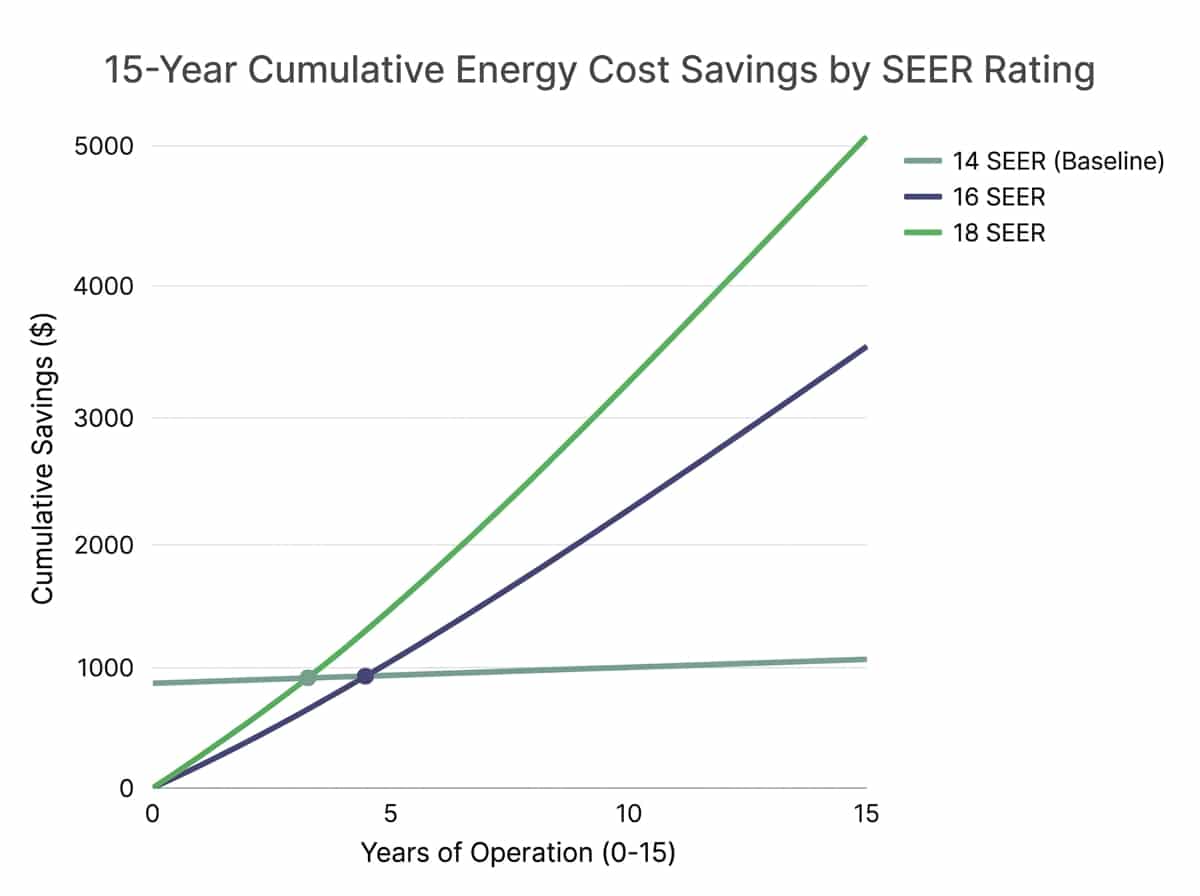
Higher SEER ratings mean lower monthly bills but higher upfront costs. Arizona’s baseline efficiency is 14 SEER. High-efficiency systems run 16 to 18 SEER. Premium systems hit 18+ SEER. The payback period matters. In Gilbert’s brutal summers, a 16 SEER system typically pays for itself in five to seven years compared to a 14 SEER model through energy savings. You can estimate your own payback using the ENERGY STAR home savings calculator, which factors in local utility rates and cooling hours. A system that costs $2,000 more upfront but saves $30 per month on electricity breaks even in just over five years, then delivers pure savings for the rest of its 15-year lifespan.
For homeowners planning to stay in their homes long-term, high-efficiency systems make financial sense. If you’re selling in two years, stick with mid-range efficiency. When choosing equipment for your HVAC system replacement project, efficiency ratings should align with your ownership timeline.
3. Ductwork Condition and Replacement Needs
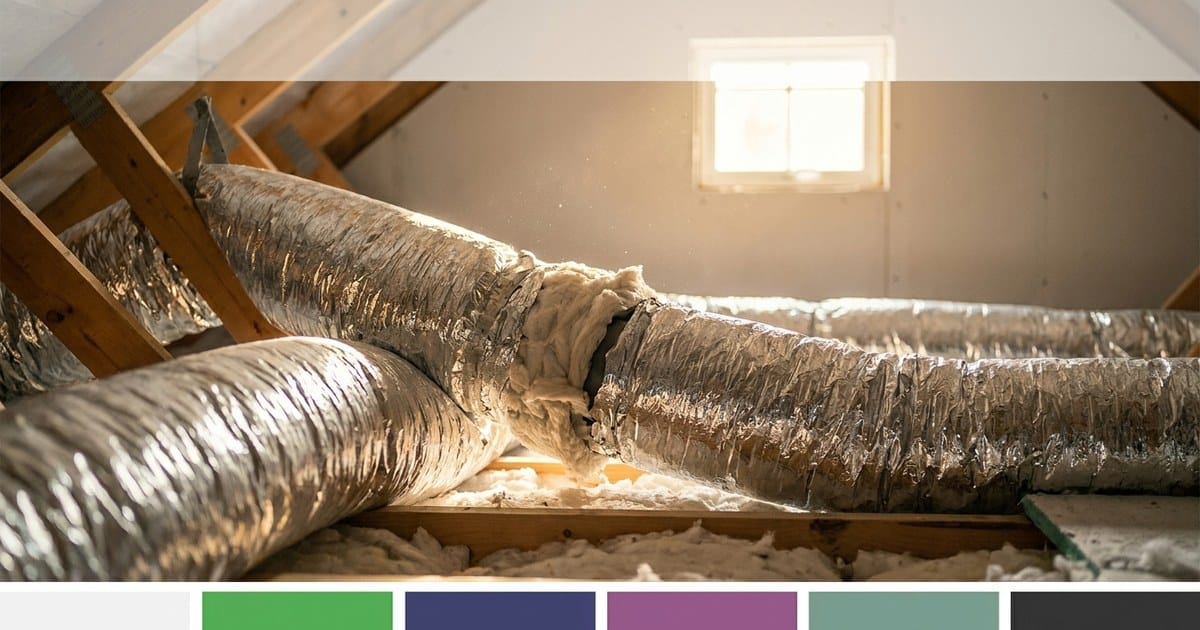
Leaky ducts lose 20 to 30 percent of cooled air before it reaches your rooms. Replacing or sealing ductwork adds $2,000 to $5,000 to your project cost, but it’s often necessary for efficiency. Homes built before 2010 frequently need partial duct replacement. Newer homes may only need sealing at connection points. Honest contractors assess duct condition during the estimate. It’s not an automatic upsell. In our work with East Valley homeowners, we’ve found that homes with original ductwork from the early 2000s often show visible gaps at plenum connections and flex-duct tears in attic spaces.
Sealing those leaks before installing a new system prevents you from cooling your attic instead of your living room. If your energy bills have climbed despite regular maintenance, duct leakage is a likely cause. Modernize’s ENERGY STAR ratings guide explains how duct efficiency impacts overall system performance and why sealed ductwork is as important as SEER rating when calculating real-world energy use.
4. Installation Complexity
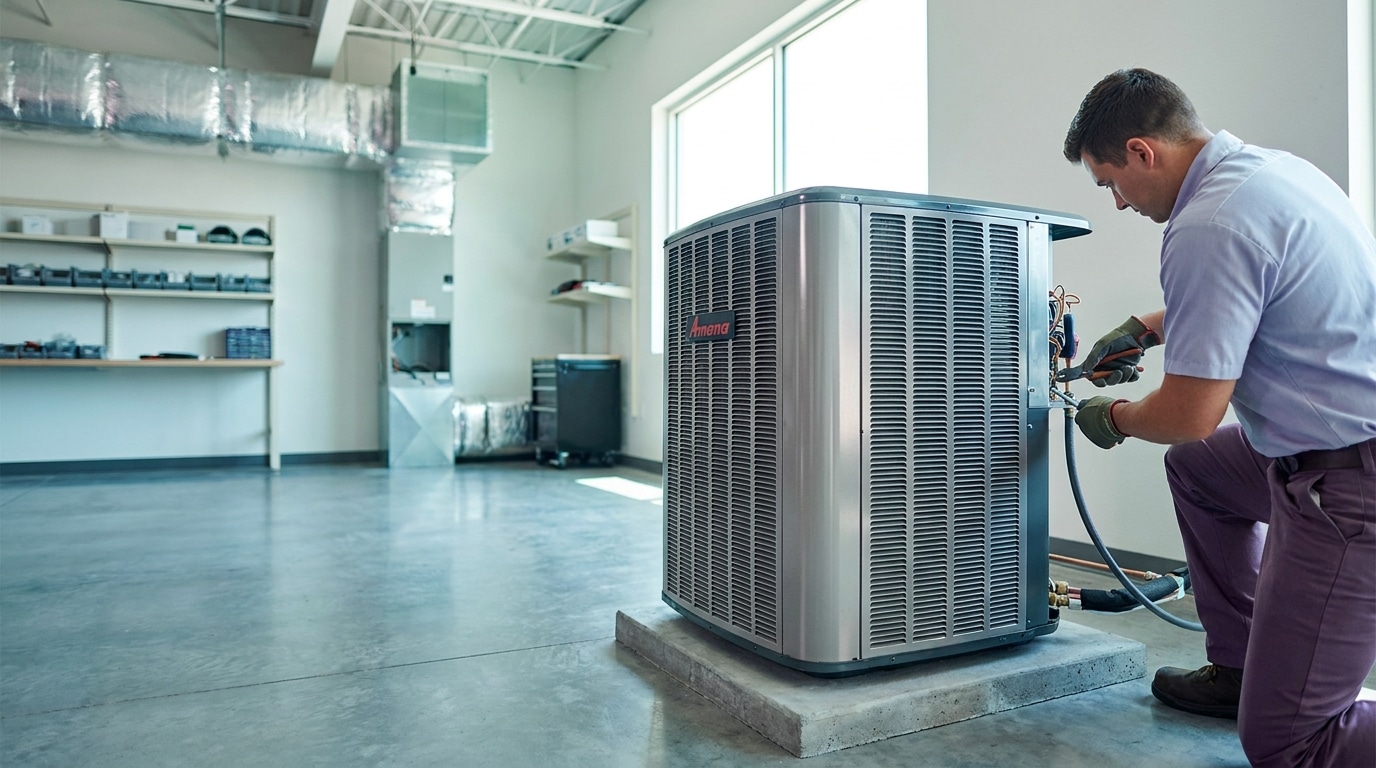
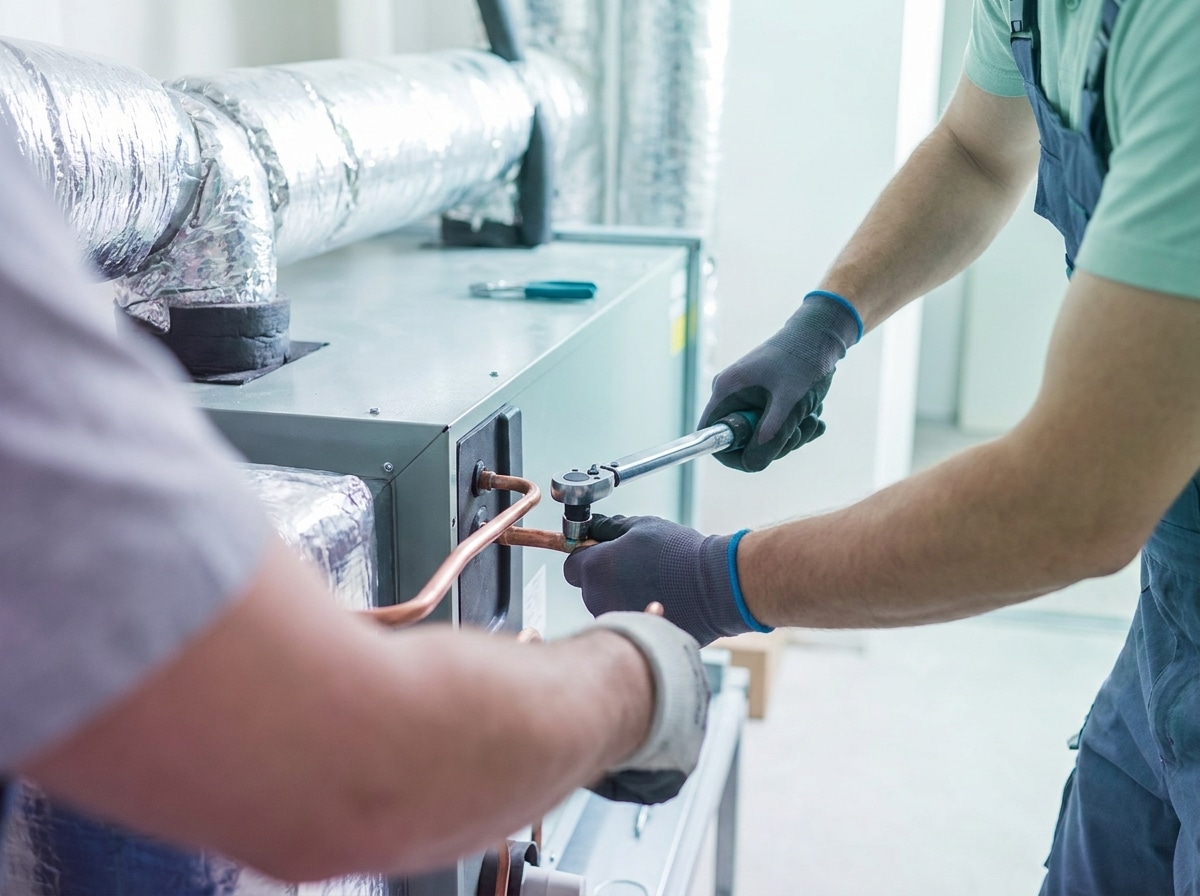
Attic access, roof-mounted units, multi-story homes, and old electrical panels increase labor costs. Quality installation matters more than equipment brand. Poor installation voids warranties and shortens system life. A two-story home in Queen Creek with a roof-mounted condenser and limited attic access will cost more to install than a single-story home with ground-level equipment placement and a walk-in attic. According to Phoenix HVAC installation standards, proper refrigerant line installation, electrical connections, and condensate drainage are non-negotiable steps that take time.
Rushing these steps to save an hour of labor creates callbacks and premature failures. We’ve seen systems installed by discount contractors fail within three years because refrigerant lines weren’t insulated properly or drain pans weren’t pitched correctly. In Arizona’s climate, installation quality adds three to five years of system life compared to rushed installs.
5. Brand, Warranty, and Financing
Premium brands like Amana, Trane, and Carrier cost more upfront but offer longer warranties and better parts availability. Extended warranties and financing options (such as GoodLeap or JB Warranties) add flexibility but increase total cost if you finance long-term. We use Amana equipment because it delivers proven reliability, strong manufacturer support, and competitive pricing without the premium markup of luxury brands. A 10-year parts warranty is standard. Extended labor warranties are available but optional. If you’re financing, understand the terms. Zero-percent introductory rates are excellent if you can pay off the balance in 12 to 24 months, but long-term financing (five-plus years) increases total cost significantly through interest. Transparent contractors itemize warranty and financing costs separately so you can compare apples to apples across quotes.
Hidden Costs to Watch For (and How to Avoid Them)
Bait-and-switch pricing is common in the HVAC industry. Here’s what contractors bury in fine print and how to spot it before signing.
Permit fees often run $200 to $500 depending on your city. Some contractors bury them in the total quote. Others itemize them separately. Ask upfront whether permits are included. Thermostat upgrades add $200 to $600 for smart models. Don’t let contractors auto-include a $500 Nest or Ecobee without asking if you want it. If your current thermostat works fine, keep it.
Refrigerant type matters. Older R-410A systems face supply constraints as the industry shifts to newer refrigerants, which can create price spikes if your system needs a mid-summer refrigerant top-up. Emergency or rush fees apply if your AC dies in July and you need same-day installation. Planning your replacement during fall or winter avoids these surcharges. Duct cleaning is useful if your ducts are filthy, but it’s often oversold as a mandatory add-on. Ask to see the ducts before agreeing to cleaning. If they’re dusty but not moldy or rodent-infested, cleaning is optional.
We avoid surprises by offering free on-site consultations with transparent, itemized quotes. Everything is listed upfront: equipment cost, labor, permits, ductwork modifications, thermostat upgrades (if you want them), and warranty options. No hidden fees. No auto-included add-ons. You see exactly what you’re paying for and why. If you need same-day emergency AC repair in Mesa during a summer breakdown, we’ll tell you upfront if rush fees apply and whether repair or replacement makes more sense given your system’s age and condition.
Is Your System Ready for Replacement or Can Repairs Buy You Time?
Your biggest question right now is probably this: “Do I really need to replace it, or can I squeeze another year out of this thing?” Here’s a decision framework based on age, repair frequency, and cost.
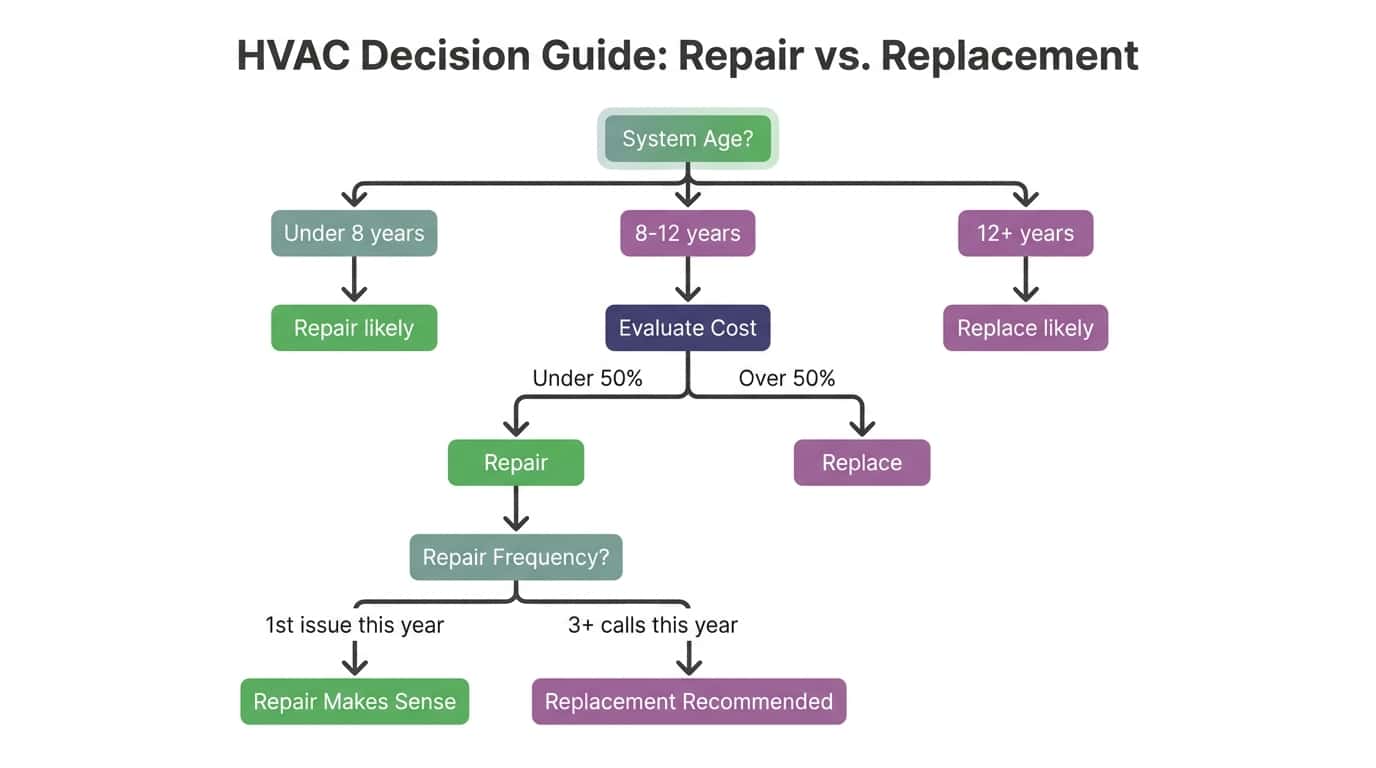
Replace (don’t repair) when your system is 12-plus years old. The average HVAC lifespan in Arizona’s climate is 12 to 15 years. Systems older than that are living on borrowed time. Replace when repair costs exceed 50 percent of replacement cost. If your compressor fails and the repair quote is $3,500, you’re better off putting that money toward a new system with a 10-year warranty.
Replace when you’ve had three or more service calls in a year. Frequent breakdowns signal cascading failures. Fixing one component doesn’t stop the next from failing. Replace when energy bills climb despite regular maintenance. Efficiency loss is a sign of internal wear. Replace when your system uses R-22 refrigerant. R-22 is phased out, so refrigerant refills are expensive and hard to source. A refrigerant leak in an R-22 system is a replacement trigger.
Repair makes sense when your system is under eight years old, you’re dealing with a single component failure (compressor, fan motor) still under warranty, and the system has been well-maintained with no pattern of recurring issues. According to the HVAC Trends 2025 repair-vs-replace survey, industry demand is shifting toward extending system life through targeted repairs when feasible, but only when the underlying system is structurally sound and the repair addresses an isolated failure rather than symptom-treating a dying system.
For a detailed breakdown of when repair makes sense, read our guide to spotting repair-vs-replace signals. It walks through diagnostic red flags and cost-benefit calculations.
How to Budget for Your HVAC Replacement
You understand costs and drivers. Now here’s how to plan the actual purchase without guesswork.
Start by getting three to four estimates. Compare line-item breakdowns: equipment model and efficiency rating, labor cost, ductwork modifications, permit fees, warranty coverage, and financing terms (if applicable). The lowest bid isn’t always best. Ask about warranty duration, installation timeline, and post-install support. A $9,000 quote with a three-year warranty and no callback guarantee is riskier than an $11,000 quote with a 10-year parts warranty and free annual maintenance.
Ask for Manual J load calculations. If a contractor quotes you based on square footage alone without measuring your home, they’re guessing. Guessing leads to wrong-sized systems, which leads to wasted money. Proper load calculations take 30 to 45 minutes and account for insulation, window placement, ceiling height, and sun exposure.
Understand financing terms. Zero-percent introductory rates are excellent if you can pay off the balance in 12 to 24 months. Long-term financing (five-plus years) increases total cost through interest. Calculate the total amount paid over the life of the loan, not just the monthly payment. A $12,000 system financed at six percent over five years costs you $13,920 total. Paying cash or using a short-term loan saves you $1,920.
Plan for off-season savings. Fall and winter installs (October through February) often come with lower prices and faster scheduling because demand drops. Summer emergency installs cost more due to high demand and rush fees. If your system is limping but still running, schedule the replacement in November and save 10 to 15 percent.
Factor in long-term savings. A $13,000 high-efficiency system that saves $80 per month on electricity pays for itself faster than a $9,000 inefficient system. Over 10 years, that $80-per-month savings totals $9,600, which offsets the higher upfront cost and then delivers pure savings for the remaining system life. For personalized help planning your replacement budget, schedule our free HVAC consultation and transparent estimates with no obligation.
What You Get When You Choose JLM for Your HVAC Replacement
We’re owner-led and family-owned. Bill Milbourn is licensed, on the job, and accessible. You’re not calling a corporate franchise call center. You’re talking to the people doing the work. We’ve completed over 3,000 lifetime installs across Gilbert, Queen Creek, Mesa, and Apache Junction using premium Amana equipment. Our track record speaks: A+ BBB rating, transparent pricing, no hidden fees, and honest assessments. We tell you what you need versus what’s optional. If repairs buy you two to three more years, we say so. If replacement is smarter long-term, we explain why with numbers, not pressure.
Every job starts with a free on-site consultation. We measure your home, assess ductwork condition, and give you a line-item quote before you commit. No surprises mid-job. No auto-included upgrades you didn’t ask for. Everything is itemized: equipment cost, labor, permits, ductwork modifications (if needed), thermostat options, and warranty coverage. You see exactly what you’re paying for and why.
We offer same-day availability for emergencies because Arizona heat doesn’t wait. If your AC fails in July, we’ll get you back online fast. But we also help you avoid emergencies by being honest about replacement timing. Replacing a 13-year-old system in October (when it’s still running) costs less than replacing it in July after it dies and you’re facing rush fees.
In our work with East Valley homeowners, we’ve found that proper system sizing and quality installation add three to five years to system lifespan compared to rushed or undersized installs. That’s not marketing talk. It’s what happens when you take time to do load calculations, seal ductwork properly, and install refrigerant lines to manufacturer specs instead of cutting corners to save an hour of labor. To keep your new system running efficiently for its full 15-year lifespan, explore our preventive maintenance plans designed specifically for East Valley climate conditions.
Your Next Step: Get a Transparent Quote with No Pressure
HVAC replacement costs $9,000 to $20,000 in Arizona. Most East Valley homes pay around $11,000 for a quality mid-efficiency system. The final price depends on system size, efficiency rating, ductwork condition, and installation complexity. Honest contractors give you transparent quotes, itemized breakdowns, and no-pressure consultations. They tell you what you need versus what’s optional. They size your system properly using Manual J load calculations instead of guessing based on square footage. They explain financing terms, warranty coverage, and long-term savings so you can make an informed decision.
If you’re ready to stop worrying about surprise fees and predatory upselling, we’re here to help. We’ve installed over 3,000 systems across Gilbert, Queen Creek, Mesa, and Apache Junction. We know what works in Arizona’s climate. We’ll measure your home, assess your ductwork, and give you a line-item quote with no hidden charges. If repairs make sense, we’ll tell you. If replacement is smarter, we’ll explain why with numbers, not pressure.
For more expert insights and practical tips on maintaining your comfort system year-round, explore our HVAC tips and updates for Gilbert residents. Our library covers everything from seasonal prep to troubleshooting common issues.
Looking to extend the life of your current system while you plan for replacement? Check out our guide on the smart way to prep your AC for Gilbert’s summer that can help you squeeze another season out of an aging unit when replacement timing isn’t ideal. For specialized cooling needs in spaces beyond your main living area, review garage AC options that don’t overwhelm small spaces to understand how ductless solutions can complement or extend your primary HVAC investment.
Ready for a transparent quote on your HVAC replacement? Call now: 602-619-3609 or schedule your free consultation online. No hidden fees, no pressure. Just honest answers and quality work from people who live in your community.
By JLM Air Conditioning & Heating