
It’s Saturday, the ladder is out, and the filter is overdue. The HVAC maintenance DIY professional question has a clear answer.
What can you DIY, and what needs a professional? You can safely handle filter changes, outdoor unit clearance, thermostat batteries, vent checks and a simple condensate line flush yourself. Call a licensed professional for refrigerant, electrical components, coil and blower cleaning, and any grinding, short cycling or ice. Most East Valley homes do best with DIY upkeep plus a twice-yearly professional tune-up.
We’re a family-owned company, and we’d rather tell you what to do yourself than sell you a visit you don’t need. If you want the full list of basics first, start with our complete AC maintenance checklist. Then come back here to see where DIY stops.
Handling the basics is smart. It keeps airflow clean, catches small problems early and saves you money. It just isn’t a substitute for an inspection of the parts you can’t see. Below, we sort the HVAC maintenance tasks homeowner and professional each handle best, explain the reasons, and give you a simple schedule built for East Valley heat.
The breakdowns we see usually come from two gaps: skipping the basics, and skipping the inspection. Do both jobs and your system has a much better shot at getting through a 110-degree afternoon.
HVAC maintenance DIY professional split: what’s yours and what’s ours?
DIY covers anything you can do with the breaker off and no tools beyond a screwdriver: filters, clearing debris, batteries, vents and the drain line. Pros handle refrigerant, electrical testing, internal coil and blower cleaning, and safety checks. If a task involves live power, refrigerant or sealed components, call a licensed technician.
Here is the split at a glance:
| Do it yourself | Call a pro |
|---|---|
| Replace the air filter | Refrigerant checks, leak repair and recharging |
| Keep two feet clear around the outdoor unit | Capacitor, contactor and wiring tests |
| Clear leaves, cottonwood and debris from the outside | Coil and blower cleaning inside the unit |
| Vacuum vents and registers | Heat exchanger and combustion safety checks |
| Flush the drain line with warm water and white vinegar | Ductwork diagnosis beyond small visible gaps |
| Replace thermostat batteries | Any grinding, ice, burning smell or short cycling |
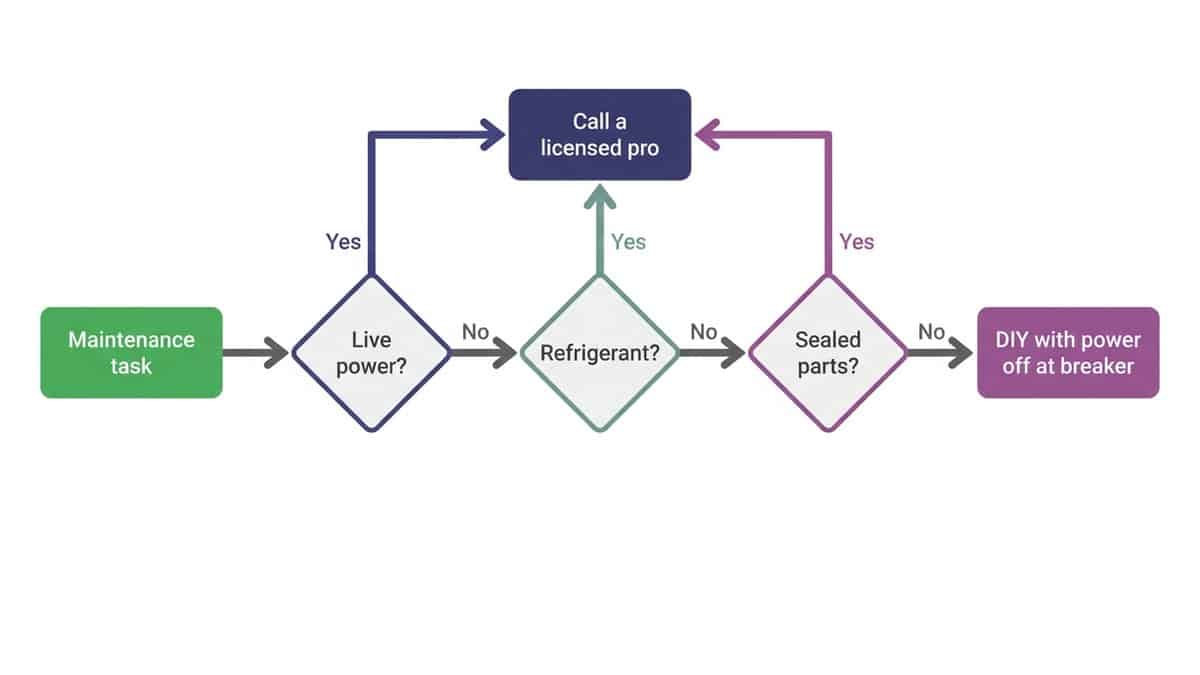
The live-power, refrigerant, sealed-parts test. Before any task, ask three questions. Does it need live power? Does it involve refrigerant? Does it mean opening a sealed or factory-closed part? One “yes” means call a licensed technician. Three “no” answers mean you can probably do it yourself, with the breaker switched off first.
The refrigerant rule is more than caution. Under Section 608 of the Clean Air Act, EPA's technician certification rules (40 CFR Part 82, Subpart F) require certification for anyone who maintains, services, repairs or disposes of equipment that could release ozone-depleting refrigerants.
Why DIY has limits in Arizona. Our systems run hard for long stretches. Summer heat keeps the compressor working for months, and monsoon dust loads filters and outdoor units faster than most homeowners expect. Winter heating adds its own wear. A system under that much stress hides problems well, which is why a quick visual check by you and a full inspection by a pro do different jobs. A good HVAC maintenance DIY professional routine uses both. If you’re wondering how often the pro side should happen, we break that down in our guide on how often an AC should be serviced.
There’s a business reason we write this guide, and we’ll say it plainly. Most of our customers come from neighbors who trust us, and they read reviews before they ever call. A seasonal tune-up that’s worth booking, ideally through a maintenance plan, earns that trust. A visit you didn’t need loses it. So we tell you what you can skip.
Takeaway: If a job touches live power, refrigerant or sealed parts, it belongs to a licensed technician.
Which maintenance tasks can you do yourself?
DIY works best on tasks that are visible, low-risk and repeatable. The rule for every one of them: shut off power at the breaker before touching anything outdoors, and never use a pressure washer on the coils. Water at that pressure bends the fins and drives grime deeper in. For a season-by-season version of these jobs, see our spring, summer and fall maintenance tasks.
In our work across 3,000+ installs and service calls in the East Valley, the same few neglected basics keep showing up on breakdown calls: a clogged filter, a blocked condensate line, an outdoor unit buried in debris. None of them takes special skill. That answers the question many owners ask us: if I change my own filter and keep the unit clear, do I really need a pro? Yes, for the inside work covered below. But these basics are yours to own, and doing them well makes your bill smaller and our job easier.
Change the filter
This is the most valuable DIY job you have. A clogged filter chokes airflow, forces the system to work harder and sits behind many summer breakdowns. Check it monthly in Arizona’s dust. The full steps are in the next section.
Keep two feet clear around the outdoor unit
Walk the unit each season. Trim shrubs, move stored items and leave two feet of open space on every side. The outdoor unit has to shed heat, and a crowded unit runs hotter and wears out sooner.
Clear leaves, cottonwood and debris
After windstorms and monsoon dust, pull leaves, cottonwood fluff and grit off the top and sides by hand or with a soft brush. Stay on the outside of the cabinet. Cleaning the coils inside is a pro job. Debris blocks airflow the same way a dirty filter does.
Vacuum vents and registers
Open every vent, keep furniture and rugs off them, and vacuum the grilles each season. Blocked vents throw off airflow balance, and that is how one room ends up never cooling.
Flush the condensate line
Your AC pulls moisture from the air and sends it down a drain line. Algae and grime can clog it. Once a season, with the system switched off at the breaker, pour about a cup of warm water mixed with white vinegar into the line’s access port. We only recommend white vinegar, not bleach. If you see standing water in the drain pan, or the line won’t clear, stop and call us. A backed-up line can shut the system down or damage ceilings.
Replace thermostat batteries yearly
Swap the batteries once a year, before they die on a hot day. That is as far as we’d go on the thermostat. If it misbehaves after fresh batteries, skip the reset-guide rabbit hole. The cause is often the AC itself, and it’s worth an AC repair call in Gilbert, Mesa or wherever you live rather than another hour of troubleshooting.
Seal small visible duct gaps
Where you can see a small gap at an easy-to-reach joint, seal it with mastic or foil-backed tape. Standard duct tape dries out and fails quickly. Leaky ducts waste the cool air you paid for. Anything hidden in the attic, crushed or disconnected is a job for a technician.
Takeaway: Filters, clearance, vents, the drain line and batteries are yours to own, and a little attention to each pays off all summer.
AC filter replacement DIY: step by step
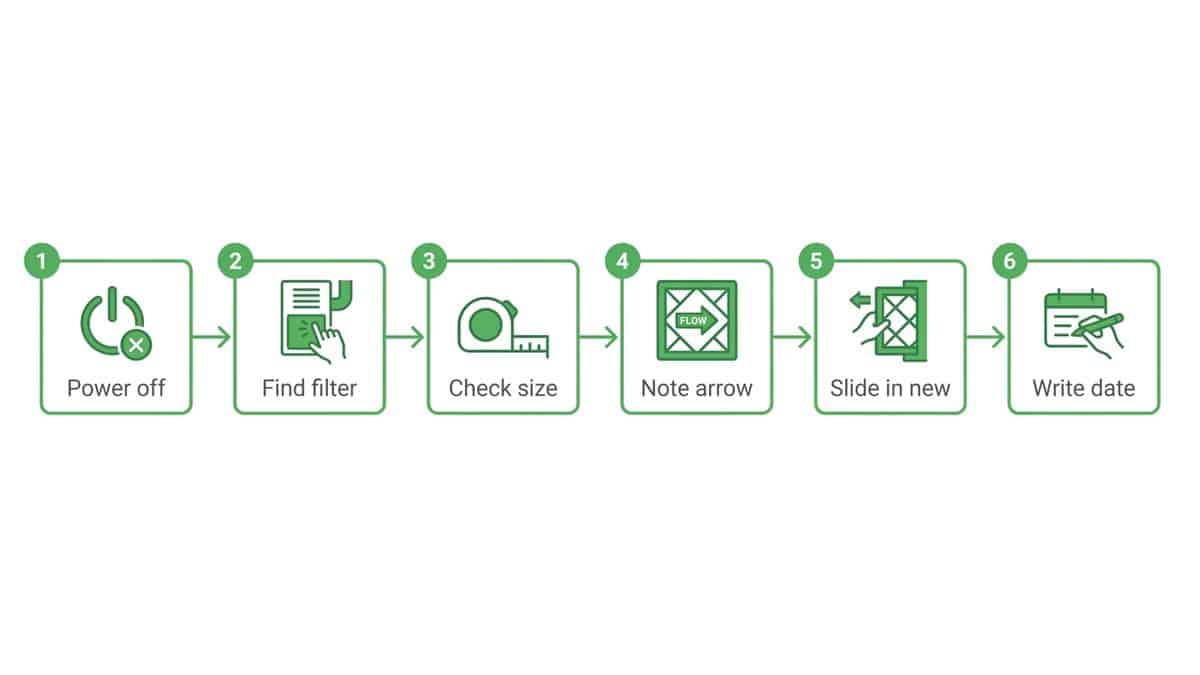
Turn the system off, slide out the old filter, note the airflow arrow, and insert a new one of the same size facing the same direction. Check it monthly in Arizona’s dust and replace it when light no longer passes through. It takes about five minutes. AC filter replacement DIY is the best return on five minutes you will find in home maintenance.
The five-minute swap
- Turn the system off at the thermostat. If the filter sits in an attic air handler, flip the breaker too, and go early in the morning before the attic heats up.
- Find the filter. It sits either behind a return grille in a wall or ceiling, or in a slot at the air handler.
- Slide out the old filter and read the size printed on the frame. Buy that exact size.
- Look for the arrow on the frame. It points toward the blower, the direction the air travels.
- Slide the new filter in with the arrow pointing the same way.
- Close the cover, turn the system back on and write the date on the frame.
How often in Arizona
East Valley homes need filter checks more often than homes in gentler climates, because dust, pollen and wind-blown grit load a filter quickly. Skip the calendar rule and use the light test. Hold the filter up to a window or flashlight. If light can’t pass through, replace it. Pets, nearby construction and windy season all speed things up. Our guide on how often to change your filter in Arizona goes deeper on timing.
Picking a filter without overbuying
A higher-rated filter catches finer particles, but denser media also restricts airflow. A system not built for that restriction can strain, and strain shortens its life. Start with the type and rating your equipment calls for, and step up only if your system handles it. Our explainer on what MERV ratings mean for Arizona dust walks through the trade-offs. If you aren’t sure what your system can handle, ask us at your next tune-up.
Takeaway: Use the right size, follow the arrow, trust the light test, and don’t assume the densest filter is the best one.
Which HVAC tasks need a professional?
In any HVAC maintenance DIY professional plan, some jobs stay off your list for good reasons. We’ll give you each reason instead of a scare line. Because these are the jobs a seasonal tune-up exists to cover, they are also why a maintenance plan pays for itself over the years.
Refrigerant checks and leaks
Refrigerant runs in a sealed loop. It isn’t like gas in a car. If the level is low, there is a leak somewhere. Handling it takes federal certification, as covered earlier, and a proper repair means finding and fixing the leak, not just topping off. Small leaks caught early also protect the compressor, which is the most expensive part of your system.
Electrical components
Capacitors, contactors and wiring take the most punishment in peak heat, and they carry real shock risk. Capacitors can hold a charge even after the breaker is off. A technician tests them with the right meters and the right training.
Coil and blower cleaning
The coils and blower sit inside the unit, wedged between delicate fins and wet electrical parts. They are easy to damage and hard to clean well. Dirty coils make the system work harder and shorten its life, so this is worth doing right.
Heat exchanger and combustion safety
If you have a gas furnace, the heat exchanger and burners are a safety matter. A technician inspects them for cracks, proper combustion and venting. If your carbon monoxide alarm sounds, leave the house and call for emergency help.
Ductwork diagnosis
Small visible gaps are yours to seal. Hidden leaks, crushed runs, poor balance or rooms that never get comfortable need a technician with the right tools to find the cause.
A word on larger jobs and paperwork. Replacing major equipment involves licensed contractors and local permit rules, so check your local requirements before any big project. Also check your manufacturer’s warranty terms, and keep dated records of your filter changes and professional visits. Our trained, licensed team and A+ BBB rating are why neighbors send us their friends and family. For a deeper look at the pro side, read our guide to HVAC preventative maintenance.
Takeaway: Every pro-only task involves live power, sealed parts or safety risk, and the cost of a wrong guess is a bigger repair bill.
What does a professional AC tune-up include?
A professional AC tune-up tests electrical components, checks refrigerant, cleans the coils and blower, flushes the drain and inspects the whole system. Our maintenance visit follows a 50-point inspection so small problems get caught before a summer breakdown.
In plain English, here is what that covers:
- Electrical: testing capacitors, contactors, wiring and connections for wear.
- Refrigerant: checking the system for proper operation and signs of a leak.
- Coils and blower: cleaning the parts you shouldn’t reach into yourself.
- Drain service: clearing the line and pan so water leaves the home as it should.
- Filtration check: confirming your filter type suits the system.
- System health report: a summary of what we found and what, if anything, needs attention.
You might wonder whether a tech will just upsell you. A trustworthy tune-up looks like this: you get a written findings report, a clear explanation in everyday words, and a quote before any extra work begins. That is how we run it, with transparent pricing and no hidden fees. If we find a repair or an upgrade, we tell you what’s needed, what’s optional and what can wait. Many customers come to us through neighbors, and that only works when we give honest advice.
If a visit does turn up a repair, you don’t have to start over with a new company. The same team handles emergency repair, system replacement and installation, and ductwork, so the person who knows your system’s history is the one who fixes it. In a valley where an upgrade decision can come up in the middle of a heat wave, that continuity saves time.
Our maintenance plan members get priority scheduling and repair discounts, which matters most when the whole valley is calling for service in July. You can see the full range of what we offer on our page about heating and air conditioning services in Arizona's East Valley.
Takeaway: A good tune-up covers what you can’t see or safely touch, ends with a written report, and never asks you to commit before you’ve seen the quote.
When should you stop and call a pro?
Stop and call if you hear grinding, squealing or banging, see ice on the unit, smell burning, notice standing water that won’t clear, or find the system short cycling or running nonstop. Shut the system off first, then call.
The red-flag list:
- Grinding, squealing, banging or rattling
- Ice on the refrigerant lines or the unit
- Short cycling or running nonstop
- A burning smell
- Standing water that won’t clear
- Weak airflow paired with rising bills
Stay calm and take the steps in order. Turn the system off at the thermostat, and at the breaker if you smell burning. Don’t keep running it to see what happens, because that is how a small repair becomes a big one. If you see ice, our guide on what to do when your AC freezes up explains why it happens and what to do while you wait. For slower warning signs, see signs your AC needs service soon.
When the afternoon hits 110 degrees, “later” isn’t an option. Summer is when emergency calls peak across Mesa, Chandler, Gilbert and Queen Creek, and it’s why we run emergency and same-day repair around the clock. We offer 24/7 emergency service and same-day availability when you need us.
And if the same failure keeps coming back, it may be time to ask a bigger question: keep repairing, or replace? That is a decision, not a panic move. We call it making the right decision on system replacement and installation, and we’ll walk you through it without pressure, with the numbers laid out in plain terms.
Takeaway: When your system makes a new noise, grows ice or smells like burning, shut it off first and call second.
How often should you do each task?
Check filters monthly in Arizona, clear the outdoor unit and check the drain line each season, and replace thermostat batteries yearly. Schedule a professional tune-up twice a year, ideally spring and fall, before the heavy summer and winter demand.
Here’s a simple year-round HVAC maintenance DIY professional schedule for East Valley homes:
| Task | Who | How often |
|---|---|---|
| Check the filter (light test) | You | Monthly |
| Clear the outdoor unit and remove debris | You | Each season |
| Vacuum vents and registers | You | Each season |
| Flush the condensate line | You | Each season |
| Replace thermostat batteries | You | Yearly |
| Check small duct gaps | You | Yearly |
| Professional tune-up | Pro | Twice a year, spring and fall |
Why spring and fall beat the middle of summer. Heating and cooling companies are busiest at the seasonal peaks. Book in the shoulder seasons and you get easier scheduling, and a technician has time to find small issues before the heat or cold arrives. A tune-up in April catches the problem before it becomes a July emergency. A visit in October gets your system ready for the colder months. Skip the spring visit and the first sign of trouble often arrives on the hottest weekend of the year, when emergency and same-day repair crews are already stretched.
Our neighborhood is our specialty. We know how East Valley dust, monsoon wind and long cooling seasons treat a system, and for homeowners in Mesa, Chandler, Gilbert, Queen Creek and San Tan Valley this rhythm is simple to keep: a quick monthly check, a seasonal walk-around and two professional visits. If you’d rather not track it yourself, a maintenance plan builds the pro visits into your calendar. Our four-season guide, the HVAC maintenance checklist for spring, summer, fall and winter, is a good companion, and you can browse our full range of HVAC services for residential and commercial customers in the East Valley.
Takeaway: A monthly filter check, a seasonal walk-around and two pro visits a year cover nearly everything a system needs.
When is maintenance no longer enough?
Maintenance extends the life of a system, but not forever. There is no single age rule for replacing an HVAC system. What matters is the pattern: repeated repairs on an older unit are the signal to weigh. A repair bill here and there is normal. A string of them is a sign to compare the cost of keeping the old system against a new one.
Homeowners searching for AC repair in Gilbert, HVAC repair in Queen Creek or AC installation in Queen Creek are often facing exactly this question. The honest answer depends on the repair history, the system’s performance and what the next repair would cost. A thermostat that keeps acting up, a unit that struggles on 110-degree days and a pile of recent repair invoices point to a bigger conversation than one more battery swap. Our emergency repair vs. maintenance cost comparison lays out how to think it through. If you want a second opinion, we offer a free on-site consultation, with no pressure to replace anything.
Takeaway: Judge replacement by how often the system fails, not by a single age number.
Where to draw your own line
Here’s the HVAC maintenance DIY professional line in three points:
- Do the visible, low-risk basics yourself: filters, clearance, vents, the drain line and batteries.
- Leave refrigerant, electrical parts, internal cleaning and safety checks to a licensed technician.
- Book a professional tune-up twice a year, spring and fall, so small problems never become summer emergencies.
You don’t need to be a pro to keep your system healthy, and you don’t need to guess about the rest. Not sure which side of the line your system falls on? Ask us. We’re a family-owned team that lives in the East Valley, and we’ll tell you honestly what you can handle and what you can’t.
Ready to put the pro half on your calendar? Schedule your spring or fall tune-up with JLM, or call us directly at 602-619-3609.