In Arizona, change your HVAC filter every 30–60 days, significantly more often than the national 90-day standard. Desert dust, year-round AC operation, monsoon dirt, and extreme heat accelerate filter clogging. Homes near construction, with pets, or running AC 24/7 in summer should inspect filters monthly and replace at the first sign of heavy buildup. A clogged filter forces your system to work harder, raising energy bills and risking breakdowns during peak cooling season.
If you live in the East Valley, you’ve probably noticed how quickly dust accumulates on furniture, how your AC runs nearly nonstop from May through September, and how haboobs can coat your entire neighborhood in a layer of fine dirt within minutes. These conditions don’t just make your home dusty; they put extreme stress on your HVAC system, and your air filter bears the brunt of it. The generic advice you’ll find on manufacturer labels or national HVAC blogs simply doesn’t account for Arizona’s unique challenges. Understanding the real replacement schedule for desert conditions will protect your comfort, lower your energy bills, and extend the life of your system. For comprehensive guidance on preparing for Arizona’s demanding climate, visit our Air Conditioning | AC Technician Near Me resource center and explore The Smart Way to Prep AC for Gilbert’s Hot Summer.
Why Arizona’s Climate Demands a Different Filter Schedule
Arizona’s desert environment creates a perfect storm of factors that clog HVAC filters faster than anywhere else in the country. While homeowners in temperate climates might safely follow the standard 90-day replacement schedule, East Valley residents face conditions that make that timeline dangerously optimistic. If you’re wondering when professional maintenance becomes essential beyond DIY filter changes, Do You Really Need Professional AC Repair in Mesa? explains when to call in expert help.
Desert Dust and Monsoon Season: A Filter’s Worst Enemy
The Phoenix metro area, including Gilbert, Queen Creek, Mesa, and Apache Junction, experiences some of the highest airborne particulate levels in the nation. Fine desert dust hangs in the air year-round, settling on every surface and getting pulled into your HVAC system with every cooling cycle. According to the Arizona Department of Environmental Quality, PM10 (particulate matter 10 micrometers or smaller) levels in the East Valley regularly exceed those in most other U.S. metropolitan areas, particularly during the dry spring months before monsoon season.
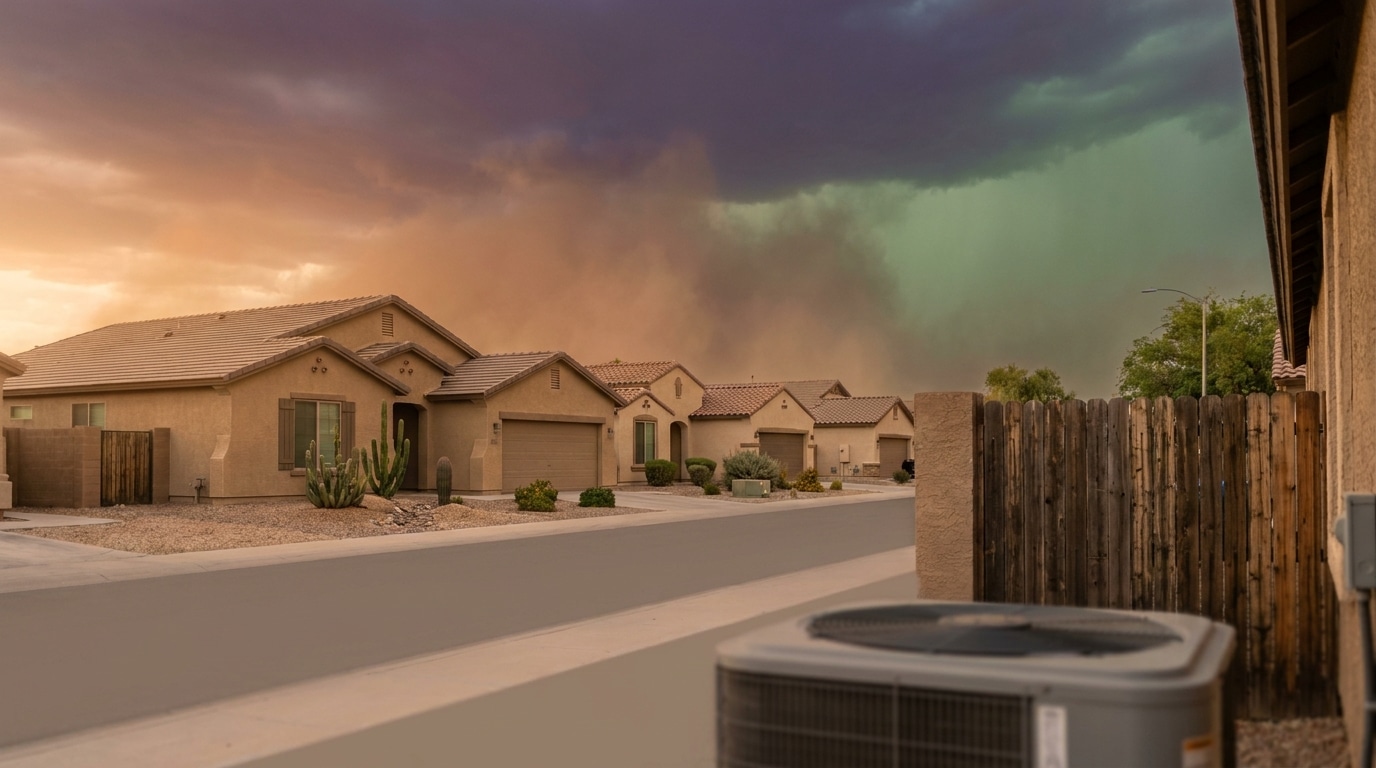
Then comes monsoon season, typically running from June through September. Haboobs (massive dust storms that can tower thousands of feet high and span miles wide) roll through the Valley with little warning. A single haboob can deposit enough dust and debris to completely clog an HVAC filter in a matter of days. Even smaller dust devils and afternoon thunderstorms kick up dirt that infiltrates homes through every crack and gap, overwhelming filtration systems that were designed for gentler conditions.
Pollen season adds another layer of stress. Desert plants like palo verde, mesquite, and various grasses release pollen from late winter through early summer, creating a dense mix of biological and mineral particles that your filter must capture. Many East Valley residents with allergies discover their filters are packed solid with pollen and dust long before the calendar suggests it’s time for a change.
Year-Round AC Use Accelerates Clogging
In most parts of the country, HVAC systems sit idle for months at a time. Northern homeowners might run their AC for three or four months in summer, then switch to heat for the winter. That limited runtime means their filters accumulate particles slowly.
Arizona is different. Your AC runs nearly year-round. From April through October, daytime temperatures regularly exceed 100°F, and your system cycles constantly to maintain a comfortable indoor temperature. Even in winter, mild afternoons often trigger cooling cycles. According to ACCA’s filtration guidance, an HVAC system that runs 8 to 10 hours per day in moderate climates will expose its filter to significantly less airflow than one running 18 to 20 hours per day during an Arizona summer.
More runtime means more air passing through the filter. More air means more dust, pollen, pet dander, and other particles trapped in the filter media. In our work with East Valley customers, we’ve found that homes near construction zones or with pets often need monthly replacements during summer, while well-sealed homes without pets can stretch to 60 days. But stretch much beyond that, and you’re asking for trouble.
Construction Activity and New Developments in the East Valley
If you live in or near one of the many new housing developments sprouting up across Gilbert, Queen Creek, and Apache Junction, your filter faces even more stress. Active construction sites generate enormous amounts of dust: cement powder, drywall particles, sawdust, dirt from excavation, and fine debris from roofing and framing work. These particles travel for miles on the wind and infiltrate nearby homes.
Homes built in the last five years in new East Valley developments see filter degradation rates two to three times faster than those in established neighborhoods, particularly if construction is ongoing within a quarter mile. Your HVAC system pulls in outdoor air through small gaps in your home’s envelope, and construction dust is so fine that it bypasses many of the natural barriers (landscaping, window screens) that help filter larger particles.
Even if you’re not immediately adjacent to a construction zone, the sheer volume of building happening across the East Valley means more airborne dust for everyone. The combination of natural desert conditions and human activity creates a filtration challenge that national HVAC guidelines simply weren’t designed to address.
The Standard 90-Day Rule Doesn’t Apply Here
Walk into any home improvement store and check the label on a standard HVAC filter. You’ll see the manufacturer’s recommendation: change every 90 days. That guidance is based on average conditions in moderate climates with typical runtime. It assumes your system runs intermittently, your air quality is relatively clean, and your home isn’t subjected to extreme heat, dust storms, or year-round AC operation.
According to research on how Arizona dust affects HVAC performance, filters in desert climates accumulate particulate matter at rates three to four times faster than those in humid or temperate regions. The 90-day standard was never intended for environments where your AC runs 16+ hours a day for six months straight while pulling in air laden with fine desert dust.
Even industry standards from organizations like ASHRAE (American Society of Heating, Refrigerating and Air-Conditioning Engineers) and ACCA (Air Conditioning Contractors of America) acknowledge that local conditions must inform maintenance schedules. ASHRAE’s technical guidance on filtration provides baselines for filter selection and replacement, but explicitly states that high-dust environments, extreme temperatures, and continuous system operation require more frequent inspection and replacement. ASHRAE’s consumer resources further emphasize the importance of adapting maintenance schedules to regional climate conditions, especially in desert environments where air conditioning systems operate under continuous load.
The disconnect between national recommendations and Arizona reality creates a dangerous gap. Homeowners who dutifully follow the 90-day schedule often discover their filters are completely clogged by day 45 or 60. By the time they remember to check, their system has been working against a blockage for weeks, wasting energy and straining components. The simple truth is this: if you’re changing your filter every 90 days in Arizona, you’re changing it too late.
How Often You Should Actually Change Your Filter in Arizona
Now for the actionable answer you came for. Based on typical East Valley conditions, here’s what you should actually do. For context on why this maintenance matters so much in Arizona’s heat, see Is Spring Too Early to Plan for Arizona AC Tune-Up?. The short answer is no, and filter maintenance is a key part of that preparation.
Standard Schedule: Every 30 to 60 Days for Most East Valley Homes
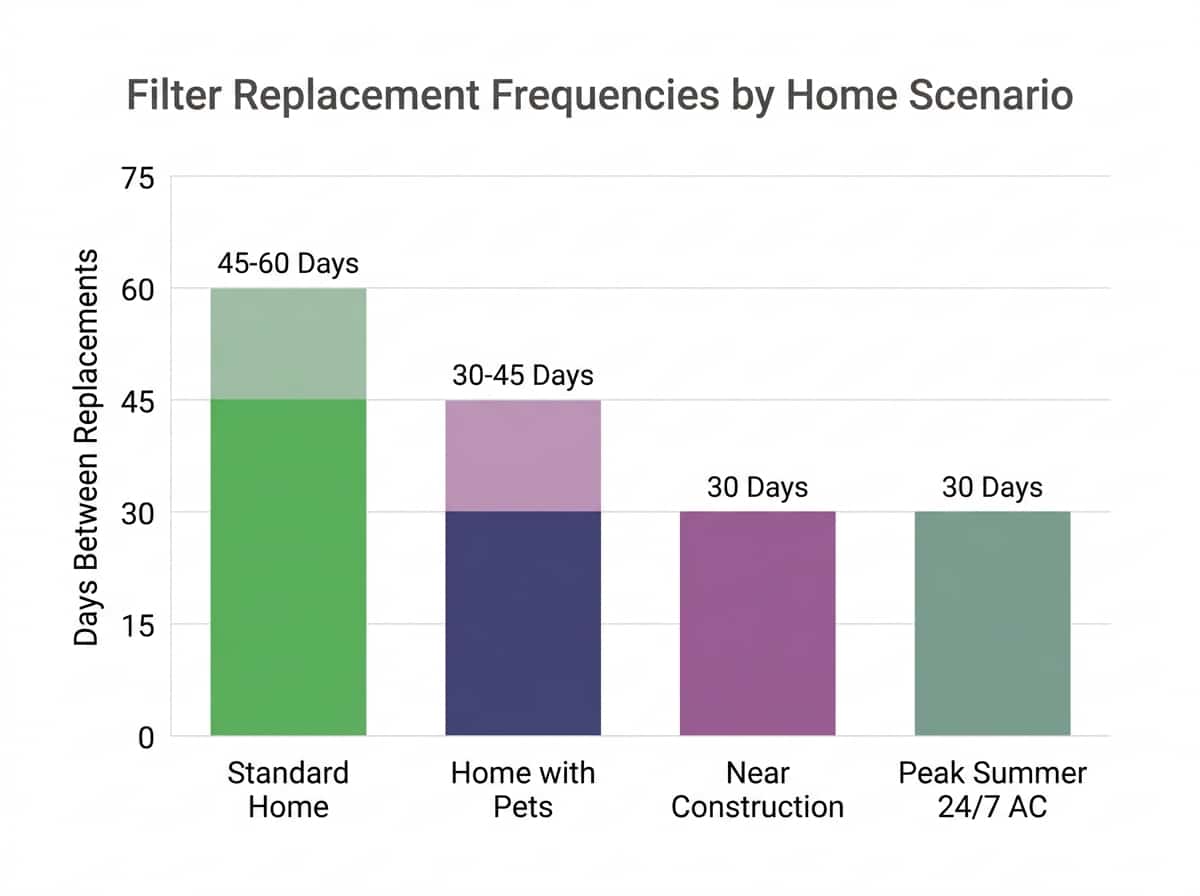
For a typical single-family home in Gilbert, Mesa, Queen Creek, or Apache Junction with no pets, moderate occupancy, and standard 1-inch pleated filters, plan to inspect your filter every 30 days and replace it every 45 to 60 days during peak cooling season (May through September). During milder months (October through April), you can extend that to 60 to 75 days, but you should still inspect monthly.
This schedule assumes:
- Your home is reasonably well-sealed (no major gaps around doors, windows, or ducts)
- You’re running a standard 1-inch pleated filter with a MERV rating between 8 and 11
- You don’t have pets
- You’re not located near active construction
- Your AC is properly sized and maintained
If any of those assumptions don’t hold, you need a more aggressive schedule.
High-Use Scenarios: Monthly Checks During Peak Summer
During Arizona’s brutal summer months, when outdoor temperatures hit 115°F and your AC runs almost continuously, monthly replacement becomes necessary for many homes. You should check your filter every 30 days and replace it immediately if you see:
- Visible dirt coating the entire surface
- Gray or black discoloration (a clean filter is white or light blue)
- Reduced airflow when you hold your hand near a supply vent
- Increased dust accumulation on furniture despite regular cleaning
Homes with pets need monthly replacement year-round. Dog and cat hair, dander, and tracked-in dirt add a significant particulate load that standard filters can’t handle for more than 30 to 45 days. If you have multiple pets or large dogs that shed heavily, inspect your filter every two weeks during summer.
If you live near active construction, treat your filter as a monthly consumable. The volume of airborne dust from nearby building sites will overwhelm even high-quality filters in 30 days or less. Some of our customers in rapidly developing parts of Queen Creek and Gilbert have needed replacement every 20 to 25 days during heavy construction phases.
Filter Type Matters: 1-Inch vs. 4-Inch Pleated vs. HEPA
Not all filters are created equal, and the type you use directly affects how often you need to replace it.
1-inch disposable pleated filters (MERV 8 to 11) are the most common and are adequate for most Arizona homes. They’re inexpensive ($15 to $25) and easy to replace, but they have limited surface area and clog faster under heavy dust loads. Plan on 30 to 60 day replacement cycles with these.
4-inch or 5-inch media filters offer significantly more surface area and can capture more particles before airflow restriction becomes a problem. These are typically installed in a dedicated cabinet adjacent to your air handler and cost more upfront ($40 to $80 per filter), but they can last 6 to 12 months in moderate climates. In Arizona, expect to replace them every 3 to 6 months depending on conditions. The added surface area makes them a good choice if you want to reduce replacement frequency without sacrificing filtration efficiency.
HEPA filters provide the highest level of filtration (capturing 99.97% of particles 0.3 micrometers or larger) but require a compatible system. Most residential HVAC systems aren’t designed to handle the airflow restriction of a true HEPA filter, so retrofitting one can reduce efficiency and strain your blower motor. If you have severe allergies or respiratory issues, talk to a qualified HVAC technician before upgrading to HEPA. You may need a dedicated air purifier instead of forcing your HVAC system to do work it wasn’t designed for.
What Happens When You Skip Filter Changes
Ignoring your filter replacement schedule doesn’t just inconvenience you. It costs you real money and puts your entire system at risk. Here’s what happens when a clogged filter forces your HVAC system to work against resistance. For guidance on when problems escalate beyond what regular maintenance can prevent, check out Why Summer in Mesa Demands Fast AC Repair.
Reduced Airflow and Strain on Your System
A clean filter allows air to pass through freely, letting your system move the volume of air it was designed to handle. As the filter clogs with dust, pollen, and debris, airflow decreases. Your blower motor has to work harder to pull air through the blockage, which increases energy consumption and puts mechanical stress on components.
Restricted airflow also means your evaporator coil (the cold component inside your air handler) doesn’t receive enough warm air to absorb heat effectively. The coil gets too cold, and moisture freezes on its surface. Ice buildup further restricts airflow, creating a cascading problem. If left unchecked, a frozen coil can cause your compressor (the most expensive component in your system) to overheat and fail.
According to FilterBuy’s guide on safe filter replacement, even a partially clogged filter reduces system airflow by 20 to 30%, forcing your blower motor to run longer and work harder to achieve the same cooling effect. That extra runtime translates directly to higher energy bills and accelerated wear on fan bearings, belts, and motor windings.
In extreme cases, we’ve seen blower motors burn out entirely because homeowners went six months or more without changing a filter. The motor simply couldn’t overcome the resistance, overheated, and failed. A blower motor replacement costs $400 to $800, all because a $20 filter wasn’t changed on time.
Higher Energy Bills and Shorter Equipment Life
When your system works harder to push air through a clogged filter, it consumes more electricity. The U.S. Department of Energy estimates that a dirty filter can increase energy consumption by 5 to 15% depending on the severity of the blockage. In Arizona, where your AC already accounts for 40 to 50% of your summer electric bill, that extra 10 to 15% can add $30 to $60 per month to your costs.
Over the course of a summer, skipping filter changes can cost you $150 to $300 in wasted electricity alone. Compare that to spending $60 to $80 on four or five replacement filters, and the math is obvious. Filters are cheap. The consequences of not changing them aren’t.
Beyond immediate energy costs, operating your system under strain shortens its lifespan. Motors, compressors, and capacitors are designed to handle normal operating loads, not the prolonged stress of restricted airflow. As outlined in this analysis of delayed filter change effects, HVAC systems with poor maintenance typically fail 30 to 40% sooner than well-maintained units. If your AC should last 15 years, neglecting filter changes can cut that to 10 or 11 years. A replacement system costs $5,000 to $10,000, so protecting your investment with routine filter changes is one of the easiest decisions you’ll make as a homeowner.
Indoor Air Quality Risks (Dust, Allergens, Mold Spores)
Your HVAC filter isn’t just protecting your equipment. It’s protecting your lungs. A functioning filter captures dust, pollen, pet dander, mold spores, and other airborne particles before they circulate through your home. When the filter becomes saturated, it can no longer trap new particles. In some cases, accumulated debris can even get pulled off the filter and blown back into your living space.
ASHRAE’s filtration and disinfection guidance emphasizes that regular filter maintenance is essential for maintaining acceptable indoor air quality, particularly in high-dust environments. A clogged filter doesn’t just stop working. It becomes a reservoir for the very contaminants it was supposed to remove. Mold spores, bacteria, and allergens can accumulate in the damp environment of a dirty filter, then get distributed throughout your home every time the blower runs.
For East Valley residents with allergies, asthma, or respiratory sensitivities, this is more than an inconvenience. Poor indoor air quality can trigger symptoms, exacerbate existing conditions, and make your home feel stuffy and uncomfortable even when the temperature is fine. Children, elderly family members, and anyone with compromised immune systems are particularly vulnerable.
If you’ve noticed that your allergies seem worse at home than outdoors, or that certain rooms feel dustier than others despite regular cleaning, a neglected filter is often the culprit.
How to Know It’s Time to Replace Your Filter
You don’t have to wait for a scheduled replacement date to know when your filter needs attention. Your HVAC system and your home will give you clear signals. Here’s what to watch for.
Visual inspection is the gold standard. Pull your filter out and hold it up to a light source. If you can’t see light passing through most of the filter media, it’s too clogged and needs immediate replacement. A filter that looks gray or black instead of white or light-colored is saturated with dust and should come out right away.
Reduced airflow from supply vents is another obvious tell. Stand near a register and feel the air coming out. If it seems weaker than usual, or if some vents blow less air than others, a clogged filter is restricting flow. You might also notice that your system runs longer than normal to reach the thermostat setpoint, or that certain rooms never quite get cool enough.
Increased dust accumulation on furniture, countertops, and floors is a sign that your filter isn’t capturing particles effectively. If you’re dusting more often than usual or noticing a layer of fine dust on surfaces a day after cleaning, your filter has likely stopped doing its job.
Longer cooling cycles or frequent system cycling can indicate airflow problems. Your AC should run in steady cycles, cooling your home to the setpoint and then shutting off. If it seems to run constantly without reaching the desired temperature, or if it cycles on and off rapidly (short-cycling), a clogged filter may be restricting airflow to the evaporator coil, causing efficiency and performance issues.
Allergy or respiratory symptom flare-ups inside your home, particularly if they improve when you leave, often point to poor indoor air quality caused by a saturated filter.
Strange odors when the system runs can indicate mold or bacterial growth on a dirty filter. A musty or stale smell coming from your vents means it’s time to replace the filter immediately and possibly have your ducts inspected.
The simplest approach is to set a recurring calendar reminder to inspect your filter on the first day of every month. It takes 60 seconds to pull the filter, check its condition, and decide whether it needs replacement. That small habit will prevent the majority of filter-related problems. For more maintenance tips tailored to Arizona conditions, visit our Blog | HVAC Tips & Updates for Gilbert, AZ Residents.
Choosing the Right Filter for Arizona Conditions
Not all filters perform equally well in the desert. Understanding MERV ratings, material types, and the trade-offs between filtration efficiency and airflow will help you choose the right filter for your home and your system.
MERV Ratings Explained (and What Works Best in the East Valley)
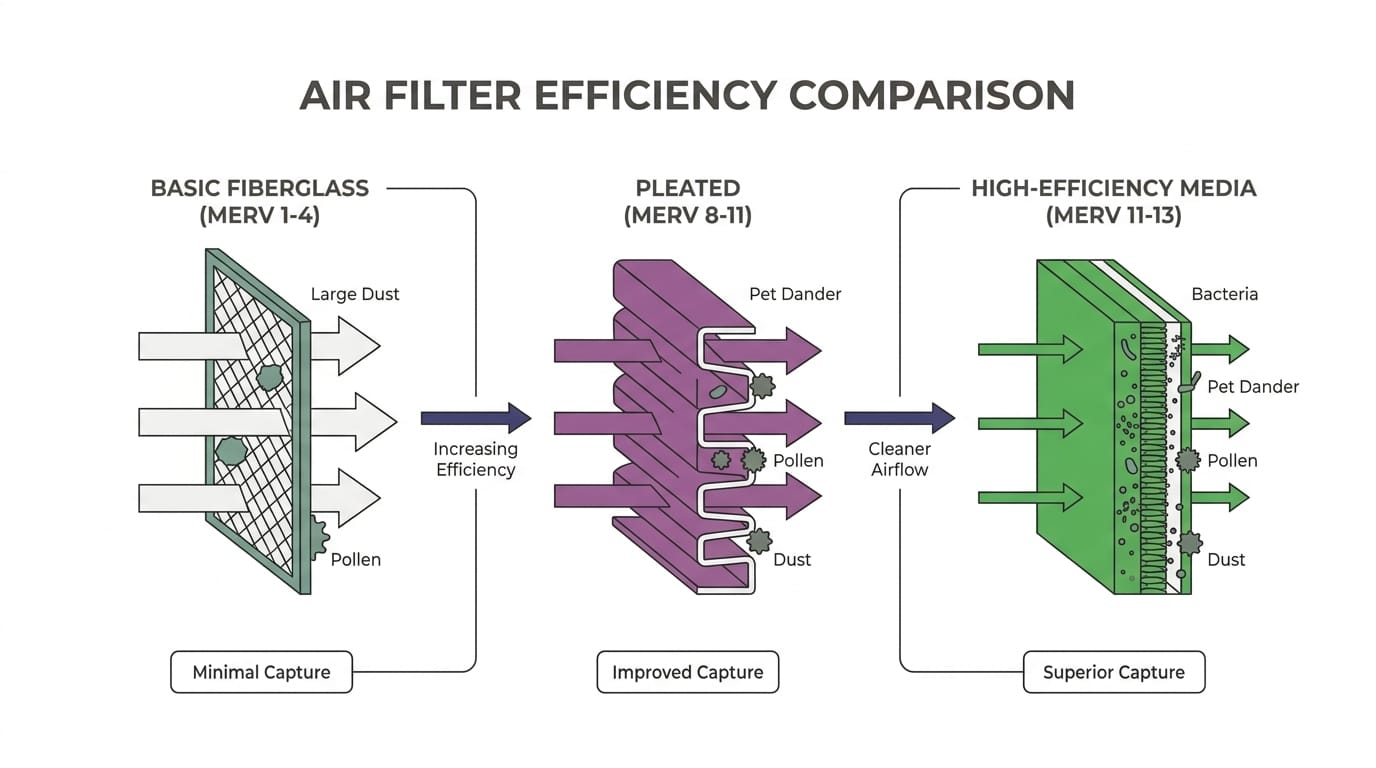
MERV stands for Minimum Efficiency Reporting Value, a standard scale from 1 to 20 that measures a filter’s ability to capture particles. Higher MERV ratings mean finer filtration but also more airflow restriction. Here’s what you need to know:
- MERV 1 to 4 (basic fiberglass filters): Capture large particles like dust and lint but do almost nothing for pollen, mold spores, or fine desert dust. These are cheap ($1 to $5) but inadequate for Arizona homes. Avoid them.
- MERV 5 to 8 (standard pleated filters): Capture pollen, mold spores, and most dust. Adequate for homes without pets or special air quality concerns. These are the baseline for Arizona. Don’t go lower.
- MERV 9 to 12 (mid-grade pleated filters): Capture finer particles including pet dander, some bacteria, and smaller dust particles. This is the sweet spot for most East Valley homes. They provide good filtration without excessive airflow restriction. Most systems can handle MERV 11 without issue.
- MERV 13 to 16 (high-efficiency filters): Capture very fine particles including smoke, viruses, and bacteria. Approaching HEPA-level performance. Check your system’s specifications before using these. Many residential HVAC units can’t handle the airflow restriction, and forcing a MERV 13+ filter into an incompatible system will reduce efficiency and strain components.
- MERV 17 to 20 (HEPA and medical-grade filters): Reserved for hospitals, cleanrooms, and specialized applications. Residential HVAC systems cannot accommodate these without major modifications.
For most Arizona homeowners, a MERV 8 to 11 pleated filter offers the best balance of particle capture, airflow, and cost. If you have pets, allergies, or live near construction, lean toward MERV 11. If your home is well-sealed with minimal dust infiltration, MERV 8 is sufficient.
Balancing Filtration Efficiency with Airflow
Higher filtration efficiency sounds appealing, but there’s a hidden cost: airflow restriction. A filter works by forcing air through a maze of fibers that trap particles. The finer the maze (higher MERV), the harder your blower motor has to work to pull air through.
Your HVAC system was designed with a specific airflow requirement (measured in cubic feet per minute, or CFM). If you install a filter that’s too restrictive, you reduce airflow below the design threshold, which causes the problems outlined earlier (frozen coils, reduced efficiency, motor strain).
Before upgrading to a higher MERV rating, check your system’s specifications or consult with an HVAC technician. Many modern systems can handle MERV 11 or 12 without issue, but older units or undersized systems may struggle. If you’re unsure, stick with the filter type your system came with or ask a professional.
ACCA’s quality maintenance standards emphasize that proper filter selection must account for both filtration needs and system capabilities. The best filter isn’t the one with the highest MERV rating. It’s the one that captures the particles you care about without compromising airflow.
When to Upgrade from Disposable to High-Efficiency Filters
If you have specific air quality concerns (severe allergies, asthma, compromised immune systems), you may need more than a standard pleated filter. Here are your options:
4-inch or 5-inch media filters offer dramatically more surface area than standard 1-inch filters, allowing for higher MERV ratings (11 to 13) without excessive airflow restriction. These require a dedicated filter cabinet installed adjacent to your air handler, which costs $300 to $600 upfront, but they only need replacement every 3 to 6 months in Arizona conditions. If you’re constantly replacing 1-inch filters and want a longer interval, this is the best upgrade path.
Electronic air cleaners use an electric charge to attract and trap particles. They’re reusable (you clean the collection plates instead of replacing them), but they require regular maintenance and don’t capture every particle type. They work well in conjunction with a standard filter, not as a replacement.
Whole-home air purifiers with HEPA or UV filtration provide the highest level of air cleaning but operate independently of your HVAC system. They’re the right choice if you need true HEPA performance without overtaxing your air handler. Expect to invest $800 to $2,000 for a quality whole-home unit.
If you’re considering an upgrade, talk to a knowledgeable technician before buying. Many homeowners waste money on filters their systems can’t support or that don’t address their specific air quality concerns. For more on different system types and their maintenance needs, check out How Mini Split Installation Works from Start to Finish. Mini-splits handle filtration differently than central systems, and homeowners planning Mini Split Installation in Gilbert AZ: What to Know First should understand these differences before committing to a ductless solution.
How JLM’s Maintenance Plans Take the Guesswork Out of Filter Changes
If managing filter replacement schedules feels overwhelming (especially during Arizona’s brutal summer when you’re already juggling irrigation timers, pool maintenance, and keeping your family cool), there’s a simpler way.
JLM’s Air Conditioning Maintenance plans include seasonal tune-ups that cover filter inspection and replacement as part of a comprehensive system check. Our technicians inspect your filter at every visit, measure airflow, check refrigerant levels, clean coils, and verify that your system is running efficiently. If your filter needs replacement, we handle it on the spot (and can recommend the right MERV rating for your specific conditions).
We also help you set up a replacement schedule that makes sense for your home. If you’re near construction in Queen Creek, we’ll recommend monthly checks. If you have three dogs and live near dusty farmland in Apache Junction, we’ll factor that in. You get a plan based on real conditions, not generic advice from a manufacturer who’s never seen an Arizona summer.
The maintenance plan also includes priority service, which means you move to the front of the queue if something breaks during a 115° heat wave. And because we’re inspecting your system twice a year (spring and fall), we catch small issues before they become expensive emergencies. A loose capacitor or a refrigerant leak detected during a routine visit costs a fraction of what a full system failure costs on the hottest day of July. For more on ASHRAE and ACCA inspection and maintenance standards that guide our service protocols, you can review the industry benchmarks we follow to ensure quality.
Conclusion: A Simple Habit That Protects Your Comfort and Your Wallet
Changing your HVAC filter every 30 to 60 days isn’t glamorous, and it won’t impress your neighbors. But it’s one of the most effective ways to protect a system that costs thousands of dollars to replace and keeps your family comfortable through Arizona’s extreme heat.
Desert dust, monsoon storms, year-round AC operation, and construction activity all conspire to clog filters faster than the national 90-day standard accounts for. The homeowners who stay on top of filter maintenance enjoy lower energy bills, fewer breakdowns, better indoor air quality, and systems that last 15+ years instead of failing prematurely. The ones who don’t end up calling us for emergency repairs during July heat waves, wondering why their AC froze up or their compressor failed.
The fix is simple: check your filter on the first of every month. If it’s dirty, replace it. If it’s borderline, replace it. Filters cost $15 to $40. The consequences of skipping them cost hundreds or thousands.
For additional HVAC insights and maintenance tips specific to Arizona, explore the resources at HVAC System | AC Technician Near Me. Homeowners looking for cooling solutions in unconventional spaces can also review Garage AC Options That Don’t Overwhelm Small Spaces for insights on how different system types and filter requirements apply beyond traditional living areas.
Need help keeping your HVAC system running smoothly through Arizona’s brutal summers? Call JLM Air Conditioning & Heating now at 602-619-3609 for same-day service, honest advice, and maintenance plans that take the guesswork out of filter changes. Call now: 602-619-3609