
It’s a Saturday afternoon in July. The thermostat outside reads 110°F, and the air from your vents has gone warm. Most East Valley homeowners have been there, or worry they will be.
Emergency AC repair cost vs preventive maintenance comes down to timing. Emergency repair usually costs more than the maintenance that would have caught the problem, because you pay for urgency on top of the repair: after-hours availability, rush parts, and failure that often damages other components. Maintenance costs less per year, but it can’t stop every breakdown.
We handle repair, installation, and maintenance across the East Valley (see JLM’s full list of HVAC services), so we have no reason to push one path over another. That short answer is only the start. The longer version decides whether you pay a little each year or a lot all at once.
This guide puts both paths side by side in plain terms. It shows what drives an emergency bill and what a tune-up covers. It also gives you a three-cost test you can run at your kitchen table, and it says honestly when a plan is the wrong spend. We’re family-owned, Bill is on the job, and we would rather you make a good decision than a rushed one.
Emergency AC repair cost vs preventive maintenance: which costs more?
A maintenance visit is a planned, predictable cost. An emergency repair is unplanned and usually larger, because urgent calls, rush parts, and secondary damage add to the basic fix. Over several years, a healthy plan often costs less than a single serious breakdown.
That is the heart of preventive HVAC maintenance savings: you swap one large, unpredictable bill for small, scheduled ones. It does not guarantee you will never pay for a repair. It improves the odds, and it lets you choose when and how you pay. The emergency AC repair cost vs preventive maintenance gap is mostly a gap in timing and certainty.
Here is the honest side-by-side. These rows are qualitative on purpose. Every home and system is different, and we would rather not hand you a made-up number.
| Factor | Preventive maintenance | Emergency repair |
|---|---|---|
| Timing | You pick the day, in spring or fall | The system picks it, often at the worst moment |
| Price certainty | Known before the visit | Unknown until the diagnosis |
| Parts | Ordered and planned | Often needed right now |
| Stress | Low | High, especially in peak summer heat |
| Effect on other components | Catches strain early | Failure can damage other parts |
| Comfort | No interruption | Your home heats up while you wait |
Read down the table and the emergency AC repair cost vs preventive maintenance comparison is lopsided on every row except one: sometimes a system fails no matter what you did. We will get to that.
If you want to see what repairs cost around here, we keep a full Arizona AC repair price breakdown on our site. It covers the repair side in detail so this guide can focus on the decision.
Some costs never show up on an invoice. Think of the night your family sleeps in a hot house, the day of work you miss waiting for a technician, and the scramble to find someone who will pick up the phone. Those costs are real even though no one bills you for them.
We built our emergency service around that moment. Same-day and 24/7 availability is how we show up when it counts. But we have also learned that the best emergency is the one that never happens. That is why we care about helping you protect your investment before the heat arrives.
If you want to compare the repair side with the typical repair categories, what common HVAC repairs cost is a good companion read.
Takeaway: in the emergency AC repair cost vs preventive maintenance comparison, maintenance is a planned cost and emergency repair is an unplanned one, and the unplanned one usually costs more.
Emergency repair cost breakdown: why it’s higher
You are paying for speed and for damage that had time to grow. After-hours response, parts needed right now, and strain on other components all raise the bill. A scheduled visit catches the same issue while it is still small.
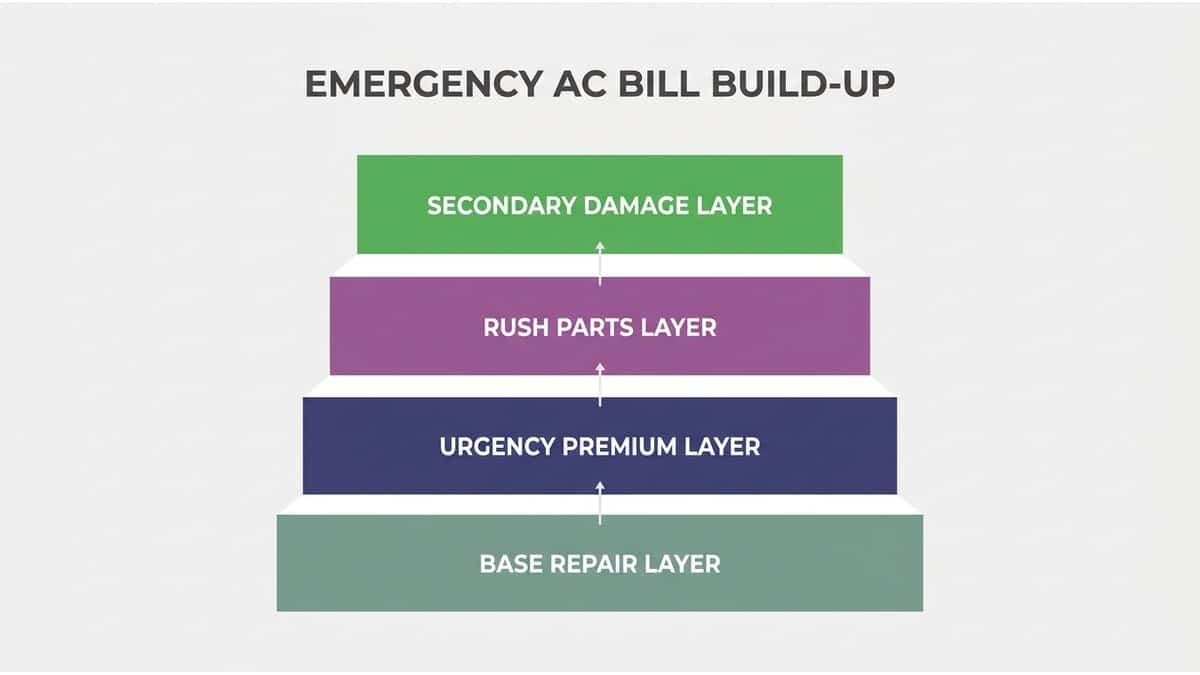
Here is the emergency repair cost breakdown in plain terms. It has four layers, and a scheduled visit avoids most of them. These layers are why emergency AC repair cost vs preventive maintenance rarely comes out even.
The urgency premium
Emergency calls and complex diagnostics carry premium pricing across the HVAC trade. It takes real staffing to keep a team ready at night and on weekends, and a technician who drops other plans to reach you is giving up something. That is a fair basis for a higher rate, and you should know it exists before you call anyone.
It also explains why a same-day repair booked on Monday morning often feels easier on the wallet than the same repair at 9 p.m. on Saturday. If you want to see how our own same-day approach works, read about our 24/7 same-day emergency service.
Small problems that become big ones
A dirty coil, a clogged drain line, or a weak part rarely fails all at once. It adds strain a little more each week. When something finally gives, the failure can damage other components that were working fine the day before.
A scheduled visit finds the same issue while it is still a small, cheap fix. A breakdown in July finds it only after the damage has spread. This is the strongest reason maintenance tends to win on cost. It is not that tune-ups are magic. It is that small problems cost less than the big ones they turn into.
The cost of the scramble
When your AC dies in peak heat, you have little time to compare options. Parts that are routine in April can be harder to get in July, when every shop in the Valley is busy. You may also feel pushed toward a fast decision on a repair, or on replacement, that you would have thought through differently with a calmer week.
We would rather you plan the cost than pay for panic. That is a big part of why we talk about maintenance at all.
Takeaway: emergencies cost more because you pay for urgency, hurried parts, and damage that had time to grow.
What does a maintenance visit cover?
A good visit is a hands-on inspection, not a filter swap. JLM’s 50-point inspection covers coil and blower cleaning, drain service, a filtration check, and a system health report so you know where your equipment stands.
On the emergency AC repair cost vs preventive maintenance question, the visit is the inexpensive side, but only if it is a real inspection. Some homeowners suspect a tune-up is a way to sell them something. That suspicion is fair, and we want to meet it directly. You should leave a visit knowing exactly what was checked, what was cleaned, and what condition your system is in. If something needs attention, we tell you plainly. If it doesn’t, we tell you that too.
Our work on preventive care starts from a simple idea: protect the investment you already made. Here is what that looks like in practice.
Airflow and cleaning
Coils and blowers do the heavy lifting in your system, and dirt makes them work harder. Cleaning the coil and the blower brings airflow back toward what it should be, and it takes strain off the parts that cost the most to replace. In the East Valley’s dusty, hot climate, this is not busywork.
A frozen coil is one common sign that airflow has slipped. If you have ever seen ice on your unit, read why AC units freeze up and how to prevent it. A good tune-up is one of the main ways to prevent it.
Drain service and filtration
Your AC pulls water out of the air all summer, and that water has to go somewhere. A clogged drain line can back up, trigger a shutoff, or leak into the home. Drain service during a visit clears the line before it becomes a problem.
The filtration check matters for the same reason. A filter that is overdue or the wrong fit restricts airflow and adds strain. We check it as part of the whole picture rather than as a standalone chore.
The system health report
This is the part many homeowners tell us they value most. The system health report is a written record of where your equipment stands: what looks good, what is wearing, and what we would keep an eye on. It turns a vague worry about an aging system into something you can read and plan around.
It also helps with the money question. If you know a part is wearing, you can budget for it. That is the opposite of an emergency.
What a tune-up can and can’t prevent
Maintenance is not insurance. It lowers the odds of many breakdowns and catches many problems early, but it can’t stop every failure. A part can still give out between visits, and an older system can still reach the end of its life.
Here is how one failure type connects to prevention: how maintenance helps protect your compressor explains why strain on one part can lead to a costly failure of another. For a shorter take on the whole cost question, see our shorter take on emergency vs. preventive costs. This guide goes further by giving you a way to decide for your own home.
Takeaway: a real tune-up is a thorough inspection with a written report, and it lowers your odds without removing them.
How to calculate AC maintenance plan ROI
Compare the yearly cost of the plan to the cost of one avoided breakdown, weighted by your system’s age and condition. If your system is older or has had repairs, the odds tilt toward a plan. If it’s new and under warranty, they tilt the other way.
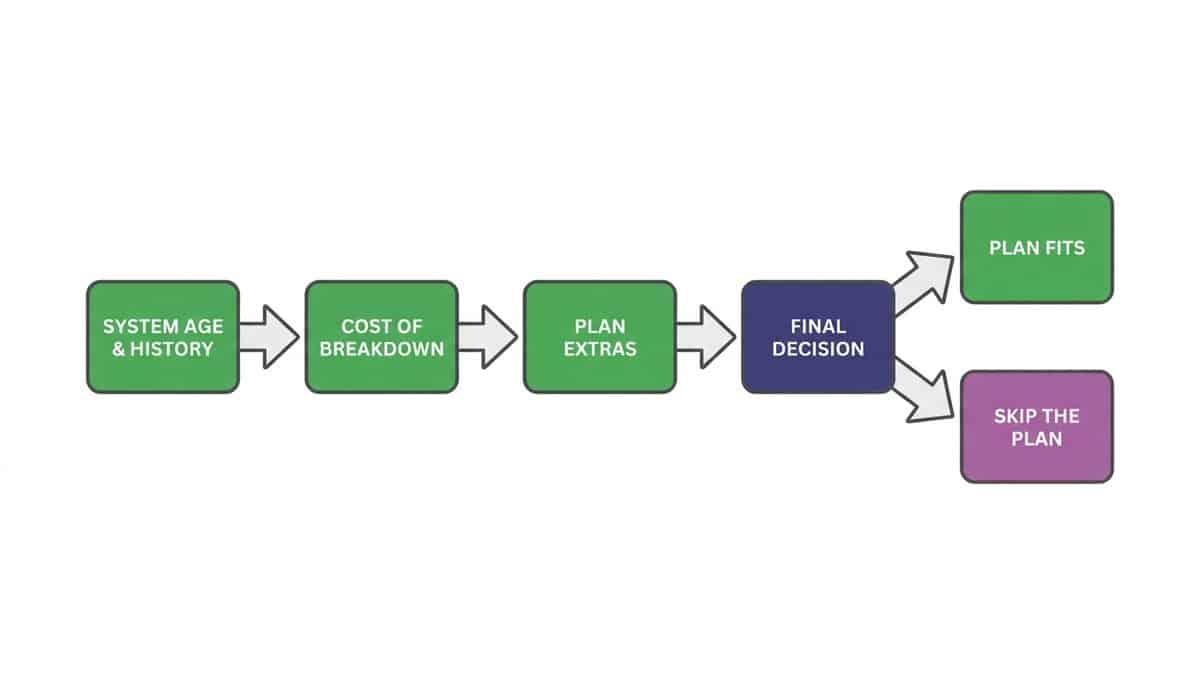
Most guides on this topic stop at “maintenance saves money” and leave you to trust them. We would rather give you the math. We call it the three-cost test. You can run it without us, and you can hand it to a spouse who wants to check the reasoning. It turns the general emergency AC repair cost vs preventive maintenance question into a number for your own house.
Step 1: Your system’s age and history
Start with how old your system is and what has happened to it. Has it needed repairs in the last few years? Has it been serviced regularly, or has it run untouched? Do you know when the last tune-up was?
Rate it low, medium, or high risk. A newer system with a clean history and a valid warranty is low. An older system with repair history and no recent service is high. In this climate, where equipment works hard for months, age matters a great deal.
Step 2: What one breakdown would cost you
Now estimate what one summer breakdown would cost, in dollars and in disruption. Dollars include the repair itself and the emergency premium. Disruption includes missed work, a hot house, and the stress of finding help.
Be honest about your household. A family with young children, an older relative, or someone working from home feels a breakdown much more than a couple who travels all summer. Put your own number on it. We won’t put one on it for you, because it varies too much from home to home.
Step 3: What the plan includes beyond the visit
Finally, look at what the plan adds past the tune-up itself. Priority scheduling can matter a lot in a heat wave. A discount on repairs helps if you need one. A written health report helps you plan.
Now put it together. Your plan’s annual cost is the variable. Your plan pays off when the chance of avoiding a breakdown, multiplied by what that breakdown would cost you, plus the value of the extras you would actually use, comes out above that annual cost. For a high-risk system, that is usually a comfortable yes. For a low-risk, covered system, it often isn’t.
Plan pricing varies, so ask for yours in writing and plug it in. For a deeper look at the numbers, we wrote up a deeper look at maintenance plan ROI. That article goes further on how year-round service prevents the biggest repair bills.
Takeaway: the AC maintenance plan ROI is positive when your system’s risk and the cost of one breakdown outweigh the plan’s annual price.
When is replacement smarter than maintenance?
Maintenance protects a system that is still worth protecting. When repairs keep stacking up on an old unit, the money is better spent on a replacement. A free on-site assessment tells you which side of that line you are on.
We say this plainly because it is where a plan can become the wrong spend. The emergency AC repair cost vs preventive maintenance math only favors maintenance for a system worth keeping. If your system is near the end of its life, a plan can pay to keep a unit going that you will soon replace anyway. That is not honest advice, so we don’t give it.
Here are signs that replacement deserves a serious look:
- Repairs keep coming, and each one buys less time than the last.
- Your energy bills have crept up and the system struggles on hot days.
- Your last health report flagged major wear on several parts.
- The system was never well maintained, and the damage is already done.
When repairs stack up on an older unit, the total you have spent can justify replacement over continued maintenance. We would rather you see that early than pay for one more patch.
We have installed more than 3,000 systems and we also repair them, so we gain nothing by pushing either side. Our job is to help you decide. We install Amana systems, and we offer a free on-site consultation with a transparent quote. Financing options through GoodLeap and JB Warranties are available if you want to spread out the cost, with no pressure to use them.
To work through the decision on your own, read our repair vs. replacement decision framework. When you want to plug in your own numbers, use the repair vs. replace calculator.
The two pages work best together with this guide. This one tells you whether a plan makes sense for a system you want to keep. Those two tell you whether the system deserves keeping.
Takeaway: maintenance makes sense for a system worth protecting, and a free assessment shows whether yours still is.
Is a maintenance plan right for your home?
A plan fits most East Valley homeowners with a system past its first few years, because summer demand is harsh on equipment. It fits less well if your system is brand new and covered, or if you plan to replace it soon.
Our best customers for a plan are homeowners who plan to stay in the house for a good while. They want predictable costs, and they would like to know someone is watching the system. If that sounds like you, HVAC maintenance plans that prevent breakdowns before they start are worth a close look.
Answer these six questions honestly. Each yes pushes you toward a plan, and each no pushes you away. Your answers settle the emergency AC repair cost vs preventive maintenance decision for your own home.
- Is your system past its first few years?
- Has it needed repairs, or has it gone without a tune-up?
- Would a summer breakdown seriously disrupt your household?
- Do you plan to stay in the home for a few more years or longer?
- Would you rather pay a small amount on a schedule than a large amount at random?
- Do you want a written record of your system’s condition?
Mostly yes? A plan probably pays. Mostly no? You may be better off paying for service as you need it.
Who should skip a plan? Skip it if your system is brand new and still under warranty, since the manufacturer is already covering much of the risk. Skip it if you are about to replace the system or sell the home. And skip it if you would never schedule the visits. A plan only works when the visits happen.
We would rather lose a plan sale than sell one that doesn’t fit. That is how a family-owned shop earns referrals. Neighbors tell neighbors, and our A+ BBB rating reflects that approach. If you are not sure, we are happy to talk it through with no pressure, and a spouse who researches before the call is welcome to join us.
Takeaway: a plan fits homeowners with a working but aging system who plan to stay, and it doesn’t fit a new, covered, or soon-to-be-replaced one.
What should a good plan include?
A good plan includes priority scheduling, repair discounts, seasonal visits, a written health report, and clear pricing with no hidden fees. Use these five items as a yardstick when you compare any plan, ours or anyone else’s.
Here is why each one matters.
- Priority scheduling. In a heat wave, everyone calls at once. A plan that moves you up the line is worth something real when it counts.
- Repair discounts. If a repair comes up, a discount softens it. Ask exactly how much and on what.
- Seasonal visits. Spring and fall tune-ups keep the system ready for the hardest months and the milder ones. A single visit a year leaves a gap.
- A written health report. You should get a record after each visit, in plain language, not just a verbal “looks fine.”
- Clear pricing with no hidden fees. The price should be in writing before you commit, and it should say what is included and what is not.
Ask for each of these in writing. A plan that cannot spell out what you get is not one you want. Plans should be transparent, because transparency is how a plan earns trust rather than suspicion.
Our own plan is built around seasonal tune-ups, priority scheduling, a discount on repairs, and a system health report. You can see how it fits with the rest of our work on heating and air conditioning services in Arizona’s East Valley. That page covers repair, installation, and maintenance in one place, which helps if you are weighing more than one option at once.
We care about being a local name you can trust. That means referrals from neighbors, reviews you can read, and an owner who picks up the phone. A plan is only as good as the people who stand behind it.
Takeaway: judge any plan by priority scheduling, repair discounts, seasonal visits, a written report, and clear pricing.
The honest bottom line
On emergency AC repair cost vs preventive maintenance, maintenance usually wins on cost, but only when the system and the plan fit. An emergency repair costs more because you pay for urgency, hurried parts, and damage that had time to grow. A tune-up catches the same problem while it is small. It can’t catch everything, and it isn’t worth buying for a system that is new and covered or about to be replaced.
Run the three-cost test: your system’s age and history, what one breakdown would cost you, and what the plan adds. If the numbers favor a plan, you will know it. If they don’t, you will know that too, and you will have saved yourself a sales pitch.
If your AC goes down at 110°F, call us anytime. We answer 24/7 and offer same-day service. If you would rather talk about whether a plan fits your system before the heat peaks, we are glad to do that too. Neighbors helping neighbors is how we like to work.