

One bedroom bakes all afternoon. Or the old unit is limping through its last summer. Either way, you are weighing a mini split vs central AC comparison before spending real money.
Central AC cools the whole house through ducts and usually makes sense when your ducts are in good shape. Mini splits cool room by room without ducts, so they fit additions, garages, and homes with leaky or no ductwork. The right choice depends on your ducts, your floor plan, and how long you’ll stay.
We are an owner-led, family-owned team serving Mesa, Chandler, Gilbert, Queen Creek, and San Tan Valley. We install both system types, with more than 3,000 installs behind us. That means our advice follows your house, not our margin. Our heating and air conditioning services across Arizona’s East Valley include central air, mini splits, and the ductwork that connects to them.
Below, we compare the two plainly, say when each one wins, and show how we help families make the right decision on a replacement or install.
Mini split vs central AC comparison: key differences
A central system uses one outdoor unit and a network of ducts to cool the whole home from a single thermostat. A mini split uses an outdoor unit linked to one or more wall or ceiling units, so each room or zone gets its own temperature control and no ducts are needed.
Both are air conditioners at heart. As the U.S. Department of Energy’s central air conditioner product lookup explains, an air conditioner uses energy to transfer heat from the interior of your home to the relatively warm outside environment. The real difference is how the cooled air gets to you.
When people search ductless air conditioning vs central, they are really asking about air delivery. Central AC pushes cool air through ducts hidden in your attic, walls, or ceilings. A mini split cools the air right where the indoor unit hangs, with refrigerant lines running to the outdoor unit instead of ducts. A “zone” simply means an area with its own temperature setting, such as a bedroom, an office, or a garage.
That setup is why mini splits earn their reputation for precision. Each indoor unit is controlled on its own, so a sunny back bedroom can run cooler than a shaded den. We explain this in more detail in our guide to how mini splits improve room-by-room temperature control.
Here is the side-by-side view for our mini split vs central AC comparison:
| Central AC | Mini split | |
|---|---|---|
| Ducts | Needs a duct network | No ducts needed |
| Temperature control | One thermostat for the main system | Separate control for each room or zone |
| Best fit | Standard floor plans with sound ducts | Additions, garages, and homes with no or poor ducts |
| Install disruption | Light if ducts are good, heavier if they need repair | Small openings for line sets and indoor units |
| Upkeep | Filter changes and duct checks | Cleaning each indoor unit’s filter, plus outdoor unit care |
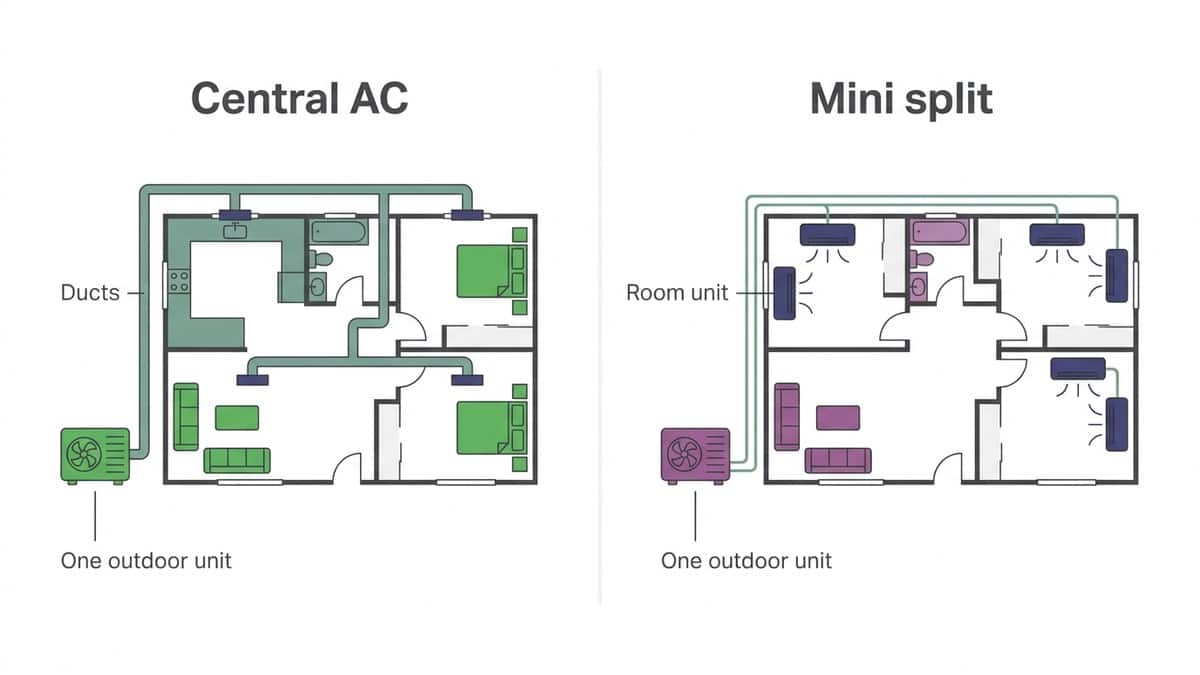
Takeaway: In any mini split vs central AC comparison, central AC delivers cool air through ducts, a mini split delivers it room by room, and that one difference drives almost every other tradeoff.
When does central air make more sense?
Central air usually wins when your home already has sound, well-sealed ducts and you want even cooling in most rooms from one thermostat. Replacing the equipment on existing ductwork is typically the simpler path for a standard single-family floor plan.
We say that plainly because it is true. If your ducts are in good shape, swapping the old condenser and air handler for a new system is often the cleanest job. It also keeps your home looking the way it does now, with no indoor units on the walls.
Central air also suits homes where nearly every room gets used and you want the whole house to feel the same. One thermostat, one schedule, and no need to manage several units.
You may be wondering, “Are you just trying to sell me the bigger job?” We hear that a lot, and it is a fair question. Owner-led means the person whose name is on the truck is accountable for what we recommend. If central air or a simple unit replacement on good ducts is the right call for your house, that is what we will tell you. If you want to know what the work involves, we walk through it in our guide to how to install a central air conditioner.
Ductwork condition is the deciding factor, so we check it during your free consultation. We look at how the ducts are routed, whether they are sealed, and whether they are sized for the system you are considering. East Valley homeowners often ask us about this part. If the ducts need work, we can bundle duct repair or new ductwork with the equipment install, so you get one plan and one quote instead of piecing it together. Getting more from your system often starts with the ducts, not the unit.
Takeaway: Choose central air when your ducts are sound and you want whole-home evenness from one thermostat.
When does a mini split make more sense?
A mini split fits when there is no usable ductwork, when ducts are leaky or hard to repair, or when you are cooling an addition, garage, or one problem room. It also suits households that want different temperatures in different spaces.
Think about the situations we see most. A converted garage that never had ducts. A sunroom or room addition the main system was never sized for. A back bedroom at the end of a long duct run that always lags behind. An older home where running new ducts would mean opening walls and ceilings. In each case, a mini split solves the problem without ducts.
Room-by-room cooling is the other big draw. Because every indoor unit works independently, you can cool the rooms you are using and ease off in the ones you are not. Zoning can reduce cooling in unused rooms, which is useful for guest rooms, home offices that are only occupied part of the day, and spaces that sit empty most of the week.
We install these systems across the East Valley, from Gilbert and Mesa to Queen Creek and Apache Junction. Our Mini-Split AC installation in Gilbert and modern zone cooling page shows how we approach a typical zoned setup.
Here is an honest tradeoff: you will see the indoor unit. It is a slim unit mounted high on a wall or set into a ceiling, and some people love the clean look while others would rather not see it. Placement matters, and a good installer will plan it with you so it works with the room instead of fighting it. Our step-by-step look at how mini split installation works covers planning, mounting, and testing from start to finish.
If you are in Gilbert, our placement and setup tips for a Gilbert mini split page covers what to settle before the crew arrives.
Takeaway: Pick a mini split when ducts are missing or poor, or when one room, an addition, or a garage needs its own control.
Mini split installation cost vs central air
Cost depends on the home, not the label. Central air cost swings with duct condition and home size. Mini split cost grows with the number of zones. A fair comparison needs an on-site look, so the honest answer is a written quote based on your actual house.
We will not print a price range in this mini split vs central AC comparison, because any number we gave would be wrong for someone. Instead, here is what actually moves the price:
- Number of zones. Each room or area with its own indoor unit adds equipment and labor to a mini split job.
- Duct repair or replacement. Sound ducts keep a central air job simple. Ducts that need sealing, repair, or replacement add to the scope.
- Home size. Larger homes need more capacity, whichever system you choose.
- Equipment tier. Higher-efficiency and feature-rich models cost more up front.
- Electrical needs. Some installs need panel or wiring updates before the new equipment goes in.
This is why the cheapest-looking option on paper is not always the cheapest in your house. A central system on bad ducts can cost more than it first appears once the ductwork is addressed. A multi-zone mini split can climb as you add rooms. If you want a broader view of what goes into pricing, our article on what drives the cost of a new furnace and AC is a good starting point.
Surprise charges are the fear we hear most. Here is how we handle it. We start with a free on-site consultation, then give you a written, transparent quote. There are no hidden fees, and you know the cost before work begins. We will also tell you what is needed and what is optional, so you are not paying for upgrades that do nothing for your home.
If budget is part of the decision, financing is available. Read through AC installation financing options in Arizona to see how payment can be spread out.
Takeaway: Duct condition drives central air cost and zone count drives mini split cost, so a written on-site quote is the only reliable comparison.
Which system handles East Valley summers better?
Either can handle Arizona heat when it is sized and installed correctly. Results come from proper sizing, sealed ducts or well-placed indoor units, and quality equipment, more than from the system type.
That surprises people who assume a mini split is “just for one room.” It is not. A properly designed multi-zone mini split setup can cool a whole home. It is also not true that central air is automatically stronger. A central system with leaky ducts or the wrong capacity will struggle on a triple-digit afternoon.
East Valley summers are long, and the afternoon heat is hard on equipment. In a mini split vs central AC comparison for Arizona heat, both system types run for many hours, so quality and installation matter. What we see over and over is that the problems blamed on “the wrong type of AC” are usually sizing problems, duct problems, or a rushed install.
Sizing deserves special attention. An oversized system cools quickly, shuts off, and leaves the air sticky and the rooms uneven. An undersized one never catches up. Our guide to AC system sizing in Arizona and why oversizing wastes money explains how a proper load calculation works.
As the East Valley HVAC authority our neighbors call, we think about the whole picture: the equipment, the ducts, the indoor air quality, and the smart upgrades that help you get more from your system. For central air, that means sealed, well-routed ducts. For a mini split, it means indoor units placed where air can move across the room. Either way, a careful install is what you are really paying for.
Takeaway: Sizing, duct sealing or unit placement, and equipment quality matter more than whether the system is ducted or ductless.
How do you decide? Three free-consultation questions
In our work with East Valley homeowners, we boil any mini split vs central AC comparison down to three questions. They are the same ones we ask on a free consultation, and you can answer them yourself before we ever visit.
Question 1: What shape are your ducts in?
Sound, well-sealed ducts point toward central air, because replacing the equipment on good ducts is the simpler job. Leaky, damaged, undersized, or missing ducts point toward a mini split, or toward a duct fix that is priced honestly alongside the equipment. We inspect the ducts as part of the visit, so you are not guessing.
Question 2: Which rooms actually need cooling?
If you want the whole house comfortable and evenly cooled, central air is built for that. If the real problem is one room, an addition, a garage, or a few spaces that get used differently, a mini split targets exactly those areas. Rooms that sit empty most of the day are a good clue that zoning could help.
Question 3: How long will you stay?
If you are staying put for years, spending on the right system and good installation pays back in comfort and efficiency. If you may sell sooner, the choice may lean toward the option that fits the way buyers expect the house to look and work. We will talk through both sides without pushing you either way.
Here is a quick “if you answered X, lean toward Y” guide:
- Sound ducts, whole-home comfort wanted: lean toward central air.
- Bad or missing ducts, targeted rooms: lean toward a mini split.
- An addition or garage on a house with good ducts: consider both, with central for the main house and a mini split for the new space.
- Unsure about ducts: start with an inspection before deciding.
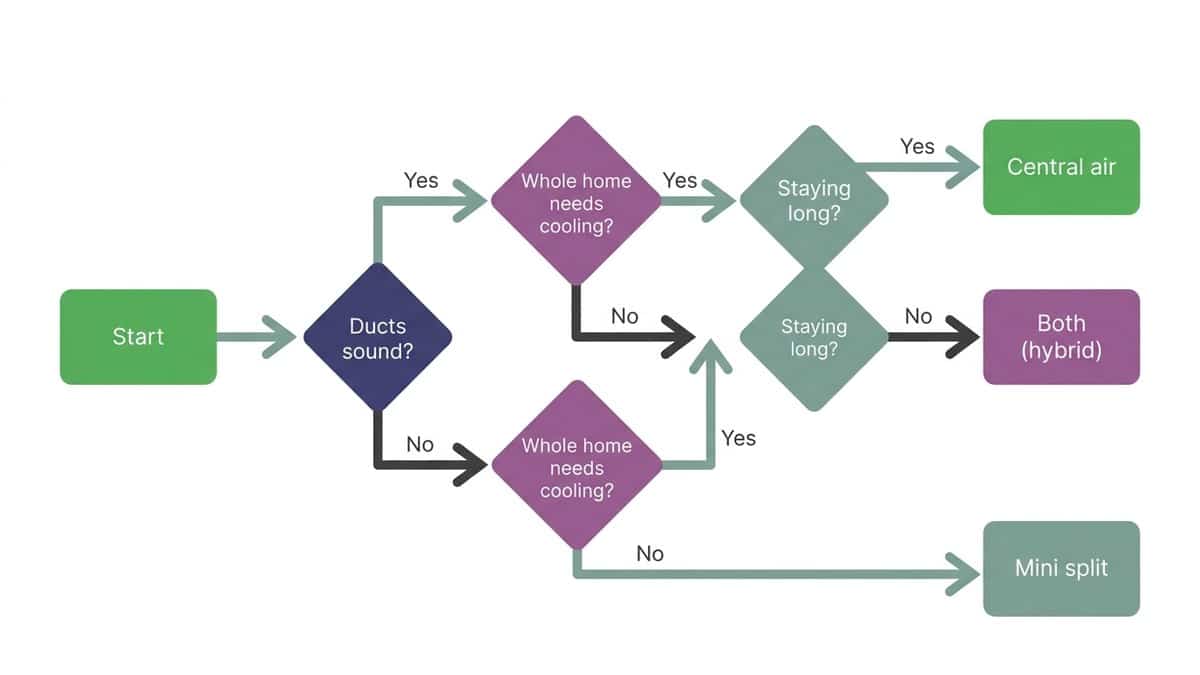
Sometimes the answer is both. A hybrid setup, with central air for the main house and a mini split for an addition, can be the most sensible fit. It avoids stretching an old duct system to reach a new space.
Incentives can also change the math. Look at available Arizona AC rebates and federal tax credits before you finalize a choice, and we can help you understand which ones may apply.
If you want to see everything we do in one place, browse our full range of HVAC services.
Takeaway: Duct condition, rooms that need cooling, and how long you will stay decide the system, and a free consultation can settle all three.
The right system follows your house
Central air fits homes with sound ducts and whole-home needs. A mini split fits homes with poor or missing ducts and rooms that need their own control. Both work well in an Arizona summer when they are sized right and installed with care. In the end, a mini split vs central AC comparison is settled by your house, not by a rulebook.
You should not have to guess, and you should not feel steered. The owner is on the job, you get a written quote before work begins, and we will tell you straight when the simpler option is the better one. We offer same-day service and 24/7 emergency response when you need it.
Book a free on-site consultation to see which system fits your house, with a straightforward quote and no pressure.