
Should you repair your AC compressor or replace the entire system? Repair an AC compressor if your system is under 10 years old, uses R-410A refrigerant, and the repair cost is less than 50% of replacement. Replace the system if it’s 12+ years old, still on R-22 (Freon), or if cumulative repair costs in the past 24 months exceed $2,000. In Arizona’s extreme heat, compressor failure on an aging system often signals additional failures within 12–24 months, making replacement the smarter long-term investment.
By JLM Air Conditioning & Heating
When a Compressor Dies, You Have Two Choices
Your AC stopped cooling in the middle of a 112°F afternoon. The technician confirms compressor failure and hands you an estimate: $3,100 to replace the compressor, or $11,500 for a complete system replacement. You need cold air by tonight, but you also need to make the right financial decision for the next 5–10 years.
Arizona’s 110°F summers mean compressor failure isn’t just inconvenient. It’s a genuine emergency. You can’t afford to wait weeks weighing options, but you also can’t afford to make a $10,000 mistake out of panic. According to ACS Comfort Solutions, same-day response is critical when indoor temperatures reach dangerous levels for children, elderly family members, and pets.
The problem: HVAC companies have an incentive to sell you a new system, and you have no easy way to verify if their advice is honest. This guide gives you the four concrete variables that determine whether repair or replacement makes financial sense, so you can walk into that conversation confident you’re making the right call for your home and budget.
What the Compressor Does (and Why Failure Is Expensive)
Your AC compressor is the heart of the cooling system. It circulates refrigerant between the outdoor condenser unit and the indoor evaporator coil, enabling the heat exchange process that removes warmth from your home. When the compressor fails, refrigerant stops moving, and your system blows warm air no matter how low you set the thermostat.
Compressor replacement is expensive because the part itself costs $1,200–$2,000, and the labor is intensive. A licensed technician must recover the existing refrigerant (EPA-mandated process), remove the failed compressor, braze in the new unit, vacuum the system to remove moisture and air, recharge with the correct refrigerant type and pressure, and verify proper operation. The total bill typically lands between $2,000 and $3,500, according to HVAC Project Cost data.
In Arizona’s climate, compressors work harder than in moderate regions. Your outdoor unit runs 8–12 hours per day from May through September, cycling on and off constantly to maintain indoor temperature. That workload accelerates wear on the compressor motor, capacitor, and internal components. Most compressors are designed to last 12–15 years, but Arizona units often fail at the 10–12 year mark due to prolonged thermal stress.
Understanding this context helps you evaluate the next decision: is a $3,000 repair on a 13-year-old system buying you five more years of reliable cooling, or just delaying an inevitable replacement while you sink money into a unit that’s already lived 85% of its expected lifespan? Learn more about when to call for professional AC repair services.
Four Variables That Drive the Repair-or-Replace Decision
The repair-or-replace decision isn’t guesswork. Four measurable factors determine whether your money is better spent on fixing the compressor or installing a new system. Each variable builds on the others to create a clear financial picture.
1. System Age
How old is your outdoor AC unit? Look for the manufacturer label on the side of the condenser (the large metal box outside your home). The serial number includes the manufacture date, typically in the first four digits (e.g., 0518 means May 2018).
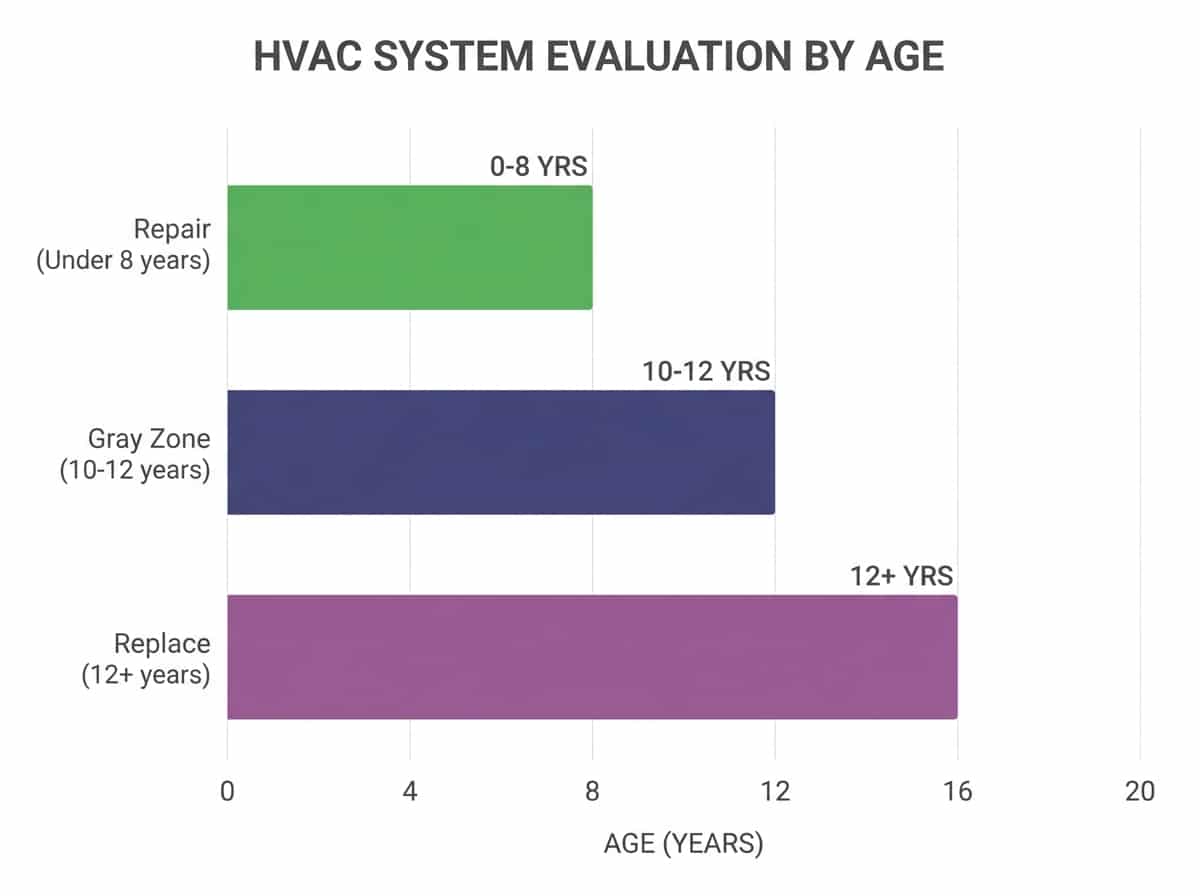
If your system is under 8 years old, compressor repair is almost always justified. The unit should have had significantly more runway, and other components (fan motor, capacitor, coils, control board) are likely in good condition. A $2,800 compressor repair on a 6-year-old system buys you 6–8 more years of cooling with minimal additional maintenance.
Between 10 and 12 years, you’re in the gray zone. The compressor may be the first failure, but the capacitor, fan motor, and evaporator coil are all approaching end-of-life. Repairing the compressor doesn’t reset the clock on those other components. Carrier’s residential HVAC lifespan data estimates 12–15 years as the typical range for central air systems in hot climates, with Arizona’s extreme summers pushing systems toward the lower end.
If your system is 12+ years old, replacement is usually the smarter financial decision. At that age, you’ve extracted most of the system’s value. Spending $3,100 to repair the compressor leaves you with an aging unit where the next failure (coil leak, blower motor, refrigerant line corrosion) is statistically likely within 18–24 months. You’ll face another emergency repair bill while still owning a system that’s worth less every month. Explore more about HVAC system longevity on our resources page.
2. Refrigerant Type (R-22 vs. R-410A)
Check your system’s refrigerant type before you commit to any repair. The type is printed on the manufacturer label (outdoor unit) and stamped on the refrigerant line set near the service valves. You’ll see either R-22 or R-410A.
If your system uses R-22 (commonly called Freon), replacement is almost always the right financial move. The EPA phased out R-22 production in 2020 due to ozone depletion concerns. Remaining R-22 supply comes from recycled refrigerant, which is expensive and dwindling. A compressor repair on an R-22 system requires a full refrigerant recharge (8–12 pounds), which now costs $150–$200 per pound versus $50–$80 per pound for R-410A.
Beyond the immediate repair cost, you’re locking yourself into a refrigerant that will become harder and more expensive to source every year. When the next failure happens (and it will, because R-22 systems are all 14+ years old at this point), you’ll face another inflated refrigerant bill. A compressor repair on an R-22 system realistically buys you 2–4 years before the next component fails or you can’t source refrigerant at any reasonable price.
R-410A systems (installed after 2010) are worth repairing if the other variables align. R-410A is the current industry standard, readily available, and significantly cheaper to recharge. A compressor repair on a 9-year-old R-410A system makes financial sense because you’re not fighting refrigerant obsolescence.
3. Repair Cost as Percentage of Replacement
Industry professionals use the 50% rule as a quick financial sanity check: if the repair cost exceeds 50% of replacement cost AND the system is 10+ years old, replacement is usually smarter. But context matters.
Example one: Your compressor repair is quoted at $3,200. A comparable new system (matching tonnage and efficiency) costs $11,000 installed. That’s 29% of replacement cost. If your system is only 7 years old and uses R-410A, the repair is defensible. You’re spending less than a third of replacement cost to restore a system that should deliver 5–7 more years.
Example two: Same $3,200 repair quote, but your system is 13 years old and on R-22. Even though the percentage is only 29%, you’re sinking $3,200 into a unit with 2–4 years of realistic life left, meaning high risk of another $1,500+ failure before you break even. This Old House reports that compressor replacement costs typically range from $2,000 to $3,500, with decisions hinging on system age and refrigerant type as much as raw cost percentage.
The percentage rule is a starting point, not a final answer. A $2,400 repair on a $9,500 replacement (25%) looks attractive on paper, but not if your system is 14 years old with a history of capacitor and fan motor replacements. You need the full context, which is why you should consider repair history alongside cost percentage. Read more about why summer demands fast AC repair in Mesa.
4. Recent Repair History
Pull out your HVAC service records for the past 24 months. Add up what you’ve spent on repairs: capacitor replacement, fan motor, refrigerant recharge, coil leak, blower motor, control board. If that total exceeds $2,000, compressor failure is the financial tipping point that makes replacement smarter.
Cumulative repair costs reveal a system in decline. Each repair addresses a single component, but the underlying reality is that everything is aging simultaneously. When one part fails, the others are under the same thermal stress, cycling load, and wear. A system that needed a $600 capacitor replacement last summer, a $900 refrigerant recharge in the spring, and now a $3,100 compressor repair has cost you $4,600 in 18 months while you still own a depreciating asset.
If this is the first major repair and your system is under 10 years old, the repair is defensible. A single compressor failure on an otherwise healthy system doesn’t predict imminent collapse. But if you’re nickeling and diming a 13-year-old unit with multiple component failures, you’re delaying the inevitable while throwing money at a sinking ship.
In our work across the East Valley, we’ve found that compressor failure on systems 12+ years old is rarely an isolated issue. Within 18 months, homeowners typically face fan motor or coil failure, pushing total repair costs past the threshold where replacement would have been smarter upfront. Regular tune-ups through preventive maintenance plans can catch early warning signs before a compressor fails, reducing emergency repair costs.
When Repair Makes Sense (Real Scenarios)
Here are three situations where compressor repair is the financially sound decision, based on the four variables above.
Scenario one: Your Lennox system is 7 years old, uses R-410A refrigerant, and has had no prior repairs. The compressor failed due to a power surge during a monsoon storm. Repair cost is $2,600. A comparable new system would be $10,800. The repair is 24% of replacement cost, your system is mid-lifespan, and R-410A refrigerant is readily available. Repair buys you 5–7 more years of cooling with a system that’s otherwise healthy.
Scenario two: Your Amana system is 9 years old (R-410A), compressor repair is quoted at $2,800, and you’ve spent $300 on routine maintenance over the past two years but had no component failures. Full replacement would cost $11,200. The repair is 25% of replacement cost, the system is below the 10-year threshold, and you’re not fighting refrigerant obsolescence or cascading failures. Repair makes sense.
Scenario three: Your Carrier system is 6 years old (R-410A), still under extended warranty for parts (you pay labor only). Compressor replacement labor is $1,200 because the part is covered. Replacement would cost $10,500. At $1,200 and mid-lifespan, repair is obvious. The warranty absorption of parts cost tips the financial equation heavily toward repair, and you’re resetting the compressor lifespan clock with a factory part.
When Replacement Is Smarter (Real Scenarios)
Here are three situations where replacement delivers better long-term value, even though the upfront cost is higher.
Scenario one: Your Goodman system is 14 years old, still on R-22 refrigerant, and compressor repair is quoted at $3,400 (including expensive R-22 recharge). You replaced the capacitor 18 months ago ($450) and had a refrigerant leak repaired last year ($800). Cumulative spending is $4,650 over two years. A new R-410A system costs $10,200 installed with a 10-year parts warranty. Replacement eliminates the R-22 liability, resets the system lifespan, delivers 40% better energy efficiency (SEER 16 vs. SEER 10), and ends the cycle of emergency repairs on a system that’s statistically near end-of-life.
Scenario two: Your Rheem system is 12 years old (R-410A), compressor repair is $2,900, and you’ve had the fan motor replaced ($700) and the control board replaced ($550) in the past 24 months. Total repair spending including the compressor: $4,150. A comparable new system costs $9,800. You’re spending 42% of replacement cost on cumulative repairs while owning a system at the 12-year mark, where failure probability accelerates sharply. Replacement avoids another likely failure within 18–24 months and gives you modern efficiency and warranty coverage.
Scenario three: Your Trane system is 11 years old (R-410A), compressor repair is $3,100, but your summer energy bills have been climbing (inefficiency from aging components). A new high-efficiency system (SEER 18) costs $12,500 but qualifies for a $300 federal tax credit and will cut your cooling costs by $60–$80 per month. Over a 10-year lifespan, the energy savings alone recover $7,200–$9,600 of the upfront cost. When you factor in avoided repairs on the old system, replacement pays for itself within 4–5 years while giving you reliability during Arizona’s brutal summers. Explore our full range of solutions on our East Valley HVAC services page.
What to Ask Your HVAC Technician Before You Decide
When the technician hands you the compressor failure diagnosis, ask these five questions to gather the data you need for an informed decision.
One: How old is my system, and what refrigerant does it use? Request the manufacture date from the serial number and confirm whether it’s R-22 or R-410A. If the technician can’t or won’t provide this basic information, that’s a red flag. Age and refrigerant type are the foundation of the decision framework.
Two: What’s the total cost to repair the compressor, including labor, refrigerant recharge, and any ancillary parts? Get a written, itemized estimate. Some companies quote the compressor part cost but bury labor and refrigerant fees in fine print. You need the all-in number to calculate the cost-to-replacement percentage.
Three: What’s the estimated lifespan of my system after this repair? A good technician will give you a realistic range based on system age and condition, not a sales pitch. If the answer is “it’ll last forever” or “it’s going to die next month,” push for specifics. A 9-year-old R-410A system with no other issues should realistically deliver 3–5+ more years after a compressor repair. A 14-year-old R-22 system might give you 2–3 years if you’re lucky.
Four: Are there other components showing wear or near failure? Ask the technician to inspect the capacitor, fan motor, contactor, and evaporator coil while they’re diagnosing the compressor. Advanced HVAC diagnostic protocols help identify marginal components before they fail. If multiple components are marginal, that context changes the repair-vs-replace calculus. A system with a failing compressor, weak capacitor, and corroded coil is signaling end-of-life.
Five: What would a comparable replacement system cost, and what financing options are available? Even if you’re leaning toward repair, get the replacement quote so you can run the cost percentage calculation. Reputable companies offer financing (0% for 12–24 months is common) that can make replacement affordable without draining savings in one check. If the technician refuses to provide a replacement quote or pressures you to decide immediately, walk away. For more on air conditioning services and transparent pricing, visit our resources page.
How to Get an Honest Second Opinion in the East Valley
For a $3,000+ decision, seeking a second estimate is smart, not paranoid. Here’s what a trustworthy diagnostic visit looks like and how to spot red flags.
A good technician will start by locating the system age on the outdoor unit label and confirming refrigerant type. They’ll test compressor start-up with a multimeter (checking electrical resistance and capacitor function), measure refrigerant pressures at the service ports, and inspect the contactor, fan motor, and coil for visible wear. The whole process takes 20–30 minutes. You should receive a written diagnosis explaining what failed, why, and what the repair entails, plus a separate quote for replacement if the system is borderline.
Red flags to watch for: pressure to decide same-day (“this quote expires tonight”), vague explanations with no data (“your system is just old, time to replace it”), no written estimate, refusal to show you the failed component or explain the failure mode, or dismissing your questions as unimportant. If a technician pushes replacement on a 7-year-old system without showing you measurable inefficiency or multiple component failures, get a second opinion.
The Air Conditioning Contractors of America provides industry-standard best practices that reputable contractors follow during diagnostic visits. According to ServiceTitan’s industry analysis, homeowners who obtain multiple estimates save an average of 18% on major HVAC repairs and replacements. Homeowners should expect technicians to follow established protocols when evaluating system performance.
At JLM, we walk you through these variables on-site. Bill Milbourn (owner and licensed technician) is on-site for estimates. You’re not talking to a sales rep trying to hit quota. You’re talking to the person who will do the work and stake his reputation on the recommendation. If repair makes sense, we’ll tell you. If replacement saves you money and stress over the next 24 months, we’ll show you why with real numbers, no pressure, just honest guidance.
Whether you need a repair or full replacement, explore our complete range of heating and cooling solutions for transparent pricing and owner-led consultations. For smaller-scale installations like mini split systems or preventive care guidance, see our guide on prepping your AC for Gilbert’s hot summer.
Conclusion: Decide with Confidence, Not Panic
Arizona heat doesn’t give you the luxury of weeks to deliberate, but you also can’t afford to make a $10,000 decision out of fear. The four-variable framework (system age, refrigerant type, repair cost as percentage of replacement, recent repair history) gives you a logical path through the panic.
Repair makes sense when your system is under 10 years old, on R-410A, the repair cost is under 50% of replacement, and you haven’t been nickeling and diming it with constant fixes. Replacement is smarter when your system is 12+ years old, still on R-22, cumulative repairs are adding up, or the compressor failure is one symptom of broader decline.
A 30-minute consultation with a licensed technician who shows you the data (not just a sales pitch) beats a rushed decision you’ll regret when the next component fails in July. Understanding HVAC regulations and compliance requirements helps ensure your contractor follows proper installation and safety standards. Commercial property owners should also review compliance requirements for commercial HVAC systems to understand code obligations.
At JLM, we’ve guided thousands of East Valley families through this exact decision. Our A+ BBB rating and referral-driven growth come from honest recommendations, not upsells. The National Home Repair Authority provides comprehensive guidance on evaluating repair versus replacement decisions for residential HVAC systems.
If your compressor just failed and you need clarity, we’ll give you the real numbers so you can decide with confidence. JLM serves Gilbert, Queen Creek, Mesa, and Apache Junction with emergency repairs and complete system replacements.
Ready for an honest assessment? Call JLM Air Conditioning & Heating at 602-619-3609 or request a diagnostic visit online.