
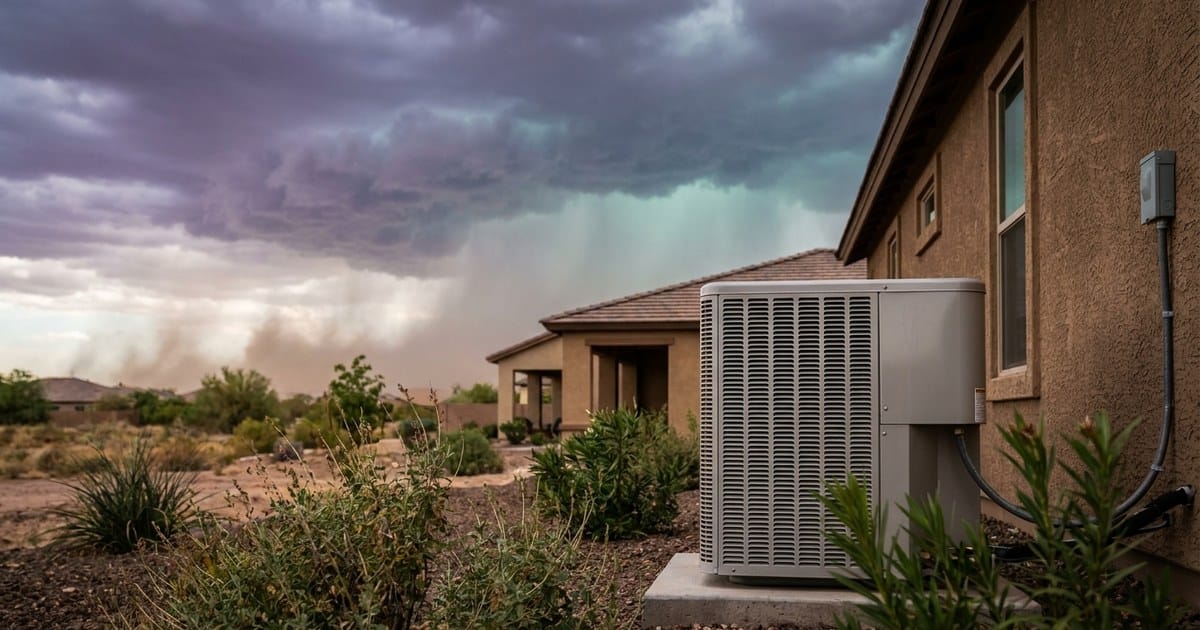
Arizona’s monsoon season (June 15 through September 30) spikes humidity from below 15% to above 50% within hours, forcing your AC to work harder to dehumidify while dust storms clog condenser coils and voltage surges from lightning stress electrical components. Pre-monsoon maintenance (coil cleaning, capacitor inspection, drain line service) prevents mid-season breakdowns when your system is under peak load.
If you’ve lived through an East Valley summer, you know what happens when the first monsoon storm rolls in: your house suddenly feels sticky even though the thermostat reads 75°F, your AC runs nonstop trying to catch up, and you start wondering whether the system is about to quit entirely. That discomfort isn’t in your head. Monsoon weather puts unique stress on HVAC systems designed for Arizona’s typically bone-dry climate, and the homeowners who wait until something breaks end up calling us in mid-August when it’s 110°F outside and their system just shut down.
The good news: most monsoon-related failures are preventable with straightforward pre-season maintenance. In our work across Gilbert, Queen Creek, Mesa, and Chandover, we see the same patterns every year. Systems that get a tune-up in April or May sail through monsoon season. The ones that skip maintenance become emergency calls the week after a major haboob. This guide walks you through exactly why monsoon weather is so hard on your AC, what maintenance prevents failures, and when to schedule service.
Why Arizona Monsoon Season Puts Unique Stress on Your AC System
Arizona’s monsoon season delivers roughly half the state’s annual rainfall in a concentrated June-through-September window. For East Valley homeowners, that means sudden shifts from the low-humidity desert conditions your AC was sized for (typically under 20% relative humidity) to spikes above 50% within hours when storms move through. Your system, designed primarily to drop air temperature in dry conditions, now has to work overtime pulling moisture out of the air while simultaneously cooling. That dual load pushes your compressor harder, increases runtime, and stresses every component when outdoor temperatures are already at their seasonal peak.
The humidity problem compounds with dust. Haboobs (those massive dust walls that roll west-to-east across the Valley from the Superstition Mountains) carry fine particulate matter that standard air filters below MERV 11 can’t fully capture. When a major storm hits Gilbert or Queen Creek, that dust coats your outdoor condenser coils. Research from the National Air Duct Cleaners Association confirms that dirty coils reduce airflow and heat rejection efficiency, forcing your compressor to run hotter than design limits. The result: efficiency drops, energy bills climb, and the system wears faster.
We’re your East Valley neighbors, and we see this pattern play out across Gilbert, Queen Creek, and Mesa every monsoon season. Our service calendar fills within days of a major dust storm. Homeowners notice the outdoor unit is caked in dust, the system cycles on and off more frequently than usual, or the house just won’t cool down despite the AC running continuously. These are all symptoms of a condenser working against reduced airflow. The systems that start the monsoon season with clean coils handle the first haboob much better than those that were already compromised going into June.
The Three Monsoon Threats Your HVAC System Faces
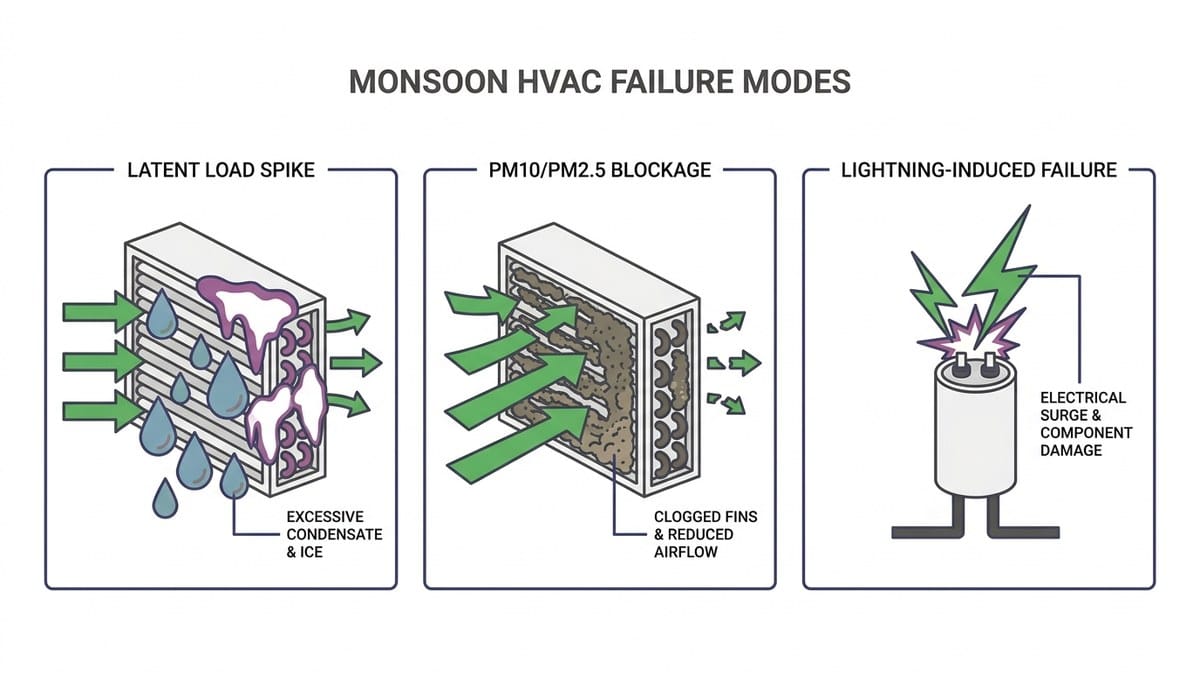
Monsoon season introduces three distinct failure modes that rarely show up during the dry spring or fall. Understanding what’s happening mechanically helps you recognize warning signs before a minor issue becomes an expensive emergency.
Humidity Overload: When Your AC Can’t Keep Up With Moisture
Central air conditioners in Arizona are sized primarily for sensible cooling (dropping air temperature), not latent cooling (moisture removal). According to ENERGY STAR, when relative humidity jumps suddenly, your evaporator coil has to condense water vapor out of the air at rates it wasn’t originally designed to handle. The drain pan fills faster, the drain line has to move more water, and if the coil temperature drops too low trying to dehumidify, ice forms on the coil itself. A frozen evaporator coil stops airflow completely, and your system shuts down.
The symptom homeowners notice first: the house feels sticky and uncomfortable even when the thermostat shows a reasonable temperature. That’s because indoor comfort depends on both temperature and humidity. When your AC can’t keep pace with moisture removal, you’re left with that clammy feeling no matter how low you set the thermostat.
Dust and Debris: The Haboob Tax on Your Condenser
A single major dust storm can deliver more particulate matter to your condenser coil than an entire dry month. PM10 and PM2.5 particles penetrate standard filters and settle on the aluminum fins of your outdoor unit, blocking airflow through the coil. When airflow drops, your system can’t reject heat efficiently, so head pressure rises. Higher head pressure means your compressor works harder, draws more amperage, runs hotter, and wears faster.
Homeowners often spot the problem visually: the outdoor unit looks dusty or caked with debris, especially on the side facing prevailing winds. If you see that, your system is already compromised. The compressor is working against reduced airflow, efficiency has dropped, and you’re paying more on your energy bill for less cooling.
Voltage Surges: Lightning’s Hidden Damage
Capacitor failure is one of the most common service calls during peak summer months, and in Arizona, that timing coincides directly with monsoon lightning activity. Even indirect strikes (lightning hitting the ground or a nearby structure) can send voltage spikes through your home’s electrical system. Capacitors store and release electrical energy to start your compressor and fan motors. A voltage spike can blow a capacitor instantly. Contactors, the switches that control power to major components, can suffer pitting or welding from surge events.
The homeowner symptom: your AC won’t start at all, or it starts and immediately shuts off. You hear a clicking sound from the outdoor unit but no fan or compressor operation. That’s almost always a failed capacitor or contactor. These are relatively inexpensive parts, but when they fail on a 110°F afternoon in July, you’re competing for emergency service slots and paying premium pricing.
Pre-Monsoon Maintenance Checklist: What to Inspect Before the First Storm
The best time to protect your AC from monsoon stress is before June 15, when the season officially starts. Scheduling maintenance in April or May means your system enters the high-load period in peak condition, and you’re not competing with the summer service rush for appointment slots. Here’s what a thorough pre-monsoon tune-up should include and why each item matters.
Condenser Coil Cleaning Your outdoor coil is ground zero for haboob damage. Pre-monsoon service removes existing dust and debris, applies coil cleaner to break down built-up grime, and rinses the coil thoroughly. A clean coil before the season starts means maximum airflow and heat rejection capacity.
Capacitor and Contactor Inspection Technicians visually inspect capacitors for bulging, corrosion, or signs of overheating, and contactors for pitting or wear. Capacitors weakened by prior summers are sitting ducks for monsoon voltage surges. Replacing a failing capacitor in May prevents a mid-August no-start failure when you need cooling most.
Drain Line Service Monsoon humidity doubles or triples condensate production. Pre-season service clears any existing blockage, treats the line with algaecide to prevent biofilm buildup, and tests flow to confirm the system can handle increased load. A clogged drain triggers a safety shutoff, and you’re left with no cooling and potential water damage. Quick solutions when your AC freezes up often start with addressing drain line issues that compound into coil icing.
Evaporator Coil Inspection The indoor coil, hidden inside your air handler, accumulates dust over time even with regular filter changes. Dust on the evaporator coil reduces airflow and prevents proper heat exchange, which leads to coil icing, especially under high humidity loads when the coil is already working overtime to condense moisture.
Filter Replacement and Upgrade to MERV 11 or Higher Standard filters rated below MERV 8 let PM10 dust particles pass through, which means haboob dust reaches your indoor coil and circulates through your home. Federal facility guidelines recommend higher-rated filters for improved particulate capture. Upgrading to a MERV 11 or MERV 13 filter before monsoon season captures finer particulates, protects your indoor coil, and improves air quality.
Thermostat Calibration and Settings Check Verify your thermostat reads temperature accurately and set the fan to AUTO, not ON. Running the fan continuously prevents proper dehumidification because air keeps moving even when the compressor isn’t running, which means moisture on the coil never drains. AUTO mode allows the coil to drip dry between cycles, which is essential for humidity control during monsoon season.
When to Schedule Your Pre-Monsoon AC Tune-Up
April and early May are the ideal window for pre-monsoon maintenance. You’re ahead of the June 15 monsoon start, your system gets serviced before it’s under peak load, and you avoid the summer service rush when appointment availability tightens and wait times stretch to a week or more.
By mid-June, service calendars across the East Valley are full. Contractors are fielding emergency calls from homeowners whose systems failed during the first heat wave or dust storm, and routine maintenance appointments are booking out 7 to 10 days. If you wait until you notice a problem (sticky indoor air, frequent cycling, reduced airflow), you’re competing for slots with people whose systems have already shut down completely. The U.S. Department of Energy recommends annual professional maintenance before the cooling season begins to ensure peak efficiency. Scheduling in April means you get a convenient appointment time, your system is protected before stress peaks, and you’re not making that emergency call in August when it’s 110°F outside and every HVAC company in the Valley is slammed.
We’ll always answer your call in August if your system goes down, but if you schedule your tune-up now, you won’t need to make that call. Pre-monsoon maintenance isn’t an upsell. It’s the difference between a system that runs reliably all summer and one that fails when you need it most.
Protect Your System Before the Next Storm
Monsoon season is predictable (June 15 through September 30, every year), but the damage it causes to unprepared HVAC systems doesn’t have to be. The humidity spikes, dust storms, and voltage surges are coming whether your system is ready or not. The homeowners who schedule pre-monsoon maintenance in April or May protect their investment, avoid mid-summer breakdowns, and keep their families comfortable when outdoor temperatures and indoor humidity would otherwise make an aging or poorly maintained system struggle.
The checklist we walked through (condenser coil cleaning, capacitor inspection, drain line service, evaporator coil maintenance, filter upgrade, and thermostat settings) addresses the three most common monsoon failure modes head-on. Clean coils handle dust intrusion. Fresh capacitors survive voltage surges. Clear drain lines manage increased condensate. These aren’t theoretical benefits. They’re the difference between a system that runs reliably through September and one that shuts down in July when you need it most.
Don’t wait until the first haboob to think about your AC. Schedule your pre-monsoon maintenance tune-up with JLM Air Conditioning & Heating today. We’ll make sure your system is ready for whatever the East Valley monsoon season brings.