
By JLM
For Arizona AC rebates and federal tax credits, the main savings now come from APS and SRP utility rebates, typically a few hundred dollars at most for a qualifying central AC system. The federal 25C tax credit ended for systems installed after December 31, 2025, so it only applies to 2025 installs. Verify current amounts before you buy.
If you searched for rebates and tax credits, you probably hoped to see thousands of dollars come off a new AC. We want to be straight with you from the start. Some of what you have read online is out of date. Some of it is real but small. A few pieces are worth your time.
This guide sorts it into three buckets: what is still available in 2026, what ended, and what to do if you installed in 2025. We are a family-owned HVAC company in Arizona’s East Valley, and our owner is on the job. We have completed more than 3,000 installs for homeowners in Gilbert, Mesa, Chandler, Queen Creek, and San Tan Valley. You can see what that work looks like on our page for AC installation and replacement in Arizona's East Valley.
Our stance is simple. A rebate is a nice bonus, not a buying strategy. The right system for your home comes first, and the incentive comes second. That is how we approach every system replacement and installation decision: make the right decision, then collect what you are owed.
One note before we start. This is general information, not tax advice. Confirm current program terms with your utility and a tax professional.
Which AC incentives remain in 2026?
In 2026, the main incentives are utility rebates from your electric or gas provider (APS, SRP, or Southwest Gas), plus financing offers. The federal 25C credit for central AC and heat pumps ended for installs after December 31, 2025. Incentives vary by utility territory and equipment efficiency.
Think of it as three layers. Each one works differently, and only some of them lower your price.
Layer one: utility rebates. Your electric or gas company pays you for installing qualifying high-efficiency equipment. These programs still run. The amounts are modest, and the equipment lists change, so check before you buy.
Layer two: federal credits. This layer changed. The 25C credit no longer applies to systems installed in 2026. It still matters if you installed in 2025 and have not filed your return yet. We cover that in the next section.
Layer three: financing and other help. Financing does not lower the price. It spreads the cost so a major purchase fits your monthly budget. In our experience, installs typically run roughly $9,000 to $20,000, depending on the system, the ductwork, and the size of the home. Income-qualified state or local programs may also exist, and they change often. [CITATION_NEEDED: Arizona state energy office or DSIRE listing of current income-qualified home energy rebate programs in Arizona]
| Incentive | Who pays | Status in 2026 | Typical size |
|---|---|---|---|
| Utility rebate | APS, SRP, or your gas provider | Available, but amounts and equipment lists change | A few hundred dollars at most for central AC |
| Federal 25C credit | U.S. Treasury, claimed on your tax return | Ended for installs after Dec. 31, 2025 | Capped amounts, 2025 installs only |
| Financing | A lender, such as GoodLeap | Available | Spreads the cost. Does not reduce the price |
| Income-qualified programs | State or local agencies | Varies, so check | Varies |
[CITATION_NEEDED: current APS and SRP residential cooling rebate pages, confirming that amounts are modest and equipment lists change]
Where should you start? ENERGY STAR keeps a home savings page that helps you look up efficient equipment and current incentive guidance for a system upgrade. Use it as a starting point, then confirm details with your utility.
Before you chase any of it, decide whether you need a new system at all. Our repair vs. replace break-even calculator walks through the math on an older unit. A rebate should never be the reason to replace a system that still has years of good service left.
Bottom line: In 2026 you have utility rebates and financing to work with, and the federal credit is gone for new installs.
Is the federal HVAC tax credit still available?
Not for new installs in 2026. The 25C Energy Efficient Home Improvement Credit ended for qualifying property placed in service after December 31, 2025. If your system was installed in 2025, you can still claim it on IRS Form 5695, up to $600 for central AC or $2,000 for a heat pump. [CITATION_NEEDED: IRS Energy Efficient Home Improvement Credit page and Public Law 119-21, stating the end date and the 2025 limits for central AC and heat pumps]
Plenty of pages online still say the credit was extended. Those pages are stale. We would rather tell you what is gone than dangle a credit that no longer exists.
What 25C covered
The credit rewarded efficient home upgrades. It was a percentage of qualifying costs, with annual dollar caps by equipment type. A central AC had to meet a SEER2 of at least 17 and an EER2 of at least 12 to qualify. (SEER2 measures cooling efficiency across a season. EER2 measures it at a steady, hot outdoor temperature.) Heat pumps had a higher cap. [CITATION_NEEDED: IRS Form 5695 instructions, 2025 efficiency thresholds and the overall percentage and annual caps]
The credit is also non-refundable. That means it can reduce the tax you owe, but it will not generate a refund beyond that amount.
How to claim it for a 2025 install
If your system went in during 2025, gather three things before you file:
- The manufacturer’s identification number for the equipment (a PIN or QMID)
- Your installation invoice
- The manufacturer’s efficiency certification for the model
Then complete Form 5695 and attach it to your return. The IRS added documentation requirements starting with 2025 filings, so do not wait until April to hunt for paperwork. [CITATION_NEEDED: IRS Form 5695 and instructions, additional documentation for 2025 tax filings]
Your tax preparer decides whether you qualify and how much you can claim. We cannot promise a tax outcome, and no installer should.
What this means if you are buying now
Do not count on the federal credit for a 2026 install. If a salesperson quotes you one, ask them to show you the IRS source.
The better plan is to price the whole project honestly. Our guide to HVAC system cost and what to expect when replacing your system breaks down where the money goes. You can also check whether anything has changed on ENERGY STAR's home savings guidance, since incentive programs shift from year to year.
Bottom line: The federal credit only helps if your system was installed in 2025, and your tax preparer should confirm the details.
How do APS and SRP rebates work?
Utility rebates are paid by your electric provider for installing a qualifying high-efficiency system. Your address decides the program: rebates don’t cross utility territories. You typically submit an application with your invoice and equipment details within a set window after installation, then wait several weeks for payment.
That is the short version. Here is how it plays out in the East Valley.
Step one: find your utility
Start with your electric bill. The East Valley is a patchwork. Some Mesa, Gilbert, and Chandler addresses are served by APS and others by SRP. In places, other providers or municipal service apply. Your city does not always tell you your utility.
We work across this whole area, so we give the same advice every time: check your bill before you pick a model. A rebate from the wrong utility is a rebate you cannot collect. If you are also replacing a gas furnace, Southwest Gas runs its own efficiency program. Being the East Valley specialists means knowing these local quirks before they cost you money.
What the programs share
Utility rebates run under demand-side management (DSM) plans, which are programs that help customers use less energy. The Arizona Corporation Commission requires utilities to offer them. [CITATION_NEEDED: Arizona Corporation Commission energy efficiency rules and DSM requirements]
Most programs follow the same pattern:
- Equipment must meet minimum efficiency ratings, which are higher than basic code-minimum units
- The installer must hold a valid Arizona contractor license
- You must apply with proof of purchase and equipment details
The license rule matters. Arizona requires HVAC installation by a contractor licensed with the Registrar of Contractors. [CITATION_NEEDED: Arizona Registrar of Contractors (roc.az.gov), HVAC licensing requirement] Our owner is licensed and on the job, which is the kind of accountability a rebate application assumes.
Timing and payment
Every program sets its own application window after installation. Some give you a few months. Miss it, and the rebate is gone. After you apply, payment usually takes several weeks. [CITATION_NEEDED: current APS and SRP rebate pages, application deadlines and processing times]
Is it a paperwork nightmare? Not if you plan for it. In plain terms, you need an application, your invoice, and your equipment details. We are glad to go through the documents you will need at your free on-site estimate, before any work starts.
If you want the broader cost picture while you plan, read all you need to know about new furnace and air conditioner cost. And when you compare programs, ENERGY STAR's home savings guidance can help you confirm which efficient equipment categories are worth asking your utility about.
Bottom line: Your utility bill decides your rebate, so check it first and apply inside the program window.
Which AC systems qualify for rebates?
Central AC qualifies by minimum SEER2 and, often, EER2 ratings. Heat pumps qualify by SEER2 and HSPF2. Most utility thresholds sit above federal minimum efficiency standards, so a basic code-minimum unit usually won’t qualify. Check your utility’s current equipment list before choosing a model.
Here is what the ratings mean in plain English. SEER2 tells you how much cooling you get per unit of electricity over a whole season. EER2 measures the same thing at a hot, steady condition, which matters in Arizona summers. HSPF2 measures heating efficiency for a heat pump. For all three, a higher number means a more efficient system. [CITATION_NEEDED: U.S. DOE appliance and equipment standards for central AC and heat pumps, Southwest region minimums]
An AC and a heat pump both cool your home. A heat pump also heats it, which fits Arizona’s mild winters. Ask us about both options if you are replacing an aging system.
We install Amana equipment, our premium partner. Higher-efficiency Amana models can land in rebate tiers. We never promise a specific model qualifies until we check your utility’s current list. Whether you are weighing AC installation in Queen Creek or a replacement in Gilbert, that check is the same. Gilbert homeowners can see how we price Amana installs in AC Installation in Gilbert: Premium Amana Systems, Transparent Pricing.
You may worry that a contractor will push the priciest unit just to hit a rebate tier. That is a fair worry. Higher efficiency costs more up front. It only pays off if your usage and utility rates make the payback work. Our page on how SEER ratings translate into energy savings shows how to run that math for an Arizona home.
Right-sizing matters even more than the label on the box. An oversized “qualifying” system cycles on and off too often, wastes money, and can wear out sooner. A Manual J load calculation sizes the system to your home’s actual cooling load. Read why proper sizing and a Manual J load calculation matter before you accept any quote.
Finally, use ENERGY STAR’s list of efficient equipment and savings resources as a cross-check. It helps you see whether a model is certified before you ask your utility about it.
Bottom line: Qualifying means beating code minimums, but the system must still be sized and priced for your home.
How much can rebates lower AC cost?
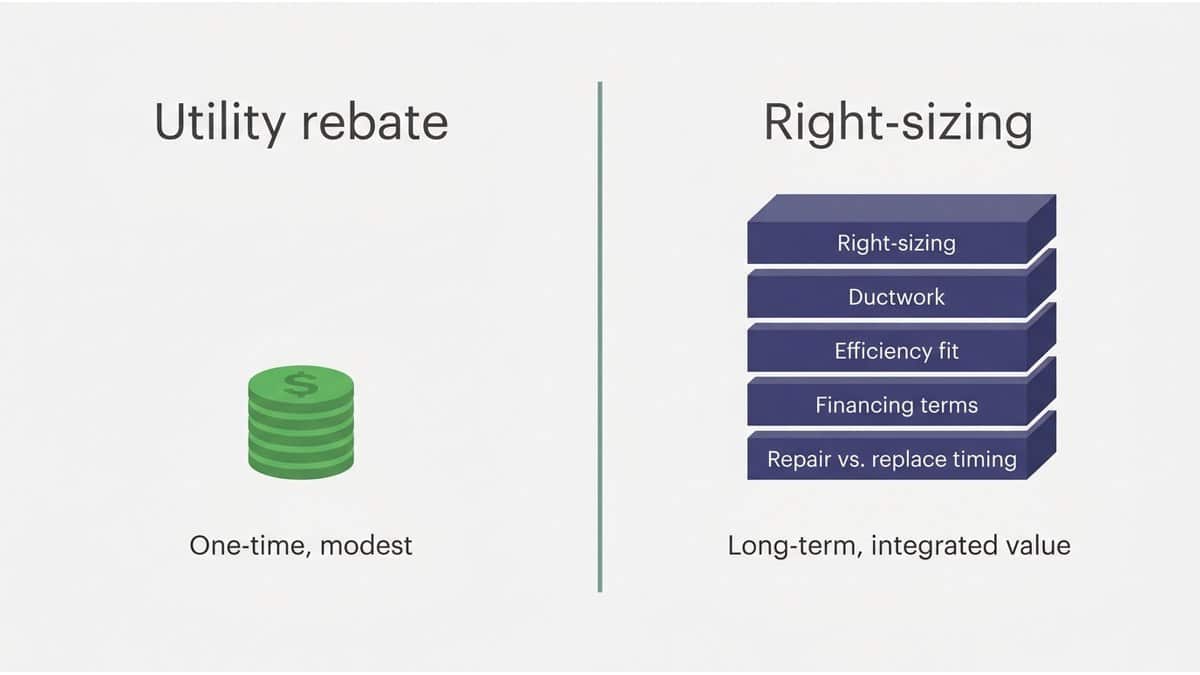
Usually by a few hundred dollars, not thousands. On a typical East Valley install (around $9,000 to $20,000 in our experience), rebates are a small slice. Bigger savings come from right-sizing the system, choosing efficiency that fits your home, financing terms, and fixing ductwork, so don’t pick equipment just to chase a rebate.
Here is an honest worked example. Say you replace a system at a hypothetical $11,000, and your utility pays a hypothetical $300 rebate. That rebate is under 3 percent of the price. (This is our own arithmetic on a made-up example, not a program figure.) Real amounts depend on your utility, equipment tier, and capacity. [CITATION_NEEDED: verified current APS or SRP central AC rebate amount to replace the hypothetical figure]
So where does the real savings come from? These levers usually move a quote more than any rebate:
- Right-sizing. A correctly sized system costs less to buy and run than an oversized one.
- Ductwork condition. Leaky or undersized ducts can undercut a great new system. Sometimes it is smarter to bundle ductwork installation with the replacement than to fix it later.
- Equipment tier. Pay for the efficiency your usage justifies, not the top of the catalog.
- Financing terms. A lower monthly payment can make the right system affordable now.
- Repair or replace timing. Replacing too early wastes money. Waiting too long can mean an emergency replacement.
- Scheduling. Planning ahead, rather than waiting for a mid-summer breakdown, gives you time to compare quotes calmly.
This is where transparent pricing matters. We give you the number on-site before work starts, with no hidden fees. A standard install takes one to two days. If you want to see how sizing and financing fit together, read about sizing and financing options for a Gilbert install.
Financing is a legitimate cost lever, as long as you compare terms carefully. See our AC installation financing and payment options for what is available.
Should you buy bigger or sooner just to catch a rebate? No. Buy what fits your home. If your older unit is already acting up, learn what to do when an older AC freezes up. A freeze-up is often the moment to compare repair and replacement honestly.
For one more reference point, ENERGY STAR's home savings page shows how efficiency upgrades can fit into a larger budget, beyond a single rebate check.
Bottom line: A rebate trims the price slightly, but sizing, ducts, and terms decide what you actually pay.
How do you claim an AC rebate?
Confirm your utility, check qualifying equipment and deadlines before you buy, use a licensed Arizona contractor, keep your invoice and model and serial numbers, and submit the application within the program window. For a 2025 install, add IRS Form 5695 to your tax return.
Here is the sequence as a checklist:
- Confirm your utility. Look at your electric bill. Note whether you also have a gas provider.
- Check the current equipment list and deadlines. Do this before you buy, not after.
- Get a free on-site estimate. This is the natural moment to ask whether the equipment under discussion fits your utility’s current criteria.
- Hire a licensed installer. Confirm the Arizona contractor license number. [CITATION_NEEDED: Arizona Registrar of Contractors (roc.az.gov), license lookup and requirement]
- Keep your paperwork. Save the invoice and the model and serial numbers of the indoor and outdoor units.
- Submit within the window. Send your application with the supporting documents before the deadline.
- For 2025 installs, file Form 5695. Gather the manufacturer certification and identification number first.
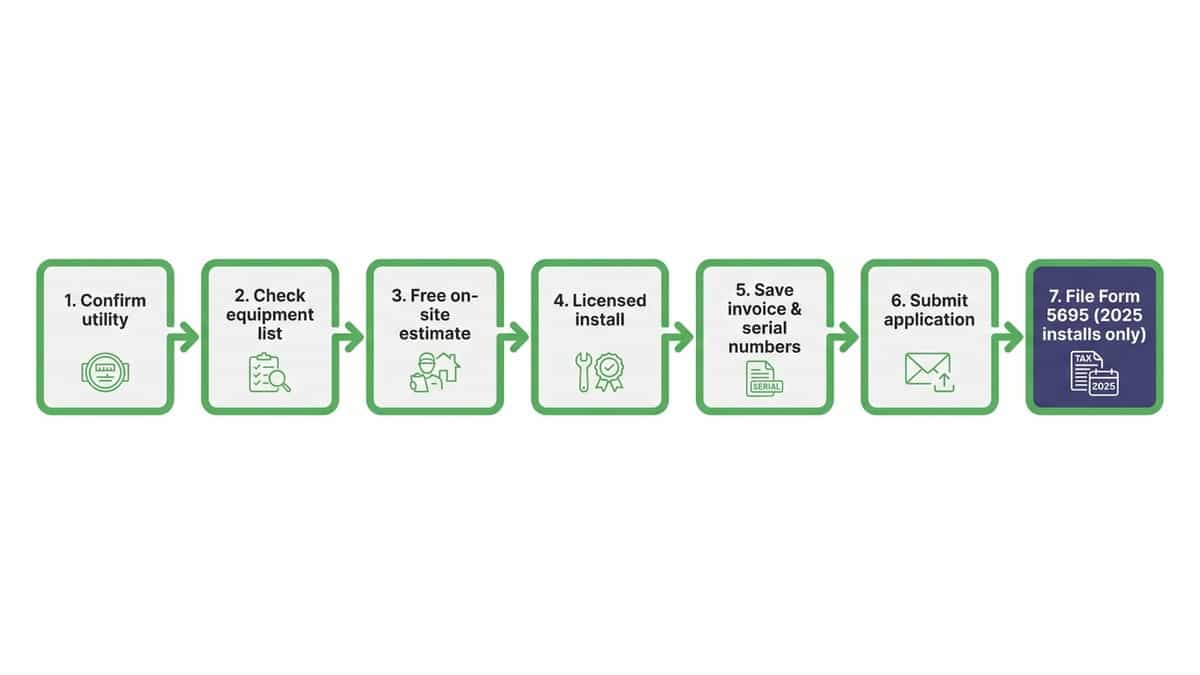
Our process mirrors this. You get a free on-site consultation, a transparent quote, scheduling, the install, and a follow-up check. Step three is where we can talk through eligibility with you, before you commit to anything. As you work through the list, keep ENERGY STAR's home savings resources open as a reference for efficient equipment categories.
Mistakes to avoid
Most missed rebates come down to a handful of avoidable errors:
- Buying before checking eligibility. A great deal on the wrong model can cost you the rebate.
- Picking the wrong territory. Your rebate comes from your own utility only.
- Missing documents. No invoice or serial number often means no payment.
- Missing the deadline. Mark the application window on your calendar the day you install.
- Assuming a rebate is guaranteed. Funds, amounts, and rules can change, so confirm before you rely on one.
Bottom line: Check eligibility before you buy, keep every document, and file on time.
Quick answers: common AC rebate questions
Can I stack utility rebates and federal credits?
For a 2025 install, generally yes. A utility rebate and the 25C credit were separate programs. A rebate can affect how much of your cost counts toward the credit, so confirm the treatment with your tax preparer. For a 2026 install, there is no federal credit to stack. [CITATION_NEEDED: IRS guidance on how utility rebates affect the cost basis for the 25C credit]
Do rebates apply to heat pumps?
Often yes. Many utility programs offer rebates for qualifying heat pumps, judged by SEER2 and HSPF2 ratings. Heat pumps both cool and heat, which suits Arizona’s mild winters. Rules differ by utility, so check your provider’s current equipment list before you choose. A 2025 heat pump install may also have qualified for the federal credit.
Is financing available if the rebate does not cover enough?
Yes. Rebates are small next to the full price, so many homeowners pair them with financing. We offer financing options, including through GoodLeap, that spread the cost over time. Financing does not reduce the price, so compare terms carefully. Ask about your options at your free on-site estimate.
Do I need a licensed contractor to get a rebate?
In Arizona, yes. HVAC installs must be done by a contractor holding an Arizona Registrar of Contractors license, and utility programs generally expect a properly licensed installer. Check the license number before you sign. Our owner is licensed and on the job. [CITATION_NEEDED: Arizona Registrar of Contractors, HVAC contractor licensing requirement]
What if my AC fails before I can check rebates?
Restore cooling first. In triple-digit heat, a failed system is a safety and comfort issue, and a small rebate should not keep your family hot. Call our 24/7 emergency line and ask about repair or replacement. You can still check eligibility before you commit. See the full list of HVAC services we offer, including repairs and upgrades. For more on matching equipment to incentives, ENERGY STAR's home savings page is a handy place to start.
Bottom line: Rebates, credits, and financing each work differently, so ask before you assume.
Ready to see your real install cost?
Here is the short version. Utility rebates are real, but they are modest. The federal 25C credit ended for installs after 2025, and it only helps if your system went in last year. The real savings come from the right-sized system at a transparent price, with financing that fits your budget.
We built this guide to be the honest version of a topic that is full of stale headlines. If you want to look beyond installation, our page on heating and cooling services across Arizona's East Valley shows everything we do for homeowners from Mesa to San Tan Valley.
Want to know what your install would cost and which rebates apply to your address? We’ll give you a straight number at a free on-site estimate.