The refrigerant your AC runs on will be harder to find and more expensive to service after 2026.
What does the R-22 phase-out mean for your AC repair costs in 2026? The R-22 refrigerant phase-out ended production in 2020, but existing systems can still be repaired using reclaimed refrigerant. As reclaimed R-22 supplies tighten further, repair costs are rising 30–50% for leak fixes and recharges according to HVAC distributors and trade publications. You don’t have to replace your system immediately, but if your unit needs more than a pound of refrigerant or has recurring leaks, replacement with a modern R-410A or A2L system will cost less over two years than repeated R-22 repairs.
If you’ve been told by another contractor that you have to replace your system now because of the refrigerant ban, that’s not the full story. The truth is simpler and less expensive than the scare tactics suggest. Your R-22 system isn’t illegal, and the federal government hasn’t outlawed repair. What has changed is the economics: R-22 is scarce, which makes common AC problems like frozen coils more expensive to fix when refrigerant is involved.
This guide walks you through the phase-out timeline, what you can expect to pay for repairs and replacement through 2027, and how to decide whether fixing your system makes sense or whether it’s time to upgrade.
What the R-22 Phase-Out Actually Means (And What It Doesn’t)
The R-22 refrigerant phase-out started with the Montreal Protocol in 1987, an international treaty to protect the ozone layer by reducing chlorofluorocarbons (CFCs) and hydrochlorofluorocarbons (HCFCs). R-22, a common HCFC used in residential air conditioning systems installed before 2010, was identified as a contributor to ozone depletion. The U.S. Clean Air Act followed through with a phased reduction plan: production of virgin R-22 dropped incrementally over two decades and ended completely on January 1, 2020.
The 2020 production ban does not mean your R-22 system became illegal overnight. Existing systems can continue to run indefinitely as long as they don’t need refrigerant. If your AC is cooling properly and isn’t leaking, you can keep using it without penalty or immediate replacement. The phase-out restricts production and import of new R-22, but repair using reclaimed (recovered and cleaned) refrigerant is still allowed.
The myth that replacement is mandatory comes from confusion about the law. Some contractors use the phase-out as a pressure tactic, framing it as a regulatory requirement when it’s actually an economic shift. The law bans producing R-22, not using it. What’s changed is availability and cost. With no new production, the only R-22 on the market comes from reclaimed supplies, recovered from decommissioned systems and purified for reuse.
According to EPA Section 608 regulations, technicians must be certified to handle refrigerants safely, and recovered R-22 must meet purity standards before it can be recharged into another system. This reclamation process adds cost and administrative overhead, which drives up per-pound pricing. But the system itself isn’t outlawed, and you’re not breaking any rules by continuing to use your R-22 AC.
If you’re being told that federal law requires you to replace your system now, ask the contractor to show you the regulation. There isn’t one. What you’re facing is a cost decision, not a compliance deadline. Understanding that distinction puts you in control of the timeline.
For homeowners with R-22 systems that are still performing well, the takeaway is simple: you have time to plan. If your AC is cooling your home and hasn’t needed refrigerant in years, there’s no emergency. But if it’s developing leaks or losing efficiency, the math is about to shift, and understanding the economics of repair versus replacement is critical to making the right decision.
Why R-22 Repair Costs Are Climbing (Supply, Demand, and Reclaimed Refrigerant Economics)
When R-22 production ended in 2020, the refrigerant market shifted from a manufacturing-driven supply chain to a reclamation-driven one. That change reshaped the economics of AC repair in ways most homeowners don’t see until they get a quote for a leak fix or a refrigerant recharge.
Before 2020, R-22 was produced in bulk by chemical manufacturers and sold through HVAC distributors at relatively stable prices. After the production ban, the only source of R-22 is reclaimed refrigerant, recovered from systems being decommissioned, cleaned to EPA purity standards, and resold. That process is more labor-intensive and less scalable than manufacturing, which means tighter supply and higher costs.
The U.S. Department of Energy’s residential HVAC literature review highlights that refrigerant availability directly impacts service pricing, particularly for legacy systems no longer in production. Since 2020, distributors have reported per-pound price increases as reclaimed R-22 becomes scarcer. The trend is expected to accelerate through 2026 and beyond as the total installed base of R-22 systems shrinks and recovery volumes decline.
Here’s the dynamic at work: every year, more R-22 systems reach end-of-life and are replaced with newer refrigerants (R-410A or the newer A2L refrigerants required under the American Innovation and Manufacturing Act). When those old systems are decommissioned, the R-22 inside is recovered and processed for reuse. But as fewer R-22 systems remain in operation, the pool of recoverable refrigerant gets smaller. At the same time, the systems still running are aging, which means they’re more likely to develop leaks and need recharges. That imbalance drives prices up.
For contractors, the cost increase shows up in invoice pricing. A refrigerant recharge that might have cost a homeowner $400 in 2019 can easily run $600–$800 today, and by 2027, that number could approach $1,000 or more depending on how much refrigerant the system needs. The labor and diagnostic work haven’t changed, but the material cost has doubled or tripled.
There’s also a quality and sourcing risk. As legitimate reclaimed R-22 becomes more expensive, gray-market refrigerant sometimes appears in the supply chain at lower prices. That refrigerant may not meet EPA purity standards, which can damage compressors or void warranties. Homeowners should ask contractors where their R-22 comes from and whether it’s been reclaimed to EPA standards. A contractor who won’t answer that question or offers a suspiciously low price is a red flag.
The broader point is this: R-22 repair costs are rising because of basic supply and demand. The refrigerant is scarce and getting scarcer. If your system needs a small repair that doesn’t involve refrigerant (a capacitor, a fan motor, a thermostat), the phase-out doesn’t affect you. But if it needs a recharge, you’re paying scarcity pricing, and that math changes the repair-versus-replace calculus in ways it didn’t five years ago. Understanding why summer in Mesa demands fast AC repair becomes even more important when refrigerant costs are climbing.
When Repairing Your R-22 System Still Makes Sense
Not every R-22 system needs immediate replacement. Understanding when repair is the smarter financial move helps you avoid paying for a new system before you have to.
If your AC unit has a failed capacitor, a broken fan motor, or a malfunctioning thermostat, those repairs don’t involve refrigerant, and the R-22 phase-out doesn’t change the cost equation. A capacitor replacement might run $150–$300, a fan motor $300–$600, and a thermostat $100–$250. Those are straightforward fixes that extend your system’s life without exposure to scarcity pricing.
The decision gets more complicated when refrigerant is involved. If your system is low on R-22 and the leak is small and easily repairable (a loose fitting, a pinhole in a line set), fixing the leak and adding refrigerant can still be cost-effective, especially if the system is otherwise reliable and you’re planning to stay in your home for only a few more years. A leak repair plus a one-pound recharge might cost $800–$1,200 today, and if that keeps you running through two more Mesa summers without other failures, you’ve avoided the $11,000 cost of a new system.
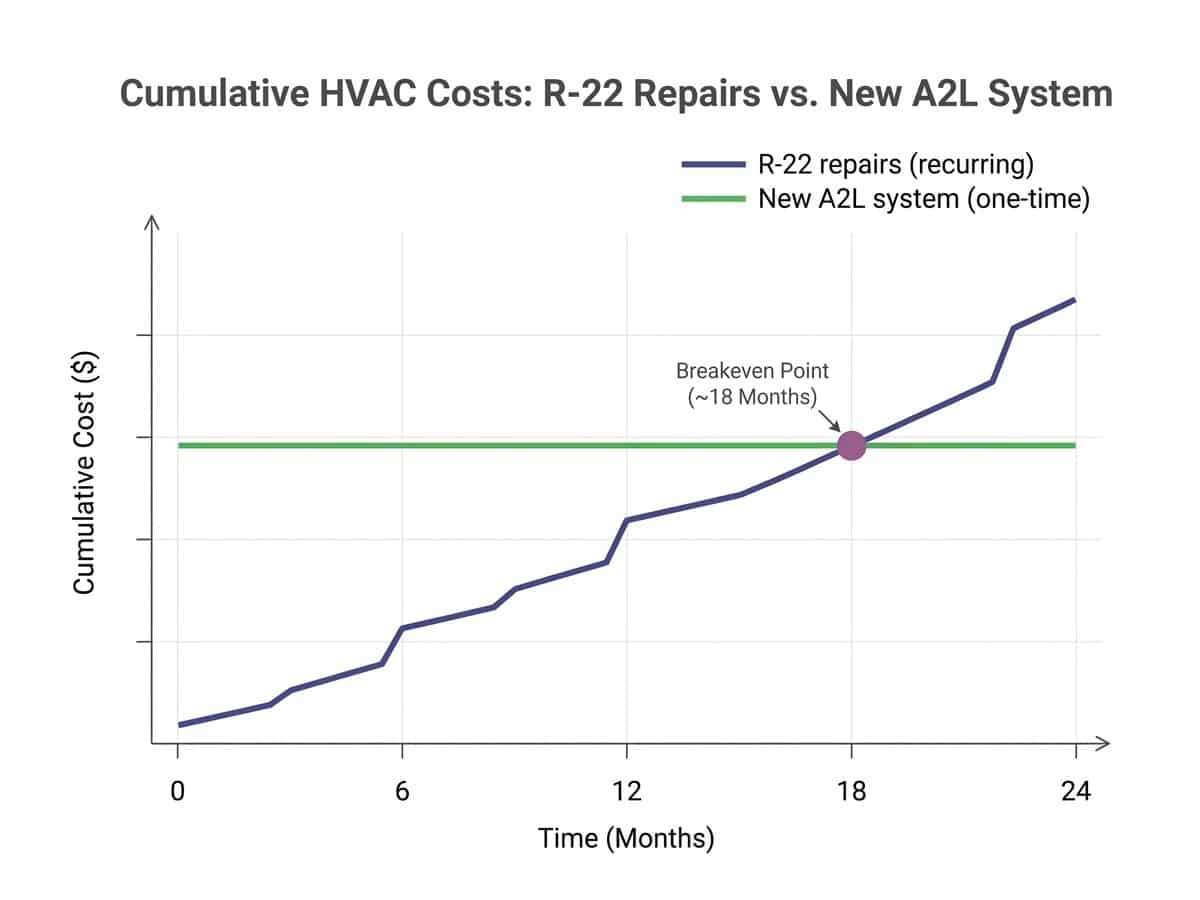
But if your system has recurring leaks, if it needs more than two pounds of refrigerant, or if it’s developing multiple failures at the same time (compressor noise, evaporator coil corrosion, ductwork leaks), the math tips toward replacement. Here’s why: a system that needs three pounds of R-22 today at $300–$400 per pound is a $1,200 material bill on top of labor and diagnostics. If the same system needs another recharge six months later, you’ve spent $2,000–$2,500 on repairs for a unit that’s still old, inefficient, and likely to fail again. Over two years, that cumulative repair spend can approach half the cost of a new system that comes with a 10-year parts warranty, higher efficiency, and no ongoing refrigerant risk.
The energy efficiency gap matters too. A 12-year-old R-22 system likely operates at a SEER (Seasonal Energy Efficiency Ratio) of 10–13. A new system installed in 2026 will meet higher efficiency standards in the Southwest, which translates to lower cooling costs according to Energy Star maintenance guidelines. For a 1,800-square-foot home in Gilbert or Queen Creek running the AC seven months a year, that efficiency gain can save money on electric bills that partially offsets the upfront cost of replacement.
The real work behind air conditioning system maintenance includes catching small problems before they become expensive ones. If your system is older than 10 years, has needed refrigerant more than once in the past three years, or is showing declining performance (longer run times, uneven cooling, higher electric bills), a consultation with a licensed contractor can help you weigh the cost of keeping it running versus the long-term savings of replacing it now.
The decision framework is straightforward:
- Repair if: The problem is a non-refrigerant component, the system is relatively young (under 10 years), and you haven’t had recurring issues.
- Consider replacement if: The system needs a large refrigerant recharge, has recurring leaks, is over 12 years old, or is developing multiple failures at once.
- Definitely replace if: You’re spending more than $2,000 per year on repairs, the compressor has failed, or you’re planning to stay in your home for five or more years.
What It Costs to Replace Your R-22 System in 2026–2027
If you’ve decided that replacement makes more sense than continued repair, understanding what drives cost variation helps you budget and evaluate quotes from different contractors.
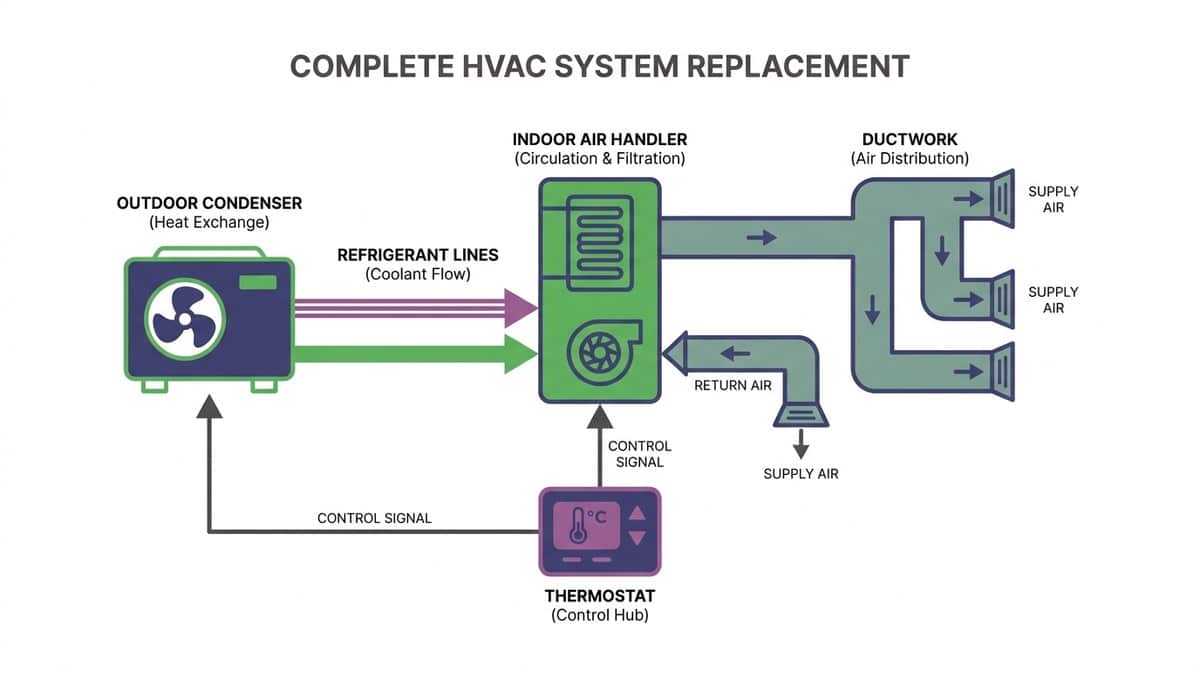
The average cost of a complete residential HVAC system replacement in the East Valley ranges from $9,000 to $20,000, with most homeowners paying around $11,000 for a quality installation using professional-grade equipment. That range reflects differences in home size, ductwork condition, equipment tier, and refrigerant type.
Home size is the primary cost driver. A 1,400-square-foot home might need a 2.5-ton system, while a 2,200-square-foot home typically requires a 4-ton or 5-ton unit. Larger systems cost more in equipment and labor. A 2.5-ton install might run $9,000–$11,000, while a 5-ton install for a larger home can reach $15,000–$18,000.
Ductwork condition affects whether you’re paying for a straightforward equipment swap or a more involved retrofit. If your existing ducts are in good shape (no major leaks, properly sized for the new system), the install is simpler and less expensive. But if the ducts are undersized, leaking, or poorly insulated, bringing them up to code adds $2,000–$5,000 to the project.
Equipment tier gives you a range of options. Entry-level systems meet minimum SEER2 efficiency standards and come with standard warranties. Mid-tier systems offer better build quality, quieter operation, and longer parts warranties, typically at a $1,500–$3,000 premium over entry-level. Premium systems with variable-speed compressors, advanced controls, and higher SEER2 ratings can add another $2,000–$4,000 but deliver better comfort and lower operating costs over the system’s lifespan.
Refrigerant type is the newest variable. Systems installed in 2025 and later are required under the American Innovation and Manufacturing Act to use A2L refrigerants (such as R-454B or R-32) instead of R-410A. A2L refrigerants have lower global warming potential and are classified as mildly flammable, which requires updated installation practices and equipment designed to handle them safely. The cost difference between an R-410A system and an A2L system is minimal, typically $200–$500.
According to Energy Star maintenance guidelines, a properly installed high-efficiency system should operate at peak performance for 15–20 years with routine maintenance, which makes the upfront investment more defensible when you amortize it over two decades.
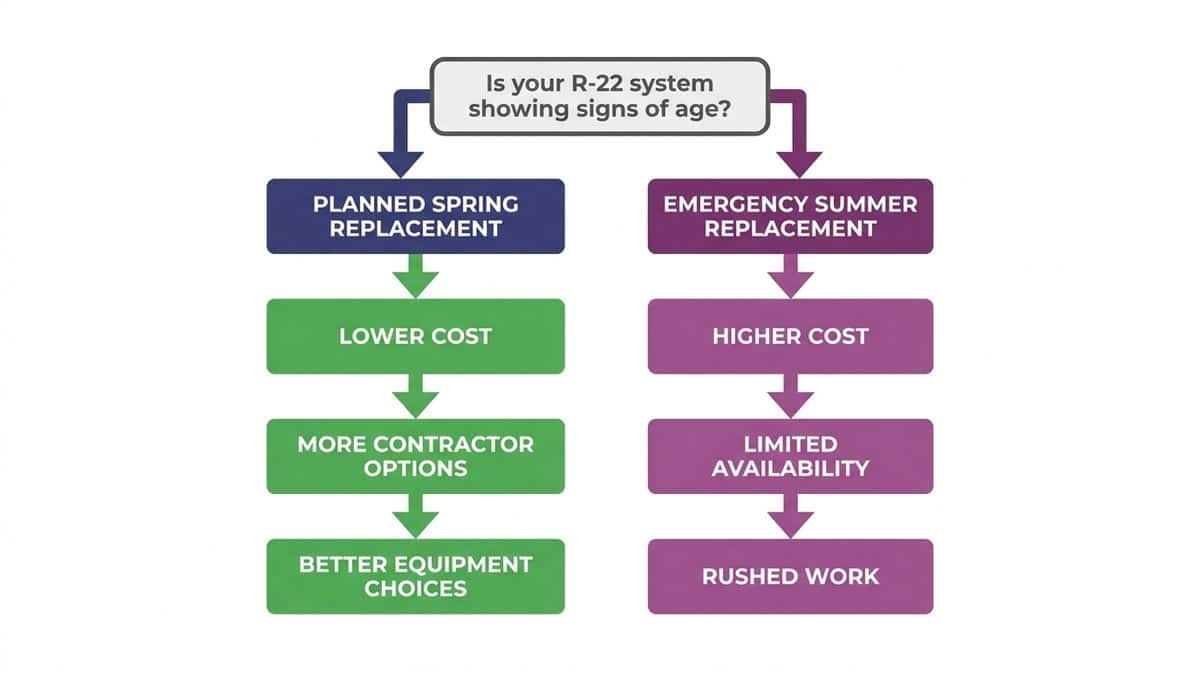
The cost of waiting is also worth considering. If you replace your system in spring 2026, you have time to compare quotes, schedule the install during a slower season, and avoid the summer rush when contractors are booked solid and pricing is less negotiable. If you wait until your system fails in July during a 110-degree heatwave, you’re replacing it in emergency mode, which limits your options and often costs more.
How to Know If Your AC Uses R-22 (And What to Do Next)
If you’re not sure whether your system uses R-22, checking is straightforward, and it takes less than five minutes.
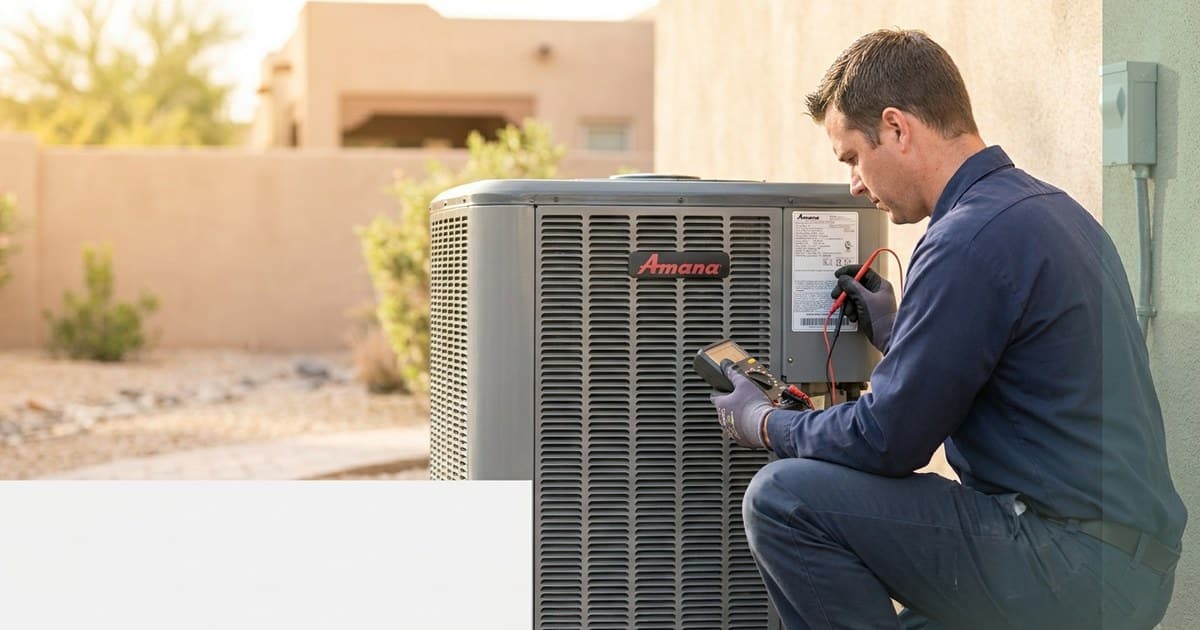
Walk outside to your outdoor condenser unit (the large metal box next to your house that hums when the AC is running). Look for a metal data plate, usually mounted on the side or back of the unit. The plate lists the manufacturer, model number, serial number, and refrigerant type. If the refrigerant line says “R-22” or “HCFC-22,” you have an R-22 system. If it says “R-410A” or “Puron,” you have a newer system that isn’t affected by the phase-out.
If the data plate is faded, rusted, or unreadable, check the age of the system using the serial number. Most manufacturers encode the year of manufacture in the first few characters of the serial number, and a quick online search of your brand’s serial number format will tell you the year. Systems installed before 2010 almost always use R-22. Systems installed after 2010 typically use R-410A.
If you still can’t tell, call a licensed HVAC technician for a free inspection. Any reputable contractor can identify your refrigerant type in seconds and explain what it means for your repair and replacement options. That inspection is also a good time to ask about the overall condition of your system, whether it has any refrigerant leaks, and what kind of lifespan you can expect before major failures start occurring.
Once you know you have an R-22 system, the next step is evaluating its condition. If it’s cooling well and hasn’t needed service in the past few years, you’re fine for now. Keep an eye on performance (longer run times, uneven temperatures, higher electric bills) and have it inspected annually to catch small problems before they become expensive ones. You can find more AC repair and maintenance guides that walk through common issues and when to call a professional.
If the system is struggling (weak airflow, warm air from vents, short cycling), it’s time for a diagnostic visit. A technician can check refrigerant levels, test the compressor and fan motors, inspect the evaporator and condenser coils, and measure system performance against manufacturer specs. That diagnostic visit will tell you whether you’re looking at a simple repair or a system that’s nearing the end of its useful life.
The worst-case scenario is not knowing your refrigerant type until the system fails on a 112-degree day in July and you’re scrambling to find a contractor who can fit you in. Taking 10 minutes now to check the data plate or schedule an inspection gives you control over the timeline and keeps you out of emergency-replacement territory.
Why Waiting Until Your R-22 System Fails Will Cost You More
Emergency AC replacement in the middle of an East Valley summer is one of the most expensive and stressful home repair scenarios a homeowner can face, and it’s almost always avoidable with a little planning.
When your AC fails in July, the outdoor temperature is regularly hitting 110–115 degrees, and your indoor temperature climbs into the 90s within hours. Your family is uncomfortable, your pets are at risk, and you need a solution immediately. That urgency limits your options. You call the first contractor who answers the phone, and if they can’t come out same-day, you call the next one. You’re not comparing quotes, reading reviews, or negotiating pricing. You’re accepting whatever it takes to get cool air flowing again.
Contractors know this. Emergency service calls during peak summer demand command premium pricing because the contractor is rearranging their schedule, pulling a crew off another job, or working after hours to accommodate you. According to the Jobber home service trends report, emergency HVAC service calls can carry a price premium compared to scheduled work, and that premium applies to both labor and equipment.
The quality and transparency of the work can also suffer under emergency conditions. A contractor who’s rushing to finish your install before dark might cut corners on ductwork sealing, refrigerant charging, or airflow balancing. You’re less likely to get a detailed written estimate or a thorough explanation of your options when the technician is working under time pressure.
Contrast that with a planned replacement in spring. In March or April, contractors are coming out of the slower winter season and have more availability. You can schedule multiple quotes, compare pricing and equipment options, read reviews, and choose the contractor who best fits your budget and expectations. You can ask detailed questions about warranty terms, financing options, and what the install process will look like. The contractor has time to do the job right, which means proper ductwork sealing, refrigerant charge verification, airflow testing, and system balancing.
The planning window also gives you flexibility on equipment choices. If you’re replacing in spring, you can choose a mid-tier or premium system that offers better efficiency and quieter operation. If you’re replacing in July, you’re often limited to whatever the contractor has in stock or can get delivered same-day, which is usually entry-level equipment.
For homeowners with R-22 systems that are 12 or more years old, the smart move is scheduling a spring inspection in 2026 or early 2027 to assess the system’s condition and get a replacement quote while you still have time to plan. Even if the system is running fine today, knowing that it’s approaching end-of-life and having a quote in hand puts you in control. If it fails in June, you already know who to call and what it will cost, which eliminates the panic and the premium pricing.
Why spring is the smart time to schedule AC work isn’t just about saving money: it’s about getting better work, more options, and less stress.
If your R-22 system is still running but showing signs of age (longer run times, uneven cooling, higher electric bills), don’t wait until it dies. Schedule a consultation now, get a replacement quote, and decide whether you want to replace it on your timeline or gamble on it lasting another summer.
What to Ask a Contractor Before You Commit to a Repair or Replacement
Not all HVAC contractors operate the same way, and asking the right questions before you commit to a repair or replacement helps you identify who’s transparent and competent versus who’s cutting corners or pushing a sale.
Are you licensed and insured? In Arizona, HVAC contractors must hold a valid ROC (Registrar of Contractors) license to perform work legally. Ask for the license number and verify it on the Arizona ROC website. Insurance (both liability and workers’ compensation) protects you if a technician is injured on your property or if the work causes damage. A contractor who hesitates to provide proof of licensing or insurance is not someone you want working on your home.
Do you have experience with A2L refrigerant systems? If you’re replacing your system in 2026 or later, it will use A2L refrigerants, which have different handling and installation requirements than R-22 or R-410A. Ask whether the contractor has completed manufacturer training on A2L systems, what safety protocols they follow, and whether their equipment (leak detectors, recovery machines, gauges) is rated for A2L use. According to EPA Section 608 regulations, technicians working with A2L refrigerants need updated certification.
Will you provide a written, itemized estimate before starting work? Verbal estimates are not enforceable, and they leave room for surprise charges after the work is done. A written estimate should break down labor, materials, equipment model and specifications, warranty terms, and total cost. It should also specify what’s included (ductwork modifications, electrical upgrades, permits) and what’s not. If a contractor won’t put the estimate in writing, walk away.
What’s your warranty on parts and labor? Equipment manufacturers typically offer a 10-year parts warranty on compressors and heat exchangers, but that warranty only applies if the system is installed correctly and registered with the manufacturer. Ask whether the contractor registers the equipment on your behalf and what labor warranty they offer. A one-year labor warranty is standard; anything less is a red flag.
Do you offer financing? If you’re looking at a $10,000–$15,000 replacement and don’t have that cash on hand, financing can make the project feasible. Ask about interest rates, term lengths, and whether there are any fees or penalties.
How do you size the system for my home? Proper HVAC sizing requires a Manual J load calculation, which accounts for square footage, insulation, window area, ceiling height, and climate zone. A contractor who sizes your system based on square footage alone or who matches the tonnage of your old system without doing a load calculation is guessing, and an oversized or undersized system will cost you money in wasted energy and shortened equipment life. Ask whether they perform a Manual J and whether you’ll receive a copy of the calculation.
What’s your process for ductwork inspection and sealing? Leaky ducts can waste a significant portion of your conditioned air according to Energy Star duct sealing recommendations, which means you’re paying to cool your attic instead of your living space. A quality contractor will inspect your ductwork, identify leaks, and seal them as part of the install. Ask whether duct sealing is included in the estimate or whether it’s an add-on, and what method they use (mastic and mesh is the gold standard; duct tape is inadequate and will fail within a year).
These questions do more than vet the contractor: they signal that you’re an informed customer who won’t settle for sloppy work or vague promises. How to identify a qualified AC repair specialist comes down to asking hard questions and evaluating the answers against industry standards, not just accepting the lowest bid.
How JLM Helps East Valley Homeowners Navigate the R-22 Transition
The R-22 refrigerant phase-out is a cost issue, not a crisis, and the decision framework is straightforward: repair if the problem is small and doesn’t involve refrigerant, replace if the system needs large recharges or has recurring leaks. The key is having accurate information and a contractor who gives you options instead of pressure.
JLM has built a reputation on honest service, quality workmanship, and transparent pricing across Mesa, Gilbert, and Queen Creek. We’re A+ rated with the Better Business Bureau because we do what we say we’ll do, we show up when we say we’ll show up, and we don’t surprise customers with hidden fees or upsell tactics.
When you call JLM for a consultation on your R-22 system, we’ll inspect it, test refrigerant levels, check for leaks, and evaluate the overall condition of the compressor, coils, and ductwork. We’ll explain what we find in plain language, give you the repair cost and the replacement cost side by side, and let you decide. If a $600 repair will get you through another two years and you’re comfortable with that, we’ll do the repair. If replacement makes more sense financially and you want to move forward, we’ll walk you through equipment options, financing, and the install timeline without pushing you toward the most expensive system in the catalog.
We offer our full range of HVAC services, from emergency repairs to complete system replacements, maintenance contracts, and ductwork upgrades. We’re available 24/7 for emergency calls because we know AC failures don’t respect business hours, especially in summer. And we back our work with written warranties on both parts and labor, so you’re protected if anything goes wrong.
The East Valley is our home. We live here, our families are here, and our business is built on referrals from neighbors who trust us to treat them fairly. That’s the JLM difference: you’re not a sales target, you’re a member of the community, and we’re here to help you make the best decision for your home and budget.
Not sure whether your R-22 system is worth repairing or whether it’s time to replace it? Call now: 602-619-3609 for a free, no-pressure consultation. We’ll inspect your system, explain your options, and give you a transparent quote. No hidden fees, no upsell pressure. Just honest answers from people who live and work in your neighborhood.