
When you call a franchise HVAC company, you reach a call center. When you call a family-owned contractor, you reach the owner. That difference shapes everything that follows: pricing, accountability, and the quality of service you receive. Family-owned HVAC companies outperform franchises because the owner is accountable for every job, pricing is transparent without corporate overhead, and customer relationships drive referrals instead of call center volume. You speak directly to decision-makers, get honest diagnostics, and avoid upsell pressure (advantages that franchise models structurally can’t match). Understanding these structural differences is essential when selecting HVAC services in the East Valley, AZ.
If you’re researching HVAC contractors in Gilbert, Queen Creek, Mesa, or Apache Junction, understanding this distinction saves you money and frustration. The company you choose will affect your home’s comfort, your monthly energy bills, and your peace of mind for the next 10-15 years. This piece walks through the structural differences between franchise and family-owned HVAC companies, explains why those differences matter for homeowners, and gives you a framework to evaluate any contractor before you sign a contract.
The Structural Differences Between Franchise and Family-Owned HVAC Companies
Franchise HVAC companies operate under a licensing model. A corporate parent owns the brand, playbook, and marketing infrastructure. Individual franchise owners pay royalties (typically 5-8% of gross revenue) and national marketing fees (another 2-4%) in exchange for brand recognition, call center support, and standardized processes. They follow corporate pricing tiers, upsell scripts, and territory rules. Franchises now represent approximately 18% of the residential HVAC market, concentrated in major metro areas where brand advertising delivers volume.
Family-owned HVAC companies answer to no corporate parent. The owner holds the contractor’s license, manages pricing, hires technicians, and builds reputation locally. There’s no call center layer between the customer and the person accountable for the work. Revenue stays in the business to cover labor, materials, fair margin, and reinvestment (not royalties to a distant headquarters). These structural differences produce measurable outcomes for customers, starting with what you actually pay.
Referrals and repeat business sustain family-owned operators. A single negative review or unresolved complaint carries reputational risk that affects the owner’s livelihood directly. Franchise models distribute that risk across territory managers, regional offices, and corporate legal teams. For a local HVAC contractor embedded in the East Valley, reputation is everything. For a franchise operator managing five territories, it’s one variable among many.
Why Family-Owned HVAC Companies Offer More Transparent Pricing
Franchise overhead gets passed to you. A $6,000 AC install at a franchise includes the technician’s labor, equipment cost, company margin, and royalties/fees to corporate (often 7-10% of the invoice). Those royalties fund national advertising, call center infrastructure, and regional management salaries. You’re paying for brand visibility and corporate systems whether you need them or not.
Family-owned contractors price based on local labor rates, wholesale equipment cost, and a fair margin to sustain the business. There’s no corporate layer extracting percentages. Transparent itemized estimates help homeowners compare bids accurately and avoid surprise charges. At JLM, we provide written, itemized quotes before any work begins. You see exactly what you’re paying for (equipment model, labor hours, materials, permits) with no diagnostic fees that don’t roll into the repair cost.
Franchise pricing often follows a “good-better-best” upsell structure. The call center books the appointment; the technician presents three options on a branded tablet, anchoring you to the mid-tier or premium package. Family-owned operators diagnose what’s actually needed and offer options based on your budget and goals, not a corporate sales playbook. When 3,000+ installs depend on referrals and repeat customers, you can’t afford to push unnecessary upgrades. Our Air Conditioning services page breaks down what’s included in every service, with no hidden fees or surprise add-ons.
Transparent pricing builds trust. JLM’s A+ BBB rating reflects years of honest estimates and work completed exactly as quoted. That accountability loop only functions when the owner stands behind every invoice.
Owner Accountability and the “Who Do I Call?” Test
When something goes wrong after the install, who answers the phone? That question exposes the accountability gap between franchise and family-owned HVAC companies. Call a franchise for a warranty claim or follow-up issue, and you reach a call center. The representative opens a ticket, escalates to a regional manager, schedules a callback from a different technician than the one who did your original job. You explain the problem multiple times to people who weren’t on-site and have no personal stake in resolving it quickly.
Call a family-owned contractor like JLM, and you reach Bill or someone on his crew who was there for your install. The owner’s direct line is on your invoice. If your AC stops cooling three days after a repair, you’re not navigating a corporate org chart. You’re talking to the person accountable for making it right. That accountability isn’t a customer service perk; it’s a structural feature of the business model. Bill’s reputation in Gilbert, Queen Creek, and Mesa depends on how he handles that call.
Workyard’s 2024 HVAC facts and statistics show that customer retention rates for independent HVAC contractors average 68%, compared to 52% for franchise operators. The difference isn’t service quality alone. It’s relationship continuity. When the same owner oversees your system from install through maintenance, problems get caught early and resolved faster.
JLM’s 24/7 emergency response illustrates this advantage. When your AC fails on a 112-degree day in Mesa, you need same-day AC repair, not a callback queue. Bill and his team prioritize emergencies because they live in the community. Your discomfort is their neighbor’s discomfort. That urgency doesn’t scale through a call center.
Referrals vs. Call Volume: How Incentives Shape Service
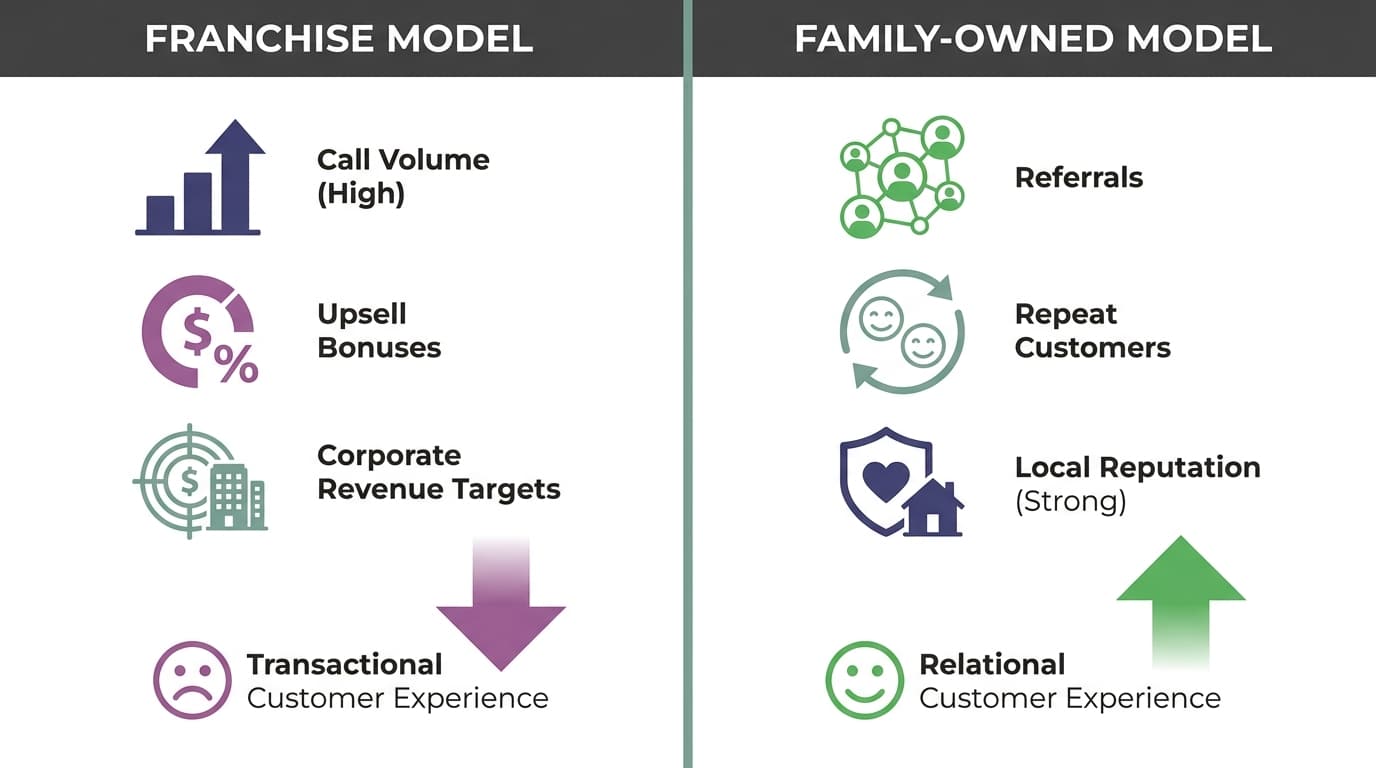
Franchise HVAC models optimize for call volume and conversion rates. The call center measures bookings per hour, average ticket size, and upsell attach rates. Technicians earn bonuses for moving customers from repair quotes to replacement packages. Regional managers track revenue per territory, not individual customer satisfaction. The system rewards scale and throughput, not relationship depth.
Family-owned HVAC companies optimize for referrals and repeat business. According to Rheem’s strategies to grow your HVAC business, word-of-mouth referrals generate 3-5 times higher lifetime value than paid advertising customers. JLM’s referral program offers $100 off your next service when someone you recommend completes an install. That only works if the referred customer has a positive experience worth talking about, which means Bill can’t afford to cut corners or oversell.
The incentive structure shapes behavior:
- Franchise model: Technician gets a spiff for selling a premium system. Customer gets a capable unit but pays for features they might not need. Call center moves to the next appointment.
- Family-owned model: Owner diagnoses the system, explains what’s broken, offers repair vs. replace options based on the unit’s age and efficiency. Customer chooses what fits their budget. Owner’s income depends on that customer calling again in three years and telling their neighbors.
This isn’t about vilifying franchises; it’s about understanding structural trade-offs. When your business model depends on local reputation and recurring relationships, you diagnose honestly. When it depends on call volume and corporate growth targets, you optimize differently. The homeowner experiences those incentives as service quality, but the root cause is economic.
At JLM, our seasonal AC prep tips for Gilbert homeowners include maintenance we could charge for separately but recommend doing yourself (changing filters, clearing debris from the condenser). We’d rather you save $80 on a service call and remember us when your system needs real work. That approach doesn’t scale through a franchise royalty model, but it sustains a family business.
When Does a Franchise Model Make Sense?
Franchise HVAC companies serve legitimate use cases. If you manage a portfolio of rental properties across multiple states, a national franchise offers standardized service agreements, centralized billing, and consistent processes. Property management firms prioritize predictability and scalability over personal relationships. A franchise delivers that.
If you’re unfamiliar with HVAC contractors in a new city and lack local referrals, a recognized franchise brand provides baseline reassurance. The Better Business Bureau profile, standardized warranties, and corporate quality control reduce uncertainty. You trade relationship depth for brand familiarity.
Some franchises offer financing programs through national lenders that small family-owned contractors can’t match. If you need a $12,000 system replacement financed over five years at promotional rates, franchise access to capital might outweigh pricing transparency. For homeowners evaluating smaller spaces, exploring options like mini split installation can provide efficient solutions without the full system replacement cost.
For the individual homeowner prioritizing trust, transparent pricing, and long-term relationship with a contractor who lives in their community, the family-owned model wins. If your HVAC needs fit the East Valley geography and you value speaking directly to the owner, franchise advantages become irrelevant. The choice depends on what you optimize for: brand recognition and scale, or accountability and local expertise.
How to Vet a Family-Owned HVAC Contractor (Questions to Ask)
Not all family-owned HVAC companies operate with the same integrity. Use these six questions to separate reputable contractors from corner-cutters:
1. Are you licensed and insured? Verify the contractor holds a valid state license (in Arizona, check the Registrar of Contractors database). Licensed contractors carry liability insurance and workers’ comp coverage. Ask for proof. If they hesitate, walk away.
2. Who will be on my job, and will I meet them before work starts? You should know who’s entering your home and touching your HVAC system. At JLM, Bill is on-site for installs and meets customers during the estimate. Technicians carry ID and wear clean uniforms. If the contractor can’t name the crew or introduce them in advance, question their accountability.
3. Do you provide a written, itemized estimate before starting work? Verbal quotes and ballpark figures invite disputes. A reputable contractor itemizes equipment model numbers, labor hours, materials, permits, and warranty terms in writing. This protects both parties and eliminates surprise charges. Written estimates are legally required in many states and are considered best practice to protect homeowners.
4. What’s your process if something goes wrong after the install? Ask how they handle callbacks, warranty claims, and follow-up issues. Do you call a main office or reach the owner directly? JLM customers have Bill’s direct line. When your AC stops cooling a week after a repair, you’re not explaining the problem to a scheduler. You’re talking to the person who supervised the work.
5. Can you provide references from recent jobs in my area? Local references prove the contractor operates in your geography and builds lasting customer relationships. Ask for three recent installs within 10 miles. Call them. Ask about pricing transparency, job cleanliness, and whether the final cost matched the estimate.
6. Do you offer a maintenance plan or ongoing support? A contractor confident in their work offers ongoing maintenance plans to extend system life and catch problems early. Annual professional maintenance maintains efficiency ratings and prevents breakdowns. JLM’s preventive maintenance agreements include priority scheduling and discounted service calls. If a contractor installs and disappears, they’re optimizing for one-time transactions, not relationships.
If a contractor hesitates on any of these six questions, keep looking. A reputable family-owned company will answer all six without hesitation, because their reputation depends on it.
What JLM’s 3,000+ Installs Taught Us About Earning Trust
After 3,000+ installations across the East Valley, we’ve learned that trust isn’t a marketing claim. It’s a daily practice built on showing up when promised, diagnosing honestly, and standing behind our work. That A+ BBB rating reflects thousands of transparent estimates, jobs completed on time and on budget, and callbacks handled personally by Bill.
One lesson stands out: customers don’t want to be sold; they want to be educated. When a homeowner asks whether to repair a 12-year-old AC or replace it, the honest answer depends on the unit’s condition, repair cost, and their budget (not our sales quota). We walk through the numbers: a $600 repair buys you 2-3 more years if the compressor and coils are sound. A $5,000 replacement delivers 15 years of higher efficiency and lower energy bills. According to Modernize’s ENERGY STAR ratings guide, newer systems can reduce cooling costs by 20-40% compared to units over a decade old. You choose based on your situation, not our revenue target.
Bill’s owner-on-the-job model means he sees what works and what doesn’t in real-time. When a technician encounters an unexpected duct modification or electrical issue during an install, Bill’s on-site to make the call: no callbacks to a regional manager, no delays. That responsiveness matters when you’re without AC in 110-degree heat. Seasonal preparedness is critical in the East Valley, which is why we emphasize planning for Arizona AC tune-ups early to avoid peak-season emergencies.
Our HVAC services across Gilbert, Queen Creek, Mesa, and Apache Junction are built on referrals. Sixty-three percent of our new customers come from existing customer recommendations. That percentage only sustains a business if every install, every repair, and every maintenance call earns the trust required for someone to stake their own reputation on referring us. We can’t afford a single job done poorly or a customer left waiting for a callback. The family-owned model makes that accountability unavoidable.
Choose a Contractor Who Answers the Phone
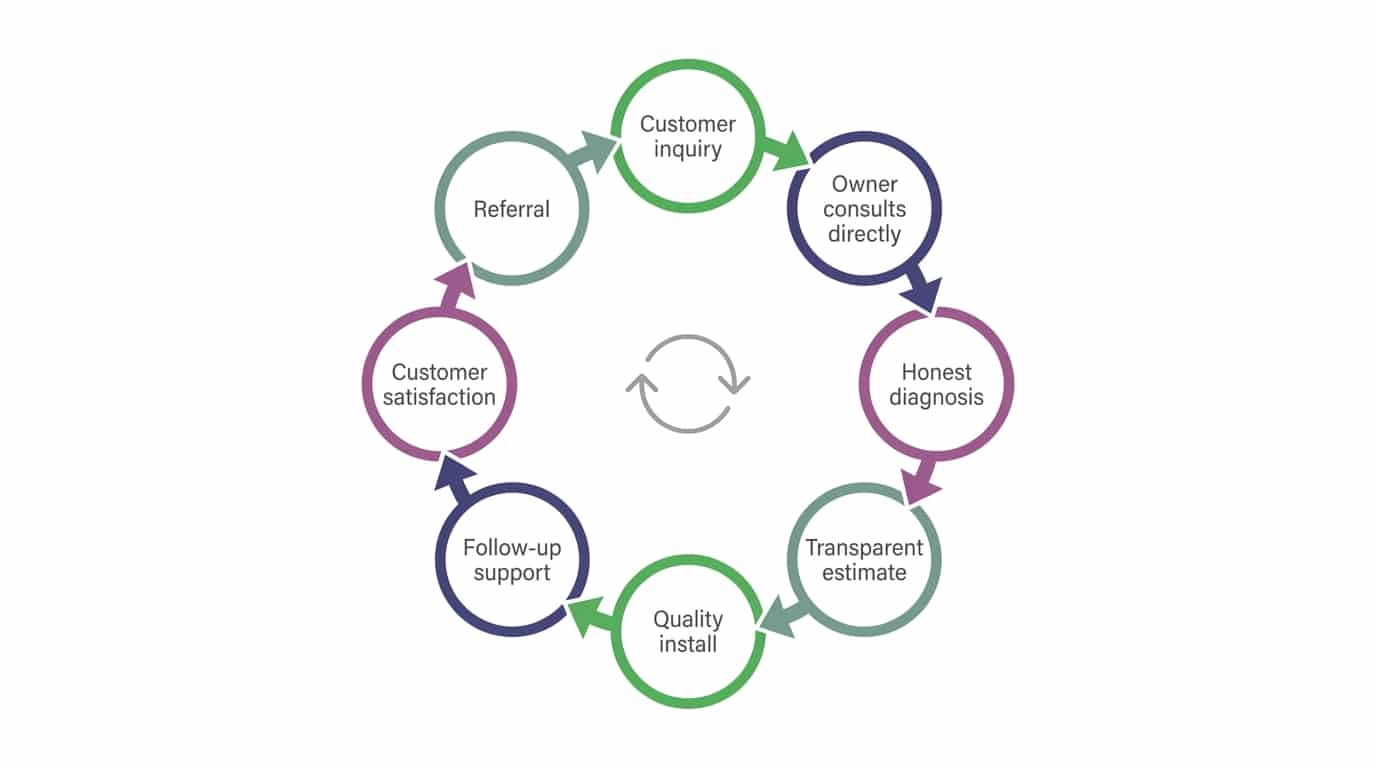
Family-owned HVAC companies outperform franchises because the incentives align with your interests: transparent pricing without corporate overhead, personal accountability from the owner, and service quality driven by referrals rather than call center quotas. The “Who Do I Call?” test cuts through marketing claims and exposes the structural difference that matters most. When your AC fails or a warranty claim arises, you need the person accountable for the work, not a ticket escalation system.
If you’re researching HVAC contractors in Gilbert, Queen Creek, Mesa, or Apache Junction, use the six vetting questions to separate reputable family-owned companies from the rest. Ask for licenses, written estimates, local references, and a clear process for handling problems. Residential HVAC licensing requirements vary significantly by state, so verify that your contractor meets all local regulations. A contractor who hesitates on transparency doesn’t deserve your business.
At JLM, Bill and his team are on the job, not behind a call center script. We’ve completed 3,000+ installs across the East Valley by diagnosing honestly, pricing transparently, and standing behind every system we touch. Our A+ BBB rating and referral-driven growth prove that the family-owned model works when you do it right.
For more HVAC guidance tailored to East Valley homeowners, explore our HVAC tips and updates.
Ready to work with an HVAC company that puts your comfort and budget first? Call now: 602-619-3609. Bill answers.