
Your AC just died at 3 p.m. on a 110°F July afternoon in Mesa. You’re sitting in a sweltering living room, frantically Googling “best AC repair near me” while your kids complain and the dog hides under the dining table. Within minutes, you have three wildly different quotes from contractors you’ve never heard of (one dirt-cheap, one sky-high, and one somewhere in the middle) and no idea which company will actually fix the problem without emptying your wallet or disappearing after the check clears.
What makes the best AC repair service? The best AC repair service combines licensed, factory-trained technicians with transparent pricing, same-day emergency availability, and a warranty on both parts and labor. Look for contractors who diagnose before selling, show you the problem, and back their work with A+ BBB ratings and verifiable customer reviews.
The difference between a quality AC repair and a regret isn’t just price. It’s whether the contractor you choose shows up with the right certifications, tells you the truth about what’s broken, honors their warranty when something goes wrong six months later, and answers the phone at 9 p.m. on a Saturday when your system fails again. This piece unpacks the six concrete, observable standards that separate reliable HVAC service from fly-by-night operations and shows you exactly what to look for before you hand over a deposit. When your family’s comfort and your home’s largest mechanical system are on the line, why fast response matters when temps hit 110°F becomes a question of health, not just convenience.
Why “Best” AC Repair Isn’t About the Lowest Bid
Most homeowners start their search by calling three contractors and picking the cheapest quote. It’s a logical instinct: AC repairs are expensive, and you want to stretch your budget. But the lowest bid almost always signals shortcuts that cost you more in the long run. Unlicensed technicians who misdiagnose the problem, refurbished parts that fail within weeks, no warranty when the repair doesn’t hold, and a follow-up bill that doubles the original estimate.
Skilled HVAC labor costs real money. According to Bureau of Labor Statistics wage data, certified HVAC technicians earn premium rates because they carry specialized training, EPA refrigerant-handling certification, and manufacturer credentials that take years to earn. When a contractor bids 40% below market, they’re either cutting corners on labor (hiring unlicensed helpers), skimping on parts (using aftermarket components not designed for your system), or planning to upsell you once they’re in the door.
Our work with East Valley homeowners shows that failed budget repairs often turn into emergency replacements within six months. A homeowner pays $150 for a “quick fix” from an unlicensed handyman, the capacitor fails again two weeks later, and they’re back to square one. This time calling a licensed contractor to undo the damage and install the right part. The total cost: $600 instead of the $350 a quality contractor would have charged upfront.
“Best” AC repair isn’t the lowest invoice. It’s the highest value: upfront cost plus long-term reliability, fewer callbacks, protection under warranty, and peace of mind that your system won’t fail again the moment monsoon season hits. When you reframe the decision around total cost of ownership instead of sticker price, the choice becomes clearer. Look for transparent pricing on all HVAC services and contractors who explain exactly what you’re paying for (parts, labor, warranty, emergency availability) before the work starts.
The Six Non-Negotiable Standards of Quality AC Repair
Quality AC repair isn’t an abstract promise. It’s a set of observable, verifiable practices you can check before signing a contract. The six standards below define what separates reliable service from risky gambles. Use them as a mental checklist when you’re comparing quotes, asking questions over the phone, or watching a technician work in your backyard.
Licensed, Certified Technicians with Ongoing Training
Every state in the U.S. requires HVAC contractors to hold a valid license, and Arizona is no exception. That license proves the technician passed competency exams covering electrical systems, refrigerant handling, safety codes, and equipment installation. But a license is the baseline, not the finish line.
Quality contractors employ technicians who hold EPA Section 608 certification, which is federally mandated for anyone handling refrigerants. According to EPA refrigerant-handling rules, improper refrigerant recovery or recharging can release ozone-depleting chemicals into the atmosphere and create serious safety hazards in your home. An unlicensed technician who skips this step isn’t just breaking the law: they’re putting your family at risk.
Beyond EPA certification, look for technicians trained by equipment manufacturers. Brands like Amana, Carrier, Trane, and Lennox offer factory training programs that teach techs how to diagnose, repair, and install their specific models. A technician certified on your exact AC brand knows the common failure points, the correct refrigerant charge, and the warranty requirements that protect your investment.
The Air Conditioning Contractors of America (ACCA) publishes quality installation standards that define best practices for system sizing, ductwork design, airflow testing, and commissioning. Contractors who follow ACCA Quality Installation (QI) protocols deliver systems that run efficiently and last longer, not just “good enough to pass inspection.”
Before a technician starts work, ask to see their license number (you can verify it online through the Arizona Registrar of Contractors), their EPA 608 card, and any manufacturer certifications relevant to your equipment. If they hesitate or claim “it’s in the truck,” that’s a red flag. Licensed, certified techs carry their credentials and show them without prompting.
Ongoing training matters, too. HVAC technology evolves constantly: new refrigerants replace old ones, smart thermostats require different wiring, variable-speed compressors need specialized diagnostics. Quality contractors invest in continuing education for their teams so they stay current with code changes, new equipment, and evolving best practices. Ask how often the company sends techs to training and which certifications they hold. Vague answers or “we train on the job” signal a contractor cutting corners on competence.
Transparent Pricing with No Hidden Fees
Transparent pricing means you know the total cost before work begins, and that total doesn’t change unless you approve additional repairs. It starts with an upfront diagnostic fee (if any), followed by a written, itemized estimate that breaks down parts, labor, and any service charges. You see exactly what you’re paying for, line by line.
Our technicians provide written estimates on-site after diagnosing the problem. We explain what failed, why it failed, what needs replacing, and what your options are (repair vs. replace, OEM part vs. aftermarket, single fix vs. bundled maintenance plan). The estimate includes the part cost, labor hours, disposal fees (if applicable), and any warranty coverage. There are no mystery charges labeled “shop fees” or “administrative costs” that appear on the final invoice.
Contrast this with bait-and-switch tactics common among less reputable contractors. They advertise a $79 diagnostic visit, show up, and tell you the compressor needs replacing for $3,500 (but “today only” they can knock $500 off if you sign right now). Or they quote $400 for a capacitor replacement, then tack on $200 in “refrigerant top-off” and “cleaning fees” you never approved. By the time the invoice arrives, the $400 job costs $850, and you have no recourse because you didn’t get anything in writing.
Transparent contractors explain their pricing structure before they roll the truck. If there’s a diagnostic fee, they tell you upfront and apply it toward the repair if you proceed. If parts need ordering, they give you a timeline and confirm availability before quoting labor. If your system qualifies for a manufacturer rebate or utility incentive, they help you claim it and subtract it from the total.
Our estimates stay valid for 30 days, so you can compare them against other quotes without pressure. If we discover additional issues mid-repair (a cracked condensate line, corroded wiring), we stop, explain what we found, quote the extra work, and wait for your approval before proceeding.
Ask potential contractors how they handle pricing surprises. Do they call you before adding unplanned work? Do they provide written change orders? Do they honor the original quote even if the job takes longer than expected? Quality contractors absorb their own inefficiencies; they don’t pass cost overruns to you because a junior tech needed supervision.
According to data from HomeAdvisor, typical AC repair costs can vary by 300% between contractors in the same market, and the difference isn’t always justified by service quality. The variation often stems from pricing opacity (contractors who hide markup in line items vs. those who disclose it upfront). When you understand what you’re paying for, you can make an informed comparison.
Same-Day Emergency Availability and 24/7 Response
Arizona heat doesn’t respect business hours. When your AC fails at 9 p.m. on a Friday in July and the indoor temperature climbs past 90°F, waiting until Monday for a callback isn’t an option (especially if you have young children, elderly family members, or pets at home). Quality HVAC contractors offer after-hours and weekend emergency dispatch because they understand that comfort and safety are time-sensitive.
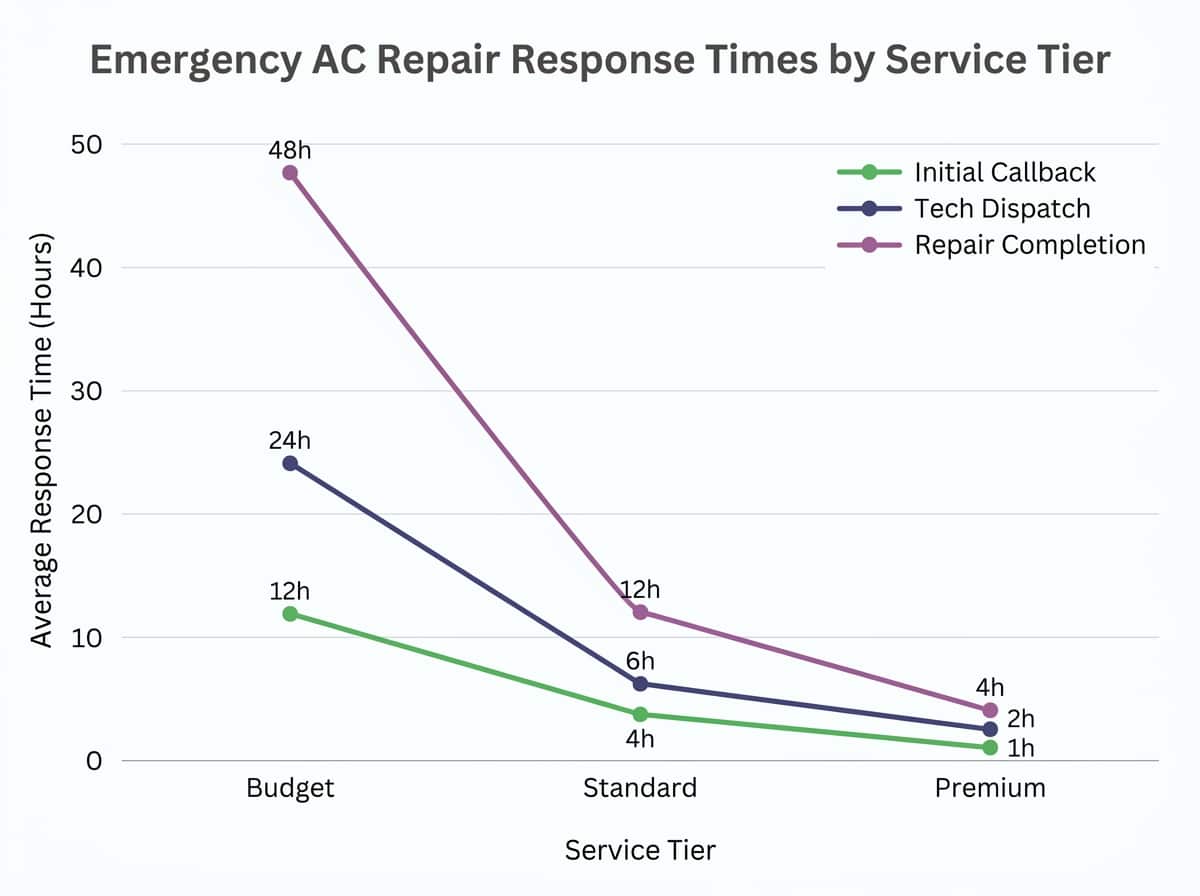
Same-day emergency availability doesn’t mean a technician arrives in 15 minutes (that’s unrealistic and usually a marketing exaggeration). It means the contractor answers the phone 24/7, dispatches a licensed tech within a reasonable window (typically 2 to 4 hours for true emergencies), and arrives with the tools and common parts needed to diagnose and often fix the problem on the first visit.
Quality contractors define what constitutes an emergency: complete system failure in extreme heat, refrigerant leaks, electrical issues that create fire hazards, or flooding from a clogged condensate line. They triage calls so true emergencies get priority, while non-urgent requests (a system running but not cooling efficiently) get scheduled for the next business day. That triage process protects everyone. You’re not paying premium after-hours rates for a thermostat battery replacement, and the contractor isn’t stretching resources away from homeowners in genuine distress.
Ask potential contractors about their emergency response protocols. Do they staff techs around the clock, or do they route after-hours calls to an answering service that schedules you for “first thing Monday”? Do they charge extra for nights and weekends (common and reasonable), and if so, how much? Do they stock their trucks with high-turnover parts (capacitors, contactors, thermostats) so they can complete most repairs without ordering parts?
We offer 24/7 emergency service with same-day dispatch for system failures. When you call our emergency line, you reach a live person who can send a tech immediately, not a voicemail promising a callback “within 24 business hours.” Our trucks carry the 20 most common failure parts, so we fix 80% of emergency calls on the first visit. If we need to order a part, we’ll set you up with a temporary solution (portable AC unit rental, zone-system workaround) so you’re not sleeping in a sauna while waiting for the compressor to arrive.
Before you need emergency service, ask about response-time SLAs (service-level agreements). Quality contractors commit to specific windows and honor them. If they say “we’ll be there within four hours” and they’re running late, they call to update you. They don’t leave you waiting by the phone, wondering if anyone’s coming. For deeper insights on maintaining your entire HVAC system year-round, explore our comprehensive resource library.
Comprehensive Diagnostics Before Selling You Anything
Quality HVAC technicians diagnose first and prescribe second. They don’t walk into your backyard, glance at the condenser, and announce that your entire system needs replacing. They run tests, measure airflow and refrigerant pressures, inspect electrical connections, check the thermostat calibration, and document what they find before quoting any repair.
A thorough diagnostic visit includes both visual inspection and data-driven testing. The technician checks the air filter, examines the evaporator coil for dirt or ice buildup, inspects ductwork for leaks, measures the temperature differential between supply and return air, and tests the capacitor and contactor with a multimeter. They use manifold gauges to verify refrigerant charge and compressor function. They document findings with photos or video so you can see the failed part, the corroded wiring, or the frozen coil yourself.
Once the technician identifies the problem, they explain what failed, why it failed, and what happens if you don’t fix it. They give you options: repair the failed component, replace it with an upgraded part, or consider a full system replacement if multiple components are near end-of-life. They provide cost estimates for each option and let you decide based on your budget, timeline, and long-term plans for the home.
Contrast this with upsell-driven contractors who arrive with a pre-written script. They’ll tell you the compressor is “on its last legs” (even though it’s running fine), that your refrigerant is “the old dangerous kind” (when in fact R-410A is still standard), or that your 8-year-old system is “way past its lifespan” (the average AC lasts 12 to 15 years in Arizona with proper maintenance). The goal isn’t honest diagnosis: it’s manufacturing urgency to close a high-ticket sale.
Our techs carry diagnostic cameras to document issues and walk you through what we found before quoting a fix. If your capacitor failed, we’ll show you the bulging case and explain that capacitors regulate motor startup and prevent compressor damage. If your evaporator coil is frozen, we’ll photograph the ice buildup and explain the three most common causes (low refrigerant, blocked airflow, or a failing blower motor). You see the problem, understand the repair, and approve the work with full confidence.
Quality contractors also educate you on when to call a licensed tech vs. attempting DIY troubleshooting. Some issues (tripped breaker, clogged air filter, dead thermostat batteries) you can fix yourself in five minutes. Others (refrigerant leaks, electrical faults, compressor failure) require specialized tools and training. A contractor who helps you avoid unnecessary service calls earns your trust and your long-term business.
Before agreeing to any repair, ask the technician to show you the failed part and explain the diagnostic process. If they can’t or won’t, that’s a signal they’re guessing rather than diagnosing. Quality techs welcome questions and take the time to educate, because informed customers make better decisions and refer more neighbors.
Warranty on Parts and Labor (and Proof You Can Enforce It)
Every AC repair comes with two types of warranty: the manufacturer’s warranty on the part itself, and the contractor’s warranty on the labor to install it. The manufacturer warranty is standard (typically 5 to 10 years on major components like compressors and heat exchangers), but it only covers defects in the part, not the cost to diagnose the failure, remove the old part, and install the new one. That’s where the labor warranty comes in.
Quality contractors offer 1 to 2 year labor warranties minimum on all repairs and installations. That warranty covers the technician’s work: if the repair fails because of improper installation, incorrect refrigerant charge, or a wiring mistake, the contractor returns and fixes it at no additional cost. You shouldn’t pay twice for the same job because a tech rushed the install or skipped a critical step.
The key word is “written.” A verbal promise (“we stand behind our work”) means nothing if the company goes out of business, the dispatcher claims “we have no record of that,” or the owner insists “the warranty only covers the part, not the labor.” Quality contractors provide written warranty documentation (either printed on the invoice or emailed as a separate certificate) that specifies exactly what’s covered, for how long, and under what conditions.
Ask to see the warranty terms before you sign the contract. Read the fine print: Does the warranty cover both parts and labor, or just one? Does it require annual maintenance to stay valid (common for manufacturer warranties on full-system replacements)? Does it transfer if you sell the home? What’s excluded (acts of God, damage from power surges, modifications by other contractors)?
According to Energy Star, manufacturer warranties on central AC systems typically range from 5 years on basic components to 10 years on compressors, but they universally require proper installation by a licensed contractor. If your system fails prematurely and the manufacturer investigates, they’ll void the warranty if they find the refrigerant charge was wrong, the unit wasn’t level, or the electrical connections didn’t meet code. That’s why hiring a quality contractor isn’t just about today’s repair: it’s about protecting the warranty coverage you already paid for when you bought the equipment.
We back every repair with a written warranty on both parts and labor, and we service what we sell. If a repair fails within the warranty period, we return and make it right (no argument, no hidden fees, no claim that “you must have changed the filter wrong”). We also help you navigate manufacturer warranties when a major component fails: we document the installation, provide proof of maintenance, and handle the warranty claim paperwork so you’re not stuck on hold with a call center.
Quality contractors also explain how ongoing maintenance affects warranty coverage. Most manufacturers require proof of annual professional tune-ups to honor extended warranties. Miss a year, and you might find your compressor replacement denied because “the system wasn’t maintained per the warranty terms.” Look for contractors who track your service history and send reminders when your annual tune-up is due.
A+ BBB Rating and Verifiable Reviews (Not Just Star Counts)
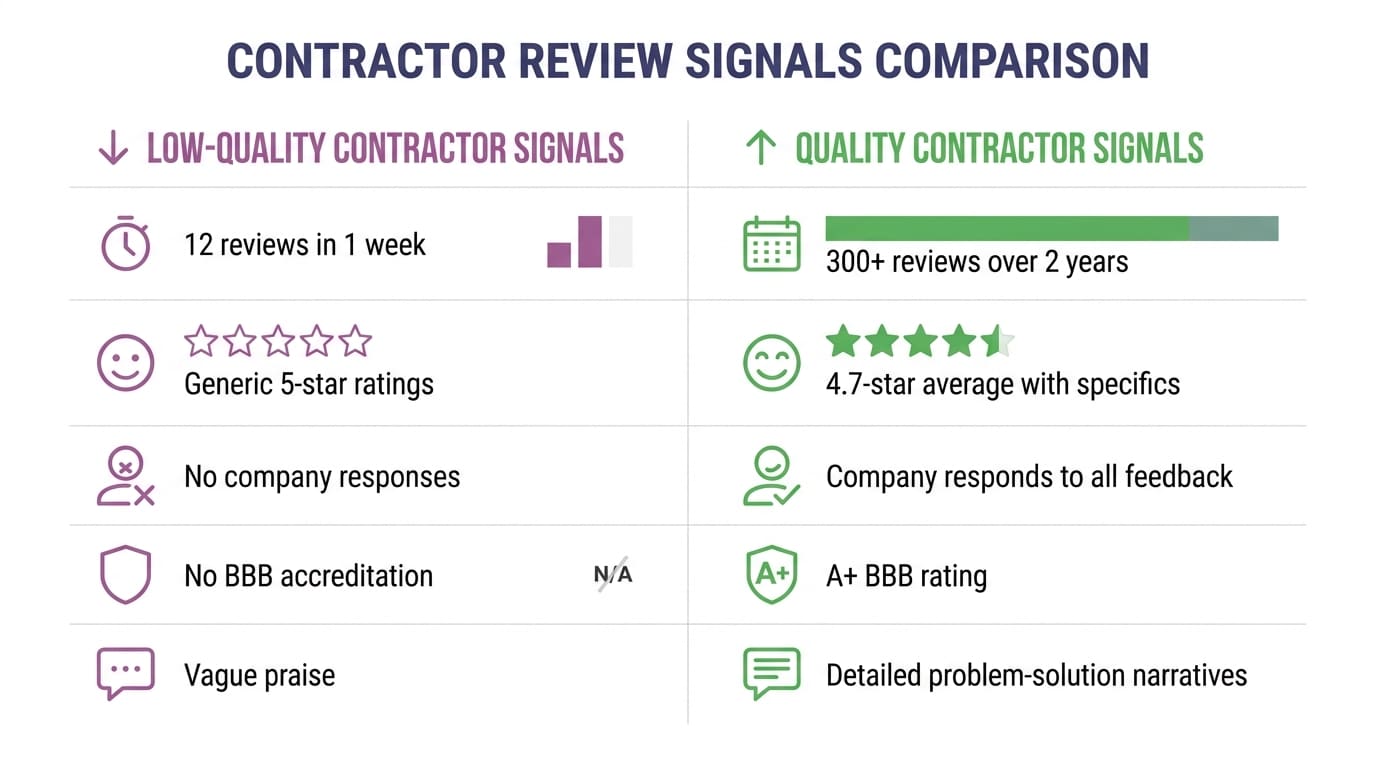
Online reviews are easy to fake, but patterns in reviews (and how a company responds to complaints) reveal the truth. A 5.0-star average from 12 reviews posted in the same week smells like a paid campaign. A 4.7-star average from 300+ reviews spanning two years, with detailed narratives and the company responding to every complaint, signals a contractor who earns trust one job at a time.
Start with Better Business Bureau accreditation. An A+ BBB rating means the company has been in business for a minimum period (typically 1 to 3 years), responds to consumer complaints within a reasonable timeframe, and resolves disputes without legal action. The BBB doesn’t guarantee quality: it measures accountability and customer-service responsiveness. A company with an A+ rating might still make mistakes, but they fix them.
Next, look for review recency and specificity. The strongest service-quality signals in HVAC reviews are: (1) mentions of the technician by name, (2) descriptions of the specific problem and how it was solved, (3) comments on pricing transparency and timeliness, and (4) photos of the work or the tech on-site. Generic reviews that say “great service, highly recommend!” tell you nothing. Reviews that say “Miguel diagnosed a failing capacitor in 10 minutes, explained the fix, quoted $220, and had us back up and running in an hour (no upsells, no surprises)” tell you everything.
Read the negative reviews, too. Every contractor gets complaints: equipment fails, miscommunications happen, weather delays jobs. What matters is how the company responds. Do they acknowledge the issue, take responsibility, and describe how they resolved it? Or do they blame the customer, make excuses, or ignore the complaint entirely? A contractor who responds professionally to criticism and makes things right earns more trust than one with a perfect rating and zero engagement.
We’ve maintained an A+ BBB rating since 2020 and respond to every review (good or bad) within 48 hours. When a customer posts a concern, we investigate, call them directly, and resolve the issue before it escalates. Our Google and Yelp profiles include 250+ reviews with an average 4.8-star rating, and you’ll see the same names appear over and over: long-term customers who’ve used us for annual tune-ups, emergency repairs, and full-system replacements across multiple properties.
Quality contractors also display third-party certifications and industry memberships on their website and trucks: ACCA member, NATE-certified technicians, Energy Star partner, Amana or Carrier authorized dealer. These badges cost money and require ongoing compliance, so they signal a contractor invested in the business for the long haul, not a fly-by-night operation that disappears after the check clears.
Before you hire any contractor, check three sources: BBB profile (complaint history and resolution rate), Google reviews (recent, detailed, with company responses), and state licensing board (verify the license is active and check for disciplinary actions). Ten minutes of research can save you thousands in regret.
Red Flags That Signal You Should Walk Away
Not every contractor deserves your business. Some warning signs should end the conversation immediately, before you waste time on an estimate or (worse) hand over a deposit to a company that won’t deliver. Watch for these red flags and walk away the moment you spot one.
No license provided or “license is in the truck.” Arizona law requires contractors to display their license number on all advertising, estimates, and invoices. If a contractor can’t produce a license number on the spot, they’re either unlicensed or operating under someone else’s credentials (both illegal). Hang up and call someone else.
Pressure to decide on-site. Phrases like “this price is only good if you sign today” or “we have a truck in your neighborhood, but we need an answer now” are sales tactics designed to prevent you from comparing quotes or researching the company. Quality contractors provide written estimates that stay valid for 30 days, giving you time to make an informed decision.
Cash-only payment or requests for full payment upfront. Licensed contractors accept checks and credit cards, which create a paper trail and consumer protections. Demanding cash suggests the company is dodging taxes, hiding from creditors, or planning to disappear. Never pay the full amount before work starts: a reasonable deposit (10 to 25%) is standard, with the balance due upon completion.
No written estimate or vague line items. An invoice that says “AC repair: $850” with no breakdown of parts, labor, or warranty is a recipe for disputes. Quality contractors itemize every charge so you know exactly what you’re paying for and can verify the part cost independently if needed.
Refusal to pull permits for installation work. Full-system replacements and major modifications (adding ductwork, relocating the condenser) require building permits in most Arizona municipalities. A contractor who says “permits are a waste of time” or “we’ll skip that step to save you money” is cutting corners that could void your homeowner’s insurance, violate local codes, and leave you liable for fines. Permits protect you: insist on them.
Generic truck with magnetic sign. Professional contractors invest in branded vehicles, uniforms, and tools because they’re building a long-term business. A contractor who shows up in an unmarked van with a magnetic sign slapped on the door might be moonlighting, uninsured, or operating without a valid license. Check the truck for company name, phone number, license number, and insurance information before letting anyone touch your equipment.
If you spot any of these red flags, thank the contractor for their time and call a licensed, reputable company instead. The East Valley has dozens of quality HVAC contractors: you don’t need to settle for one that raises alarms. Plan ahead with pre-season tune-ups from a trusted contractor so you’re not making emergency decisions under pressure when your AC fails in July. For a comprehensive look at cooling strategies for different spaces, including garages and workshops, read our detailed guide on space-specific climate solutions. If you’re considering energy-efficient alternatives like mini splits, learn how the installation process works from start to finish.
Conclusion
Quality AC repair isn’t a mystery: it’s a checklist of observable standards you can verify before signing a contract. Licensed, certified technicians with ongoing training. Transparent pricing with no hidden fees. Same-day emergency availability backed by 24/7 dispatch. Comprehensive diagnostics before any upsell. Written warranties on both parts and labor. A+ BBB ratings and verifiable, detailed customer reviews. These six standards separate contractors who protect your investment from those who leave you with a bigger problem than you started with.
The best AC repair near you isn’t the cheapest bid or the flashiest ad. It’s the contractor who shows up with credentials, explains what’s broken and why, quotes the work honestly, backs it with a warranty, and answers the phone when you need them most. You don’t have to guess: you can verify every standard with a license lookup, a review search, and a few direct questions over the phone.
When your AC fails and you need East Valley repair that checks every box, call a contractor with a track record you can see: licensed technicians, A+ BBB rating earned over years of accountable service, transparent pricing with no surprises, and comprehensive diagnostics before selling you a solution.
When you need East Valley AC repair that checks every box (licensed techs, transparent pricing, same-day service, and a proven track record), call JLM Air Conditioning & Heating. We’ve completed installations across Gilbert, Mesa, and Queen Creek, hold an A+ BBB rating, and back every job with a written warranty.
By Bill Milbourn, Master HVAC Technician