By JLM
In an Amana HVAC systems Arizona comparison, Amana comes out as a solid choice for homes where the system is sized correctly and installed well. Its main edge is a long parts warranty that requires registration. Against other major brands, installation quality, duct condition and yearly maintenance matter more in 110°F heat than the nameplate. If warranty fine print is your main worry, start with how HVAC warranty coverage works, parts versus labor.
Let’s be upfront. JLM installs Amana equipment, with more than 3,000 installs behind us, so weigh our view with that in mind. We are a family-owned East Valley company founded in May 2020, and the owner is on the job. This guide shows you how to check any brand, including ours, before you sign.
Most homeowners reading this are close to a big purchase. They worry about a system that fails in year seven, and a warranty that does not help when it does. So we will first look at what the warranty really covers. Then we will look at what decides whether a system survives an Arizona summer.
Is Amana a good AC brand for Arizona heat?
Amana is a reasonable, value-minded choice for Arizona when the system is sized to the home and installed properly. In 110°F weather, airflow, refrigerant charge and duct condition drive breakdowns more than the brand. We install Amana because it fits that standard, but you should weigh that disclosure.
What “reliable” means at 110°F
Amana AC reliability, like any brand’s, depends on the conditions it runs in. An East Valley system runs through a long cooling season. The compressor works hard, and attic heat bakes the ducts and equipment. A system that is slightly oversized, short-cycles, or runs low on charge will wear out early. That is true of every brand on the market.
We see how systems fail in real heat because we handle HVAC system repairs and upgrades, plus emergency and same-day repair calls, during the worst weeks of summer. Whether it is AC repair in Gilbert or HVAC repair in Queen Creek, that work shapes how we install. We would rather spend an extra hour on airflow and charge than return in July for a repair call.
What Amana does well, and where it is not the fit
Amana does a few things well for the homeowners we serve. It offers a range of efficiency tiers, so you can match the system to your budget. The equipment is familiar to local technicians. And its warranty can be strong when you complete the paperwork, which we cover below.
Amana is not the right fit in every case. If your ducts are failing, no brand will fix that. If you want a specific feature set, or the lowest possible upfront price, you may prefer another line. We would rather tell you that on a free consultation than sell you the wrong box.
East Valley is our neighborhood and our specialty, and our customers are review-sensitive and often arrive by referral. That is why we would rather earn trust with a straight answer than win a job with a brand pitch.
Lifespan also depends on maintenance as much as the badge. Our guide on how long HVAC systems last in Arizona, by brand and maintenance walks through what extends or shortens a system’s life here.
If you are replacing an older unit, efficiency matters too. ENERGY STAR's home savings page lists efficiency upgrades and the savings and incentives that may be available for qualifying systems.
Takeaway: Amana can hold up in Arizona heat, but the install and the ducts decide the outcome more than the brand does.
What does the Amana air conditioner warranty cover (and what doesn’t it)?
The Amana air conditioner warranty generally covers parts for a set term, and the longest terms typically require online registration after installation. Labor is usually not covered by the manufacturer, so your installer’s labor warranty matters. Confirm the exact terms for your model on Amana’s website before you buy.
We keep this section focused on being warranty-ready. For the broader brand-versus-brand view, see our Amana HVAC systems versus competitors breakdown.
Parts versus labor, and the registration window
A parts warranty means the manufacturer supplies a replacement part if a covered part fails. It does not pay the technician to diagnose and install it. Labor coverage comes from your installer, and it varies a lot from company to company.
That makes two questions essential. How long does the installer’s labor warranty last, and what does it include? Get both answers in writing before work starts.
Registration is the second trap. The longest warranty terms usually apply only if the unit is registered within a set window after installation. Miss the window and you may fall back to a shorter term. Ask your installer who registers the unit, and check Amana’s page for the deadline on your model.
How claims get complicated
Most claim problems come from paperwork, not the equipment. These are the usual causes:
- The unit was never registered, or was registered late.
- Nobody kept the install invoice, model number or serial number.
- There are no maintenance records, so a manufacturer questions whether the system was cared for.
- The install was done by an unlicensed contractor, which can raise questions about the work.
- The labor warranty was a handshake promise, not a written one.
Federal warranty law, enforced by the Federal Trade Commission, limits some of what a manufacturer can require around service and maintenance. Read the specific wording for your product.
Our Warranty-Readiness Checklist
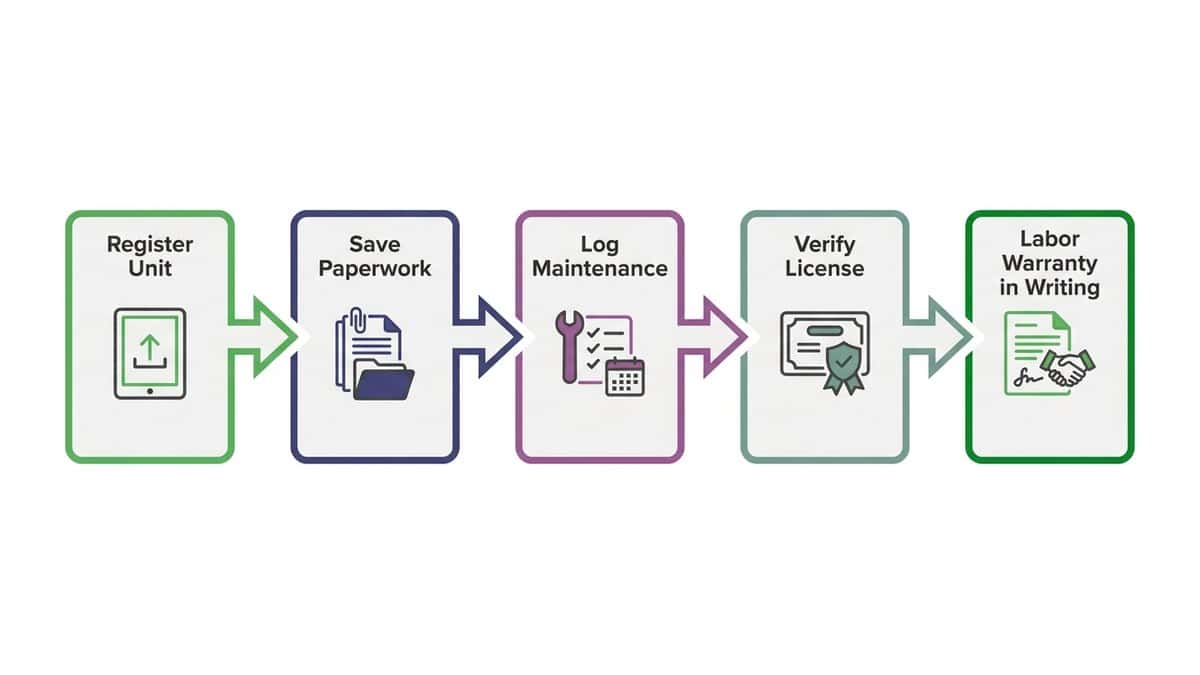
We built this checklist from our work with East Valley homeowners. Do these five things within the registration window:
- Register the unit. Confirm who is doing it and get a confirmation in writing.
- Keep the paperwork. File the install invoice, model number and serial number together.
- Record maintenance. Log each seasonal tune-up. Our maintenance plan, with its 50-point inspection and seasonal visits, creates that record automatically.
- Verify the license. Look up your installer on the Arizona Registrar of Contractors site and confirm the classification.
- Get the labor warranty in writing. Know the length and what it covers.
Warranty fine print also interacts with efficiency choices. A higher-efficiency model may qualify for savings, and ENERGY STAR's home savings guidance is a good place to see what a system upgrade could unlock before you pick a tier.
We serve homeowners in Gilbert, Queen Creek, Mesa, Chandler and San Tan Valley, and the same file-it-now habit applies in every one of them. If we handle air duct installation or install ductwork alongside your new system, keep that invoice in the same folder.
Takeaway: A strong warranty only helps if the unit is registered, the records exist and the labor coverage is in writing.
How do Amana HVAC systems compare with other brands in Arizona?
Compare brands on the same five points: warranty terms, efficiency rating (SEER2), build features for heat, parts availability locally, and installer support. Most major brands are close on equipment. The biggest gap is usually between installers, not nameplates.
If you search “best HVAC brands Arizona,” you will find plenty of rankings. We do not rank here. This Amana HVAC systems Arizona comparison sticks to criteria you can check yourself.
SEER2 stands for Seasonal Energy Efficiency Ratio, version 2. It measures how much cooling a system delivers per unit of electricity over a season. A higher number generally means lower running costs, though the savings depend on your home and your habits.
Use this table to compare any brand, Amana included. We name no competitors here, and every row applies equally to all of them.
| Criterion | What to ask | Where Amana fits |
|---|---|---|
| Warranty terms | Parts term, labor term, registration deadline | Long parts coverage when registered; confirm current terms for your model |
| Efficiency (SEER2) | The exact SEER2 rating of the quoted model | Offered in several efficiency tiers; ask for the model’s rating |
| Heat-focused build | Spec sheet for high ambient temperatures and coil protection | Review the manufacturer’s spec sheet for your model line |
| Local parts and support | Which parts your installer stocks or can get quickly | Familiar to local technicians; confirm with your installer |
| Installer dependence | Licensing, load calculation, charge and airflow checks | Same for every brand, and often the deciding factor |
Look at the last row again. Two identical systems can perform very differently depending on who sets the charge, checks airflow and seals the ducts.
If you want to see what an Amana job looks like in practice, read about AC installation in Gilbert: Amana systems, sizing and financing options.
Federal efficiency minimums vary by region, and the Southwest has its own floor. Check the current standard at the U.S. Department of Energy before assuming a unit qualifies.
Utility rebates may also depend on SEER2 tier and on the contractor you use. Check the current residential cooling programs from APS or SRP, whichever serves your address.
Takeaway: Compare brands on the same five criteria, and expect the installer to matter as much as the equipment.
What matters more than the brand in Arizona heat?
Correct sizing, a sealed and well-designed duct system, a proper refrigerant charge and yearly maintenance matter more than the brand. Attic ducts can run far hotter than the living space. A leaky or undersized duct system can shorten the life of any brand.
Sizing, ducts, charge and airflow
Start with sizing. A Manual J load calculation, the method published by ACCA, works out how much cooling your home actually needs based on its size, insulation, windows and orientation.
Oversizing feels safe, but it backfires. An oversized unit cools quickly, shuts off, and repeats. That short-cycling wears the compressor and leaves humidity behind. We cover it in why oversizing an AC wastes money.
Next, check the ducts. A new system connected to old, leaky or crushed ductwork loses much of what you paid for. Our work includes ductwork inspection, sealing, air duct installation and replacement. Many homeowners bundle installing ductwork with a new system, and more customers ask about it every season. It is one of the smartest ways to get more from your system, along with indoor air quality and smart upgrades.
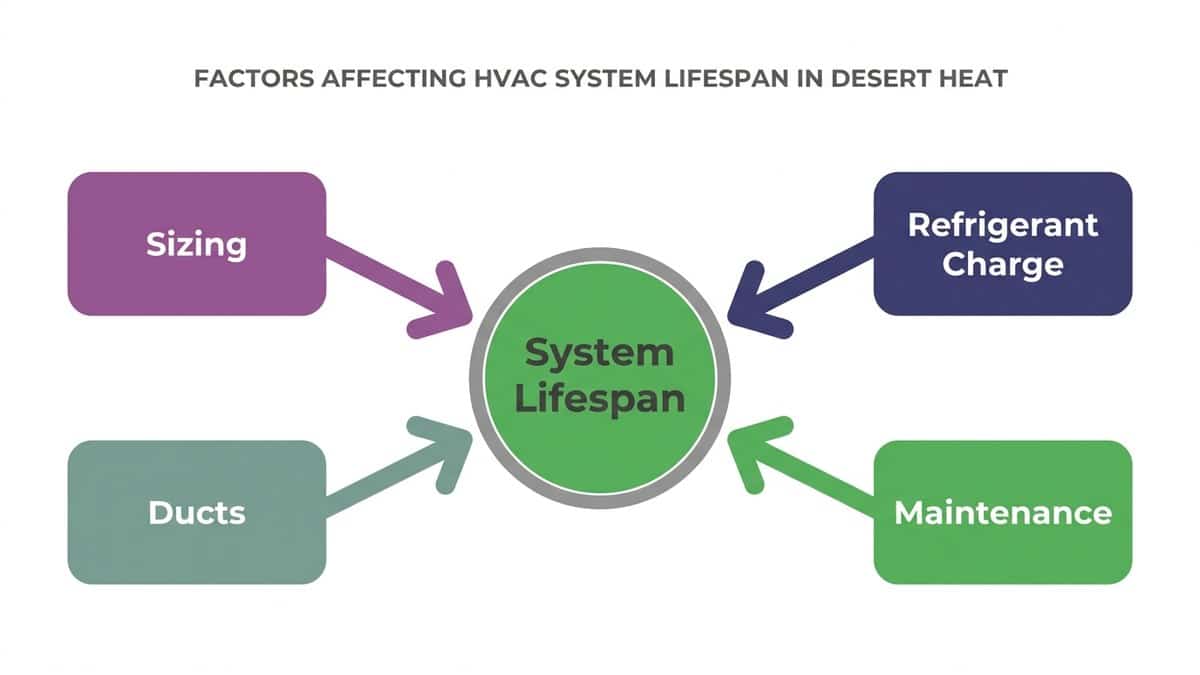
Charge and airflow come next. Too little or too much refrigerant strains the compressor and cuts efficiency. Poor airflow does the same, and it can freeze the coil. If that happens, our guide on what to do when your AC freezes up explains the first steps.
Maintenance as a warranty and lifespan factor
Maintenance is both a lifespan factor and a warranty factor. A seasonal tune-up catches small problems before they become July failures. It also builds the record a manufacturer may ask for.
Even a highly efficient unit gives up its savings through leaky ducts. ENERGY STAR's home savings resources show how a full system upgrade, not just a new box, makes the difference.
This is why we offer a free on-site consultation and an energy assessment. We build custom solutions, not cookie-cutter ones, because every East Valley home is a little different.
Takeaway: Size the system with Manual J, fix the ducts and keep up the maintenance, and almost any quality brand will last longer.
How much does an Amana system cost in the East Valley?
Full replacements typically run roughly $9,000 to $20,000 for East Valley homes. The final number depends on system size, duct work, home layout and efficiency tier, so treat any range as a starting point until someone looks at your house.
Here is what moves the price:
- System size: Larger homes need more capacity, which costs more.
- Duct condition: Repairing or replacing ducts adds cost but protects the investment.
- Home layout: Attic access, number of zones and equipment location all change labor time.
- Efficiency tier: Higher SEER2 models cost more upfront and can cost less to run.
To weigh that last tradeoff, read what SEER ratings mean for your energy bill. It helps you decide whether a higher tier pays back in your home.
For a wider picture, our guide to new furnace and air conditioner costs breaks down the pieces of a full project.
Rebates and efficiency programs can reduce your net cost. ENERGY STAR's home savings page is a good starting point for qualifying upgrades. Your utility may offer its own program, so confirm which one serves your address.
If the budget is the sticking point, look at financing and payment options for a new system.
We keep pricing transparent. You get a free on-site estimate and a written quote with no hidden fees. Because we are owner-led, the person who quotes your job is on the job. That is how East Valley neighbors in Mesa, Chandler and Gilbert come to us, and many arrive by referral. Owner-led and community-proven is not a slogan for us. It is how we earn the next referral.
Takeaway: Price depends on size, ducts and efficiency tier, so insist on a full written quote before work starts.
What should you ask before you buy an Amana system?
Ask these questions of any installer and any brand. The answers tell you more than a brochure will.
- What is the exact model and SEER2 rating you are quoting?
- Did you run a Manual J load calculation for my home?
- Will you inspect my ducts, and what will you do if they are leaking?
- What does your labor warranty cover, and for how long, in writing?
- Who registers the manufacturer warranty, and by when?
- Is your Arizona contractor license active, and for which classification?
- What is included in the full written quote, and what could change the price?
- Does a maintenance plan fit my warranty and my budget?
Making the right decision on system replacement and installation means collecting these answers before you compare prices. A lower quote that skips the load calculation or the duct inspection is not really lower. The same goes for a quote on AC installation in Queen Creek or anywhere else in the East Valley.
Please hold us to the same list. We welcome the scrutiny. If you want to see how we apply it, read about AC installation in Gilbert with premium Amana systems and transparent pricing.
You can also look at our HVAC replacement and installation services to see what is included in a typical project.
Already have a quote from another company? Bring it to us. We will give you an honest read, with no pressure.
Takeaway: Eight good questions will reveal more about an installer than any brand name will.
Ready for an honest second opinion?
Brand matters, but less than most homeowners expect. Amana is a solid option for Arizona homes when it is sized right, installed well and registered on time. Your best protection is a licensed installer, a written labor warranty and a clean paper trail.
We are owner-led, so the person who quotes your job is accountable for it. Our free on-site consultation includes a transparent quote. If you want the full menu, see the full list of heating and cooling services we offer.
A second opinion on any other company’s quote is always welcome. No pressure, just plain answers from a family-owned team that lives in the East Valley too.