In Arizona’s desert climate, residential central air conditioners last 12–15 years on average, shorter than the 15–20 year national norm. Extreme heat, extended high-load operating seasons, and compressor stress compress equipment lifecycles. Proper installation, annual maintenance, and choosing desert-rated units with strong warranties extend lifespan toward the upper range.
If you’re staring at a 10- or 12-year-old AC and wondering whether it’s normal for your system to struggle (or if you’re being sold a replacement you don’t really need), this guide will give you the facts. We’ll walk through why Arizona’s climate shortens equipment life, what you can expect from different brands, how maintenance actually impacts longevity, and when replacement makes more sense than one more repair. No pressure, no upselling. Just honest guidance from people who’ve installed more than 3,000 systems across the East Valley.
Why Arizona’s Climate Shortens HVAC System Lifespan (Compared to National Averages)
Arizona’s desert environment is brutal on air conditioning equipment. When manufacturers publish lifespan estimates, they’re typically based on moderate climates with seasonal heating and cooling loads. Arizona doesn’t have that luxury. Your AC runs hard from April through October, enduring ambient temperatures that regularly exceed 110°F. According to the U.S. Department of Energy’s climate zone classifications, Phoenix and the East Valley fall into Zone 2B (hot-dry), one of the most demanding cooling environments in the continental U.S. Equipment installed in moderate climates (Zone 4A, for example) typically reaches 15–20 years before needing replacement. In Zone 2B, that same equipment hits end-of-service at 12–15 years. The difference isn’t quality. It’s operating hours and thermal stress.
The core issue is that residential central air conditioners weren’t originally designed for the sustained high-load duty cycle Arizona demands. Most units are rated to handle ambient temperatures up to 125°F, but prolonged exposure to 110°F+ reduces efficiency, stresses compressor bearings, and accelerates refrigerant degradation. When your system runs 10–12 hours a day for six months straight, components simply wear out faster.
Compressor Run-Hours and Thermal Stress
The compressor is the heart of your AC unit, and it’s also the most expensive component to replace. In a moderate climate, a residential compressor might accumulate 15,000–20,000 operating hours over 15 years. In Arizona, that same compressor can rack up 25,000–30,000 hours in 12 years due to the extended cooling season and higher daily runtimes.
That means a 12-year-old Arizona AC has the mechanical wear of a 17- or 18-year-old system in a cooler state. When you factor in the thermal stress of starting and stopping in 110°F+ ambient conditions, it’s clear why compressor failures spike around the 12-year mark here. For homeowners exploring alternative cooling solutions for spaces like garages, understanding mini split installation can provide insights into more flexible, zone-specific options.
Ambient Temperature and Design Limits
Most residential AC units are rated to cool effectively when outdoor temperatures are below 115°F. Above that threshold, efficiency drops sharply, and internal components (capacitors, fan motors, refrigerant circuits) begin operating outside their design envelope. Phoenix routinely hits 115°F+ during July and August. Those peak-load days don’t just reduce your system’s ability to cool your home. They age the equipment faster.
Heat exchangers, evaporator coils, and condenser coils all degrade more quickly when subjected to sustained high temperatures. Refrigerant pressure increases, putting additional strain on seals and joints. Capacitors (which help start the compressor and fan motors) fail at higher rates in extreme heat. Even ductwork insulation breaks down faster when attic temperatures exceed 140°F, which is common in Arizona homes during summer.
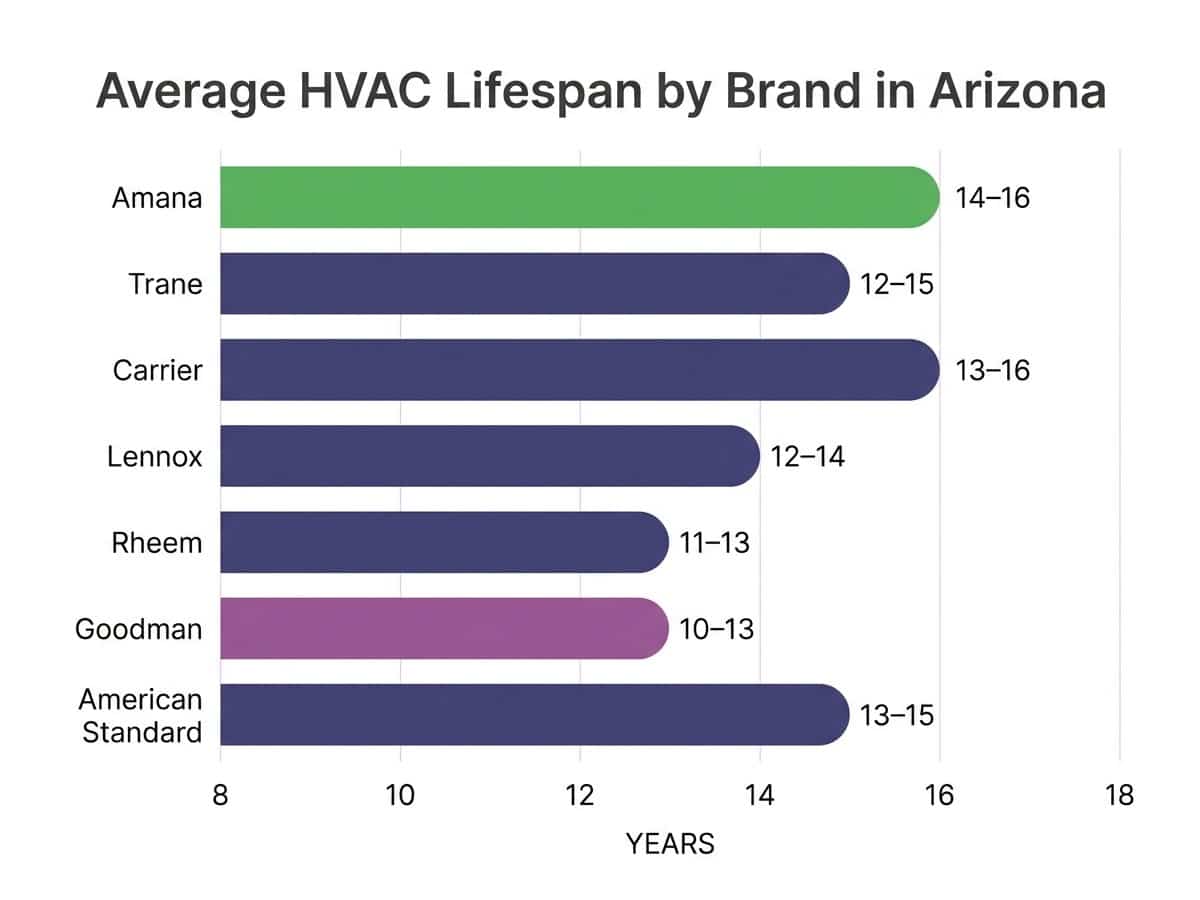
Average HVAC System Lifespan in Arizona by Brand (Comparison Table)
Not all equipment is built the same, and brand selection does influence how long your system lasts in Arizona’s climate. The table below shows typical lifespan ranges for major brands we see across the East Valley, based on our experience with more than 3,000 installs and what manufacturers’ warranty terms suggest about expected service life.
| Brand | Typical Arizona Lifespan | Compressor Warranty | Notes |
|---|---|---|---|
| Amana | 14–16 years | 10 years (Lifetime Limited on select models) | Desert-rated compressors; JLM’s preferred brand for Arizona installs. Solid performance in high-ambient conditions. |
| Trane | 13–15 years | 10 years | Higher upfront cost; strong build quality. Good longevity if properly maintained. |
| Carrier | 13–15 years | 10 years | Premium tier; reliable but repair parts can be expensive. Strong warranty support. |
| Lennox | 12–14 years | 10 years | Mid-to-high tier; performs well but requires consistent maintenance to hit upper range. |
| Rheem | 12–14 years | 10 years | Good value; widely available parts. Consistent performance in Arizona heat. |
| Goodman | 10–13 years | 10 years | Budget-friendly; shorter lifespan reflects lower initial cost. Adequate for price-conscious buyers. |
| American Standard | 13–15 years | 10 years | Similar to Trane (same parent company); reliable in desert conditions. |
These ranges assume proper installation (accurate load calculation, correct refrigerant charge, sealed ductwork) and annual maintenance. A poorly installed premium brand will fail earlier than a well-maintained budget brand. Installation quality matters more than the nameplate.
At JLM, we install Amana premium systems because they consistently reach the upper end of the HVAC system lifespan in Arizona when paired with our load-calc-first installation process and annual tune-up plans. Bill personally oversees every install to ensure the system is sized correctly and set up for long-term performance. That attention to detail is what pushes a 12-year system to 15 or 16 years.
Upgrading to a high-efficiency system (16+ SEER2) not only reduces energy costs by 20–40% but also tends to correlate with longer equipment life due to improved compressor and coil design.
The Two Scenarios That Trigger Replacement
There are two common paths to system replacement: age-driven end-of-service and premature failure due to poor installation or sizing. Understanding which scenario you’re in helps you make a smarter decision about repair vs. replace.
Age-Driven Replacement (Equipment Past Design Life)
The first scenario is straightforward: your system has reached 12–15 years, and you’re facing a major repair (compressor replacement, evaporator coil leak, or heat exchanger crack). At this point, the equipment has delivered its expected service life in Arizona’s climate. Manufacturer warranties have expired (most compressor warranties are 10 years). Parts availability may be limited for older models.
We’ve seen customers limp along with repeated repairs: $1,200 for a capacitor and fan motor, $800 for a refrigerant recharge, $1,500 for a coil cleaning and minor leak repair, and then face a major compressor bill six months later. These cascading failures are a sign the system has reached end-of-service. A new system comes with a decade of worry-free operation.
If your system is past 12 years and requiring frequent repairs, schedule a replacement estimate. We’ll assess the remaining lifespan realistically and show you the cost-benefit of replacing now vs. waiting for the next failure. No pressure, just numbers.
Premature Failure from Poor Installation or Sizing
The second scenario is more frustrating: your system is only 6–10 years old, but it’s already failing or running inefficiently. This is almost always a sign of poor installation, either incorrect sizing (too large or too small for your home’s cooling load) or sloppy workmanship (improper refrigerant charge, unsealed ducts, inadequate airflow).
Oversized systems short-cycle. They cool the house quickly, then shut off before removing humidity. The result is a clammy, uncomfortable home and a compressor that’s starting and stopping dozens of times a day instead of running in long, efficient cycles. Short-cycling is murder on compressors. We’ve seen 8-year-old oversized units with failed compressors that should have lasted 12–15 years.
Undersized systems run continuously, never quite reaching the thermostat setpoint on 110°F days. Continuous operation means the compressor never gets a break, which accelerates wear. Ductwork leaks (common in poorly installed systems) compound the problem by dumping cooled air into the attic before it reaches your living space.
If your system is under 10 years old and failing, get a second opinion before replacing it. The problem might not be the equipment. It might be improper installation. At JLM, we start every replacement project with a Manual J load calculation to ensure correct sizing. We also inspect and seal ductwork as part of the installation process. Proper sizing and installation quality are what determine whether your new system lasts 12 years or 16.
How Maintenance Extends (or Fails to Extend) Lifespan
Annual maintenance isn’t optional in Arizona if you want your AC to reach 15 years. Skipping tune-ups doesn’t just void your warranty. It accelerates the mechanical wear that shortens equipment life. The question isn’t whether maintenance matters. The question is how much lifespan it actually adds.
Based on our experience across 3,000+ installs, well-maintained systems in the East Valley consistently reach 14–16 years, while systems with no documented maintenance history typically fail at 10–12 years. That’s a 2–4 year difference.
What Annual Maintenance Actually Does
An annual tune-up isn’t about cleaning your filter and calling it good. A professional maintenance visit includes a 50-point inspection covering every component that affects system performance and longevity:
- Coil cleaning: Outdoor condenser coils accumulate dust, pollen, and debris. Fouled coils reduce heat transfer efficiency, forcing the compressor to work harder and run hotter. Cleaning the coils annually keeps efficiency near factory specs and reduces compressor strain.
- Refrigerant charge check: Low refrigerant (from slow leaks) causes the compressor to overheat and fail prematurely. We measure superheat and subcooling to verify the system is charged correctly, and we locate and repair leaks before they become expensive problems.
- Blower and motor service: The indoor blower motor moves air across the evaporator coil. If the blower is dirty or the motor bearings are worn, airflow drops, and the system struggles to cool. Annual cleaning and lubrication extend motor life and maintain airflow.
- Drain line service: Arizona’s monsoon season brings high humidity, which means your AC’s condensate drain line can clog with algae and mold. A clogged drain causes water damage and system shutdowns. We clear and treat drain lines during every tune-up.
- Electrical connections and capacitor testing: Loose electrical connections create resistance, which generates heat and damages components. Capacitors (which start the compressor and fan motors) degrade in Arizona’s heat. We test and replace weak capacitors before they fail and strand you in July.
These tasks aren’t upselling. They’re mechanical preservation. A clean coil, correct refrigerant charge, and properly functioning blower are what keep your compressor from overheating and dying at year 11 instead of year 15. For customers managing temperature control in specialized spaces, our thermostat installation service ensures precise monitoring that helps identify maintenance needs early.
Maintenance as a Warranty Condition
Here’s something most homeowners don’t realize until it’s too late: manufacturer warranties require documented annual maintenance. If your compressor fails at year 8 and you can’t produce service records showing annual tune-ups, the warranty is void. You’re paying out-of-pocket for a compressor replacement that should have been covered.
ENERGY STAR recommends annual professional maintenance as a core strategy for extending equipment life and protecting your investment. Manufacturer warranty fine print echoes this. Skipping maintenance doesn’t just age your system faster. It eliminates your financial safety net when a covered component fails.
At JLM, every maintenance visit is documented in your customer record. If you’re on our annual tune-up plan, you have a paper trail proving you’ve met the manufacturer’s maintenance requirement. That documentation protects your warranty and gives you leverage if a major component fails prematurely.
When to Repair vs. When to Replace (Decision Framework)
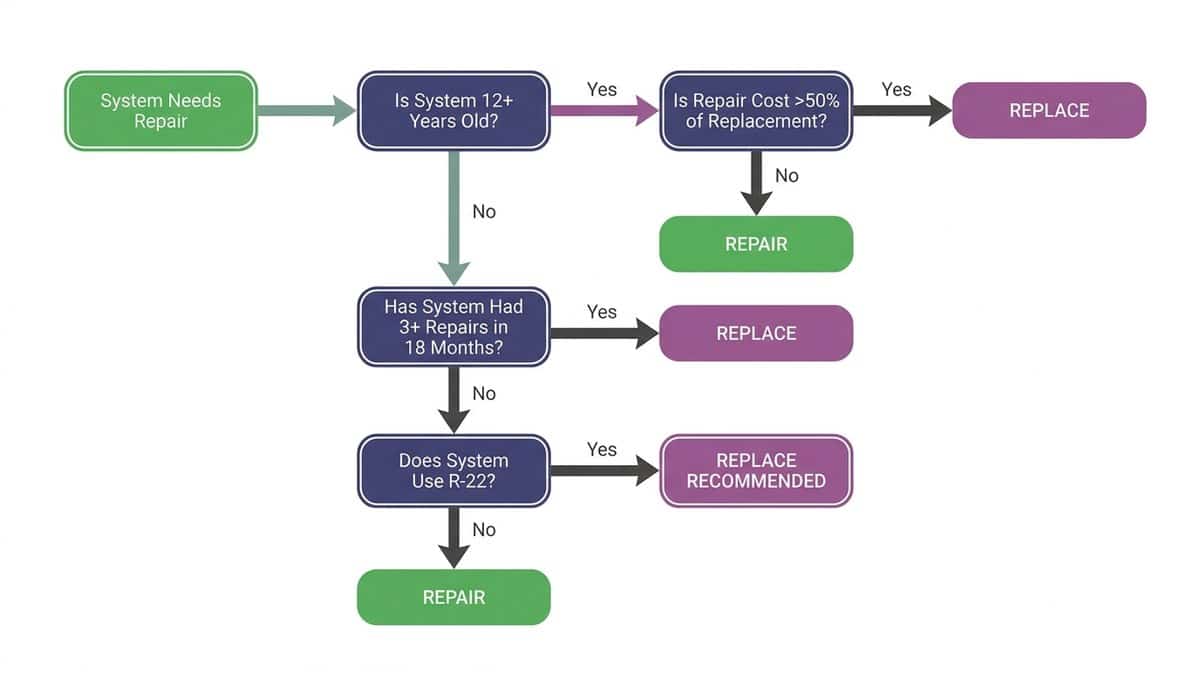
The hardest decision homeowners face is whether to invest in one more repair or schedule a replacement. There’s no universal answer. It depends on system age, repair cost, recent repair history, and energy efficiency. But you can use a structured framework to make a confident decision.
The 50% Rule and Repair Cost Thresholds
Industry guidance suggests that repairs exceeding half the cost of replacement favor replacement over repair. In Arizona, where a full replacement averages $8,000–$12,000 (depending on system size and efficiency according to RSMeans cost data), that threshold falls at $4,000–$6,000.
Consider this example: if your 12-year-old AC needs a major compressor replacement and a new system would cost $10,000, you need to weigh spending several thousand dollars to fix a system that’s already at end-of-service. You’ll get another 2–3 years from the repaired compressor (maybe), but you’re still looking at a replacement within the warranty period of the new system. You’re often better off putting that money toward a new system with 10 years of coverage.
The math shifts if your system is only 6–8 years old and the repair is isolated (a failed capacitor, a single refrigerant leak, a blower motor). In that case, a modest repair buys you 4–6 more years of service, which makes financial sense. The key question is whether the repair addresses a single component failure or a cascade of age-related issues.
If you’ve had three or more repairs in the past 18 months (capacitor, refrigerant recharge, fan motor, coil cleaning), your system is telling you it’s at end-of-service. Each small repair is a band-aid. The underlying issue is age and wear. At that point, replacement is the smarter long-term investment.
When you call JLM for a repair estimate, we’ll walk you through the cost-benefit analysis and show you both options: repair cost vs. replacement cost, expected lifespan of the repaired system, and total cost of ownership over the next 5 years. We’re not in the business of selling you a new system when a repair is genuinely adequate. But we’re also not going to let you throw money at an aging compressor when a new system makes more financial sense.
If you’re weighing repair vs. replace and want to understand the full financial picture, check out our guide on new furnace and air conditioner cost.
R-22 Phase-Out and Refrigerant Compatibility
If your system was installed before 2010, it likely uses R-22 refrigerant (Freon). R-22 has been phased out under the EPA's Clean Air Act Section 608 due to its ozone-depleting properties. Production ceased in 2020, which means R-22 supply is limited to recycled stock.
A refrigerant recharge that once cost a few hundred dollars now runs significantly higher because R-22 is scarce. If your older system develops a refrigerant leak, you’re facing a choice: pay inflated prices for a temporary fix, or replace the system with a modern unit that uses R-410A or R-32 refrigerant (both EPA-approved and widely available).
This is a replacement accelerator. Even if your 15-year-old system is otherwise functional, a refrigerant leak makes repair costs prohibitive. You’re better off investing in a new system that won’t strand you with escalating refrigerant costs over the next 3–5 years.
Replacing an R-22 system with a modern high-efficiency unit reduces energy costs substantially and eliminates the refrigerant cost liability. The payback period on the efficiency gain alone is typically 5–7 years in Arizona’s cooling-dominated climate.
What to Look for in a Replacement System (Arizona-Specific Buying Criteria)
If you’ve decided it’s time to replace your system, the next question is what to buy. Not all systems are created equal, and Arizona’s climate demands specific features that aren’t priorities in moderate climates. Here’s what to prioritize to ensure your new system reaches 15+ years in the East Valley.
SEER2 Ratings and Arizona Rebate Programs
SEER2 (Seasonal Energy Efficiency Ratio 2) is the updated efficiency metric that replaced SEER in January 2023. Higher SEER2 means lower operating costs and, often, better build quality. In Arizona, the minimum legal efficiency is 14.3 SEER2 for split systems (per the DOE’s 2023 efficiency standards).
We recommend 16+ SEER2 for Arizona homes because the efficiency gain pays for itself faster here than in cooler climates. Higher-efficiency systems typically deliver better performance and longevity in extreme heat conditions.
Arizona utilities (SRP, APS, TEP) offer rebates for high-efficiency equipment. According to SRP’s rebate program, current incentives provide $250–$450 for systems rated 16+ SEER2, depending on the tier. APS offers similar incentives. These rebates stack with federal tax credits (25C credit under the Inflation Reduction Act provides up to $600 for heat pump installations).
Check ENERGY STAR for current rebate programs and qualified equipment lists. We help customers navigate rebate applications as part of every install. For specialized applications such as garage mini split installation, efficiency considerations become even more critical due to the unique thermal challenges of unconditioned spaces.
Installation Quality Matters More Than Brand Alone
This is the single most important point in this guide: installation quality determines whether your system lasts 12 years or 16, regardless of brand. A premium Trane or Amana system installed by an unlicensed contractor with no load calculation will fail at 10 years. A mid-tier Rheem installed correctly by a licensed ROC contractor with proper load calc and duct sealing will reach 15.
What “correct installation” means in Arizona:
- Manual J load calculation: This is the industry-standard method for calculating your home’s cooling load (BTU/hour) based on square footage, insulation, window area, orientation, and occupancy. Oversizing or undersizing the system shortens its life. We run a Manual J on every install.
- Proper refrigerant charge: Factory-set refrigerant charge is rarely correct after installation. We measure superheat and subcooling on-site and adjust the charge to match your system’s design specs. Incorrect charge kills compressors.
- Duct sealing and airflow testing: Leaky ducts waste cooled air and force your system to run longer to maintain temperature. We seal ducts with mastic (not just tape) and verify airflow at each register. Proper airflow is what keeps the evaporator coil from icing and the compressor from overheating. Learn more in our comprehensive guide on air duct installation.
- Licensed contractor (ROC required in Arizona): Arizona law requires HVAC contractors to hold an active ROC license (CR-39 or K-55 classification). Unlicensed work voids manufacturer warranties, fails permitting inspections, and leaves you with no recourse if the install is botched. Verify your contractor’s ROC license before signing a contract.
Bill has personally overseen more than 3,000 installs across Gilbert, Queen Creek, and Apache Junction. Every job starts with a load calc, and Bill inspects the final installation to ensure it meets our quality standard. That’s how we consistently see Amana systems reach 15–16 years when customers stay on our annual maintenance plan.
If you’re evaluating contractors, ask three questions: Do you run a Manual J load calculation? Are you licensed (ROC number)? Will you seal my ducts and test airflow? If the answer to any of those is no, keep looking. For homeowners considering whole-home upgrades, our resource on central air conditioner installation provides additional context on the comprehensive installation process.
How JLM Helps You Maximize System Lifespan
At JLM, we’ve built our reputation on honest guidance and quality workmanship. We’re not a franchise. We’re a family-owned business, and Bill is on the job for every install. That accountability is what allows us to stand behind our work and deliver systems that consistently reach the upper end of Arizona’s lifespan range.
Here’s what sets us apart:
- Transparent repair vs. replace guidance: We’ll never upsell you on a replacement if a repair is viable. We walk you through the cost-benefit, show you the numbers, and let you decide. Our goal is long-term relationships, not one-time sales.
- Premium Amana systems with desert-rated compressors: We install Amana because the brand consistently performs in Arizona’s climate. Strong compressors, solid warranties, and reliable parts availability mean fewer headaches for you.
- Manual J load calculation on every install: Proper sizing is non-negotiable. We calculate your home’s actual cooling load and match the system to it. Not guesswork, not rules of thumb.
- Annual maintenance plans that protect your warranty: Our tune-up plans document every service visit, which keeps your manufacturer warranty valid and gives us a baseline for tracking system health over time.
- 24/7 emergency response: Arizona heat doesn’t wait for business hours. If your system fails on a 110°F Saturday, we’re on-call to get you back up and running.
We’ve served the East Valley for six years, completed more than 3,000 installs, and earned an A+ BBB rating. Our customers stick with us because we do what we say we’ll do. No hidden fees, no pressure, no surprises. Just honest work from people who live in your community and care about your comfort. For customers in Gilbert exploring professional mini split installation in Gilbert, we bring the same load-calc-first approach and quality standards.
Proper installation combined with annual maintenance is the single most effective strategy for extending equipment life and protecting your investment. That’s exactly what we deliver.
Conclusion
Arizona’s desert climate shortens HVAC system lifespan in Arizona to 12–15 years due to extreme heat, extended operating seasons, and compressor stress. Brand selection, installation quality, and annual maintenance determine whether your system reaches the lower or upper end of that range. When repair costs approach half of replacement value (or your system is past 12 years and requiring frequent fixes), replacement is the smarter financial choice. For homeowners looking to enhance comfort and efficiency through advanced controls, our smart thermostat installation service complements any new system installation.
If you’re approaching the 12–15 year mark or facing a major repair decision, don’t guess. Get honest guidance from a contractor who’s accountable for the advice. At JLM, we’ll assess your system, explain your options (repair vs. replace), and give you a transparent quote with no hidden fees or upselling.
Call now: 602-619-3609
We’re here 24/7 for emergency service, and we’re always available to answer questions about HVAC system lifespan in Arizona, maintenance, or replacement planning. Let’s figure out what’s best for your home.