Smart thermostats reduce Arizona cooling costs by 10–15% through automated scheduling, geofencing, and adaptive learning that prevents overcooling during peak hours, according to data from the U.S. Department of Energy. In Phoenix’s sustained 110°F+ summers, features like utility demand-response participation (SRP/APS programs), remote monitoring, and multi-stage compressor compatibility deliver measurable ROI. Installation costs $250–$350 including the device; utility rebates ($50–$100) and annual savings (as documented by the DOE) typically recover the investment within 12–18 months.
If you’re running a manual thermostat or an older programmable model in the East Valley, you’re leaving money on the table every summer. JLM Air Conditioning & Heating has completed over 3,000 installations across Gilbert, Queen Creek, and Mesa, and we’ve tracked the savings firsthand. The difference isn’t just a marketing claim. It’s real, measurable, and backed by smart thermostat energy savings Arizona utility data. For comprehensive guidance on optimizing your entire HVAC System | AC Technician Near Me, smart thermostats represent one of the highest-ROI investments you can make.
Why Arizona’s Desert Climate Demands Smart Thermostat Control
Phoenix’s summer heat isn’t comparable to most U.S. markets. When daytime highs hold at 110°F or above for weeks at a stretch, your AC runs longer cycles, draws more power, and faces greater stress than systems in milder climates. A manual thermostat can’t adapt to those conditions. You set a temperature, the compressor runs until it hits the setpoint, and the cycle repeats. If you’re away from home during the afternoon peak or overnight when temps finally drop into the 90s, a manual thermostat keeps running at the same intensity.
That’s where smart thermostats change the equation. They learn your schedule, sense when you’re home, and adjust cooling output based on real-time occupancy and weather data. In Arizona’s desert climate, that precision matters more than anywhere else. According to research published by the National Institutes of Health, maintaining optimal indoor air quality and temperature control directly impacts respiratory health and comfort, especially during extreme heat events. For families concerned about both energy costs and indoor comfort, Indoor Air Quality: How HVAC Systems Impact Your Health provides essential guidance on creating healthier home environments.
The sustained cooling load in Phoenix also means your HVAC system is one of the largest contributors to your monthly utility bill. Energy costs spike during summer peak hours (3–8 PM), when grid demand is highest and SRP or APS rates climb. A smart thermostat with demand-response capability can automatically raise your setpoint by 2–4 degrees during those windows, earning you rebate credits while reducing strain on both your system and the grid. Ductwork Cleaning: How Clean Ducts Save 10–15% on Cooling Costs in Arizona can further amplify those smart thermostat energy savings Arizona homeowners realize by ensuring conditioned air reaches its destination without leakage.
How Smart Thermostats Cut Cooling Costs by 10–15%
The documented savings come from three core features working together: adaptive scheduling, geofencing, and utility demand-response participation. Each one addresses a specific inefficiency that manual or basic programmable thermostats can’t solve.
Adaptive Scheduling vs. Static Programs
A programmable thermostat follows a fixed schedule. You tell it to drop to 78°F at 6 PM when you get home and raise to 82°F at 8 AM when you leave. That works fine if your schedule never changes. But life doesn’t follow a script.
Smart thermostats learn from your behavior. They track when you adjust the temperature, recognize patterns over a few weeks, and build a dynamic schedule that adapts automatically. That flexibility eliminates the wasted cooling that a fixed program can’t prevent.
Geofencing: Cooling Only When You’re Home
Geofencing uses your smartphone’s location to detect when you’re approaching home or leaving. When you drive away in the morning, the thermostat raises the setpoint to save energy. When you’re 15 minutes from home in the afternoon, it starts precooling so the house is comfortable when you walk in.
In Arizona’s summer heat, geofencing prevents a common mistake: leaving the AC at 76°F all day to avoid walking into a hot house. That costs you 8–10 hours of unnecessary full-power cooling. A smart thermostat with geofencing savings features lets the temperature rise to 85°F while you’re gone, then brings it down to 76°F by the time you return.
One caution: default geofencing radii are often too wide for Arizona’s suburban sprawl. During installation, we adjust the radius to match your actual commute so the timing is precise.
Demand-Response Rebates from SRP and APS
Both Salt River Project (SRP) and Arizona Public Service (APS) operate demand-response programs that send signals to enrolled smart thermostats during peak grid demand. When the utility needs to reduce load (typically hot weekday afternoons in July and August), your thermostat automatically raises the setpoint by 2–4 degrees for a few hours. In exchange, you earn bill credits: $25–$50 per summer season on top of your efficiency savings.
These programs are voluntary. You can opt out of any specific event if you need full cooling that day. Most customers don’t notice the temperature change. The rebate offsets your smart thermostat installation cost over time and reduces strain on Arizona’s grid during the highest-risk hours for outages.
Smart Thermostat Compatibility: Does Your HVAC System Qualify?
Not every smart thermostat works with every HVAC system. Compatibility depends on the type of compressor, the control signals your system uses, and whether your wiring includes a common wire (C-wire) to provide continuous power.
Single-Stage vs. Multi-Stage Compressors
A single-stage compressor runs at one speed: full power. Most Arizona homes built before 2010 have single-stage systems. They’re reliable and straightforward, but they can’t modulate output to match cooling demand. A smart thermostat on a single-stage system still delivers savings through scheduling and geofencing, but it won’t unlock variable-speed efficiency.
Two-stage and variable-speed compressors adjust output to match load. These systems are more efficient, but they require a thermostat that can send multi-stage or modulating control signals. Installing a single-stage thermostat on a multi-stage compressor forces the system to run at full power all the time, erasing the efficiency advantage you paid for.
According to the EPA's guidance on HVAC filtration and system performance, proper system matching and control calibration are essential to maintaining both efficiency and indoor air quality. When you call HVAC System Repairs & Upgrades, we verify your compressor type and recommend a compatible smart thermostat before you buy.
The C-Wire Requirement
Most smart thermostats need continuous power to maintain a Wi-Fi connection and run the display. Older thermostats used battery power and only drew current when calling for heating or cooling. Smart thermostats add a sixth wire: the C-wire (common), which completes the 24VAC circuit and provides steady power.
If your existing thermostat has a C-wire connected, installation is straightforward. If not, you have three options. First, some HVAC systems have an unused C-wire bundled inside the wall that just needs to be connected at both ends. Second, you can install a C-wire adapter at the air handler or furnace. Third, a few smart thermostat models include a power-stealing circuit that draws trickle current through the existing wires without a dedicated C-wire.
When we handle the installation, we test for C-wire presence first. If it’s missing, we install an adapter or run a new wire rather than relying on a workaround that might fail later.
Installation Cost Breakdown: Device + Labor + Rebates
Transparency matters when you’re deciding whether a smart thermostat makes financial sense. Here’s the real cost structure for an East Valley installation in 2026, with no hidden fees.
Device cost: $120–$250, depending on brand and feature set. A basic Wi-Fi thermostat with scheduling and remote access runs $120–$150. Mid-range models with geofencing and multi-stage support cost $180–$220. Premium models with humidity sensors, air quality monitoring, and advanced demand-response features reach $230–$250.
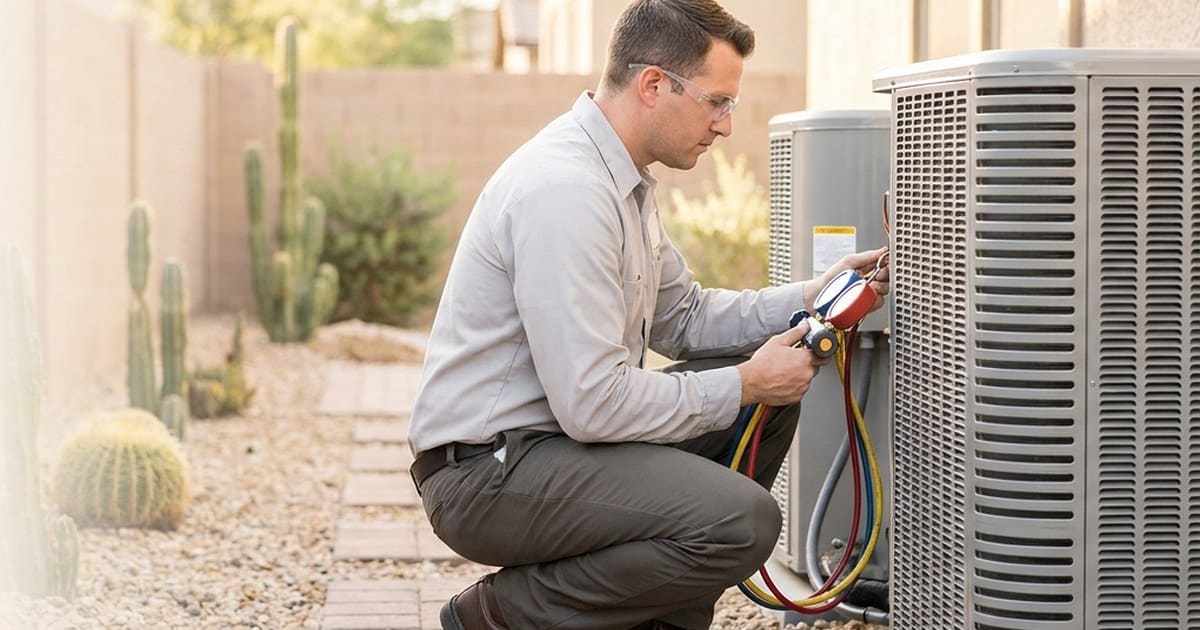
Labor cost: $100–$150 for a professional installation by a licensed C-39 HVAC contractor. That includes compatibility verification, C-wire installation or adapter if needed, device mounting, wiring, Wi-Fi setup, and system testing to confirm all heating and cooling stages respond correctly. Installation typically takes 1–2 hours.
Utility rebates: SRP and APS both offer thermostat rebates Arizona programs for smart thermostat installation when you enroll in their demand-response programs. As of 2026, SRP’s M-Power Days program provides a $75 rebate, and APS offers $50–$100 depending on the device model and program tier. You apply after installation using your receipt and thermostat serial number. Rebates arrive as bill credits within 6–8 weeks.
Total out-of-pocket cost after rebate: $170–$300. Compare that to annual savings documented by the U.S. Department of Energy on a typical East Valley home (2,000–2,500 sq ft, average cooling load). The payback period is 12–18 months. After that, the savings compound every summer. According to research on home health and energy efficiency, investments in HVAC control and air quality improvements deliver long-term benefits beyond immediate cost savings. For families looking to reduce both energy bills and system maintenance frequency, smart thermostats are one of the highest-ROI upgrades available. Learn more about installation options at How Mini Split Installation Works from Start to Finish.
Arizona Utility Rebate Programs: How to Stack Savings
Arizona’s two major utilities operate demand-response programs that reward smart thermostat participation with bill credits. These programs are underutilized because most homeowners don’t know they exist or assume enrollment is complicated. It’s not.
SRP M-Power Days: SRP’s residential demand-response program pays customers to allow the utility to adjust their smart thermostat during peak demand events. When grid load is high, SRP sends a signal to your thermostat raising the setpoint by 2–4 degrees for 2–4 hours. You can opt out of any event through the app if you need full cooling that day. Participation earns a $75 installation rebate plus $25–$50 in annual bill credits. Enrollment is free and takes about 10 minutes through SRP’s website after your thermostat is installed.
APS Cool Rewards: APS offers a similar program with tiered rebate levels. The standard tier provides a $50 installation rebate and moderate setpoint adjustments during peak events. The enhanced tier offers $100 upfront and allows larger adjustments in exchange for higher annual credits. Like SRP, you can opt out of specific events. Enrollment requires an APS account and a compatible smart thermostat.
Both programs stack with any manufacturer rebates or seasonal promotions. According to the EPA's guidance on improving indoor air quality, integrating energy efficiency measures with utility programs amplifies both environmental and financial benefits.
Choosing the Right Smart Thermostat for Arizona Homes
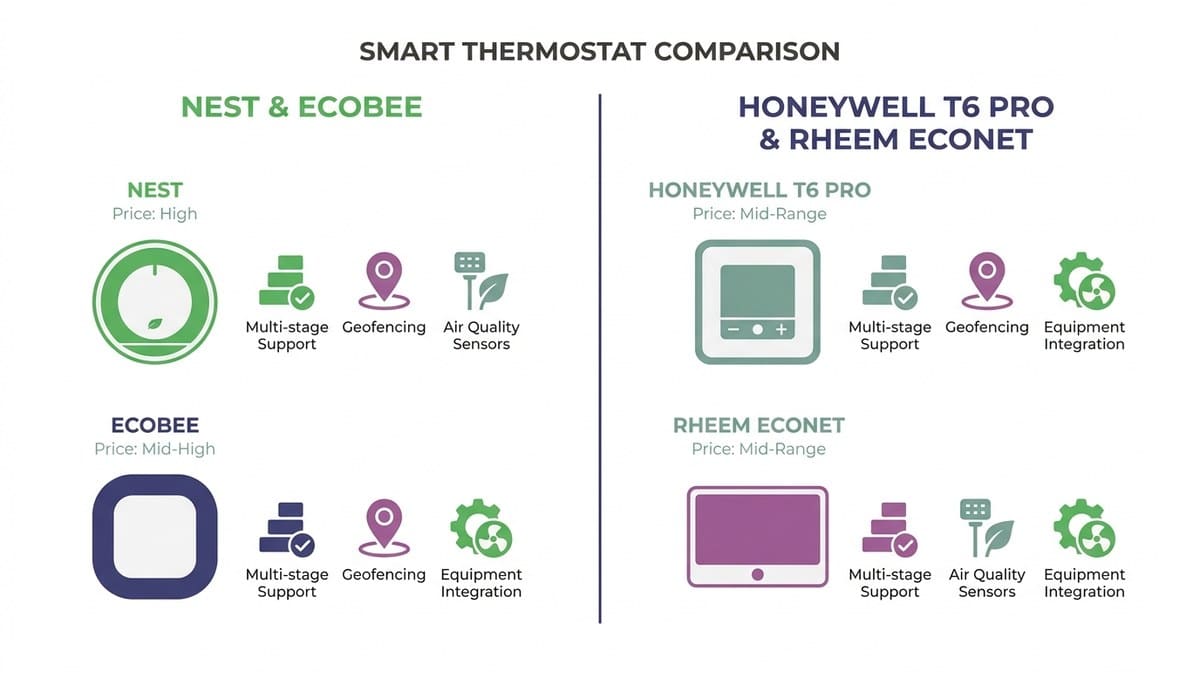
Four brands dominate the Arizona smart thermostat market: Nest, Ecobee, Honeywell, and Rheem. Each has strengths depending on your budget, existing HVAC system, and smart home ecosystem.
Nest Learning Thermostat: Google’s flagship model learns your schedule automatically without manual programming. The interface is intuitive, the design is sleek, and it integrates with Google Home for voice control. Nest supports multi-stage systems and includes geofencing. The main downside: no built-in air quality sensors. Nest works well for customers who prioritize ease of use and Google ecosystem integration. Price: $200–$230.
Ecobee SmartThermostat: Ecobee includes a remote room sensor that tracks occupancy and temperature in a second zone. That’s valuable in Arizona homes with hot spots where one room consistently runs warmer than the rest. Ecobee also includes humidity and air quality sensors, making it a better choice for customers concerned about monsoon season moisture or dust intrusion. It integrates with Amazon Alexa, Apple HomeKit, and Google Assistant. Ecobee’s demand-response integration with SRP and APS is seamless. Price: $180–$220.
Honeywell T6 Pro: A budget-friendly option with solid performance. The T6 Pro supports multi-stage systems, includes geofencing, and works with most HVAC brands. The interface is less polished than Nest or Ecobee, but it’s reliable and straightforward. Honeywell is a good fit for customers who want smart features without premium pricing. Price: $120–$150.
Rheem EcoNet: If you have Rheem or Amana HVAC equipment, the EcoNet thermostat offers tighter integration and system diagnostics that third-party thermostats can’t access. EcoNet monitors refrigerant levels, compressor performance, and airflow in real time, alerting you to potential issues before they cause a breakdown. That’s a significant advantage in Arizona’s high-stress cooling environment. EcoNet also supports demand-response and geofencing. Price: $200–$250.
Decision criteria: if you have Rheem or Amana equipment, start with EcoNet. If you want air quality monitoring and remote sensors, choose Ecobee. If you prioritize Google integration and learning automation, pick Nest. If you’re budget-conscious and want solid performance without extras, go with Honeywell T6 Pro. For more on how HVAC systems impact overall comfort and health, see Indoor Air Quality: How HVAC Systems Impact Your Health.
Installation Process: What to Expect When You Hire an HVAC Tech
Professional installation takes 1–2 hours from start to finish. Here’s the step-by-step process so you know exactly what to expect.
Step 1: Compatibility verification. Before we remove your old thermostat, we verify your HVAC system type (single-stage, two-stage, or variable-speed) and check your existing wiring. We confirm whether a C-wire is present or if we need to install an adapter.
Step 2: Power off and wire labeling. We shut off power to the HVAC system at the breaker to prevent shorts during wiring. Then we remove the old thermostat faceplate and label each wire according to its terminal. This ensures we connect the new thermostat correctly.
Step 3: Mounting and wiring the new device. We mount the new thermostat base to the wall, level it, and route the wires through the opening. Each wire connects to its corresponding terminal on the new thermostat per the manufacturer’s diagram. If a C-wire adapter is needed, we install it at the air handler or furnace and test for 24VAC voltage at the thermostat.
Step 4: Power on and Wi-Fi pairing. We restore power and boot the thermostat. The device walks through an initial setup: language, time zone, Wi-Fi network selection, and account creation. We connect the thermostat to your home Wi-Fi and pair it with the manufacturer’s app on your smartphone.
Step 5: System testing and calibration. We test each HVAC mode (cooling, heating if applicable, fan-only) to confirm the system responds correctly. For multi-stage systems, we verify that the thermostat calls for low-stage cooling first and only ramps to high-stage when needed. We check temperature sensor accuracy and adjust calibration if the reading is off by more than 1 degree.
Step 6: Demand-response enrollment. If you want to participate in SRP M-Power or APS Cool Rewards, we guide you through the enrollment process on your phone. We confirm the utility account is linked, the thermostat is registered, and you’re set to receive the installation rebate. This takes about 10 minutes and ensures you don’t miss out on $50–$100 in credits. According to the CDC's guidance on ventilation and air purification, proper HVAC setup and air quality monitoring contribute to healthier indoor environments. Learn more about air purification options at HVAC Air Purification: Reduce Allergens, Dust & Contaminants.
Real-World Savings: What Our East Valley Customers See
In our work with Gilbert and Queen Creek homeowners, we’ve tracked 12–18 month payback periods on smart thermostat upgrades when paired with properly maintained HVAC systems. One customer in Queen Creek replaced a 12-year-old programmable thermostat with an Ecobee SmartThermostat in May 2025. Her July cooling bill dropped from $430 to $370 (a 14% reduction) after enrolling in SRP M-Power and adjusting her geofencing settings. The efficiency came entirely from the thermostat’s adaptive scheduling and demand-response participation.
Another Gilbert homeowner with a two-stage Amana system installed a Rheem EcoNet thermostat in April 2026. By August, he was seeing $60–$80 monthly savings compared to the previous summer. The EcoNet’s system diagnostics also alerted him to a refrigerant leak in June, which we repaired before it caused a full compressor failure. That early detection saved him $1,200–$1,500 in emergency replacement costs.
The savings are consistent across different home sizes, construction ages, and utility providers. The key variables are system compatibility (multi-stage systems see higher savings), duct condition (leaky ducts erase efficiency gains), and customer engagement with the app. As noted in studies on indoor air quality and home health, maintaining optimal HVAC performance contributes to both smart thermostat energy savings Arizona homeowners value and better indoor environments for families.
When you’re ready to start saving, understanding Air Conditioning | AC Technician Near Me services helps you maintain the system efficiency that maximizes your smart thermostat investment.
Common Mistakes That Erase Your Savings
Smart thermostats deliver measurable savings, but only when installed and configured correctly. Four common mistakes can erase your efficiency gains or delay payback.
Mistake 1: Installing a smart thermostat on a failing HVAC system. If your AC is 12+ years old, uses R-22 refrigerant, or requires frequent repairs, a $300 thermostat won’t solve the underlying problem. In those cases, the smarter investment is replacing the entire system with a high-efficiency unit that includes advanced controls. When you call us for a consultation, we assess your system’s condition first and recommend the right solution for your timeline and budget.
Mistake 2: Skipping utility rebate enrollment. SRP and APS rebates are free money, but they require deliberate enrollment after installation. Many customers install the thermostat, start using it, and forget to apply for the rebate. Don’t leave $50–$100 on the table. Apply within 30 days of installation.
Mistake 3: Not adjusting geofencing radius. Default geofencing settings trigger cooling when you’re 5–10 miles from home. In Arizona’s suburban sprawl, those radii are too wide. During setup, adjust the radius to 1–2 miles so the system triggers closer to your actual arrival time.
Mistake 4: Ignoring duct leaks and air seal issues. According to ENERGY STAR data on duct sealing benefits, up to 30% of conditioned air can be lost through leaky ducts in a typical home. A smart thermostat can’t recover that loss. Pair your smart thermostat upgrade with professional duct sealing and air leak repair to maximize ROI.
When to Upgrade Your Thermostat vs. Replace Your Entire HVAC System
Not every home is a good candidate for a smart thermostat. If your HVAC system is nearing the end of its lifespan, upgrading the thermostat is like putting premium tires on a car with a failing transmission.
Upgrade your thermostat if: your AC is less than 10 years old, runs reliably with minimal repairs, uses modern refrigerant (R-410A or R-32), and has a single-stage or multi-stage compressor in good condition. In that scenario, a smart thermostat is a high-ROI upgrade that extends the value of your existing system.
Replace your entire HVAC system if: your AC is 12+ years old, uses R-22 refrigerant (which is expensive and being phased out), requires frequent repairs ($300+ annually), or struggles to maintain your setpoint during peak afternoon heat. At that point, investing $250–$350 in a smart thermostat delays the inevitable. A new high-efficiency system (16 SEER or higher) includes advanced controls as part of the package, delivers better smart thermostat energy savings Arizona homeowners need compared to older units, and comes with a manufacturer warranty covering parts and labor for 5–10 years.
We won’t upsell you a new system if your current AC has life left in it. But we also won’t install a smart thermostat on a system that’s one summer away from failure. Honest assessment protects your budget and prevents wasted money. If replacement makes sense, we provide a transparent estimate with options at different efficiency levels so you can choose what fits your timeline and comfort priorities. For more guidance on system health and indoor comfort, visit Why Summer in Mesa Demands Fast AC Repair.
Conclusion + Next Steps
Smart thermostats cut Arizona cooling costs according to the U.S. Department of Energy through adaptive scheduling, geofencing, and demand-response participation. In Phoenix’s extreme summer heat, those features translate to documented annual savings on a typical East Valley home. Installation costs $250–$350 including the device, and utility rebates recover $50–$100 of that upfront expense. Most customers see payback within 12–18 months, with compounding savings every summer after that.
Success depends on three factors: choosing a thermostat compatible with your HVAC system, installing it correctly with proper C-wire support and calibration, and enrolling in SRP or APS demand-response programs to maximize rebates. A professional installation by a licensed C-39 contractor ensures all three happen correctly the first time.
JLM Air Conditioning & Heating has completed over 3,000 installations across Gilbert, Queen Creek, Mesa, and Chandler. We’re a family-owned team with an A+ BBB rating, and owner Bill Milbourn is on the job alongside our technicians. When you call, you’re speaking to people who live in the East Valley and understand Arizona’s cooling demands firsthand. We won’t upsell you a device that doesn’t fit your system, and we won’t skip the steps that separate a functional install from an optimized one. For more HVAC efficiency tips and updates, explore our Blog | HVAC Tips & Updates for Gilbert, AZ Residents.
Ready to cut your cooling costs and qualify for utility rebates? Call now: 602-619-3609 for a free smart thermostat consultation and compatibility check. We’ll assess your HVAC system, recommend the right device for your home and budget, and handle the installation so you start saving this summer. No hidden fees, no upsells. Just honest advice from a family-owned team with 3,000+ installs and an A+ BBB rating.