
Should you repair or replace your AC? Replace your AC system when repair costs exceed 50% of replacement cost, the unit is over 15 years old, or you’re facing frequent breakdowns (3+ repairs in two years). For a system that’s 12+ years old with a major repair, replacement usually saves more money over the next 5 years than continued repairs.
That decision can feel overwhelming when you’re holding a $1,200 repair quote in your hand and wondering if you’re just throwing money at a system that’s about to fail again. You’re not alone. Every summer, hundreds of East Valley homeowners face this exact question, and the stakes are high. Make the wrong call, and you’re either bleeding cash on repeated repairs or paying $11,000 for a new system you didn’t actually need yet.
Why Summer in Mesa Demands Fast AC Repair becomes especially critical when you’re trying to decide whether a failing system will survive another season. After 3,000+ installations across Gilbert, Queen Creek, and Mesa, we’ve developed a decision framework based on real data from our service history: we’ve tracked system age, repair frequency, and lifetime costs across thousands of customer accounts to identify the exact thresholds where replacement becomes the financially sound choice. This guide gives you the same framework we use when walking customers through their options: honest, transparent, backed by real numbers. Sometimes the right call is to repair. Sometimes it’s to replace. We’ll show you exactly how to tell the difference.
By JLM
When to Repair vs. Replace Your AC: The 5-Minute Decision Framework
Use this three-question checklist to determine whether repair or replacement makes financial sense for your AC repair vs replacement decision:
Question 1: How old is your system? If your AC is 15+ years old, replacement is almost always the better long-term investment. Arizona’s extreme heat accelerates wear on AC components. According to the U.S. Department of Energy’s residential HVAC research, systems in hot climates typically last 12 to 15 years compared to 15 to 20 years in milder regions.
Question 2: Does the repair cost exceed half of what a new system would cost? When a repair quote approaches or exceeds 50% of a new system’s installed price, replacement delivers better value. Based on our 3,000+ installations, typical replacement costs in the East Valley range from $9,000 to $13,000 depending on system size and efficiency rating. You’re halfway to a brand-new, efficient system with a 10-year warranty instead of patching an aging unit with no guarantee it won’t break again.
Question 3: Have you had three or more repairs in the past two years? Frequent breakdowns signal systemic decline. Each repair buys you 6 to 18 months at best. If you’re calling for service multiple times per year, you’re paying for repairs without building equity in a solution.
The decision matrix (based on 3,000+ JLM service history data points):
- System under 10 years old + first major repair + repair cost under $1,000 = REPAIR
- System 10 to 14 years old + repair cost under 50% of replacement + infrequent failures = REPAIR (with caution)
- System 15+ years old OR repair cost over 50% of replacement OR 3+ repairs in 24 months = REPLACE
At JLM, we’ve earned an A+ BBB rating by giving homeowners the same honest assessment whether we’re walking out with a $400 repair invoice or a $12,000 install contract. The framework above reflects exactly how we evaluate every service call. No pressure, no hidden agendas. Just the math that helps you make the right call for your home and budget. How to Know If You’re Dealing with an AC Repair Specialist helps you evaluate whether your contractor is giving you an honest assessment.
How to Calculate the Real Cost of Repairing vs. Replacing
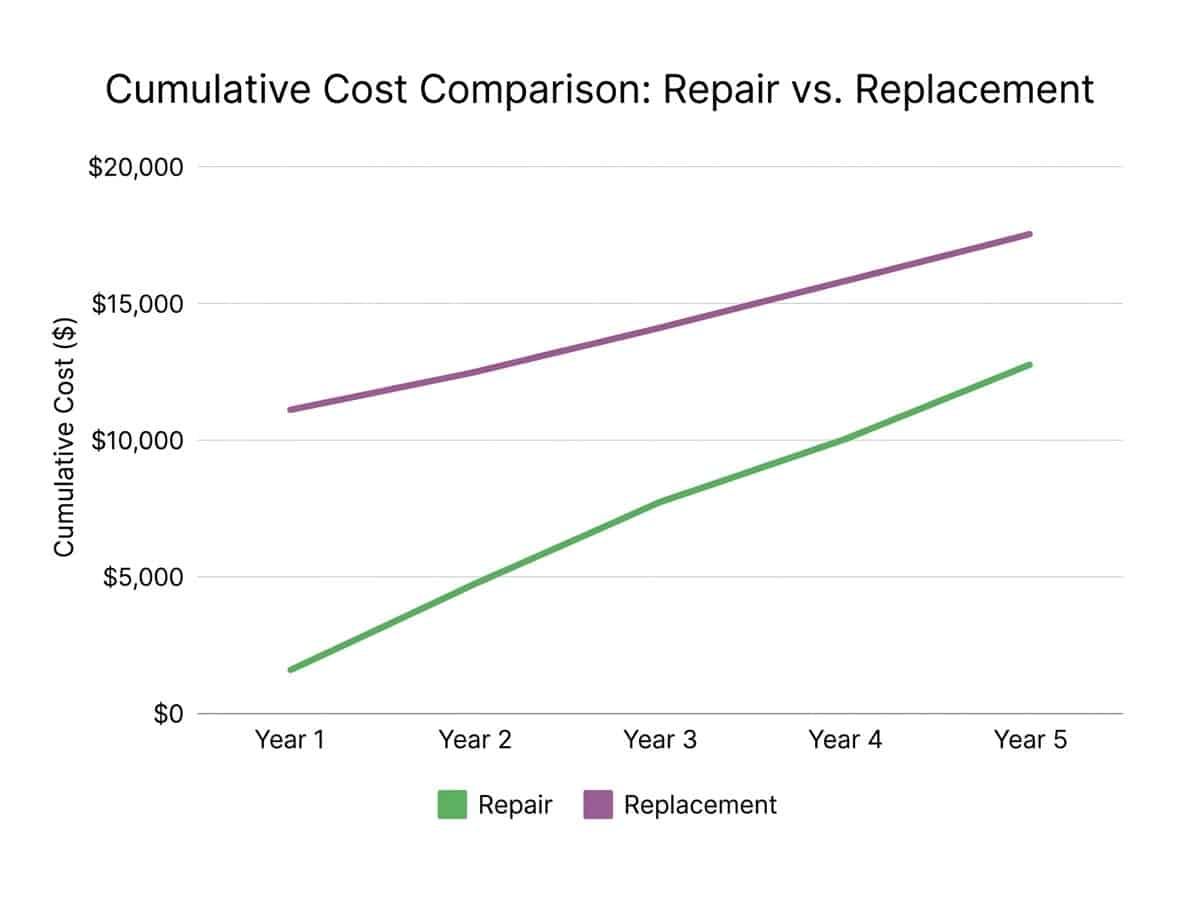
The sticker price of a repair tells you nothing about the real financial picture. To make an informed AC repair vs replacement decision, you need to calculate total cost of ownership over the next five years: repairs, energy bills, and the risk of additional breakdowns.
Step 1: Calculate annual cooling hours. In Arizona, most homes run AC approximately 5,000 hours per year (roughly 14 hours per day during peak season, tapering in winter). That’s your baseline for energy cost calculations.
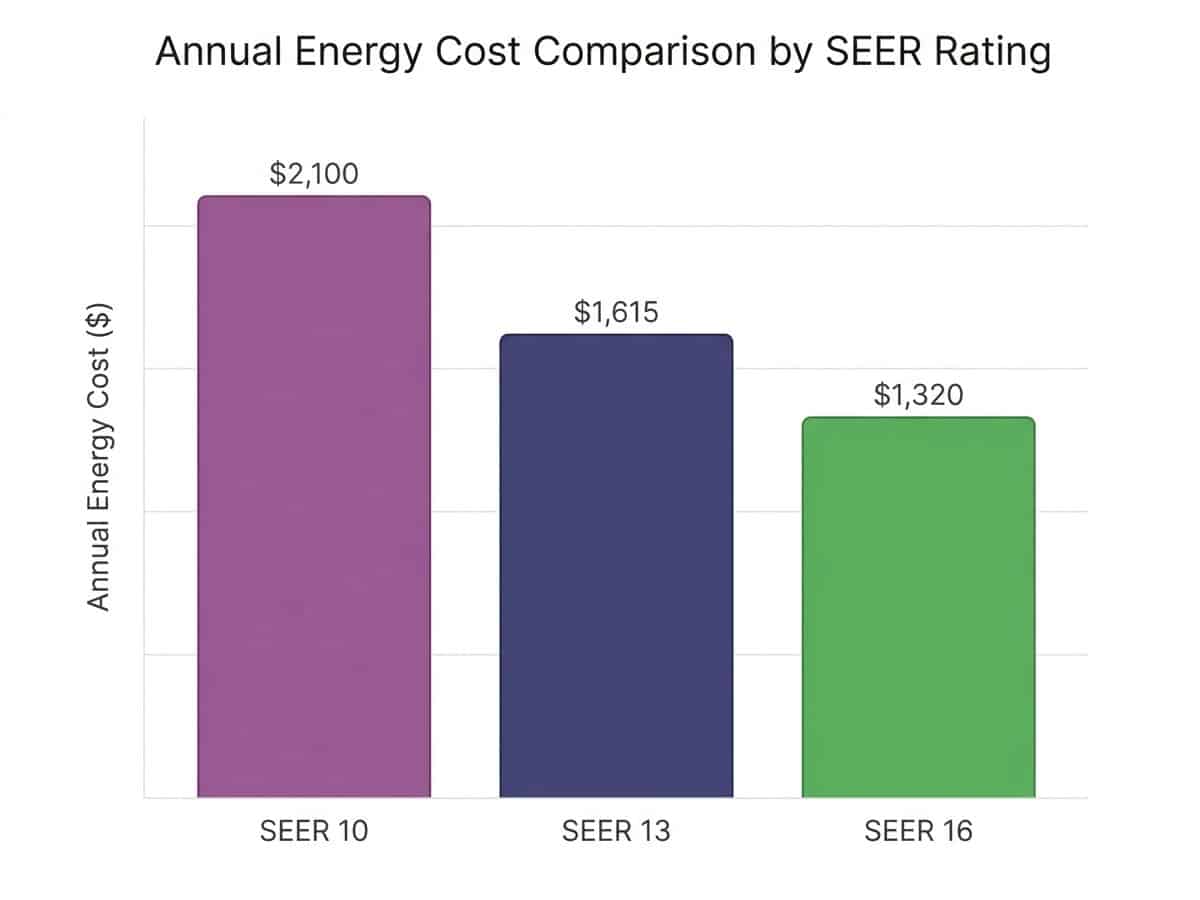
Step 2: Compare energy consumption. Older systems rated at SEER 10 or lower consume significantly more electricity than modern SEER 16+ units. According to Energy.gov efficiency standards research, upgrading from SEER 10 to SEER 16 can reduce cooling energy consumption by approximately 38%.
Step 3: Factor in repair risk. A 13-year-old system that needs a major compressor repair today will likely need another major repair (blower motor, coil, capacitor) within 18 to 24 months. Budget an additional amount for future failures within the next two years.
Step 4: Run the numbers. Repair scenario (13-year-old system):
- Immediate repair cost
- Expected future repairs (2 years)
- Higher energy costs over 5 years due to lower efficiency
Replacement scenario (new SEER 16 system):
- Upfront installation cost
- Minimal repair costs (warranty coverage)
- Lower energy costs over 5 years due to higher efficiency
The tipping point: When repair costs plus projected energy waste exceed 70% of replacement cost within three years, replacement is the financially sound choice. In our service experience across 3,000+ Gilbert and Mesa installations, systems over 12 years old facing major component failures (compressor, coil, or air handler) typically cross that threshold immediately.
The Hidden Costs of Delaying Replacement
Waiting too long to replace a failing AC system costs more than the price difference between repair and replacement. According to the 2024 Jobber Home Service Trends Report, emergency HVAC service calls carry premium pricing due to after-hours labor rates and expedited parts sourcing.
Emergency service premiums: When your AC fails on a 115-degree Saturday afternoon, you’re calling for same-day or next-day service. Emergency dispatch fees can add $400 to $800 on top of the repair itself. For a family of four, that’s an unplanned expense hitting when you’re least prepared.
Secondary costs of system failure:
- Temporary lodging: If your system fails overnight and temperatures inside your home exceed 90°F, you may need to relocate vulnerable family members (elderly relatives, infants) to a hotel.
- Food spoilage: A refrigerator running in a 95°F kitchen loses efficiency. Extended heat exposure compromises food safety.
- Health risk: The CDC’s extreme heat guidance identifies indoor heat as a medical emergency for elderly residents or those with respiratory conditions when temperatures regularly exceed 110°F.
The cost of “waiting one more season”: If your 14-year-old system is limping through summer on temporary repairs, delaying replacement until next spring seems financially prudent. But if the compressor fails in July, you’re paying emergency rates and living without AC during peak heat. That emergency replacement costs substantially more than a planned spring install, and you’ve lost the ability to shop contractors, compare quotes, or finance strategically. Do You Really Need Professional AC Repair in Mesa? walks through the warning signs that mean “don’t wait.”
The Five Factors That Determine Your AC Repair vs Replacement Decision
Beyond the three-question framework, five specific factors determine when to replace AC system versus repair. Each factor carries a measurable threshold. When two or more thresholds are crossed, replacement is almost always the right call.
Factor 1: System Age and Expected Lifespan
AC systems in Arizona last 12 to 15 years on average. The extreme heat cycle (110°F+ outdoor temps, 75°F indoor setpoint) creates a temperature differential that the compressor must work against for 5,000+ hours per year. That’s significantly more stress than systems in milder climates face.
Age thresholds:
- Under 8 years: Repair is almost always the right call unless the damage is catastrophic.
- 8 to 12 years: Evaluate repair cost and frequency. A capacitor replacement makes sense; a major coil replacement may not.
- 12 to 15 years: The system is approaching end-of-life. Repair only if the cost is modest and this is the first major failure.
- 15+ years: Replace. Even if the immediate repair is affordable, you’re buying limited service on a system with degraded efficiency and mounting failure risk.
Efficiency degradation: AC systems lose efficiency over time due to coil fouling, refrigerant micro-leaks, and compressor wear. The Real Work Behind Air Conditioning System Maintenance can slow efficiency loss, but it can’t reverse age-related decline.
Parts availability: Manufacturers discontinue parts for systems over 12 years old. That blower motor repair might require overnight parts ordering because the OEM part is no longer stocked locally. Repair timelines stretch from same-day to 5 to 7 days, leaving you without AC during the wait.
Factor 2: Repair Cost as a Percentage of Replacement
The industry standard is the 50% rule: if a single repair costs more than half the price of a new system, replacement delivers better value.
The 50% rule adjusted for age:
- System under 8 years: repair justified up to 70% of replacement cost
- System 8 to 12 years: repair justified up to 50% of replacement cost
- System 12+ years: repair justified only if under 30% of replacement cost
Why Spring Is Great for Scheduling Mesa AC Repair explains how off-season repairs cost less due to parts availability and contractor scheduling flexibility, which can shift the 50% threshold slightly in favor of repair.
Factor 3: Frequency of Repairs
Three or more service calls in 24 months signals systemic decline. You’re no longer dealing with isolated component failures; the entire system is aging out.
The maintenance distinction: Some homeowners confuse routine maintenance (filter changes, coil cleaning, annual tune-ups) with recurring repairs. Regular air conditioning maintenance extends system life and prevents breakdowns. Repairs indicate failure. If you’re calling for service three times in two years because components keep breaking, the system is telling you it’s done. According to Energy Star’s HVAC maintenance guidance, well-maintained systems should not require major component replacements more than once every 8 to 10 years.
Factor 4: Refrigerant Type (R-22 Phase-Out)
If your system uses R-22 refrigerant (common in units installed before 2010), replacement is financially inevitable within the next 2 to 3 years.
Why R-22 matters: The EPA phased out R-22 production in 2020 under the Clean Air Act’s refrigerant regulations. Remaining stockpiles are expensive and dwindling. A refrigerant recharge that once cost substantially less now runs significantly higher depending on supply. That cost will only increase as inventory depletes.
The regulatory timeline: R-22 will become commercially scarce by 2030. If your system is 12+ years old and uses R-22, every dollar spent on refrigerant is money you won’t recover. Replace now while you can plan the timing and negotiate pricing.
Factor 5: Rising Energy Bills
If your monthly cooling costs have increased 20%+ over the past two years (adjusted for rate changes and usage patterns), your system is losing efficiency and costing you money every day it runs.
How to identify efficiency loss: Pull your summer electricity bills for the past three years. Normalize for rate increases (check your utility’s rate schedule) and compare June to August consumption in kilowatt-hours (kWh), not just dollar amounts. If kWh consumption is climbing despite consistent thermostat settings and similar weather patterns, your AC is working harder to deliver the same cooling.
Energy cost impact: According to Energy.gov efficiency standards research, a SEER 10 system consumes approximately 38% more electricity than a SEER 16 system for the same cooling output. In Arizona’s climate with extended cooling seasons, that efficiency difference translates to substantial annual savings. Air Conditioning | AC Technician Near Me covers the full range of efficiency diagnostics we perform during consultations, including blower door tests and duct leakage assessments that reveal hidden energy waste.
Common Scenarios: What We’d Recommend (and Why)
Here are four real-world scenarios we’ve encountered during consultations. These are composites based on actual service calls across Gilbert, Queen Creek, and Mesa, anonymized to protect customer privacy.
Scenario 1: 10-year-old system, major compressor repair needed Customer context: Homeowner has maintained the system well (annual tune-ups, regular filter changes). This is the first major failure. System uses R-410A refrigerant. No recent energy bill increases.
Our recommendation: REPLACE. At 10 years old, the system is at the midpoint of its expected lifespan. Once the compressor fails, other major components (coil, blower motor) often follow within 2 to 3 years. A new system delivers 12 to 15 years of service, substantial energy savings, and full warranty coverage. Financially, replacement wins over a 5-year window.
Scenario 2: 7-year-old system, capacitor replacement needed Customer context: Homeowner noticed the AC running but not cooling effectively. Technician diagnosed a failed start capacitor. System is otherwise healthy, well-maintained, and uses R-410A.
Our recommendation: REPAIR. Capacitors are wear items that fail after 5 to 8 years of normal use. An affordable capacitor repair on a 7-year-old system extends the system’s life by 5 to 8 more years. This is a textbook repair scenario: affordable, isolated failure, plenty of service life remaining.
Scenario 3: 16-year-old system, coil leak discovered Customer context: System has been repaired twice in the past three years (blower motor, capacitor). Uses R-22 refrigerant. Energy bills have increased substantially over two years.
Our recommendation: REPLACE. At 16 years old, the system has exceeded its expected lifespan. The coil leak requires both coil replacement and refrigerant recharge (R-22), pushing the true repair cost significantly higher. You’re spending that money on a system with limited life left, degraded efficiency (costing you monthly in energy waste), and R-22 refrigerant risk. Replacement gives you a modern SEER 16 system, R-410A refrigerant, and substantial annual energy savings.
Scenario 4: 14-year-old system, frequent shutdowns, rising bills Customer context: System cycles on and off irregularly, struggles to maintain temperature on 110°F+ days, and energy bills have climbed substantially in two years. Technician found refrigerant loss (slow leak), dirty coils, and a failing contactor.
Our recommendation: REPLACE. This is systemic decline, not an isolated failure. Repairs address symptoms, not the root cause (an aging system losing efficiency and reliability). At 14 years old with multiple symptoms, you’re 18 to 24 months from total replacement regardless. A planned install now avoids emergency failure risk and starts delivering energy savings immediately.
How to Get an Honest Assessment (What to Ask Your HVAC Contractor)
Not every HVAC contractor gives homeowners a transparent cost comparison. Some default to “you need a new system” because replacement commissions are higher than repair invoices. Others will patch a dying system indefinitely to keep you as a repeat service customer. Here’s how to get an honest evaluation when deciding should I replace my AC.
Question 1: What’s the system’s current SEER rating and expected remaining lifespan? A qualified technician can estimate remaining service life based on age, maintenance history, and component condition. If the answer is vague, push for specifics. A 12-year-old system in Arizona with regular maintenance has 3 to 5 years left. A 16-year-old system with deferred maintenance has substantially less.
Question 2: Can you show me a side-by-side AC repair cost vs replacement analysis? This is the transparency test. If the contractor won’t (or can’t) walk you through a 3 to 5 year total-cost-of-ownership comparison, they’re either uninformed or hiding the financial reality. What Does Commercial AC Repair Actually Involve? explains the diagnostic process legitimate contractors follow before recommending repair or replacement.
Question 3: Will you guarantee this repair for at least 12 months? Reputable contractors warranty their work. Ask for a 12-month labor warranty (parts warranties are typically covered by the manufacturer). If they won’t offer it, the repair is high-risk.
Question 4: What financing options are available for replacement? Replacement is a capital expense. Contractors who partner with financing providers give you flexibility to spread cost over multiple years. If financing isn’t offered, ask why. Budget-focused homeowners often choose replacement over repair when financing turns a large upfront cost into a manageable monthly payment that’s offset by energy savings.
Question 5: Do you have references from recent install customers? Check Google reviews, BBB rating, and ask for contact info for 2 to 3 recent customers. Stationary refrigeration and air conditioning technician trade groups recognized by the EPA demonstrate a track record of quality installs and transparent communication. A contractor who hesitates to provide references is a red flag.
What to Expect During a JLM Free Consultation
When you call JLM for a repair-or-replace consultation, here’s what happens:
Step 1: On-site system inspection (30 to 45 minutes). Our senior technician will inspect your AC system, test performance (airflow, temperature differential, refrigerant pressure), check the age and condition of major components (compressor, coil, blower motor), and review your maintenance history. We’ll also ask about recent energy bills and any performance issues you’ve noticed.
Step 2: Transparent cost comparison. We’ll provide a written estimate for the recommended repair alongside a side-by-side comparison of repair cost plus projected energy cost over 5 years versus replacement cost plus projected energy cost over 5 years, remaining service life of the current system, and warranty coverage for repair versus replacement.
If the math favors repair, we’ll tell you. If replacement makes more financial sense, we’ll explain why with real numbers, not pressure tactics.
Step 3: Financing options (if replacement is recommended). We partner with GoodLeap to offer financing for qualified buyers. We’ll walk you through monthly payment options and show how energy savings offset the cost.
Step 4: No-pressure decision. You’ll have the estimate in writing. Take time to compare quotes from other contractors if you’d like. We’re confident our pricing, workmanship, and A+ BBB rating speak for themselves. Simple Signs Your Garage Air Conditioning Needs Help covers some of the diagnostic red flags we look for during inspections, whether it’s a residential or garage/workshop system.
Ready to get an honest answer? Call now: 602-619-3609 or request a free consultation online. We’ll give you a transparent assessment with zero pressure.
Frequently Asked Questions
How long does an AC replacement take?
Most residential AC replacements are completed in 1 to 2 days. Day one involves removing the old system, installing the new outdoor condenser and indoor air handler, connecting refrigerant lines, and testing for leaks. Day two (if needed) covers ductwork modifications, thermostat programming, and final system calibration.
Can I finance a new system?
Yes. JLM partners with GoodLeap to offer financing options for qualified buyers. Monthly payments typically range from modest amounts depending on system size and term length. When you factor in monthly energy savings from a high-efficiency system, the net monthly cost is far more manageable than a large upfront payment.
What rebates or incentives are available in Arizona?
Arizona utilities (APS, SRP) offer rebates for high-efficiency HVAC system installations depending on system SEER rating and utility provider. Federal tax credits (under the Inflation Reduction Act) provide incentives for qualifying ENERGY STAR systems. We’ll help you identify and apply for available incentives during your consultation.
Should I replace just the outdoor unit or the whole system?
Replacing only the outdoor condenser rarely makes sense unless the indoor air handler is less than 5 years old. Mismatched systems (new outdoor unit paired with an old indoor unit) operate at reduced efficiency and void manufacturer warranties. For optimal performance and warranty coverage, replace both the indoor and outdoor components as a matched system.
What’s the warranty on a new system?
Most systems come with a 10-year limited parts warranty when registered within 60 days of installation. JLM provides a 1-year labor warranty on all installations. Extended warranty options are available for customers who want additional coverage beyond the manufacturer’s standard terms.
Do you offer maintenance plans for new installs?
Yes. We recommend annual maintenance (spring tune-up before cooling season) to keep your system running efficiently and extend its lifespan. Maintenance plans include filter replacement, coil cleaning, refrigerant pressure check, electrical connection inspection, and blower motor lubrication. Plan members receive priority scheduling and discounted service rates. Big Differences Between AC Repair Experts and General Techs highlights the expertise level that matters when choosing a contractor for ongoing maintenance. Repairs | AC Technician Near Me provides additional guidance on the full spectrum of repair services available when issues arise.