
What are the best AC installation financing options in Arizona? Arizona homeowners replacing an AC system can choose from 0% APR manufacturer financing (24–60 months with approved credit), PACE energy loans (long-term, property-assessed), home equity lines, utility rebate programs, and federal tax credits for high-efficiency systems. The right option depends on credit score, home equity, and timeline.
If you’ve just received a $12,000 quote for AC replacement, you’re likely feeling relief (your home will be cool again) and sticker shock (where will that money come from?). Most East Valley families facing AC installation financing in Arizona ask the same question: how do I make this affordable without draining savings or maxing out credit cards?
The answer lies in understanding your financing landscape. Between manufacturer 0% APR air conditioning plans, PACE property-assessed loans, federal tax credits worth up to $2,000, and Arizona utility rebates, you have more pathways to affordable AC replacement than you might realize. This guide walks you through each option with transparent breakdowns of costs, terms, and trade-offs.
Arizona summers test every air conditioning system. How Arizona summers test every AC system makes replacement a time-sensitive decision. When your system fails in June, you need AC installation financing in Arizona that moves as fast as the heat does.
By JLM
Why AC Installation Costs What It Does (and Why Financing Makes Sense)
A typical AC replacement in Gilbert, Queen Creek, or Apache Junction runs $9,000 to $20,000, according to industry data. That range reflects equipment quality, system size, installation complexity, and efficiency ratings based on ENERGY STAR’s Heating & Cooling Guide.
AC installation financing in Arizona transforms a five-figure expense into manageable monthly payments. Instead of waiting months to save $15,000, you can replace a failing system now and spread the cost over 2–5 years. The key is choosing a structure that doesn’t bury you in interest or surprise fees.
At JLM, we’ve completed over 3,000 installs across the East Valley since opening our doors. Our detailed breakdown of AC replacement costs shows exactly what each line item delivers. We’ve never marked up a system price because a customer chose financing over cash. Transparency isn’t optional in this decision.
What You’re Actually Paying For in a $9K–$20K Install
Your quote includes several components, each adding value you’ll rely on for 12–15 years:
Equipment: A premium system like Amana typically costs several thousand dollars wholesale. You’re paying for efficient compressors, durable coils, and refrigerant compliance with EPA refrigerant regulations. Cheap brands offer shorter warranties, lower efficiency, and more callbacks.
Labor: Professional installation takes 1–2 days and requires licensed technicians. Skilled HVAC technicians command competitive rates that ensure quality work. Crew costs cover sizing calculations, ductwork modifications, electrical hookups, refrigerant charging, and system testing.
Materials and permits: Copper line sets, condensate drains, thermostat upgrades, electrical work, and city permits ensure code compliance and safe operation.
Disposal and warranty: Proper disposal of your old system (including refrigerant recovery) follows EPA requirements. Extended warranties or service agreements protect you from expensive repairs later.
When you understand where your investment goes, affordable AC replacement financing doesn’t feel like paying for air. It’s investing in comfort, efficiency, and safety for your family.
The Risk of Skimping: Why the Cheapest Quote Isn’t Always the Smart Choice
Lower-priced quotes might sound attractive until you realize what’s been cut. Some contractors use builder-grade equipment with shorter warranties instead of premium systems, skip load calculations (leading to undersized or oversized systems), rush installation (improper refrigerant charge, leaky ducts), and disappear when callbacks arise.
The cost of shortcuts shows up later: higher utility bills from inefficient operation, premature equipment failure (you’re replacing again in years instead of over a decade), and expensive repairs that aren’t covered because the installer didn’t pull permits.
Quality installation matters more than you might think. The Smart Way to Prep AC for Gilbert’s Hot Summer starts with getting the system right the first time: proper sizing, thorough testing, and professional workmanship that lasts.
JLM’s A+ BBB rating and extensive install history across the East Valley reflect our commitment to doing it right. We use premium equipment, follow manufacturer specifications, pull permits, and stand behind our work.
0% APR Manufacturer Financing: The Most Popular Option for Qualified Buyers
Many homeowners who need AC installation financing in Arizona choose manufacturer 0% APR plans. These promotional offers (typically 24–60 months, no interest with approved credit) let you spread the full system cost over several years without paying a dollar in finance charges if you pay off the balance before the promotional period ends.
Companies like GoodLeap, Synchrony, and Wells Fargo Home Projects partner with HVAC manufacturers and contractors to offer these plans. The manufacturer subsidizes the interest cost as a sales incentive.
The catch is credit qualification. Most 0% APR air conditioning financing plans require a credit score around 680 or higher. Below that threshold, you’ll face higher rates or need to explore alternatives like PACE loans or home equity lines.
When you’re evaluating whether replacement is the right call for your system, understanding your financing options helps you make a confident decision. A system financed at 0% APR over 48 months with manageable monthly payments becomes accessible for most East Valley families when you factor in energy savings from a modern, efficient unit.
How 0% APR Plans Work (and the Deferred Interest Trap to Avoid)
Here’s the basic structure: you finance your system at 0% APR for a set period (commonly 24 to 60 months). Your monthly payment equals the total divided by the number of months. As long as you pay the full balance within that promotional period, you pay zero interest.
The trap is deferred interest. Many 0% APR offers include a clause: if you carry any balance past the promotional period (even a small amount), you’re retroactively charged interest on the original balance from day one at rates typically between 18% and 26%. Miss one payment or misjudge your payoff date, and you’re suddenly paying significantly more.
To avoid this trap: verify your payoff date when you sign the contract, set up automatic payments slightly above the minimum, and pay off the balance a month early if possible. Licensed contractor verification through Arizona’s Registrar of Contractors ensures your contractor discloses these terms clearly. Demand transparency before you sign.
At JLM, we walk every customer through the fine print. We’ve seen too many families surprised by deferred interest to let it happen on our watch.
Typical Approval Requirements and What to Do If You Don’t Qualify
0% APR financing typically requires meeting certain credit thresholds and income verification standards set by the financing partner.
Common requirements include:
- Credit score meeting the lender’s minimum threshold
- Debt-to-income ratio within acceptable limits
- Stable income documentation (W2s, pay stubs)
- No recent bankruptcies or foreclosures
If your credit doesn’t meet these requirements, you might not qualify for 0% APR. That doesn’t mean you’re stuck paying cash. PACE loans (discussed next) have more flexible credit requirements, and personal loans or home equity lines can work if you have equity.
Alternative paths include finding a co-applicant (a spouse or family member with stronger credit), negotiating a partial down payment to reduce the financed amount, or exploring contractor-sponsored payment plans (some HVAC companies offer in-house financing with easier approval).
Garage AC options and smaller projects sometimes qualify for lower-limit credit lines if you’re not ready to finance a full system replacement yet.
PACE Loans: Long-Term, Low-Interest Financing Tied to Your Property
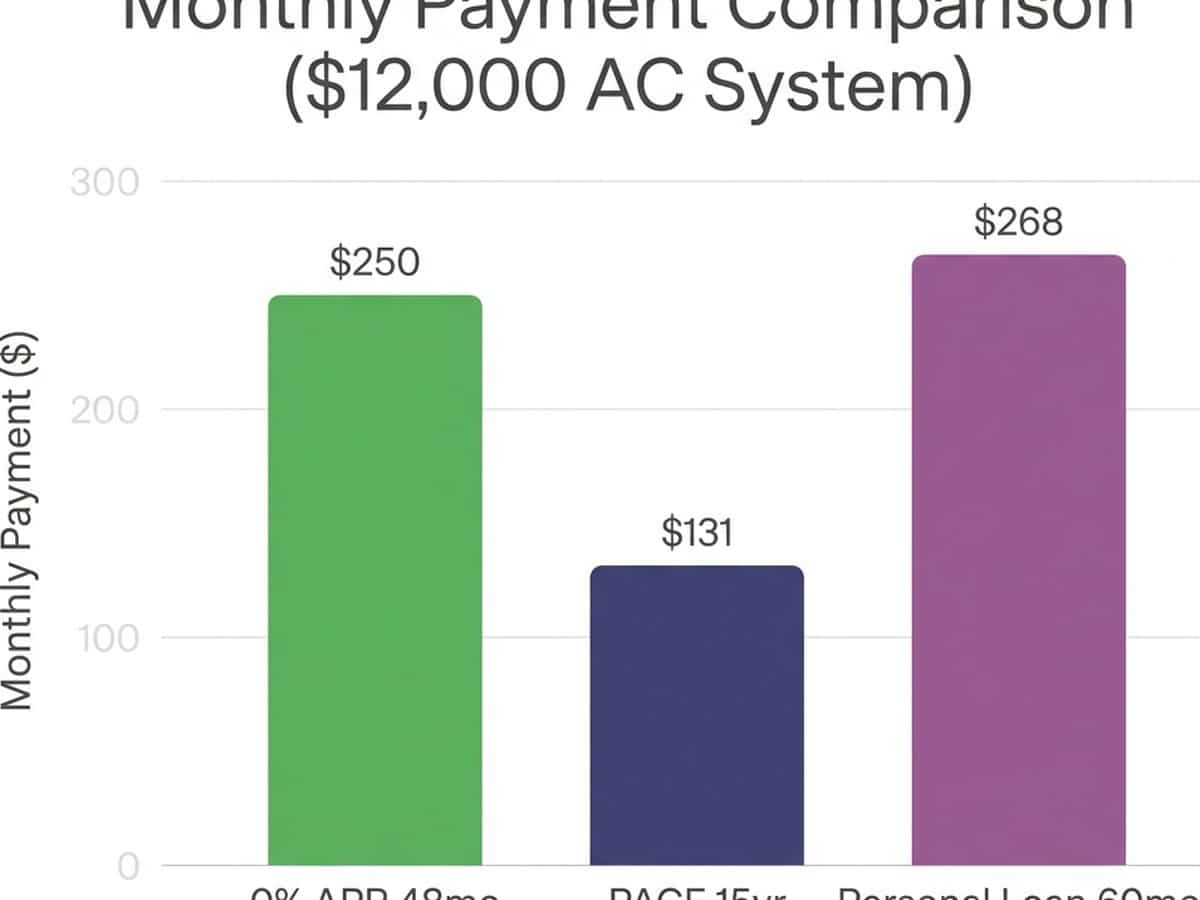
Property Assessed Clean Energy (PACE) loans offer an alternative for homeowners who don’t qualify for 0% APR or prefer longer repayment terms. PACE programs finance energy-efficient home improvements (including AC replacements) and repay the loan through a special assessment on your property tax bill over 10 to 20 years.
PACE loans have several advantages: they don’t require high credit scores (approval focuses on home equity and on-time property tax history), they offer competitive interest rates, and they transfer to the next homeowner if you sell.
The trade-off is long-term commitment. A PACE loan spread over many years provides lower monthly payments, but you’ll pay interest over the life of the loan. However, for homeowners who can’t qualify for manufacturer financing or need lower monthly payments, PACE provides access to energy-efficient upgrades.
Protecting yourself from contractor fraud starts with verifying licensing. Always confirm your contractor is properly licensed before signing AC installation financing in Arizona documents.
Is PACE Available in Your East Valley City?
PACE availability varies by county and city. In Arizona, Maricopa County (which includes Gilbert, Queen Creek, Mesa, and Apache Junction) participates in PACE programs through administrators like Ygrene and Renewable Funding.
To confirm eligibility, visit your county’s PACE program website or ask your HVAC contractor if they’re a participating provider. Not all contractors accept PACE financing.
PACE loans require that you own the property (no rentals), have sufficient equity, and be current on property taxes and mortgage payments. If you meet these criteria, PACE can unlock AC installation financing in Arizona even with moderate credit scores.
PACE vs. Traditional Financing: Which Is Right for You?
Choose 0% APR manufacturer financing if you have strong credit, can commit to paying off the balance within the promotional period (24–60 months), and want to minimize total cost (zero interest equals lowest lifetime expense).
Choose PACE financing if your credit score doesn’t meet manufacturer financing thresholds, you need lower monthly payments (spreading over 10–20 years), you have home equity, and you’re comfortable with the loan transferring if you sell.
Avoid PACE if you plan to sell within a few years (some buyers balk at assuming the assessment), if you’re already stretched on property taxes, or if you can qualify for 0% APR.
Federal Tax Credits and Utility Rebates: Free Money You Shouldn’t Leave on the Table
The 2023 Inflation Reduction Act expanded federal tax credits for energy-efficient home improvements. Homeowners who install qualifying high-efficiency AC systems or heat pumps can claim up to $2,000 via IRS Section 25C on their federal tax return. This credit applies to equipment meeting ENERGY STAR efficiency thresholds (typically SEER2 16+ for central AC, higher for heat pumps).
Arizona utility companies also offer rebates for high-efficiency HVAC upgrades. APS (Arizona Public Service) and SRP (Salt River Project) provide rebates depending on system efficiency and program availability. These rebates reduce your upfront cost, which means less to finance with your AC installation financing in Arizona plan.
Stacking these incentives compounds savings. A new high-efficiency system might save you money monthly while you’re making payments.
For more on qualifying systems, visit our HVAC System pages.
How to Claim the Federal Tax Credit (and What Systems Qualify)
To claim the Section 25C credit:
- Verify your system meets ENERGY STAR Most Efficient or AHRI certification thresholds (your contractor provides this documentation).
- Save your Manufacturer Certification Statement (included with qualifying equipment).
- File IRS Form 5695 (Residential Energy Credits) with your tax return.
- Claim the credit amount (up to $2,000 for heat pumps or central AC).
Not all systems qualify. Builder-grade units often miss the efficiency cutoff. Ask your contractor to confirm eligibility before you sign the contract.
JLM installs Amana systems that regularly qualify for both federal credits and utility rebates. We provide all documentation you need to claim incentives.
Arizona Utility Rebates: What APS and SRP Are Offering
Check your utility provider’s website for current program details and application deadlines. Programs change annually, and some have limited funding that runs out mid-year. Apply as soon as installation is complete to avoid missing the window.
APS: Offers rebates for ENERGY STAR certified central AC systems, plus additional rebates for smart thermostats and duct sealing. Rebates are processed within several weeks of installation.
SRP: Provides rebates for high-efficiency AC systems, with expedited processing for online applications. SRP also offers time-of-use rate plans that reduce summer cooling costs when paired with efficient equipment.
Federal energy-efficient purchasing guidelines emphasize the long-term savings from high-efficiency systems, which compounds the value of upfront rebates.
Other Financing Paths: Home Equity Lines, Personal Loans, and Credit Cards
If manufacturer financing and PACE don’t fit, three additional paths exist:
Home equity line of credit (HELOC): If you have significant home equity, a HELOC offers flexible borrowing at variable interest rates. You pay interest only on what you borrow, and repayment terms run 10–20 years. The risk is that your home secures the loan (default could lead to foreclosure). HELOCs work best for homeowners with stable income and significant equity who want flexibility for future projects beyond AC replacement.
Personal loan: Unsecured personal loans (from banks, credit unions, or online lenders) offer fixed rates and terms. No home equity required, but rates may be higher than PACE or HELOCs. Personal loans make sense if you need moderate funding, have good credit but no home equity, and want predictable monthly payments.
Credit cards (0% intro APR): Some credit cards offer 12–18 month 0% intro APR periods. If you can pay off the balance within that window, this path avoids interest entirely. The risk is high: miss the payoff deadline, and you’re charged substantial APR on the remaining balance. Use this path only if you have disciplined cash flow and a clear payoff plan.
The EPA sets national standards for refrigerant handling that protect both the environment and homeowners. Choose a licensed contractor who follows these regulations regardless of your AC installation financing in Arizona method.
When a HELOC Makes Sense (and When It Doesn’t)
Choose a HELOC if you have substantial home equity, need flexibility to finance other projects over the next few years (kitchen remodel, roof replacement), and are comfortable with variable interest rates. HELOCs offer lower monthly payments (interest-only during the draw period), and interest may be tax-deductible if used for home improvements.
Avoid a HELOC if home values in your area are declining, you’re close to retirement (income will drop), or you lack discipline (the flexibility to borrow and re-borrow can lead to over-use). A HELOC puts your home at risk. Only use it if you’re confident in your ability to repay.
The Credit Card Gamble: 0% Intro APR vs. Deferred Interest
Credit cards with 0% intro APR can work for smaller projects if you’re disciplined. Calculate your monthly payment needed to pay off the balance before the intro period ends. Set up automatic payments above that amount to ensure timely payoff.
The danger is similar to manufacturer deferred interest plans: carry a balance past the intro period, and you’re paying high APR retroactively on the original balance.
Credit cards should be your last resort. Manufacturer 0% APR plans offer longer promotional periods (24–60 months vs. 12–18 months), higher limits, and terms designed for HVAC projects.
How to Compare Offers and Choose the Right Financing for Your Situation
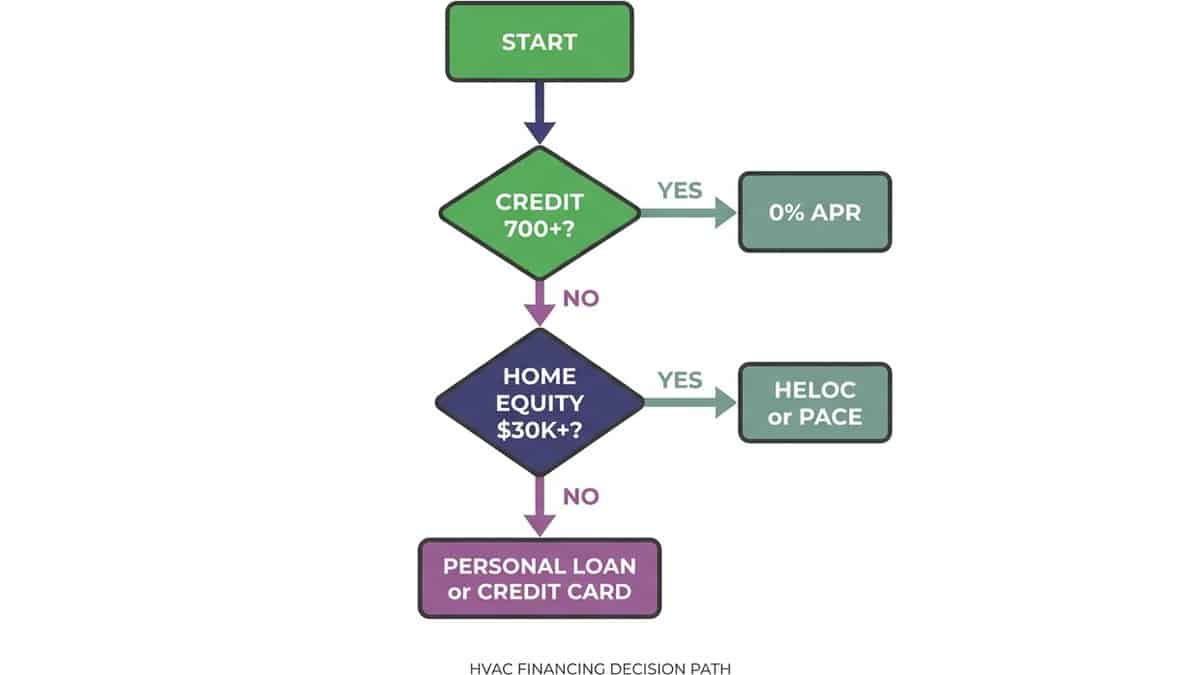
Choosing the right AC installation financing in Arizona path requires comparing total cost, monthly payment, approval likelihood, and flexibility. Here’s a decision framework:
If your credit score is strong and you can commit to 24–60 months: Choose 0% APR manufacturer financing. Total cost equals system price (no interest). Monthly payment equals system price divided by months. Lowest lifetime cost.
If your credit score is moderate or you need lower monthly payments: Choose PACE financing. Total cost equals system price plus interest over 10–20 years. Monthly payment is lower, but lifetime cost is higher. Good for cash flow management.
If you have substantial home equity and want flexibility: Consider a HELOC. Variable rates and long terms offer flexibility, but you’re risking your home.
If you need moderate funding and have no home equity: A personal loan works. Fixed rates, predictable payments. Higher cost than PACE but no property lien.
If you can pay off within 12–18 months and are disciplined: A 0% intro APR credit card avoids interest entirely, but the risk is high if you miss the payoff deadline.
For more on making the right choice, read why choosing a family-owned contractor matters when financing an install. Transparency and honesty matter more when you’re committing to years of payments.
Questions to Ask Any HVAC Contractor About Financing
Before you commit to AC installation financing in Arizona, ask your contractor:
- Do you mark up the system price for financed purchases? (Honest contractors say no.)
- What happens if I pay cash instead? (You should see the same price.)
- Are there prepayment penalties? (Most plans have none, but verify.)
- Who processes the financing application, and when do I get approval? (Same-day or quick approval is standard.)
- What documentation do I need for tax credits and rebates? (Contractor should provide Manufacturer Certification Statements and AHRI certificates.)
Verifying your contractor holds proper state licensing requires proper licensing and refrigerant handling credentials. Always check credentials before discussing financing. A contractor who skips permits or cuts corners won’t provide the documentation you need to claim incentives.
At JLM, we welcome these questions. We partner with GoodLeap and other finance providers, but we never pressure customers into financing over cash. Our pricing is the same regardless of payment method, and we provide all documentation you need to claim federal credits and utility rebates.
Why JLM Offers Multiple Financing Partners (and Never Pressures You Into One)
JLM partners with GoodLeap, Synchrony, and other finance providers to give you options. We’ve completed over 3,000 installs across Gilbert, Queen Creek, Apache Junction, and the broader East Valley, and we’ve seen that one-size-fits-all financing doesn’t work for every family.
Some customers qualify for 0% APR and pay zero interest. Others prefer PACE loans for lower monthly payments. Still others pay cash or use a HELOC. We present every option with transparent terms and let you decide what fits your budget and timeline.
Our A+ BBB rating reflects this approach: we don’t steer customers toward high-margin finance products, we don’t mark up system prices for financed purchases, and we don’t disappear after installation. Bill and the JLM team walk you through every option, answer every question, and stand behind the work for years.
What Happens After You Choose a Financing Option: The JLM Install Process
Once you’ve chosen an AC installation financing in Arizona path, here’s what happens next:
Free consultation: Bill or a senior technician visits your home for an on-site assessment (free, no obligation). We measure your space, inspect ductwork, discuss your cooling needs, and answer questions about system options and financing.
Transparent quote: Within 24 hours, you receive a detailed quote breaking down equipment, labor, materials, permits, and optional add-ons (extended warranty, smart thermostat, UV air purifiers). The price is the same whether you pay cash or finance.
Financing application: If you choose financing, we submit your application to the lender. Approval timing varies by lender. You’ll receive terms in writing before you sign.
Scheduling: Once approved, we schedule installation based on season and availability. We order equipment, pull permits, and coordinate with your utility provider if needed.
Professional install: Our licensed team arrives on schedule, installs the system per manufacturer specifications, tests refrigerant charge and airflow, verifies thermostat operation, and cleans up the work site. Bill oversees every install to ensure quality.
Customer training: Before we leave, we walk you through system operation, maintenance requirements, filter changes, and thermostat programming. We also enroll you in our maintenance plan (optional) for annual tune-ups and priority service.
For more details, visit our Air Conditioning installation and repair services page.
Timeline: From Financing Approval to Cool Air in Your Home
Day 1: Free consultation and on-site assessment.
Day 2–3: Receive detailed quote and review AC installation financing in Arizona options.
Day 3–4: Submit financing application and receive approval.
Day 5–14: Schedule installation based on availability (faster in spring/fall, longer wait times in peak summer).
Install day: Professional installation (timing varies by system complexity and ductwork modifications).
Post-install: System testing, customer training, final walkthrough, and maintenance plan enrollment.
Total timeline from consultation to cool air: typically 1–3 weeks in off-peak season, 2–4 weeks in summer. Financing approval is the fastest step. Installation scheduling drives the timeline.
What to Expect on Install Day (and How We Ensure Quality)
On install day, our licensed team arrives with premium tools, professional-grade equipment, and a commitment to getting it right the first time. We follow a checklist that ensures every step meets manufacturer specifications and local code requirements:
- Remove and properly dispose of old system (including refrigerant recovery per EPA standards)
- Install new condenser and air handler per manufacturer specs
- Connect refrigerant lines and charge system to precise levels
- Modify or seal ductwork as needed for optimal airflow
- Install programmable thermostat and test all functions
- Verify electrical connections and breaker sizing
- Test system operation under load (cooling cycle, airflow, temperature drop)
- Clean work area and haul away debris
Bill oversees every install. As the owner, he’s on the job to ensure quality, answer customer questions, and catch issues before they become callbacks. This hands-on approach is why our A+ BBB rating and extensive install history speak for themselves.
We don’t rush. We don’t cut corners. We install systems that last because we do it right from day one. If you’re wondering whether you need professional AC repair, the answer is yes. The same professional approach applies to every installation we complete.
Conclusion
Replacing your AC system is a major investment, but it doesn’t have to strain your budget. Between 0% APR air conditioning manufacturer financing (the lowest-cost option for qualified buyers), PACE loans (long-term, flexible credit requirements), federal tax credits, and Arizona utility rebates, you have multiple pathways to affordable AC replacement.
The right AC installation financing in Arizona path depends on your credit score, home equity, timeline, and cash flow. A family with good credit and stable income should choose 0% APR and pay zero interest. A homeowner with moderate credit and substantial equity might prefer a PACE loan with lower monthly payments. There’s no universal answer, just the option that fits your situation.
At JLM, we’ve walked thousands of East Valley families through this decision. We partner with multiple finance providers, we provide transparent quotes with no markup for financed purchases, and we deliver professional installations backed by our A+ BBB rating. Quality and transparency aren’t negotiable. Whether you pay cash or finance over several years, you get the same honest service and premium workmanship.
If you’re considering a mini split installation as an alternative to traditional central AC, many of these same financing options apply. For smaller projects like garage cooling, explore specialized mini split solutions that offer financing flexibility.
Ready to explore your AC installation financing in Arizona options and get a transparent quote for your AC replacement? For more HVAC tips, visit our HVAC Tips & Updates for Gilbert, AZ Residents.