
Your AC technician just told you that recharging your system will cost $800 instead of the $150 you paid five years ago. The culprit? Your system runs on R-22 refrigerant, a substance the EPA banned from production in 2020 under the Montreal Protocol to protect the ozone layer. Existing R-22 can still be used for repairs, but limited supply has driven prices from $10 per pound to $80 or more. Most systems using R-22 are 15+ years old and nearing end-of-life, which means homeowners face a choice: pay for expensive recharges that buy a season or two, or upgrade to a modern R-410A system designed to last 15–20 years. This isn’t a sales pitch. It’s federal regulation meeting the natural lifespan of aging equipment, and the math matters.
In our work with East Valley homeowners, we’ve seen R-22 refrigerant prices jump from $10–$15 per pound five years ago to $80–$120+ per pound today. A typical recharge requires 5–10 pounds, which means a service call that used to cost $150–$200 now runs $600–$1,200 for refrigerant alone, not including labor or leak repairs.
Why R-22 Was Phased Out (and What That Means for Your System)
The EPA’s decision to phase out R-22 refrigerant wasn’t arbitrary. R-22 is a hydrochlorofluorocarbon (HCFC) that depletes the ozone layer, which protects the planet from harmful ultraviolet radiation. Under the Montreal Protocol’s timeline, the United States banned production and import of R-22 effective January 1, 2020. Existing stock can still be sold and used for repairs, but once that supply runs out, it’s gone.
Most air conditioning maintenance customers we work with have systems that were installed before 2010, when manufacturers transitioned to R-410A. If your system is 15 years old or older, it’s past the typical 12–15 year lifespan for residential air conditioning equipment. The phase-out didn’t force upgrades overnight. It simply removed new production from a market where aging systems were already due for replacement.
That’s not price gouging. It’s basic supply and demand on a finite resource. The takeaway is this: if your system runs on R-22, you’re operating on borrowed time with a substance that gets more expensive every year.
What It Costs to Keep an R-22 System Running
Refrigerant doesn’t evaporate or “run out” naturally. If you’re adding R-22, your system has a leak. Small leaks might justify a recharge if the system is otherwise healthy, but recurring refrigerant loss points to a deeper problem. Ignoring the leak means you’ll be recharging again in 6–18 months, and each visit adds hundreds or thousands to your total cost.
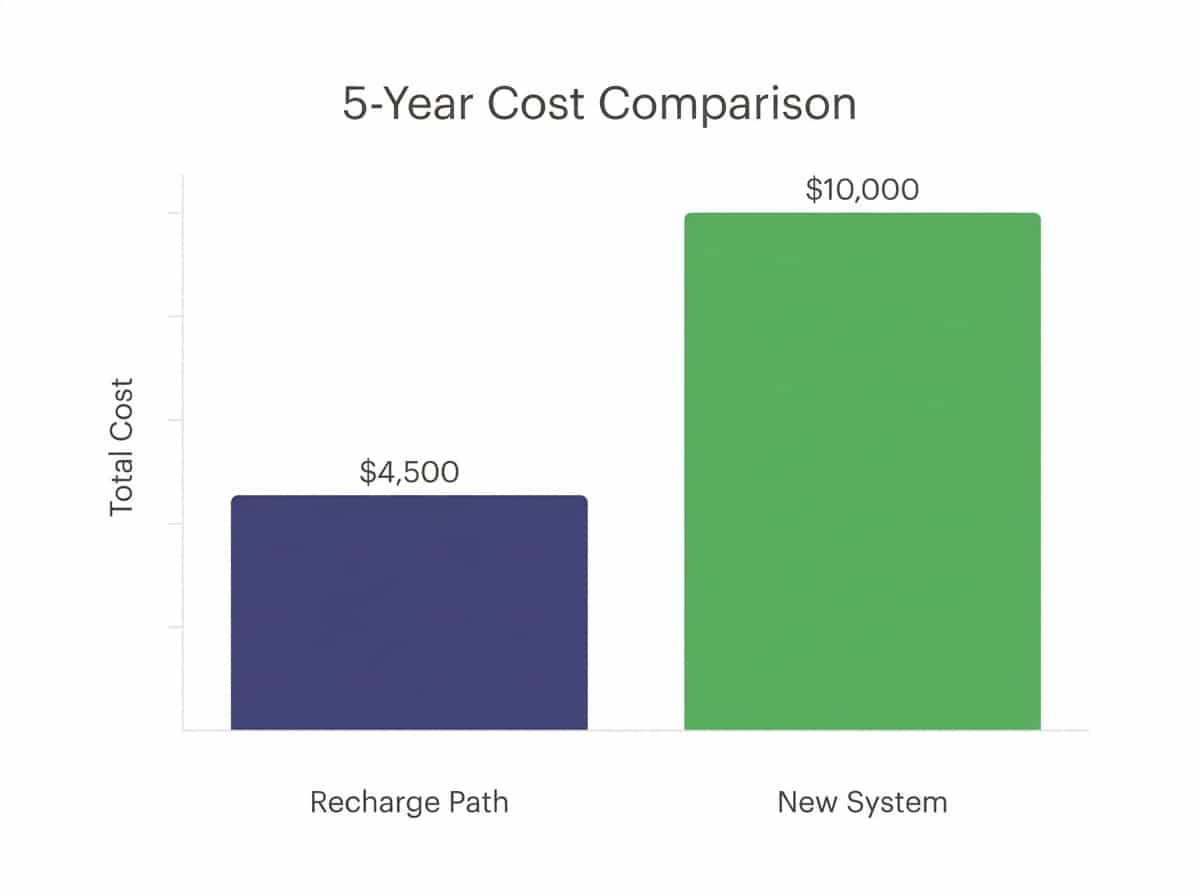
Let’s break down the real economics. Five years ago, a homeowner with a slow leak might recharge once every few summers for $150–$200 and consider it routine maintenance. Today, that same recharge costs $600–$1,200. If you recharge twice in three years, you’ve spent $1,200–$2,400 on a temporary fix while still running an inefficient 15-year-old system that costs $200–$400 more per year in energy bills compared to a modern unit.
Now compare that to replacement. A new R-410A system operates more efficiently and doesn’t harm the ozone layer with a 16+ SEER rating costs $9,000–$15,000 upfront, but it saves 20–40% on cooling costs every summer. Expected lifespan is 15–20 years with proper preventive maintenance. Factor in the energy savings and avoided recharge costs, and most homeowners hit breakeven in 5–8 years.
Refrigerant Recharge vs. System Replacement: The Math
Recharge option: $600–$1,200 per visit. If your system is 15+ years old, you might get one or two more seasons before a compressor or coil fails. Annual operating cost (including higher energy bills from inefficiency) runs $200–$400 more than a modern system. You’re paying twice: once for the recharge, again in wasted electricity.
Replacement option: $9,000–$15,000 upfront for a new R-410A system with 16+ SEER rating. You save 20–40% on cooling costs immediately. Expected lifespan is 15–20 years with annual tune-ups. ROI breakeven typically happens in 5–8 years when you factor energy savings and avoided repeat recharges.
We’ve had customers spend $2,500 over two summers on R-22 recharges, only to replace the system when the compressor finally gave out. If you’re facing a second recharge, it’s usually time to talk replacement.
Three Signs It’s Time to Upgrade (Not Just Recharge)
Deciding between repair and replacement isn’t always obvious, especially when you’re trying to avoid a big expense. Here’s an honest decision framework based on what we see in the field.
1. Your system is 15+ years old. Even if it’s still running, efficiency has degraded 20–30% from day one. Parts are harder to source. You’re one compressor failure away from a forced replacement in the middle of July when demand is high and lead times stretch. An aging R-22 system is like an old car with 200,000 miles on it: you can keep fixing it, but every repair brings you closer to the next breakdown.
2. You’ve recharged refrigerant more than once in the past three years. Recurring refrigerant loss means you have an ongoing leak. Leak detection and repair can cost $500–$1,500 depending on location. If the leak is in the evaporator coil or compressor, repair cost approaches replacement cost. At that point, you’re putting new money into old equipment with no guarantee the next component won’t fail. If your system needs professional AC diagnostics more than once a season, it’s sending you a message.
3. Your energy bills have climbed noticeably. Older R-22 air conditioners typically run at 10–12 SEER. Modern systems hit 16–20 SEER. A 2,000-square-foot home in Gilbert running a 10-SEER system can spend $300–$500 more per summer than a 16-SEER system. That’s real money every year, and it adds up faster than you think.
We’re not saying every old system needs immediate replacement. If your R-22 unit is 12 years old, this is your first recharge, and the leak is small and inexpensive to fix, recharging might buy you two more seasons to budget for a new system. But if you’re 15+ years in, dealing with a second or third recharge, and watching your utility bills climb, replacement is the smarter financial move.
What to Expect During an R-22 System Replacement
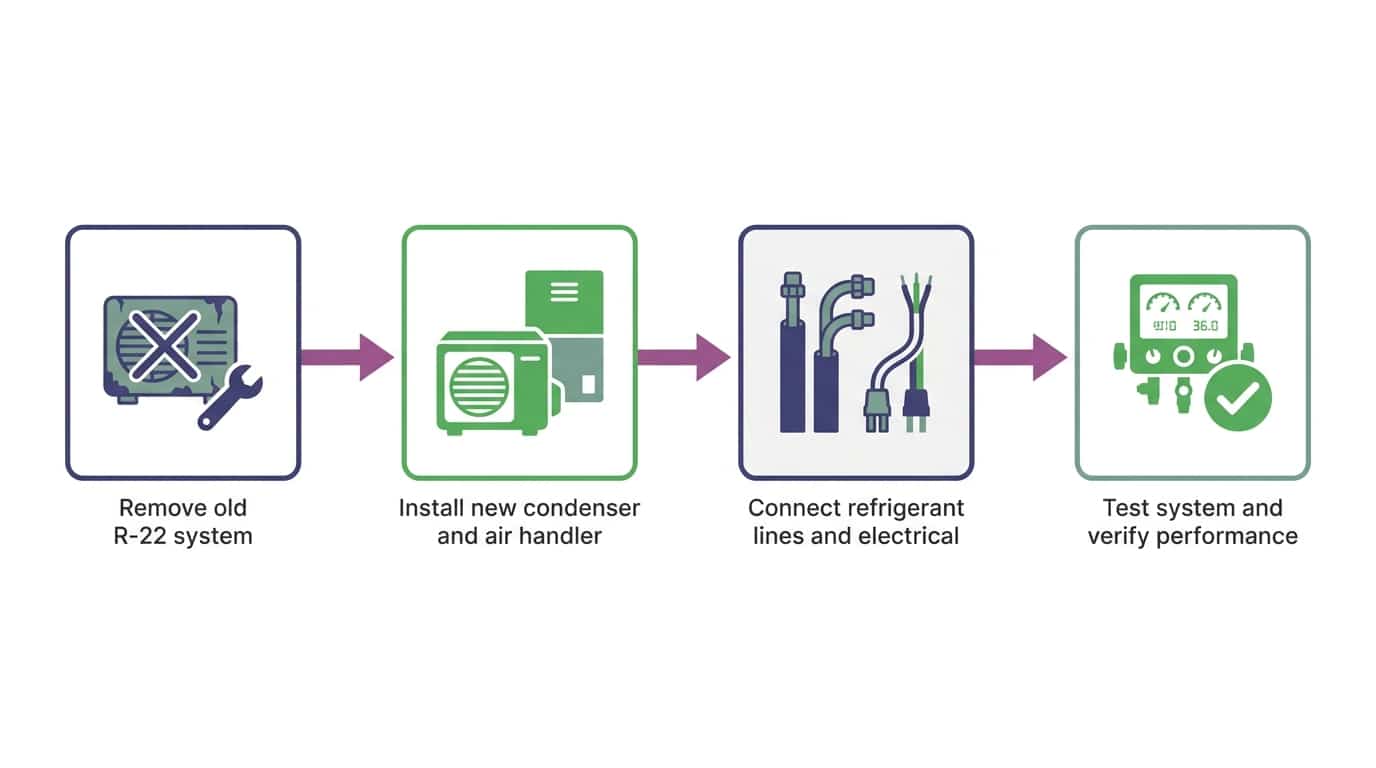
Many homeowners delay replacement because they imagine weeks of disruption, hidden costs, or contractor chaos. The reality is much simpler. Most residential AC installations take one to two days, depending on system size and whether ductwork needs modification. You’ll have cooling back the same day or the next.
Here’s what’s included in a standard replacement: new outdoor condenser unit, new indoor air handler or furnace, refrigerant line sets, electrical connections, thermostat setup (upgrade to programmable or smart thermostat if needed), system testing, and startup. What’s not included: optional ductwork replacement (only necessary if ducts are damaged or severely undersized), whole-home air quality add-ons like UV lights or advanced filtration, and structural modifications if you’re upgrading to a larger system.
Our HVAC installation process starts with a free on-site consultation. We assess your current system, measure your home’s cooling load, inspect ductwork, and discuss your budget and priorities. You get a detailed, written estimate before any work starts. No surprises, no pressure.
Choosing the Right Replacement System
Proper system sizing requires a Manual J load calculation, not the old “one ton per 500 square feet” rule of thumb. Manual J accounts for insulation, window placement, ceiling height, and Arizona’s extreme summer heat. An oversized system short-cycles and wastes energy. An undersized system runs constantly and never catches up.
SEER rating matters, but there’s a point of diminishing returns. A 16-SEER system is the minimum efficiency standard in Arizona and delivers solid savings over older equipment. An 18–20 SEER system saves more but costs $1,500–$3,000 extra upfront. Most East Valley homeowners find the sweet spot at 16–18 SEER.
We install Amana premium systems because they’re reliable, backed by strong warranties, and proven over 3,000+ installations we’ve completed across the East Valley. Bill and the team are on jobs with you, not sitting in an office. You’re talking to the owner, not a call center.
If your home has ductwork issues or you’re adding cooling to a room addition, ductless mini-split installation offers a high-efficiency alternative to central AC. Mini-splits eliminate duct losses and give you zone control, which can save another 15–30% on cooling costs in the right application.
Can You Still Get R-22 Refrigerant? (And Should You?)
Yes, R-22 is still available. The EPA didn’t ban homeowners from purchasing or using it for repairs. What’s banned is production and import of new R-22. The refrigerant on the market today comes from reclaimed and recycled stock, which is why supply is limited and prices keep climbing.
Federal rules allow homeowners to continue repairing and recharging air conditioners that use R-22 as long as refrigerant is available and you’re willing to pay the price. There’s no mandate forcing you to replace a working R-22 system. The economics just make replacement the smarter long-term choice for most people.
When recharging makes sense: your system is under 12 years old, this is your first recharge, the leak is small and inexpensive to fix, and you need one or two more seasons to budget for replacement. Recharging buys you time without throwing good money after bad.
When it doesn’t make sense: your system is 15+ years old, you’re facing a second or third recharge, the leak is in a major component like the compressor or evaporator coil, or you’re tired of rising energy bills and want predictable cooling costs. At that point, every dollar spent on refrigerant is a dollar you won’t get back.
Our advice: if you’re recharging for the second time in three years, it’s time to have the replacement conversation. We’ll give you an honest assessment based on your system’s age, condition, and repair history. If recharging makes sense, we’ll tell you. If it doesn’t, we’ll explain why and show you the math. For more guidance on air conditioning service and troubleshooting, our content library covers the most common repair and replacement scenarios East Valley homeowners face.
What R-410A (and Newer Refrigerants) Mean for Your Next System
R-410A has been the industry standard since 2010. It doesn’t deplete the ozone layer, operates at higher pressure (which improves efficiency), and will remain serviceable for decades. Homeowners sometimes worry that R-410A will be “the next R-22” and get phased out, but that’s not on the horizon. The refrigerant performs well, meets environmental standards, and has broad manufacturer support.
Newer refrigerants like R-32 and R-454B are emerging as alternatives to R-410A as part of the next wave of climate-friendly cooling technology. These alternatives offer slightly better efficiency and lower global warming potential than R-410A. You don’t need to wait for them. R-410A systems installed today will run reliably for 15–20 years, and modern refrigerant options give you flexibility if you ever need service or expansion.
The bigger benefit of upgrading isn’t just the refrigerant. It’s the overall system design. Modern air conditioners run quieter, cool more evenly, and integrate with smart thermostats for better control and scheduling. Warranties are stronger. Parts are widely available. Even new high-efficiency systems benefit from preparing your new AC for Arizona’s extreme summers with annual pre-season tune-ups, but you’re starting with equipment designed to handle 115-degree days without breaking a sweat.
How JLM Helps East Valley Homeowners Navigate the R-22 Phase-Out
We’ve completed over 3,000 system installations across Gilbert, Mesa, Queen Creek, and Apache Junction. We’re family-owned, A+ BBB-rated, and Bill is on jobs with the team. You’re not talking to a call center. You’re talking to the owner who lives in your community and stands behind every install.
Our approach is simple: we provide free on-site consultations to assess your system’s age, refrigerant type, leak status, and energy efficiency. We’ll give you a transparent recommendation. If recharging makes sense, we’ll tell you. If replacement is the smarter move, we’ll show you the numbers and explain your options. No pressure, no upselling.
In 2025 alone, we helped 80+ East Valley families transition from aging R-22 systems to modern, high-efficiency Amana equipment. We stood behind every install with transparent pricing, detailed estimates, and workmanship guarantees. That’s the JLM difference: honest advice, quality work, and direct accountability.
If your AC is running on R-22 and you’re not sure whether to repair or replace, the worst move is waiting until July when temperatures hit 115 degrees and you’re forced into a panic decision. Why Mesa homeowners can’t afford to wait until summer to address AC issues is simple: lead times stretch, availability shrinks, and you lose negotiating power when you’re in crisis mode. Assess your system now while you have time to make an informed choice.
Make the Smart Choice Before Summer Heat Forces Your Hand
The R-22 phase-out is real. It’s not a sales tactic, and it’s not going away. The math heavily favors replacement for systems 15+ years old, but every home and budget is different. Sometimes a recharge buys you valuable time. Sometimes it’s wasted money. The smart move is to get an honest assessment before summer heat forces your hand and turns a planned upgrade into an emergency expense.
If your AC is running R-22 and you’re not sure whether to repair or replace, schedule a free on-site consultation with JLM today. We’ll assess your system, explain your options, and give you a transparent estimate with no pressure and no hidden fees. Call us at 602-619-3609 to get started, or explore our library of HVAC tips and system guides for Arizona homeowners.
By JLM Air Conditioning & Heating