Do UV lights in HVAC systems work? Yes. UV-C lights use short-wavelength ultraviolet radiation to inactivate airborne pathogens (bacteria, viruses, mold spores) as air cycles through your system. Effectiveness depends on exposure time, lamp placement, and system design. UV lights complement filtration but don’t replace it. They deliver the clearest value in humid climates or homes with mold, allergy, or immune concerns.
If you’ve been told UV lights “purify your air” or “eliminate all germs,” you’re probably wondering whether that’s backed by science or just another HVAC upsell. The short answer: UV-C technology is proven, but it’s not a magic fix. Whether it makes sense for your Gilbert or Mesa home depends on your specific air-quality challenges, your existing filtration, and how your system is designed. Why Summer in Mesa Demands Fast AC Repair often surfaces similar concerns. Homeowners want to know what genuinely protects their indoor environment versus what’s just marketing noise.
Here’s what UV-C lights actually do, what they don’t, and when they’re worth the investment.
What UV-C Lights Are and How They Work in HVAC Systems
UV-C lights emit ultraviolet radiation in the 200 to 280 nanometer wavelength range. That’s the germicidal band: short enough to penetrate the cell walls of bacteria, viruses, and mold spores and disrupt their DNA or RNA, rendering them unable to reproduce or cause infection.
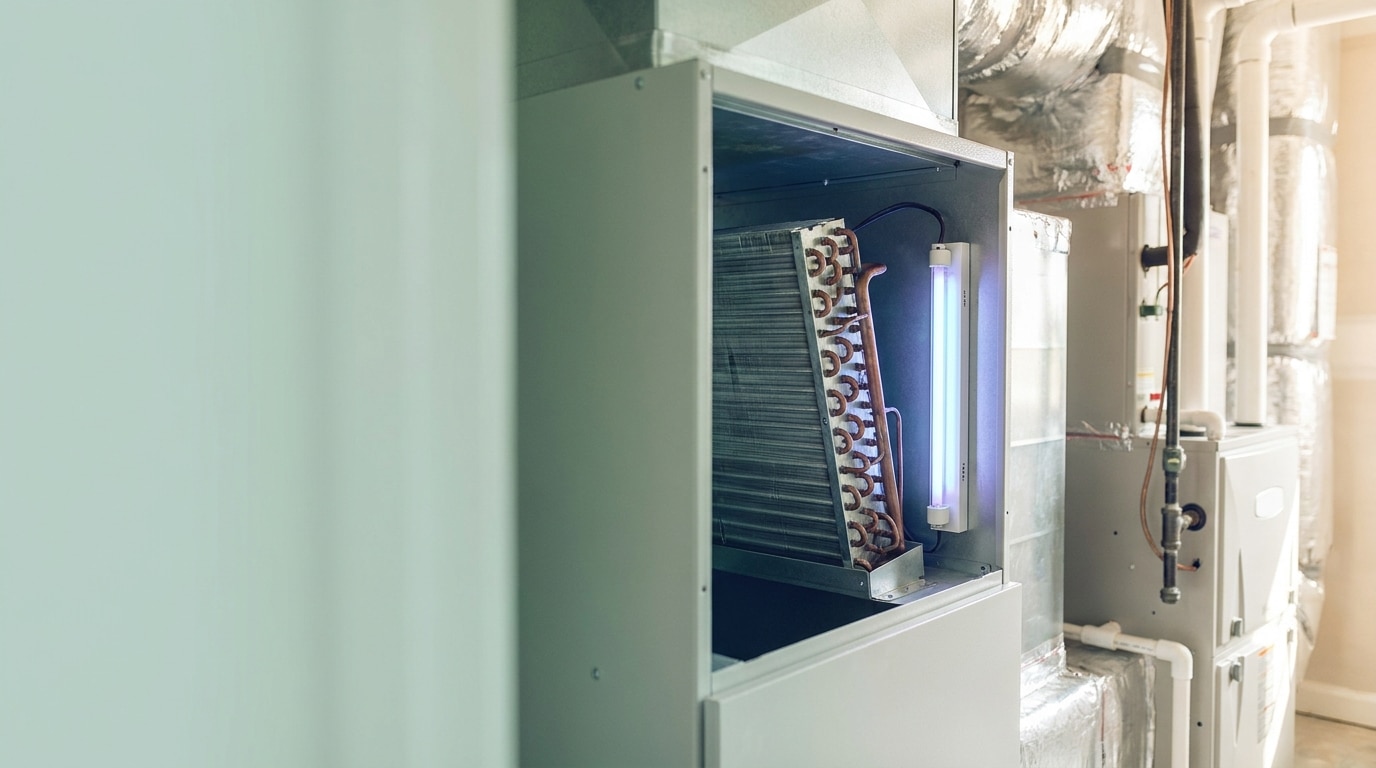
In HVAC systems, a UV-C lamp sits inside your air handler or ductwork. As air circulates through your system, it passes the lamp. Pathogens in that airstream are exposed to UV-C radiation. If exposure time is sufficient (typically a fraction of a second to a few seconds, depending on lamp strength and airflow speed), the pathogens are inactivated.
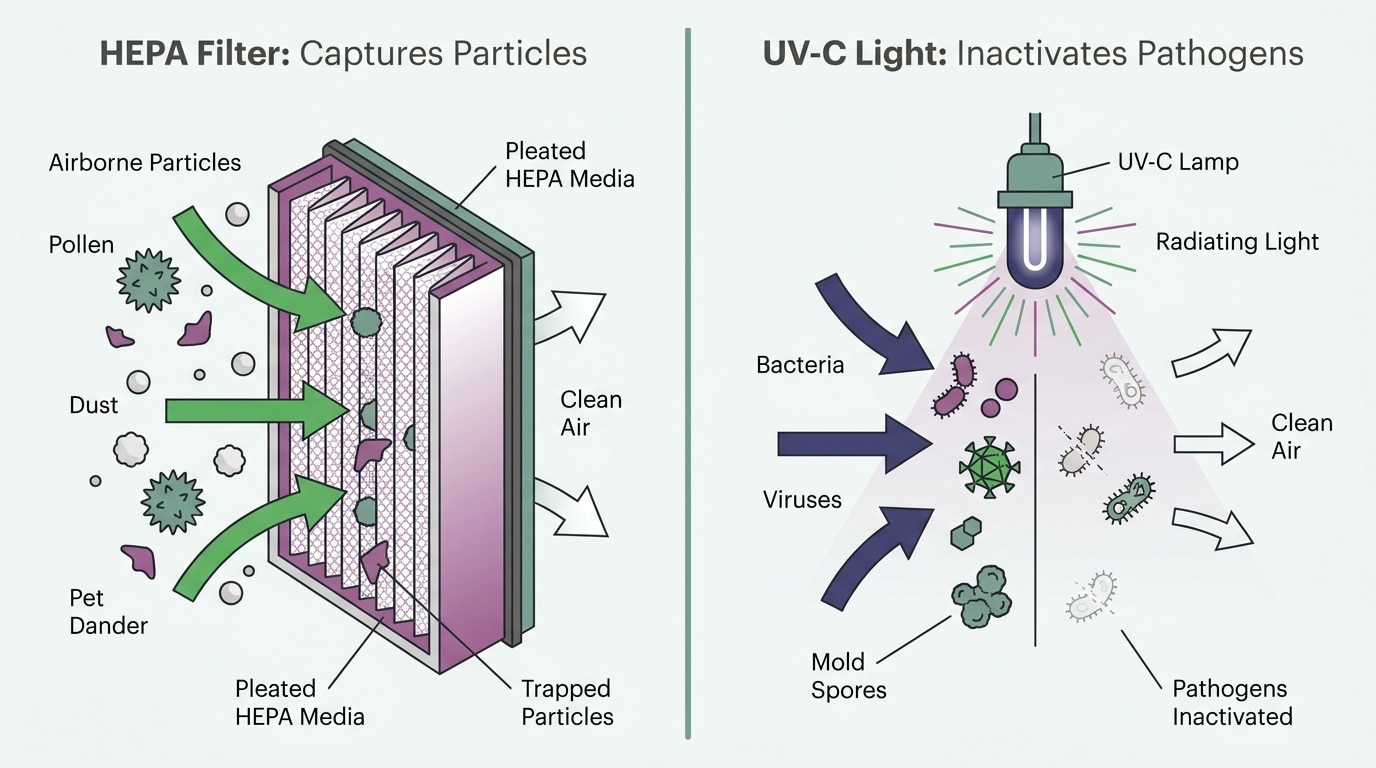
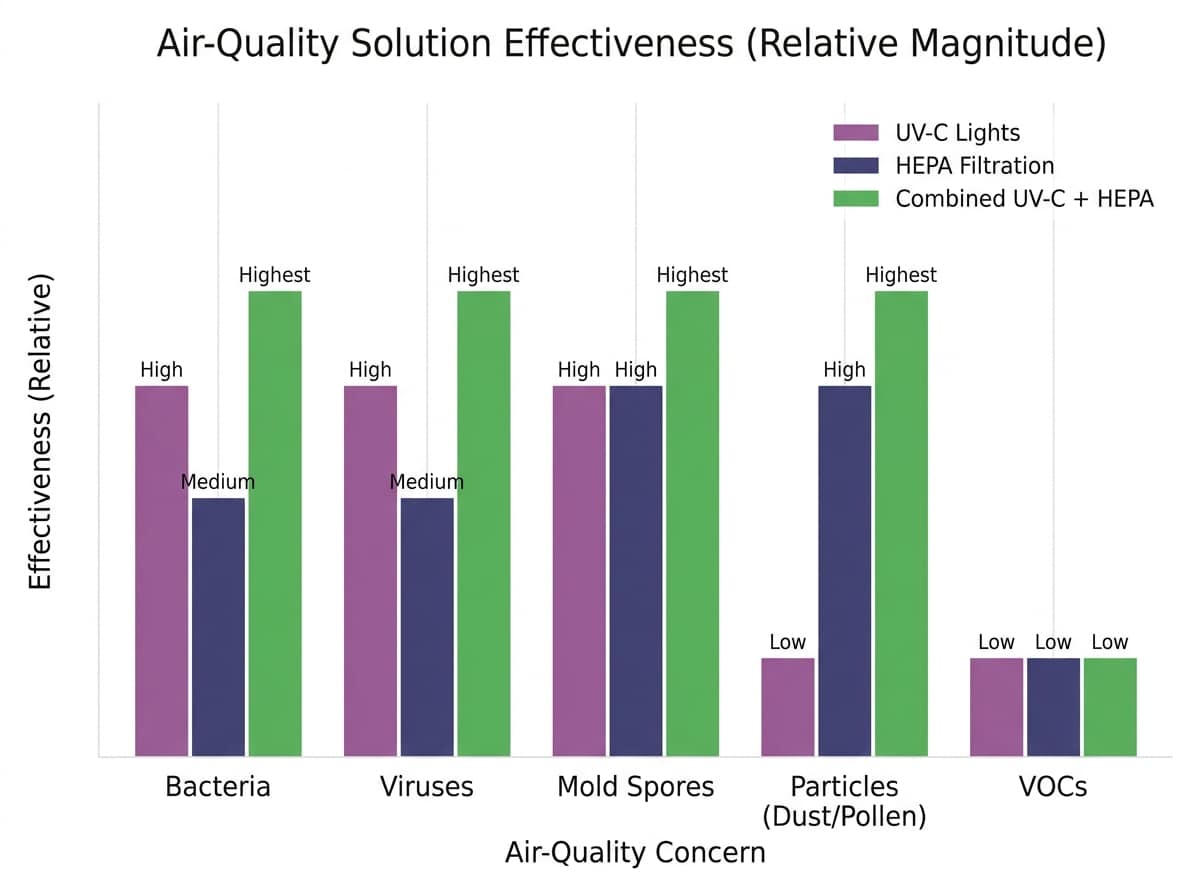
UV-C doesn’t filter or capture anything. It kills living organisms. Dust, pollen, and pet dander pass right through. Volatile organic compounds (VOCs) and odors aren’t affected. That’s why UV lights work best when paired with mechanical filtration (MERV-rated filters or HEPA) that captures particulates, and proper ventilation that exhausts stale air. For more insights on maintaining indoor air quality year-round, see our Blog | HVAC Tips & Updates for Gilbert, AZ Residents.
The CDC’s air cleanliness guidelines recognize UV-C as one component of a multi-layered indoor air quality strategy. It’s not a substitute for filtration or ventilation, but it adds a germicidal layer that mechanical systems alone can’t provide.
Coil-Sterilization vs. Air-Sterilization: Two Types of UV Systems
There are two common UV-C configurations in residential HVAC, and they solve different problems.
Coil-mounted UV lights sit near your evaporator coil (the cold metal fins inside your air handler where refrigerant absorbs heat). These lamps run continuously, bathing the coil surface in UV-C radiation. The goal isn’t to treat the airstream. It’s to prevent mold and biofilm growth on the coil itself. Coils are dark, damp, and cool: ideal conditions for mold. A coil-mounted UV lamp keeps the surface sterile, which improves heat-transfer efficiency and reduces the musty smell that comes from a dirty coil. If you’re dealing with chronic coil mold (common in the East Valley during monsoon season), this is the configuration that makes sense. Learn more about maintaining cooling efficiency in our Air Conditioning | AC Technician Near Me section.
In-duct air-sterilization UV lights sit in the return or supply duct, where moving air passes directly under the lamp. These systems target airborne pathogens in real time: bacteria, viruses, mold spores circulating through your home. Effectiveness depends on how long each particle is exposed to UV-C (a function of airflow speed and lamp intensity). In-duct UV is the configuration to consider if you’re focused on reducing microbial load in the breathing air, not just keeping your coil clean.
Some systems use both: a coil lamp for maintenance and an in-duct lamp for air treatment. Your HVAC contractor should recommend the configuration that matches your specific air-quality goals.
The Science: What UV-C Lights Actually Kill (and What They Don’t)
UV-C radiation is proven effective against a wide range of airborne pathogens. CDC guidance on germicidal UV effectiveness confirms that UV-C inactivates bacteria (including Staphylococcus and Streptococcus), viruses (including influenza and coronaviruses), and mold spores (including Aspergillus and Penicillium) when exposure dose is sufficient.
A peer-reviewed study on UV-C pathogen inactivation demonstrated that specific pathogens have different sensitivities. Bacteria tend to be more UV-resistant than viruses; some mold spores require higher doses than others. In a residential HVAC system, that means a UV lamp with the right intensity, correctly positioned in the airstream, will reduce microbial counts. But it won’t eliminate 100% of pathogens on a single pass, and it won’t touch anything that isn’t a living organism.
Here’s what UV-C does not address:
- Particulates. Dust, pollen, pet dander, and other allergens aren’t alive. UV-C has no effect. You still need a MERV-rated or HEPA filter to capture those.
- VOCs and odors. Cooking smells, cleaning-product fumes, off-gassing from furniture: UV-C doesn’t break down chemical compounds. You need activated carbon filtration or proper ventilation for that.
- Mold that’s already growing on surfaces. UV-C prevents new mold growth on coils and duct interiors, but it doesn’t clean existing contamination. If you have visible mold, you need professional remediation first.
The AIHA’s fact sheet on germicidal irradiation emphasizes that UV-C is most effective in controlled environments where exposure time can be optimized. In a fast-moving HVAC airstream, that means lamp placement and system airflow matter as much as the lamp itself.
UV Lights vs. HEPA Filters and Other Air-Quality Upgrades
UV-C lights and HEPA filters are often compared, but they do different jobs. A HEPA filter captures 99.97% of particles 0.3 microns or larger (dust, pollen, mold spores, bacteria, even some viruses). It physically traps them. UV-C kills living organisms but doesn’t capture anything. An airborne virus might pass through a UV lamp and be inactivated, but if it’s embedded in a dust particle that the filter would have caught, the UV lamp alone won’t help.
EPA’s technical guidance on HVAC UVGI makes this clear: UV lights don’t replace filtration. They complement it. The best residential air-quality systems layer multiple technologies. High-efficiency filtration (MERV 13 or higher, or true HEPA) captures particles. UV-C kills pathogens that pass through or grow on system surfaces. Proper ventilation (fresh-air intake, exhaust fans) dilutes indoor pollutants and reduces humidity.
ASHRAE’s technical guidance on filtration and UVGI recommends evaluating your entire HVAC system before adding UV. If your ductwork leaks, your coil is clogged, or your filter is undersized, fix those first. UV won’t solve poor airflow or humidity problems. If your system is already running efficiently and you want an extra germicidal layer (for allergy relief, mold prevention, or pathogen reduction), then UV makes sense. For context on how different HVAC configurations affect air quality, check out How Mini Split Installation Works.
Electronic air cleaners (ionizers, plasma filters) are another option, but many produce trace ozone as a byproduct. UV-C doesn’t. Whole-home dehumidifiers reduce moisture (one of the root causes of mold) and pair well with UV coil lights to keep your evaporator clean.
In our work with East Valley homeowners, we’ve seen UV-C installations deliver the clearest benefit in homes with recurrent mold on evaporator coils, particularly in Queen Creek and Apache Junction, where monsoon humidity lingers in ductwork. For families with asthma or seasonal allergies, UV lights reduce microbial load, but pairing them with high-MERV filtration and regular coil cleaning delivers better overall results.
When UV Lights Make Sense for Your Gilbert or Mesa Home
UV-C lights deliver the clearest benefit in specific scenarios. Here’s when they’re worth considering:
You have visible mold on your evaporator coil. If your HVAC tech has shown you black or green growth on the coil fins, a coil-mounted UV lamp will keep it from coming back. Monsoon humidity in the East Valley (especially in Gilbert, Queen Creek, and Apache Junction) creates perfect conditions for coil mold. A UV lamp runs 24/7, sterilizing the surface so mold spores can’t take hold.
Someone in your home has asthma, allergies, or a compromised immune system. UV-C reduces airborne bacterial and viral load, which can help minimize respiratory triggers. It’s not a cure, but it’s one more layer of protection. Pair it with high-MERV filtration and regular duct cleaning for the best results. For professional guidance on comprehensive system care in the East Valley, see our HVAC Services in the East Valley, AZ.
Your home is humid year-round. High indoor humidity (above 60% relative humidity) accelerates mold growth on coils and in ductwork. If you don’t have a whole-home dehumidifier and your AC runs frequently, a UV lamp helps manage microbial growth in the system.
You’ve optimized filtration and still have air-quality concerns. If you’re already using MERV 13+ filters, sealing duct leaks, and maintaining your system regularly, and you still want better pathogen control, UV-C is the logical next step.
UV lights are less critical in dry, well-ventilated homes with good filtration and no recurring mold issues. If your biggest air-quality problem is dust or pollen, upgrade your filter first. If you’re dealing with odors, invest in activated carbon filtration or better kitchen/bathroom exhaust. UV won’t solve those problems.
CDC’s ventilation and indoor air quality recommendations emphasize a layered approach: source control (reducing pollutants at the source), filtration (capturing particles), and disinfection (killing pathogens). UV-C is the disinfection layer. It works best when the other two are already in place.
Installation, Maintenance, and Cost: What to Expect
UV-C lamp installation is straightforward. A licensed HVAC technician mounts the lamp inside your air handler (for coil sterilization) or in the supply or return duct (for air sterilization). The lamp plugs into a dedicated power supply, which is wired into your HVAC system or a nearby outlet. The entire process takes one to two hours.
Cost: Expect to pay $500 to $1,200 for a residential UV-C system, including the lamp, mounting hardware, power supply, and labor. Coil-mounted lamps tend to be on the lower end of that range (simpler installation, smaller lamp). In-duct air-sterilization systems cost more because they require larger lamps and more precise placement to maximize exposure time. For comparison, see our Air Conditioning Maintenance pricing.
Annual maintenance: UV-C lamps lose output over time. Most residential lamps are rated for 9,000 to 12,000 hours (about one year of continuous operation). After that, the lamp still glows, but UV-C output drops below the effective threshold. You need to replace the bulb annually, even if it looks fine. Replacement bulbs cost $50 to $150 depending on the model. Your HVAC contractor can swap the bulb during your annual tune-up.
Energy use: UV lamps draw 15 to 40 watts, about the same as a CFL light bulb. Running continuously, that’s roughly $2 to $5 per month in electricity. There’s no noticeable impact on your utility bill.
Safety: UV-C radiation is harmful to eyes and skin. That’s why the lamp is installed inside your ductwork or air handler, where it’s fully enclosed. Never look directly at an operating UV lamp or bypass the safety interlocks on your air handler. Professional installation ensures the lamp is positioned safely and complies with manufacturer guidelines.
DIY UV kits are available online, but improper installation voids your HVAC warranty and creates safety risks. Placement matters. Too far from the coil or airstream, and the lamp is ineffective. Too close, and you risk damaging plastic drain pans or wiring harnesses. A qualified technician knows where to mount the lamp, how to wire the power supply, and how to verify the lamp is working correctly.
Common Myths and Marketing Claims to Ignore
UV-C is proven technology, but it’s also easy to oversell. Here are the claims to ignore:
“UV lights eliminate 99.9% of airborne pathogens.” That’s misleading. UV-C can inactivate a high percentage of pathogens under ideal lab conditions (controlled exposure time, specific lamp intensity, no airflow turbulence). In a real HVAC system, airflow speed, lamp placement, and system design all affect results. A well-installed UV lamp significantly reduces microbial load, but it won’t eliminate every pathogen on every pass. The claim is technically possible in theory, practically overstated in most residential applications.
“You’ll never need to clean your coils again.” False. UV lamps prevent mold and biofilm growth on coils, but they don’t stop dust, pollen, and dirt from accumulating on the fins. Those particulates block airflow and reduce heat transfer, which hurts efficiency. You still need to schedule periodic coil cleaning (every one to three years depending on your environment) to maintain peak performance.
“UV lights improve HVAC efficiency by 30%.” Unsubstantiated. A UV coil lamp can help maintain efficiency by preventing mold buildup that would otherwise insulate the coil and reduce heat transfer. That’s an indirect benefit. The efficiency gain depends on how dirty your coil would have gotten without the lamp, which varies by home. Clean coils (with or without UV) improve efficiency. A UV lamp alone, without addressing airflow restrictions, duct leaks, or refrigerant charge, won’t deliver a 30% boost. The real value is prevention, not a dramatic performance jump.
“UV lights make filters unnecessary.” Absolutely not. UV kills living organisms. It doesn’t capture dust, pollen, pet dander, or any other particulate. If you remove your filter because you installed a UV lamp, you’re allowing dust to coat your coil, blower, and ductwork. Your system will run less efficiently, and the UV lamp will do nothing to stop it. Always run a filter (at least MERV 8, ideally MERV 13 or higher) alongside UV.
The best HVAC contractors are honest about what UV lights do well and what they don’t. If a sales pitch sounds too good to be true (instant allergy relief, zero maintenance, dramatic energy savings), it probably is. If you’re concerned about professional credibility, see Do You Really Need Professional AC Repair in Mesa? for context on how to evaluate HVAC recommendations.
How to Decide if UV Lights Are Right for Your Home
Use this checklist to evaluate whether UV-C makes sense for you:
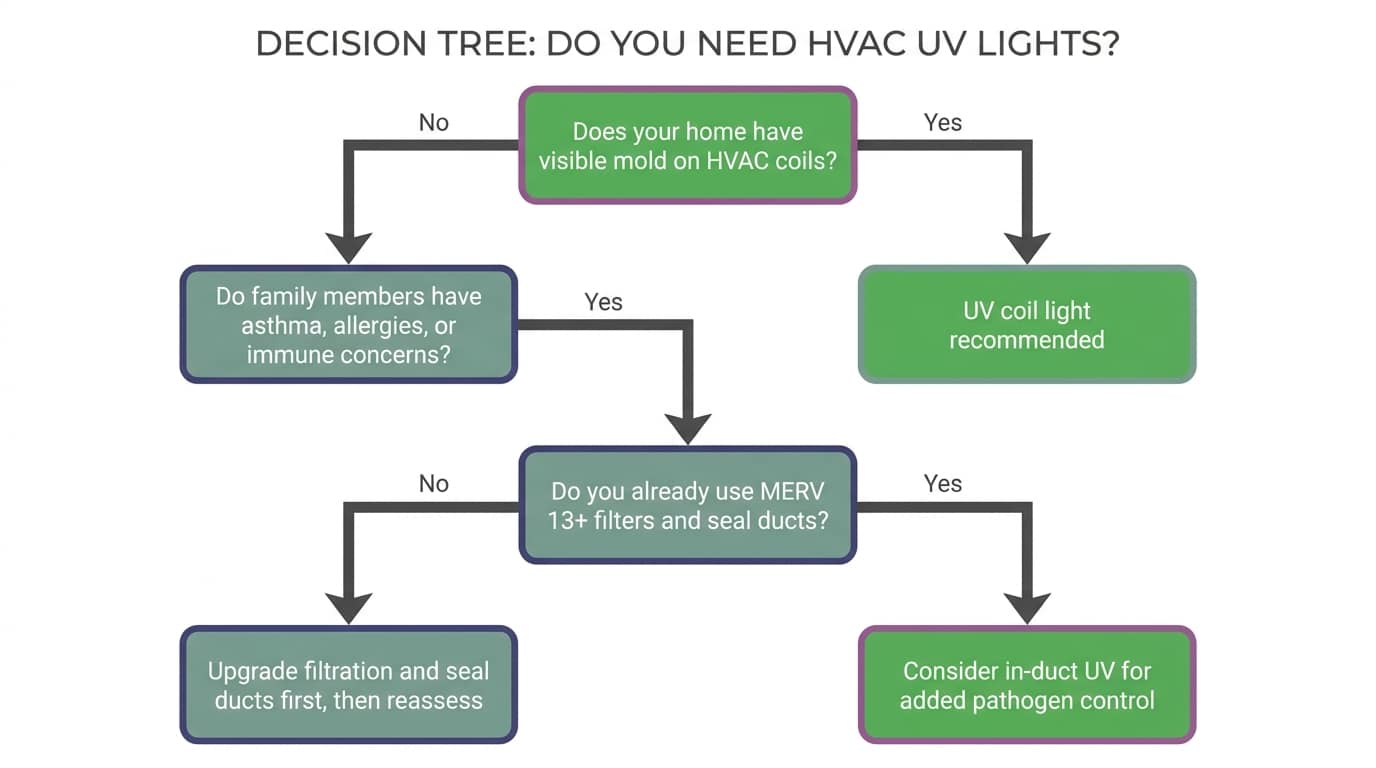
Do you have visible mold on your evaporator coil? If yes, a coil-mounted UV lamp will prevent it from returning. If no, move to the next question.
Do family members have asthma, allergies, or compromised immune systems? If yes, reducing airborne bacterial and viral load can help. Pair UV with high-efficiency filtration for the best results. If no, move to the next question.
Is your home humid year-round (relative humidity consistently above 50%)? If yes, UV helps manage microbial growth in your HVAC system. If no, mold is less likely to be a problem. For additional options addressing small-space cooling and humidity control, consider our guide on Garage AC Options That Don’t Overwhelm Small Spaces.
Have you already optimized your filtration and duct sealing? If yes, UV is the logical next step for pathogen control. If no, prioritize those upgrades first. They’ll deliver bigger air-quality and efficiency gains than UV alone.
Are you looking to reduce maintenance frequency on your coils? If yes, a UV coil lamp can extend the time between professional cleanings. If coil maintenance isn’t a recurring issue, this benefit may not justify the cost.
If you answered yes to two or more of the above, UV lights are worth a consultation. If you answered no to most, you’ll get better results by upgrading your filter, sealing duct leaks, or installing a whole-home dehumidifier. For seasonal planning guidance, see our article on Spring Smart for AC Tune-Ups.
During a free JLM consultation, we assess your indoor air quality, inspect coils for mold, and review your current filtration. If UV-C makes sense for your home, we’ll explain where the lamp goes and what results you can expect. If it doesn’t, we’ll recommend what will (whether that’s upgrading to MERV 13 filters, sealing duct leaks, or scheduling a deep coil cleaning). No upsells, no hidden fees. For homes exploring mini split systems, we also offer detailed guidance on Mini Split Installation in Gilbert AZ: What to Know First.
For a broader understanding of your HVAC options and seasonal maintenance needs, explore our HVAC System | AC Technician Near Me resources.
Conclusion
UV-C lights work. They inactivate airborne pathogens, prevent mold growth on coils, and add a germicidal layer that filtration alone can’t provide. But they’re not a cure-all. UV lights are most valuable in homes with mold issues, high humidity, or family members with respiratory sensitivities. They work best when paired with high-efficiency filtration, proper ventilation, and regular HVAC maintenance.
If your coil stays clean, your filters are high-quality, and your air-quality concerns are minimal, UV lights may not be worth the investment. But if you’re battling monsoon-driven mold in the East Valley, dealing with recurring allergy symptoms, or looking for an extra layer of protection, UV-C is a proven, science-backed upgrade.
Want to know if UV-C lights are right for your Gilbert or Mesa home? Call JLM at 602-619-3609 or schedule your free air-quality consultation online. We’ll inspect your system, assess your indoor air quality, and recommend the upgrades that actually fit your needs. Bill and the team live in the East Valley and understand the air-quality challenges you’re facing.
By JLM