Searching BBB rating HVAC trustworthiness usually means one thing. The AC just died, or a big quote just landed, and every contractor says “trust us.”
A BBB rating is a snapshot of how a contractor handles customer complaints and business practices. An A+ suggests problems are rare and get resolved, which makes it a useful first filter. It does not prove good workmanship. Pair it with a verified license, proof of insurance and bond, written estimates, and reviews that describe real jobs.
Here is our stance. A rating is a receipt for past behavior. It is not a promise about your job. JLM holds an A+ BBB rating, and we are proud of it. We still want you to check us the way you would check anyone. This guide shows how, starting with the gap between an owner-led shop and a company with a call center in the middle. If that gap matters to you, see how a local shop compares with a large franchise.
Can a BBB rating show HVAC trustworthiness?
It tells you part of the story. A BBB rating reflects how a company handles complaints and runs its business. That is a real signal of accountability. It is not proof of good workmanship, so treat it as one check among several. BBB rating HVAC trustworthiness is about accountability, not about the quality of the install.
The objection is fair: “A badge is just marketing. Anyone can put a logo on a website.” A logo alone proves little. Many contractor directories call their members “trustworthy” and never say how they checked. Trust needs a method, and a rating is only one piece of it.
We use a simple method, the trust stack. It has four steps:
- Verify. Check the rating and the credentials yourself, at the source.
- Read. Study the reviews for patterns, not star counts.
- Ask. Find out how they quote and who answers when you call.
- Watch. Notice how they behave before you hire them.
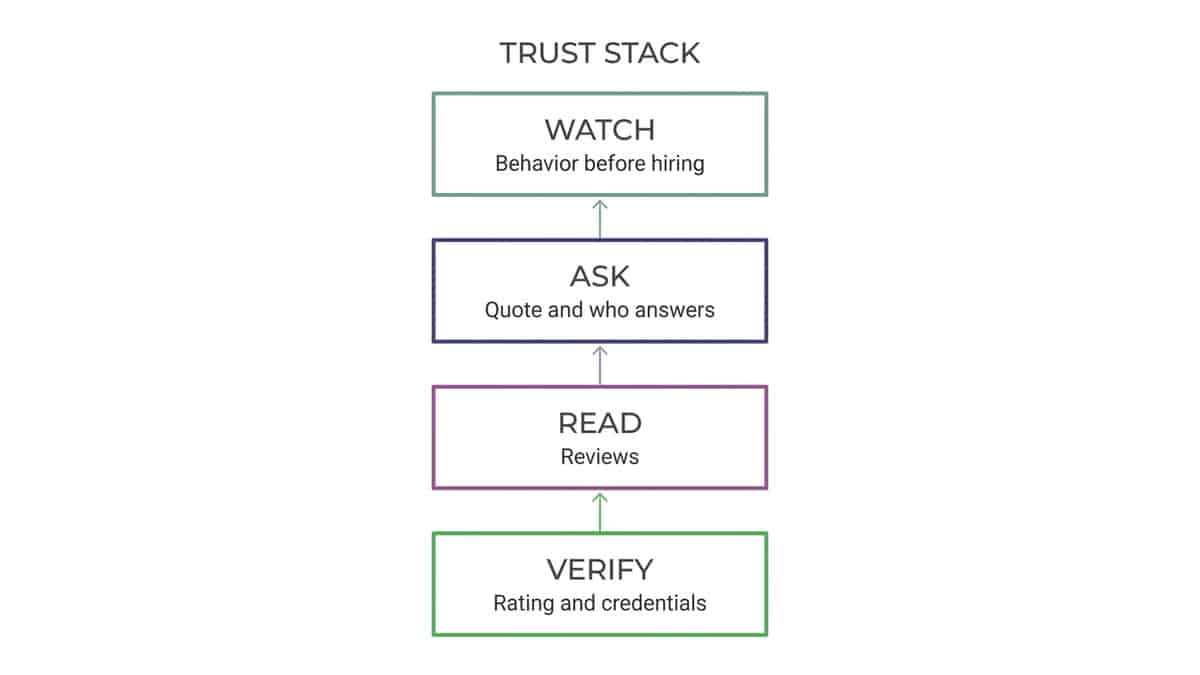
The “Ask” step is where we put our own work on the line. At JLM, every estimate is given on-site, in writing, before work begins. If a company will not do that, no letter grade should settle your nerves. Our own A+ BBB rating explainer covers the plain-English basics. This article is about what to do next.
A rating helps you decide who to call, and the other three steps help you decide who to hire.
What does an A+ BBB rating mean?
An A+ is the top letter grade. It points to a company with a clean record on customer complaints and a habit of resolving problems when they come up. It is earned over time, which is why it is harder to fake than a logo.
If you search “A+ rating what it means,” you will find plenty of definitions. Here is the short version. The rating describes behavior: how a business treats customers when something goes wrong, and how it conducts itself day to day. It does not describe how well a system was sized, installed or sealed. When you weigh BBB rating HVAC trustworthiness, an A+ is the strongest letter to see, and it is still only a description of behavior.
Two cautions help you read it honestly:
- A rating is not the same as paid membership or accreditation. They are separate things, so do not let a badge on a website stand in for the real record.
- Look at the actual BBB profile. Read the complaint history and see how the company responded. A profile tells you far more than a logo.
For JLM, the A+ did not come from a marketing plan. After more than 3,000 system installs, our business runs on referrals and repeat customers, not franchise fees and corporate advertising. Referrals only keep coming when the last job went well and the last problem got fixed. That is the habit the rating reflects.
We lay out why homeowners pick an owner-led company in why East Valley homeowners choose JLM. Read it, then hold us to it.
An A+ is a useful first filter because it is earned slowly, but it is still a filter and not a verdict.
What can’t a BBB rating tell you?
It cannot tell you how well a system was sized, installed or sealed. It cannot tell you who answers your call, how a quote was built, or whether the recommendation fit your home. You check those separately. This is where BBB rating HVAC trustworthiness runs out, and your own checking has to take over.
A letter grade also cannot show whether a recommendation was shaped by what is best for your house or what is best for the seller’s margin. That last one deserves a closer look.
Franchise and local companies buy from the same manufacturers (Amana, Carrier, Trane, Lennox). They follow the same building codes and the same ACCA installation standards. Access to good equipment is not the difference. The difference is how financial incentives shape what gets recommended. Some companies push proprietary financing, in-house warranty programs or exclusive equipment bundles that maximize margin. A homeowner comparing quotes should ask why a specific package is being pitched.
The structure behind the company matters too. Franchise HVAC companies tend to optimize for transaction volume across a wide footprint. Technicians rotate territories, customer service staff turn over, and the franchise itself may change hands. Your relationship is with a brand, not a person. That can work fine for a one-off repair. It limits continuity if you want someone to remember your system in five years.
A local shop makes a trade. It lacks a franchise’s marketing budget and has no corporate parent to guarantee continuity if the owner retires. In return you get flexibility, accountability and a cost structure without franchise fees. When something goes wrong, you talk to the decision-maker, who has a personal reputation at stake in your neighborhood. We name no competitors here, because the point is the structure, not the brand.
Quotes are where the incentive question shows up first, so read how to spot dishonest pricing and hidden fees before you sign anything.
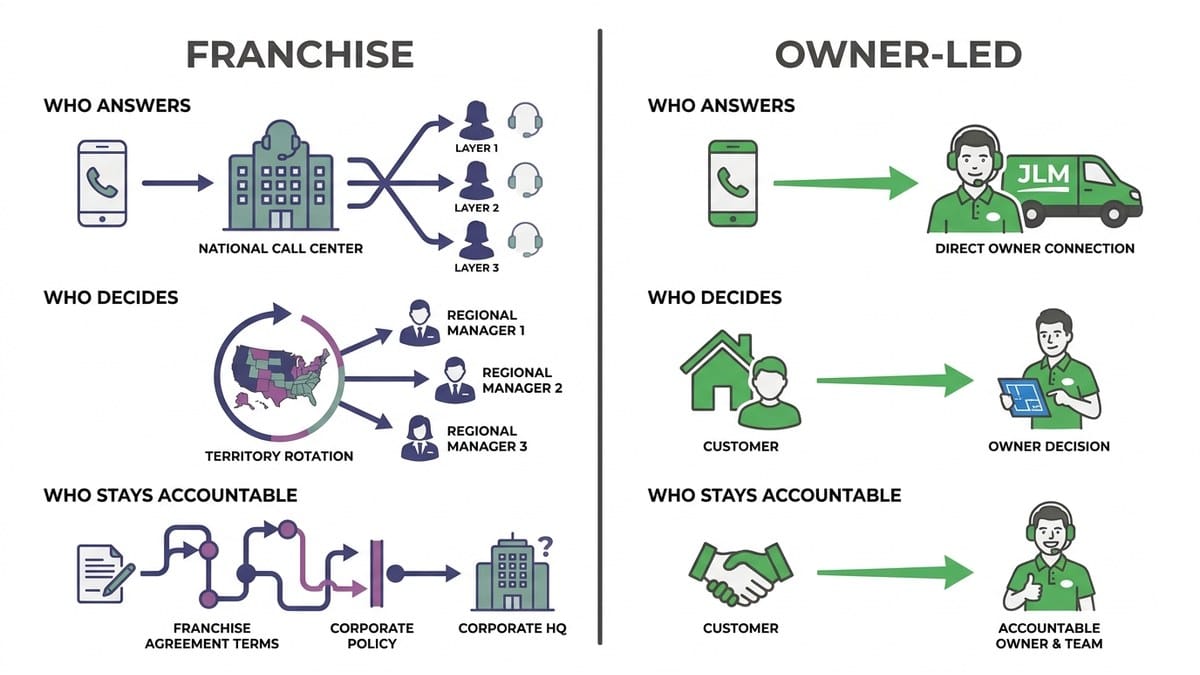
A rating shows how a company treats problems, and you have to check for yourself how it treats your house.
What should licensed bonded insured HVAC mean?
Licensed means the state recognizes the contractor to do the work. Insured protects your home if something is damaged. Bonded gives you a path to recourse if the job goes wrong. Ask for proof of each and verify it yourself. BBB rating HVAC trustworthiness is only as strong as the license and insurance standing behind it.
The key word is verify. A contractor saying “yes, we’re covered” is a claim. A document you can confirm with the issuing source is proof. You do not need to be an expert to do this. You just need to ask and follow through.
Use this short checklist before you hire anyone:
- Ask for the license. Get the license number and classification, then confirm them with the state licensing authority.
- Ask for proof of insurance. Request a current certificate, and confirm it with the insurer if anything looks off.
- Ask about the bond. Find out what it is and who issued it.
- Match the paperwork to the name. The company on the license should be the company on the quote.
A few answers should slow you down:
- A vague pitch like “we’ll install a high-efficiency system,” with no specifics.
- Pressure to decide today.
- A suspiciously short timeline, such as a same-day install for a full system replacement.
- No clear answer to “who inspects the finished work?”
Any one of these can signal corners getting cut. Our guide on how to find a trustworthy, licensed HVAC contractor walks through the same steps in more detail.
At JLM, Bill, the owner, is licensed and on jobs regularly. Ask us the same questions you would ask anyone else. We would rather you check than guess.
Paperwork you verified yourself is worth more than any badge you were shown.
How do you read contractor reviews safely?
Look for patterns, not stars. Trust reviews that name the job, the technician and what went wrong or right. Read the lower ratings and the owner’s replies. A steady spread of detailed reviews beats a burst of generic praise.
Contractor reviews trust works like a rating does: it is a record of past behavior. The question is whether the record is real and relevant to you. Reviews are the second half of any serious look at BBB rating HVAC trustworthiness, because they fill in the workmanship the letter grade leaves out. Here is a practical way to read them.
Favor detail over volume. “Great service, highly recommend” tells you nothing. “They replaced our blower motor, explained the cost before starting, and the tech texted when he was on the way” tells you plenty.
Read the complaints first. Every business has a few unhappy customers. What matters is the kind of complaint, and whether it is about price surprises, missed appointments or poor follow-up. Then read how the owner responded. A calm, specific reply that offers to fix things says more than a perfect score.
Match the review to your job. A glowing review for a thermostat swap does not tell you how a company handles a full system replacement. Look for reviews close to the work you need.
Watch the timing. A steady trickle over months looks different from a sudden flood of near-identical praise.
Reviews matter even more for a local shop. A local company lacks a franchise’s marketing budget, so customers unfamiliar with the owner rely on reviews and word of mouth instead of brand recognition. That makes a long pattern of detailed reviews the most telling signal you have.
For a broader checklist, read the red flags and green lights of a good contractor.
Read reviews like a detective, and let the details decide, not the star count.
What does JLM’s A+ rating look like?
At JLM, it shows up as written on-site estimates before work starts, no surprise charges at completion, and direct access to Bill, the licensed owner, when something needs fixing. Across more than 3,000 installs, that is the standard the rating reflects.
We would rather show you than brag. Here is what that looks like day to day:
- Written estimates, on-site, before work begins. You see the price before anyone picks up a tool.
- No hidden fees. What is on the estimate is what you pay.
- Direct access to the owner. If you have a concern, you reach Bill. He is on jobs regularly and personally accountable for making things right. That kind of access is uncommon in an industry where corporate call centers often sit between the customer and the decision-maker.
- A referral-driven business. Most of our growth comes from neighbors telling neighbors. Referrals are earned one job at a time, and they are the habit behind our rating, not the other way around.
- Premium equipment. We install from manufacturers like Amana, and we explain what is needed and what is optional.
The standard is the same for a family in Gilbert and for a commercial property in Mesa. We serve residential and commercial customers across the East Valley, and you can see everything we do on our HVAC services for residential and commercial customers page. Beyond repair and installation, we also handle thermostat wiring, ductwork cleaning and indoor air quality testing. If a replacement is on your mind, financing options exist, and we are glad to talk through them.
We start with a free consultation. It is a low-pressure way to test everything in this article: ask for the estimate in writing, ask about credentials, and see who answers.
That standard is a habit, not a slogan, and the A+ is simply what that habit looks like on paper.
Use the A+ first, then check everything
Go back to the stance. A rating is a receipt for past behavior. Use the A+ as your first filter, then run the trust stack on anyone, JLM included. BBB rating HVAC trustworthiness is where your search starts, not where it ends.
Verify the rating and the credentials at the source. Read the reviews for patterns. Ask how the quote is built and who picks up the phone. Watch how the company behaves before you hire it. A contractor who welcomes all four steps is telling you something. One who dodges them is telling you something too.
Nobody can promise perfect service, and we will not. What we can promise is that you will know the price before work begins, and that you can reach the person who owns the business. If you want a sense of how we handle everything from a failed AC to a full install, see our heating and air conditioning services across the East Valley.
Test us the same way you would test anyone else. Start with a free consultation, bring your questions, and judge for yourself.