
What are the Arizona AC rebates tax credits 2026 homeowners can still use? In 2026, Arizona homeowners can still lower AC replacement costs with utility rebates from providers like APS and SRP, which pay for qualifying high-efficiency systems. The federal tax credit for HVAC was set for systems installed through 2025, so check your install date and talk to a tax pro. Rebate rules change, so confirm before you buy.
You have a replacement quote in your hand, and the number is bigger than you hoped. Naturally, you wonder whether any legitimate help exists. Maybe a neighbor mentioned “free money” for efficient systems. Maybe you saw an old article that promised a big tax credit.
Here is the honest picture. Some of that help is real. Some of it has changed. And a lot of what you will read online is out of date. Program amounts and deadlines shift, so we are not going to hand you a list of figures that goes stale by spring. Instead, we will show you how to check what applies to your address and your install date. We will also show you how to combine rebates, a payment plan and lower monthly bills. If cost is your main worry, our guide to AC installation financing options in Arizona pairs well with this one.
What AC rebates and tax credits are available in Arizona in 2026?
The most dependable help in 2026 comes from your electric utility. APS and SRP have offered rebates for qualifying high-efficiency AC systems, and the programs change by year. Federal tax credits for HVAC have been tied to earlier install dates, so verify your situation before counting on one.
We are a family-owned HVAC company serving Gilbert, Queen Creek, Apache Junction and the greater East Valley. We help homeowners stay comfortable year-round, and we know a replacement is rarely a planned expense. A failing system in July does not wait for your budget. So the question “what help is out there?” is a fair one, and it deserves a straight answer.
If you want a broader tour of the programs, read our earlier overview of AC incentives. This guide takes a different angle. It is a decision guide for 2026, built around verifying what applies to you.
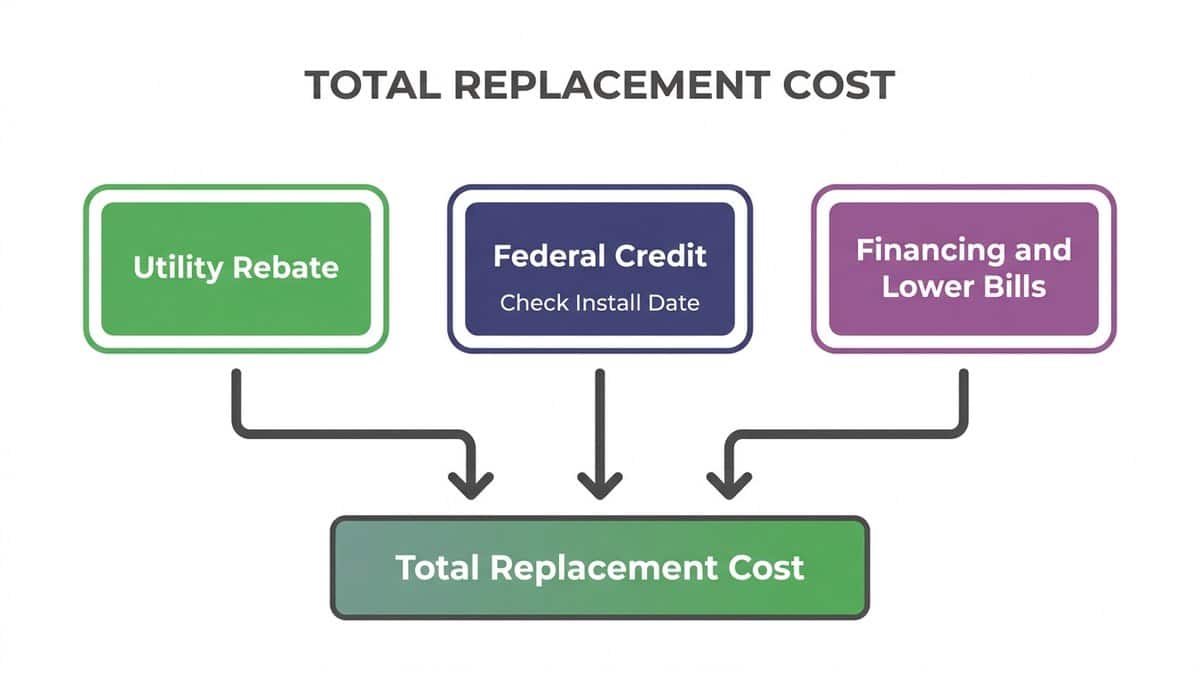
Utility rebates
These come from the company that sends your electric bill. They are the most reliable lever because utilities run them as ongoing programs rather than one-time federal measures. They are also the ones that reward energy efficient HVAC rebates directly: you buy a qualifying system, and the utility pays a portion back.
Federal credits
The federal home-efficiency credit for HVAC depends on when a system was installed. That date matters more than the equipment. We cover this in the next section.
Financing and lower operating cost
This third bucket is the one people forget. A payment plan spreads the cost. A more efficient system also lowers your monthly cooling bill for years. Neither is a rebate, but both reduce what the replacement really costs you.
Why does “check the date and your address” beat any list of numbers? Because the date decides the federal question, and your address decides the utility question. A dollar figure printed in a blog post last year may not match this year’s program. When you know which two facts to check, you can verify any claim yourself, including ours.
Our free consultation is a good place to do that checking. We look at your system, your home and the equipment in your estimate, and we talk through which incentives are worth confirming before you sign.
Takeaway: utility rebates are your steadiest help in 2026, and two facts decide everything else: your install date and your address.
Is there still a federal tax credit for air conditioning in 2026?
The federal home-efficiency credit for HVAC applied to systems installed through 2025. For a system installed in 2026, do not assume it applies unless Congress extends it. If you installed earlier, you may still be able to claim it on that year’s return. Ask a tax professional.
That is the short answer to every federal tax credit air conditioning question we hear. Plenty of web pages still describe the credit as current. Some are written by manufacturers for the previous tax year. Others come from contractors who have not updated an old post. If you plan a 2026 install based on one of those pages, you could be counting on money that is not there.
The credit also has a feature people overlook. It is non-refundable. That means it can only reduce the tax you owe. It does not produce a check if your tax bill is smaller than the credit. So even in years when it applied, its value depended on your own tax situation. A tax professional can tell you what it was worth to you.
If you already installed a system last year
You may still be able to claim the credit on that year’s return. Keep your invoice, the equipment model details and any manufacturer certification paperwork. Then bring them to whoever prepares your taxes. We cannot give tax advice, and we will not guess at what you qualify for. What we can do is make sure you have clear records of what was installed and when.
If you are installing in 2026
Plan as though the federal credit is not part of your budget. If Congress extends or restores it, treat that as a pleasant surprise. This is the safest way to compare quotes, because it keeps you from choosing a system or a contractor based on a credit that may not exist.
We will never pressure you with a deadline on this. Some companies use “act now before the credit disappears” as a sales tactic. That is not how we work. Our job is to give you the straight truth about your system and let you decide on your own schedule. If you want to understand what a higher efficiency rating actually saves on your bills, we explain the math in how SEER ratings translate to energy savings.
One more point on how rebates and credits interact. A utility rebate can reduce the amount that counts toward a federal credit. So the two do not always add up the way a headline suggests. If both ever apply to you, a tax professional should do that math.
Takeaway: treat the federal credit as a possible bonus for earlier installs, not a line in your 2026 budget, and let a tax professional confirm your own case.
How do APS and SRP rebates work?
Your address decides which utility rebate program you can use. APS and SRP each set their own rules, efficiency tiers and deadlines, and most ask for proof of purchase and installer details after the job. Check your electric bill to see who serves you.
Think of APS SRP rebates as two separate programs, not one. They share a general idea: the utility pays you back when you install more efficient cooling, because that helps the whole grid at peak summer demand. But the details belong to each utility.
Find your utility first
Your electric bill names your provider. That one step saves a lot of confusion. Utilities do not cross territory lines. If APS serves your home, SRP’s rebate does not apply to you, and the reverse is also true. A friend one street over may be on a different utility than you, so their experience may not match yours.
Our service area includes Mesa, Chandler, Gilbert, Queen Creek and Apache Junction. We are not going to tell you which city sits under which utility, because boundaries do not always follow city limits. Your bill is the reliable answer. Look at it before you start comparing rebates.
Why rebate terms change and how to check current ones
Utility rebate programs are governed by state demand-side management plans. In plain terms, regulators approve a plan for how a utility will help customers use less energy, and that plan runs on a cycle. When a new cycle begins, the terms can change. Efficiency tiers may move. Amounts may shift. Some programs may pause, restart or look different.
That is exactly why a fixed number in a blog post is risky. A figure that was right last year may be wrong today. So treat any dollar amount you read online, including old ones from us, as a starting point and not a promise.
Here is a simple way to check current terms:
- Confirm your utility from your bill.
- Visit that utility’s residential rebate page and read the current AC or heat pump program.
- Note the efficiency rating it asks for, shown as SEER2.
- Note whether it requires an enrolled or approved contractor.
- Note the deadline for submitting after installation.
- Ask your contractor to compare the equipment in your estimate with those requirements.
Some programs may require a contractor who is enrolled with the utility. That is worth asking about before you sign. A licensed contractor can be perfectly legal and still not be enrolled in a given program. Ask directly, and ask early.
Processing also takes time. A rebate rarely arrives the week after your install. Plan your budget so you are not counting on that money to cover your first payment.
Our technicians have training and experience across installations, replacements, maintenance and repair work. That background helps when we sit down with a homeowner and compare an estimate against a program’s equipment rules. Still, you should always confirm current terms with the utility itself, because that is the source that decides.
Takeaway: your bill tells you which utility’s rules apply, and the utility’s own current page is the only source worth trusting for amounts and deadlines.
Which AC systems earn energy efficient HVAC rebates?
Qualifying systems generally have to meet a minimum efficiency rating, shown as SEER2, and be properly matched indoor and outdoor equipment installed by a licensed Arizona contractor. Some programs also want an enrolled installer. A higher rating does not automatically earn a bigger payoff.
Most energy efficient HVAC rebates work the same basic way. The utility sets a minimum bar. If your new system meets or beats it, you may qualify. Let us break that down in plain English.
Efficiency ratings in plain English
SEER2 is a score for how efficiently an air conditioner turns electricity into cooling over a season. A higher number means the system uses less power to cool the same space. That is all you need to know to read a rebate page.
Programs often set tiers. Meeting a lower tier may earn a smaller rebate, and meeting a higher tier may earn a larger one. But a higher rating is not always the right buy. A very efficient system costs more up front, and whether it pays back depends on how you live in the home. We cover that more in the next section.
In our work across 3,000+ installs in the East Valley, one pattern holds: the best system is the one sized and matched correctly for the home. A rating alone does not tell you that. We will not recommend a bigger or pricier unit just to chase an incentive.
Matched systems and why a mismatched install can sink a claim
Rebate programs usually expect the indoor and outdoor equipment to be a matched pair. If the outdoor unit is new but the indoor coil is an older, different model, the combination may not meet the program’s rules. It may also not deliver the efficiency the rating promises.
Always ask your contractor to confirm the full system, indoor and outdoor, and to give you the model details for both. If the paperwork lists mismatched parts, a claim can be denied on a technicality. That is the kind of avoidable mistake we want you to dodge.
Licensing and contractor requirements
Arizona requires AC contractors to be licensed, and the contractor’s license number is usually asked for when you claim a rebate. Check that the number on your estimate is valid before you sign. If you are unsure, ask for it in writing.
We offer AC repair, AC installation and replacement, AC maintenance and tune-ups, heating repair and maintenance, and thermostat services. You can see the full range of AC repair, installation and maintenance across the East Valley on our services page. When we review an estimate with you, we go through the model details together, so you know exactly what is going into your home.
We are not going to claim that any particular model qualifies for a particular program today. That depends on current utility tiers, and those change. What we will do is help you check the equipment in your quote against the current requirements.
Takeaway: a qualifying system is a properly matched, correctly sized, licensed install that meets your utility’s current SEER2 tier, and a higher number is not automatically a better buy.
How to stack rebates, financing and lower energy bills
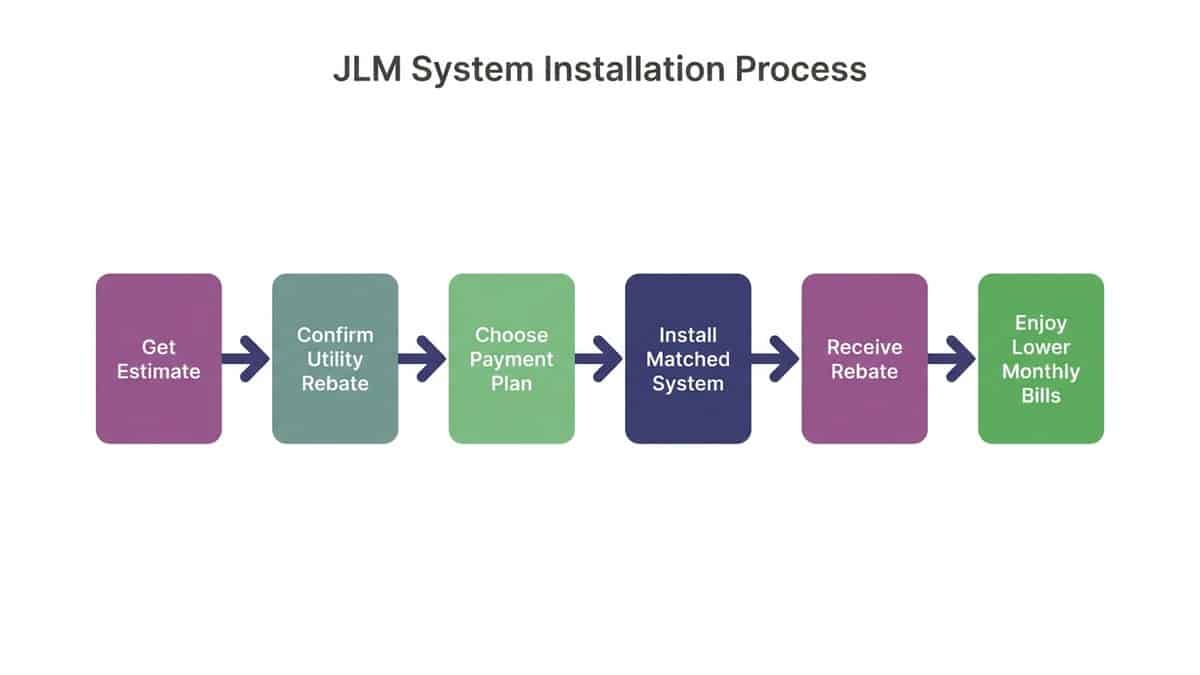
The best outcome is rarely one big incentive. It is usually a rebate, plus a payment plan, plus a more efficient system that lowers your monthly cooling cost. Together, those three levers do more than any single program.
This is the part most rebate articles skip. They list programs. But the real cost of a replacement is not the sticker price minus one rebate. It is the full picture of what you pay now, what you pay each month and what you save over the years you stay in the home.
If you want a baseline before stacking anything, start with what an AC replacement really costs. Once you know the price range for your home, the savings levers make more sense.
Rebate first, then financing
Think of it as two steps. The rebate lowers what you ultimately pay. The payment plan changes when you pay it. They solve different problems.
A utility rebate often arrives after the job is done and the paperwork is processed. That means you may need to cover the full cost up front or finance it, then receive the rebate later. A payment plan helps with that gap. We offer financing options through GoodLeap and JB Warranties, so you can spread the cost while you wait on any rebate you qualify for.
Remember the interaction we mentioned earlier. A rebate can reduce the base that counts toward a federal credit, if one ever applies. So rebates and credits do not simply add up. When both are in play, let your tax professional run the numbers.
For a deeper look at what to expect on price, see what to expect when replacing your HVAC system. It walks through what drives the total.
When a higher-efficiency system pays off, and when it does not
An efficient system lowers your monthly bill. In the East Valley, cooling runs for much of the year, so the savings can add up. We explain how efficient systems lower summer cooling bills in a separate guide.
But efficiency pays off most when three things line up. You plan to stay in the home for several years. Your current system is old and inefficient. And the home’s ducts and insulation let the new system do its job. If you plan to move soon, or your ductwork leaks a lot of cooled air, the most efficient model may not be worth the extra cost.
Here is how we think about it with homeowners:
- Staying put for years: a higher-efficiency system often makes sense, because you collect the bill savings for a long time.
- Selling soon: a solid, correctly sized mid-tier system may be the smarter spend.
- Old system, high bills: the gap between your old unit and any modern unit is already large, so even a standard efficient model helps.
- Leaky ducts or poor insulation: fix those first, or the new system cannot deliver its rated performance.
That last point is where honest advice matters. The most efficient model is not always the right one for your home. A rebate is a bonus. It should never be the reason to oversize or upsell.
Takeaway: the real cost lever is a rebate plus a payment plan plus a right-sized efficient system, and the right system comes first.
How do I claim an AC rebate without losing it?
Confirm eligibility before you sign, keep the invoice and equipment model details, and submit the application inside your utility’s deadline. Most lost rebates come from skipped steps, not bad luck. Ask your contractor to walk you through the paperwork up front.
If rebate paperwork feels risky to you, that makes sense. A technicality can cost you real money. The good news is that the rules are mostly simple, and a short checklist covers them. Most rebates require documentation such as the invoice, equipment model details and proof of installation, submitted within the utility’s deadline.
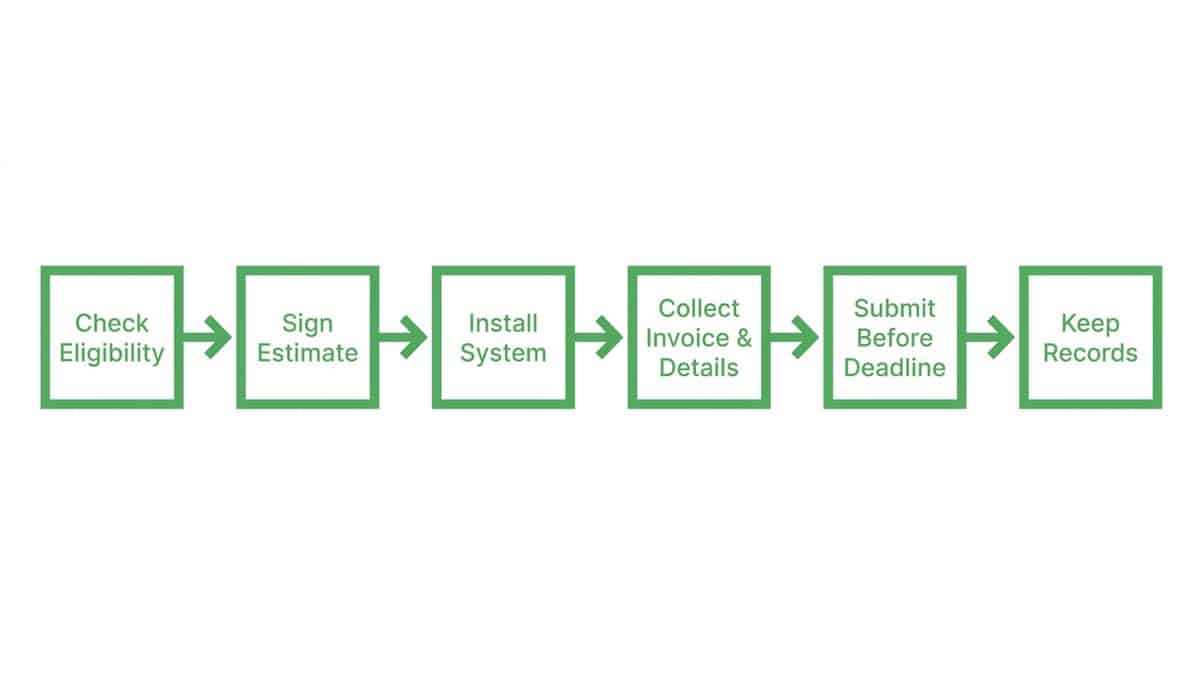
Before you sign
Do your homework while you still have leverage.
- Confirm your utility from your electric bill.
- Read that utility’s current rebate terms and efficiency requirements.
- Ask whether the program requires an enrolled or approved contractor.
- Confirm the contractor’s Arizona license number.
- Ask for the full model details of both the indoor and outdoor equipment.
- Ask who submits the application and what documents you will receive.
That last question matters. Contractors differ on how much paperwork help they give. Ask us, and ask anyone else you are comparing, exactly what is included. Do not assume.
After install
Once the system is in, move quickly while the details are fresh.
- Get an itemized invoice that lists the equipment models.
- Keep any manufacturer or warranty paperwork.
- Take note of the installation date.
- Submit the application inside the utility’s deadline, and do not wait until the last day.
- Save a copy of everything you send.
- Keep your records for tax time too, in case a tax professional needs them.
Any honest contractor hands you an itemized invoice and the model details. If you are told to “figure it out later,” treat that as a warning sign. Our technicians have worked across installations, replacements, maintenance and repair, and we know how much a clean invoice helps. You can read more about our AC installation and replacement service to see how we handle the work from estimate to finish.
Mistakes that cost homeowners rebates
Most of these are avoidable.
- Signing before checking eligibility. If the equipment does not meet the tier, you find out too late.
- Mismatched equipment. An outdoor unit paired with a different indoor coil can fail a program’s rules.
- A contractor the program does not accept. Some programs want an enrolled installer.
- Missing documents. No invoice, no model details, no claim.
- Missing the deadline. Utilities set their own windows, and they are firm.
- Assuming the neighbor’s rebate is yours. Utility territories do not overlap.
None of these are bad luck. They are skipped steps. A few minutes before you sign can protect your rebate.
Takeaway: verify first, document everything and submit early, and your rebate is far more likely to arrive.
Should a rebate decide whether you repair or replace?
No. A rebate should never push you to replace a system that can be repaired sensibly. Incentives are a bonus on top of a good decision, not a reason to make a bad one.
We say this plainly because we have seen how incentives can warp advice. A big rebate headline can nudge people toward replacing a unit that still has solid years left. That is how homeowners end up spending more than they needed to. Our approach is the opposite. We look at the system first and the incentives second.
Our educational guides come from field experience, not a content template. That is also how we advise in person. We look at the age of the system, its repair history, the cost of the fix on the table and how long you plan to stay. A system that has frozen up, for example, is often a repair question first, and our guide to quick solutions when your AC freezes up in Mesa covers what to check. Then we tell you what we would do in your shoes.
If you are weighing a repair bill against a new system, our repair-versus-replace decision framework lays out how to think through the choice. It gives you a clear way to compare the cost of repair with the cost of replacement. For a shorter read, try a homeowner’s guide to repair or replace.
Here is what our free consultation covers. We come to your home and look at the system you have. We talk through your options, including repair when repair makes sense. We give you a transparent estimate with no hidden fees. We also talk through which incentives are worth confirming for your address, and how financing might fit. You leave with a straight answer, and you owe us nothing for asking.
Takeaway: decide on the system first, and treat any rebate as a bonus that never drives the decision.
Three rules to follow before you sign
Arizona AC rebates are real, but they reward homeowners who check the details. Three rules cover almost everything in this guide.
Verify the date. The federal HVAC credit was tied to installs through 2025. For a 2026 install, do not count on it, and ask a tax professional about your own case.
Verify your utility. Your electric bill tells you whether APS or SRP rules apply. Read that utility’s current terms, because they change by plan cycle.
Verify before you sign. Confirm eligibility, matched equipment, a licensed contractor and your paperwork plan before you commit to a quote.
Do those three things, and you will be ahead of most homeowners. You will also be able to tell a real offer from hype. When you are ready to compare options, JLM’s full list of HVAC services shows everything we do for East Valley homes.
Not sure which incentives apply to your home? Our free consultation gives you a straight answer before you sign anything.