What makes an HVAC system energy efficient, and how much can you actually save? An energy-efficient HVAC system uses a high SEER rating (16-22+), variable-speed compressors, and smart thermostats to cool your home using less electricity. In Arizona’s extreme heat, upgrading from a 10-SEER system to an 18-SEER unit can cut cooling costs by 30-40%, potentially $600-$1,200 per year for a typical Gilbert home. Payback on an $11,000 install typically happens in 7-10 years through lower utility bills.
If your summer electric bills have been doubling or tripling when temperatures hit 110°F, you’re not alone. Many East Valley homeowners face the same problem: an aging AC that runs constantly but barely keeps up, leaving you with bills that feel impossible to manage. When you’re researching HVAC Services in the East Valley, AZ, the question isn’t just “should I upgrade?” It’s “how much will I really save, and will the investment pay back before I need another repair?”
This guide compares your options, from full system replacement to smart upgrades on your existing equipment, so you can make the decision with real numbers and clear timelines. You’ll learn what makes systems efficient, how much different SEER levels save per month, and when it makes sense to replace instead of patch. We’ve helped over 3,000 East Valley families make this choice, and we’ll walk you through the same honest evaluation we give every customer.
What Makes an HVAC System “Energy Efficient”?
An energy-efficient HVAC system uses less electricity to deliver the same cooling output. Three factors determine efficiency: the SEER rating (Seasonal Energy Efficiency Ratio), the type of compressor, and the quality of your ductwork and insulation.
SEER ratings measure how much cooling a system produces per watt of electricity. Minimum federal standards require 14 SEER for new systems in the Southwest. High-efficiency models run from 16 to 22+ SEER. Each 2-point jump in SEER reduces energy use by roughly 10-15%.
Variable-speed compressors adjust their output to match your home’s cooling needs, unlike older single-stage units that run at full blast every time they cycle on. This flexibility cuts energy waste and extends equipment life. ENERGY STAR-certified systems use 15-20% less energy than standard models by combining high SEER ratings with variable-speed technology.
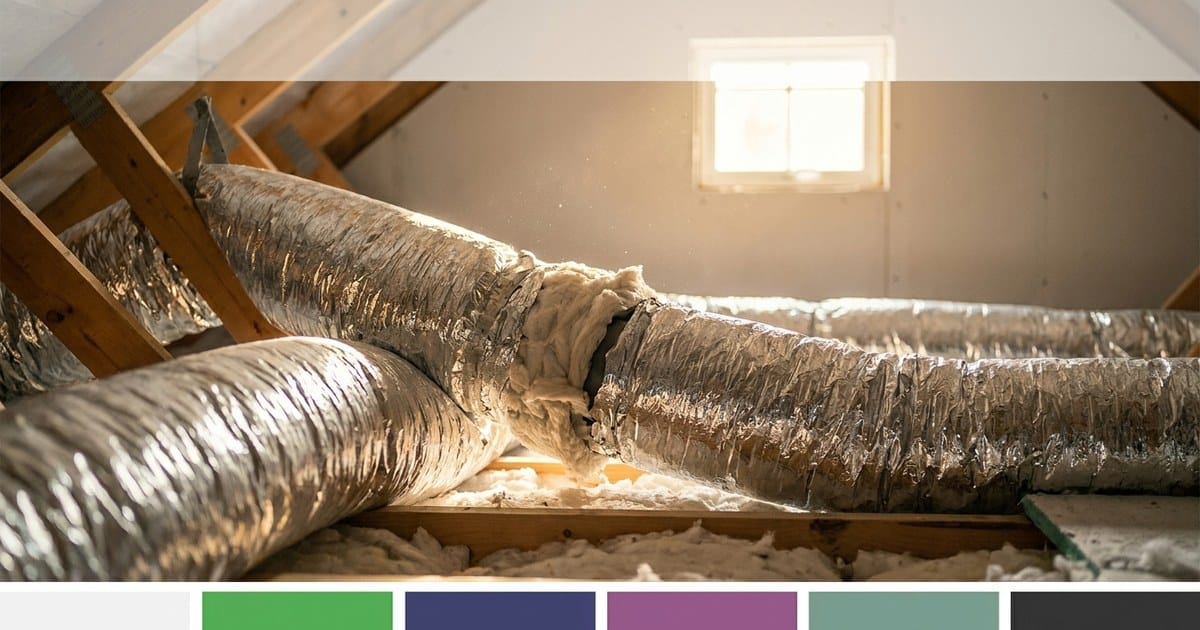
Ductwork and insulation matter just as much as the equipment. Leaky ducts in your attic can lose 20-30% of cooled air before it reaches your rooms. Proper sealing and insulation recover that loss and let your system work less. The EPA recommends duct sealing as one of the most cost-effective efficiency upgrades, especially in homes with unconditioned attic spaces.
When you’re evaluating Blog | HVAC Tips & Updates for Gilbert, AZ Residents, you’ll see these three factors come up again and again. That’s because they work together. A 20-SEER system with leaky ducts performs worse than a 16-SEER system with sealed ductwork. The whole system has to be right, not just the outdoor unit.
How Much Can You Actually Save on Cooling Costs?
The money question: what does efficiency actually mean for your monthly bill? In Arizona, where cooling accounts for 50-60% of your summer electricity use, the savings are substantial.
A typical 1,800-2,200 square foot home in Gilbert or Mesa with a 10-SEER system running in July might cost $400-$500 per month in cooling alone. Upgrading to an 18-SEER system drops that to $260-$325 per month, a reduction of $140-$175 monthly during peak summer. Over four months (June through September), that’s $560-$700 in savings per year.
According to research on energy efficiency strategies and upgrades, high-efficiency HVAC upgrades can reduce cooling costs by 20-40% in hot climates. A 2019 ACEEE report on residential efficiency found that replacing a 10-SEER system with an 18-SEER unit saves homeowners $200-$400 annually in moderate climates. In Arizona’s extreme heat, savings often exceed $600 per year because your system runs 10-14 hours a day instead of 4-6 hours in milder regions.
The payback timeline depends on equipment cost and your current system’s inefficiency. An $11,000 install with $800 annual savings pays back in about 14 years. If you’re replacing a failing 12-year-old system and would have spent $3,000-$4,000 on repairs over the next few years, your real payback drops to 10-11 years. Factor in utility rebates (many East Valley providers offer $200-$400 for high-efficiency installs), and you shave another year off.
One detail homeowners often miss: payback accelerates as electric rates rise. Arizona utilities have increased rates 3-4% annually over the past decade. If rates continue climbing, your $800 annual savings in year one becomes $900-$950 by year five, shortening your breakeven point.
When evaluating your options, ask for a side-by-side cost comparison based on your home’s square footage, insulation quality, and current electric rate. Any contractor who quotes a system without calculating your cooling load and projected savings is guessing. We run the numbers for every home because that’s the only way to give you an honest answer about what you’ll actually save.
New High-Efficiency System vs. Upgrading Your Current Setup
Should you replace your whole system or upgrade components like your thermostat, ductwork, and filters? The answer depends on three factors: your system’s age, its current SEER rating, and your budget timeline.
If your system is 12+ years old and rated below 13 SEER, full replacement delivers better long-term value than incremental fixes. Older units lose efficiency as components wear, and repair costs compound quickly. A $1,200 compressor repair on a 14-year-old system buys you maybe two more seasons before the next failure. A new 18-SEER system gives you 15-20 years of reliable service with lower monthly bills from day one.
If your system is 5-8 years old and rated 14-16 SEER, upgrades can bridge the gap until replacement makes sense. A smart thermostat, duct sealing, and high-efficiency air filters can cut energy use by 15-20% for a combined investment of $800-$1,500. That’s far less than a $10K-$12K replacement, and you still see monthly savings while extending your system’s life.
Smart thermostats adjust cooling schedules based on when you’re home, outdoor temperature, and humidity levels. According to DOE research on simulation-driven smart thermostat benchmarking, programmable and smart thermostats alone can cut HVAC energy use by 10-15%. A $200-$300 thermostat that saves $150 per year pays back in two summers.
Duct sealing and insulation cost $800-$1,200 for a typical home, depending on attic access and duct length. You’ll recover 20-30% of lost cooled air, which translates to $100-$200 in annual savings. Combined with a smart thermostat, you’re approaching the efficiency gains of a new system at one-tenth the cost.
Air filtration upgrades include high-efficiency MERV filters (MERV 11-13) and UV light purification systems. ASHRAE research on filtration and disinfection shows that MERV filters improve indoor air quality by trapping smaller particles, but they also restrict airflow slightly, so your system works a bit harder. UV systems kill bacteria and mold in ductwork, reducing odors and allergens without affecting efficiency. Budget $400-$800 for UV installation.
When Why Summer in Mesa Demands Fast AC Repair, you’re often forced into emergency decisions without time to compare options. If your system is approaching 10 years old, plan your replacement or upgrade strategy now during spring or fall, when contractors have scheduling flexibility and you’re not sweating through a 108°F afternoon while waiting for quotes.
The conversation we have with homeowners starts with age and repair history. If you’ve spent more than $1,500 on repairs in the past two years, that’s a signal. If your system is cycling on and off every five minutes (short-cycling), that’s another one. We’ll be straight with you about whether a repair or replacement makes more sense for your situation and your budget.
What to Look for When Comparing Energy-Efficient Systems
When you’re evaluating quotes from HVAC contractors, four criteria separate a quality install from one that underdelivers on promised savings: SEER rating, equipment brand and warranty, proper sizing and load calculation, and installation quality.
SEER ratings in Arizona should be at least 16 for meaningful efficiency gains. The Department of Energy confirms that moving from 14 to 16 SEER is worth the price difference for residential central air conditioners. Moving from 16 to 20+ SEER makes sense if you plan to stay in your home 10+ years and want maximum long-term savings. Beyond 20 SEER, diminishing returns set in unless you’re chasing net-zero energy goals.
Equipment brands matter for reliability and parts availability. Amana, Carrier, Trane, and Lennox all manufacture quality high-efficiency systems. Amana units (what we install most often) offer strong warranties and competitive pricing. Carrier and Trane cost 10-15% more but have slightly longer service histories. Any reputable brand will deliver the promised SEER rating if installed correctly. The warranty is more important than the badge: look for 10-year parts coverage and verify what labor costs you’ll pay if something fails in year eight.
Proper sizing requires a load calculation based on your home’s square footage, insulation, window area, roof color, and orientation. An undersized system will run constantly and never cool your home adequately. An oversized system will short-cycle (turn on and off every few minutes), which wastes energy and wears out components faster. If a contractor quotes a system size without measuring your home or asking about insulation, find another contractor.
Installation quality determines whether your high-efficiency system actually delivers the promised savings. Shortcuts like skipping duct inspection, using undersized refrigerant lines, or failing to test airflow after startup can reduce real-world efficiency by 15-25%, even on a 20-SEER unit. Ask how the contractor verifies airflow, tests refrigerant charge, and seals duct connections. When exploring HVAC System | AC Technician Near Me providers, prioritize those who measure before they quote and explain their installation checklist upfront.
We measure every home before we quote. We test airflow after every install. We seal every duct connection. That’s not because we’re perfectionists (though we are). It’s because we’ve seen too many “high-efficiency” systems fail to deliver savings because someone cut corners during installation. You’re spending $10K-$15K. You deserve to see the full payback you were promised.
Common Mistakes That Waste Money on “Efficient” Systems
Even with a high-SEER system, homeowners lose savings through avoidable mistakes. Oversizing is the most common. A contractor who doesn’t calculate your cooling load will often install a larger system “to be safe.” The result: short-cycling that wastes energy and makes your home feel clammy because the system shuts off before removing humidity.
Skipping duct sealing negates efficiency gains. Research on dust in ventilation ducts shows that accumulation and leaks significantly impact system performance. If 25% of your cooled air leaks into the attic, your 18-SEER system performs like a 13-SEER unit. Budget $800-$1,200 for duct sealing when you replace your system, and you’ll capture the full savings potential.
Neglecting filter changes reduces efficiency by 5-15%. A clogged filter chokes airflow, forcing your system to run longer to cool the same space. Replace 1-inch filters monthly during summer or switch to a 4-inch filter that lasts three months.
Ignoring your thermostat settings costs money. Setting the thermostat to 68°F when it’s 110°F outside makes your system run nonstop without ever reaching the target temperature. A realistic summer setting is 76-78°F when you’re home, 82°F when you’re out. Each degree below 78°F adds roughly 3-5% to your cooling bill.
Skipping annual maintenance is false economy. A tune-up costs $120-$180 and catches small problems (dirty coils, low refrigerant, worn belts) before they become expensive repairs. A well-maintained system runs 10-15% more efficiently than a neglected one. If you want to keep your high-efficiency investment performing as designed, The Smart Way to Prep AC for Gilbert’s Hot Summer starts with a spring tune-up.
We tell customers this upfront: the most expensive high-efficiency system in the world won’t save you a dime if you don’t maintain it. Change your filters. Get your annual tune-up. Let us seal your ducts. Do those three things, and you’ll see every dollar of savings we promised.
Real-World Efficiency: What JLM Customers See
Over 3,000 installs across the East Valley have given us a clear picture of what real-world efficiency looks like in Arizona’s climate. Bill Milbourn and our installation team track performance data from every system we install to verify that projected savings match actual results.
Our Gilbert and Queen Creek customers who upgraded from 10-SEER systems to 18-SEER Amana units report cooling cost reductions averaging 33-38% in their first summer. That translates to $550-$750 in annual savings for a typical 2,000 square foot home with moderate insulation and west-facing windows.
One Queen Creek family we worked with replaced a 1996 AC (8 SEER, failing compressor) with a new 18-SEER Amana system in May 2025. Their July 2025 bill dropped from $521 to $318, a $203 monthly reduction. Over the four-month summer season, they saved $812. With a $10,800 install cost and a $300 utility rebate, their net investment was $10,500. At $812 annual savings, payback will happen in 13 years, but they also avoided a $2,400 compressor replacement on the old system, bringing their real payback to under 10 years.
The biggest variable in real-world savings is ductwork condition. Homes with well-sealed ducts see savings that match or exceed the SEER rating promise. Homes with leaky ducts lose 15-25% of the efficiency gain. When we recommend duct sealing as part of a system replacement, it’s not an upsell. It’s the difference between seeing 35% savings or 20% savings on the same equipment investment.
We track this data because it matters. Every install we do, we follow up six months later to ask how the system is performing and whether the savings match what we projected. That feedback loop keeps us honest and helps us refine our estimates for the next customer. When we tell you you’ll save $700 per year, we’re basing that on what hundreds of similar homes in your neighborhood have actually experienced.
Is a High-Efficiency HVAC System Worth It in Arizona?
Arizona’s 110°F summer days make HVAC efficiency pay back faster than almost anywhere else in the country. Your system runs 10-14 hours a day from June through September. That’s 1,200-1,700 hours of runtime per year compared to 600-800 hours in moderate climates. Every efficiency point you gain multiplies across those extra hours.
If your system is 10+ years old, replacement beats repeated repairs. A 12-year-old AC has already outlived its expected lifespan, and repair costs compound quickly. Spending $1,500-$2,000 per year on repairs makes a $11,000 replacement with 15-20 years of reliable service the better financial choice.
If you’re planning to stay in your home 5+ years, the payback math works. Seven to ten years is typical for high-efficiency systems in Arizona. Shorter timelines favor smart thermostats and duct sealing over full replacement, unless your system is failing. Longer timelines favor maximum SEER (18-20+) because you’ll capture more cumulative savings.
When considering whether Do You Really Need Professional AC Repair in Mesa? becomes a replacement conversation, run the numbers. If your system is less than 8 years old and the repair costs under $800, repair makes sense. If it’s 10+ years old and the repair exceeds $1,200, replacement is usually smarter.
Only you know your budget and timeline. We’ll give you the honest numbers: your current system’s efficiency, projected savings from a replacement, and the payback timeline based on your home’s cooling load and electric rate. No pressure, no upselling. If repair makes more sense, we’ll tell you. If replacement is the better long-term move, we’ll show you why.
The conversation is straightforward. We measure your home. We calculate your cooling load. We show you what a new system would cost and what you’d save each month. Then you decide. That’s how it should work, and that’s how we’ve built trust with over 3,000 families across Gilbert, Mesa, Queen Creek, and Apache Junction.
Conclusion
Energy-efficient HVAC systems cut Arizona cooling costs by 30-40% compared to aging, low-SEER equipment. The decision between full replacement and incremental upgrades depends on your system’s age, current efficiency, and how long you’ll stay in your home. Systems 10+ years old with SEER ratings below 13 should be replaced. Newer systems (5-8 years, 14-16 SEER) benefit from smart thermostats, duct sealing, and high-efficiency filters at a fraction of replacement cost.
When comparing systems, prioritize SEER rating (16-20 for Arizona), proper sizing through load calculation, quality installation, and a solid warranty. According to the 2023 ENERGY STAR Summary of HVAC and Smart Thermostats, certified equipment delivers consistent performance when properly installed. Avoid oversizing, duct leaks, and deferred maintenance, all of which waste the efficiency you paid for. Understanding How Mini Split Installation Works from Start to Finish can also help if you’re considering targeted cooling solutions for specific rooms or additions.
If you’re ready to see real payback numbers for your home, we’ll walk you through it with no pressure and no hidden fees. We’ll assess your current system, calculate your potential savings, and help you decide what makes sense for your budget and timeline. That’s the JLM approach, and it’s how we’ve earned the trust of thousands of East Valley homeowners who wanted straight answers before making a $10K decision.
When you’re exploring Air Conditioning | AC Technician Near Me providers, look for transparency in the estimate process. Look for contractors who measure before they quote. Look for someone who’ll tell you when repair makes more sense than replacement. Regular Air Conditioning Maintenance is also essential to preserving the efficiency you’ve invested in. We think that’s how this business should work, and we’re happy to prove it on your next service call.
Ready to stop guessing and start saving? Contact JLM Air Conditioning & Heating for a free consultation and honest estimate. We’ll show you exactly what efficiency means for your home, your bill, and your long-term comfort. Call us today to schedule your in-home assessment and get a transparent quote with real savings projections.
By Bill Milbourn, Owner/Lead Technician, JLM Air Conditioning & Heating