

It’s a quiet Saturday in late February. The patio door is open and the AC is off. Here is the short answer on the spring AC tune-up timing Arizona homeowners ask about most.
For most East Valley homes, the best time for a spring AC tune-up is late winter to early spring, before daily highs climb and schedules fill. Book earlier if your system is older or struggled last summer. If summer has already started, book now and ask for the next open slot.
The heat in Arizona does not ask permission. One week your windows are open, and the next your system is running all day. People who plan ahead get the easy appointment, the relaxed visit, and a summer without surprises. We’re a family-owned shop, and AC maintenance and tune-up service across the East Valley is a core part of what we do. This guide helps you pick your date. It does not repeat a task checklist. It answers one question: which week is right for your home?
What is the best spring AC tune-up timing in Arizona?
Late winter into early spring is the best window. The weather is mild, your AC is barely running, and technicians have open schedules. A tune-up then catches small problems before the first stretch of serious heat puts the system under load.
Good spring AC tune-up timing Arizona homes need is not the same as the generic national advice to service your AC “in spring and fall.” Here is why it differs in the desert. An AC in Phoenix-area weather does not get a gentle ramp-up. It goes from resting to working hard in a few weeks. Parts that were fine in October can show wear by May. If a technician looks at the system while it is cool outside, any worn part or small leak gets fixed without a rush. Nobody is sweating in the living room while you wait for a part.
There is a second reason. In our work with East Valley homeowners, the people who book early tend to treat maintenance as part of protecting their investment, not as a chore. A system that gets a yearly look usually has fewer ugly surprises. That is the heart of preventive care, and it is why AC maintenance in spring pays off more than waiting for a problem.
Our owner, Bill Milbourn, grew up in Chicago, a city that teaches you to take weather seriously. He brought that habit to the desert. In Arizona, the weather you plan for is the heat. If you want the longer case for acting early, read why spring isn’t too early for a tune-up.
Think of it as a window, not a single date. The front of the window gives you the most choice. The back of the window still works. After that, you are competing with everyone else.
Takeaway: book while the weather is mild and the calendar is open.
Pre-summer HVAC prep: which date fits your home?
Match the date to your system. Newer, trouble-free systems can wait for the middle of the window. Older systems, systems with a rough last summer, and homes on a maintenance plan should book first. If you are listing or buying a home, schedule it before the sale process.
Here are six common scenarios that shape spring AC tune-up timing Arizona homeowners face. Find the one that sounds like you.
1. Late winter: the sweet spot
This is the easiest path. Appointments are plentiful, so you can pick a day that suits you. If the technician finds something, you have weeks to approve and schedule the fix. Nothing is urgent.
Choose this window if your system is in decent shape and you like to check things off early. It is also a good fit if you are new to the house and don’t know the system’s history.
2. Early spring: still fine
Slots are tighter, but you have time. The mornings are warm and the afternoons are getting longer. Most homes can still get a visit and a repair, if needed, before the real heat arrives.
If you missed late winter, don’t worry. Book this week rather than next. Every week of delay trims your choices.
3. Older system or a rough last summer: go first
Be honest with yourself about age and history. If your AC is getting on in years, or it struggled last summer, it has more to prove this year. Maybe it blew warm air in August. Maybe a room never cooled. Maybe a tech told you a part was “getting tired.”
These systems should be first in line. A small issue on an older unit can grow fast under load. Book at the front of the window and tell us what happened last summer. That detail helps the technician know where to look.
We will tell you plainly what we find. If the system has years left, we say so. If it is near the end, we explain your options without pressure.
4. On a maintenance plan: let the plan set the date
If you are already on a plan, the schedule is mostly decided for you. Use the plan’s spring visit and don’t second-guess it. It is there so you never have to wonder about timing.
A plan is not right for every home. Some homeowners prefer a one-time visit each year, and that is a fair choice. If you’re unsure, read how often your AC should be serviced and decide what fits your home and budget.
5. Selling or buying: schedule before the sale
If you plan to list, get the tune-up done before the sale process starts. A clean service record gives buyers one less thing to worry about. It also gives you time to fix anything the visit turns up, rather than negotiating it under a deadline.
If you are buying, ask for a look at the system early. Realtors and agents often point their clients to us for this reason. A cooling system you don’t know is a risk you can check off cheaply.
6. Summer’s already here: book the next opening
If the heat has arrived, don’t wait for a perfect date. Book the next open slot and describe what your system has been doing. We cover exactly what to do in the last section below.
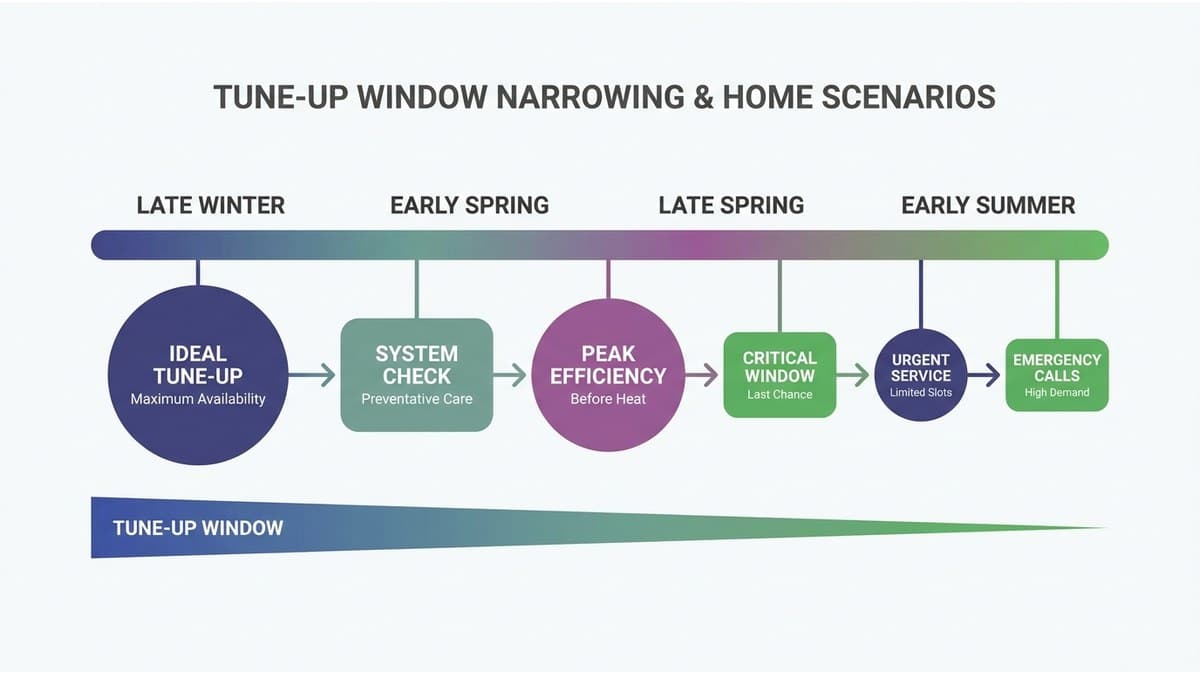
Takeaway: pick your scenario, then book at the front of your window.
Why does waiting cost you more?
Once temperatures climb, everyone calls at once. Appointments get scarce, and a small problem can turn into a breakdown on the hottest day. Emergency repairs usually cost more than the maintenance that would have caught the issue.
Look at it from the homeowner’s side. In March, a tune-up is a calm visit. You choose the time. You ask questions. If a part is worn, you replace it on your schedule. In July, the same part fails at 4 p.m. on a 110-degree day. Now you are paying for urgent service, and you are waiting for an open slot while the house heats up.
That is the real cost of waiting. It is not only money. It is the stress of a hot house, a packed calendar, and fewer choices.
We keep 24/7 availability and same-day help for urgent repairs, and we’re glad to use it when we’re needed. But we would rather see your system in spring than in an emergency. You can read more about why July and August bring the most breakdowns in our guide to summer AC emergencies.
None of this is a reason to panic. It is a reason to put one appointment on the calendar.
Takeaway: a spring visit costs less than a summer emergency, in money and in stress.
What does a spring tune-up actually check?
A spring tune-up inspects the parts that fail under heat: electrical connections, refrigerant level, coils, blower, drain line, and filtration. The goal is to find worn parts and small leaks now, while a fix is simple and nobody is sweating.
Here is what each part means in plain terms.
Electrical connections. Loose or worn wiring can cause a system to quit under load. Technicians check and tighten connections so the unit starts and runs reliably.
Refrigerant level. Refrigerant is the fluid that carries heat out of your home. If the level is low, there is usually a leak somewhere. We check it and explain what we find. Adding refrigerant without finding the leak only buys time.
Coils. The indoor and outdoor coils trade heat. In the desert, dust coats the outdoor coil fast. A dirty coil makes the system work harder and cool less. Coil cleaning is a job for a pro, not a garden hose.
Blower. The blower moves air through your home. If it is dirty or worn, airflow drops and rooms feel uneven.
Drain line. Your AC pulls moisture from the air, and the drain line carries it away. A clogged line can cause water damage or shut the system down.
Filtration. A clean filter protects the system and the air you breathe. Our technicians check it during every visit.
Our tune-up follows a 50-point inspection, and the technician explains findings plainly, with no hidden fees. If something is optional, we say so. If something needs attention, we show you why. For the full list of tasks across every season, see our season-by-season AC maintenance checklist.
A quick note on do-it-yourself jobs. Changing a filter and clearing leaves and debris from around the outdoor unit are smart homeowner tasks. Refrigerant, electrical parts, and coil cleaning are not. Leave those to a licensed technician.
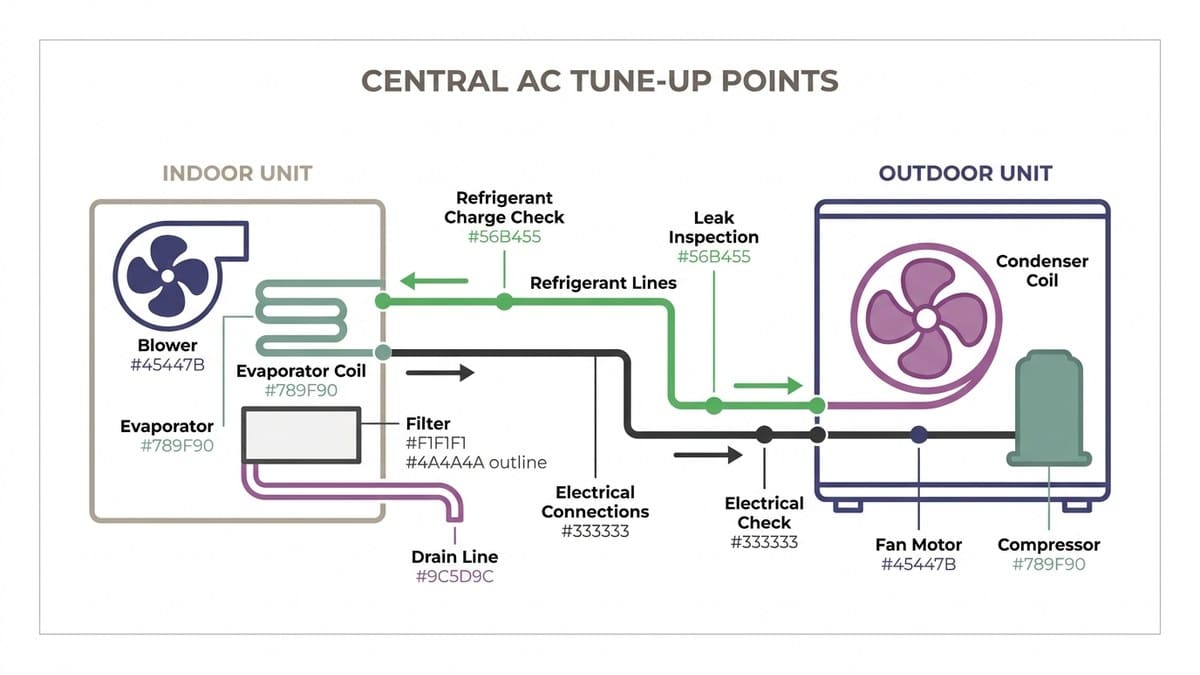
Takeaway: a tune-up looks at the exact parts that fail first in Arizona heat.
How do you know your AC can’t wait?
Don’t wait if you notice weak airflow, rising energy bills, strange noises, ice on the unit, or rooms that won’t cool. Those are signs of an active problem, and a tune-up date is the wrong answer to them. Call for service now.
A calendar is a good guide when your system is healthy. It is a bad guide when something is already wrong. Here is what should move you to the front of the line:
- Weak airflow. Vents that blow softly may point to a blocked filter, a failing blower, or a duct problem.
- Rising energy bills. If your bill climbs and your habits haven’t changed, the system may be working too hard.
- Strange noises. Grinding, squealing, or banging means a part is struggling.
- Ice on the unit. Ice on the coil or lines means airflow or refrigerant trouble. Turn the system off and call.
- Rooms that won’t cool. Uneven cooling can mean a duct, airflow, or charge issue.
Our technicians advise a simple habit that helps prevent freeze-ups: check your AC filter every month throughout summer. It takes a minute and costs very little.
If you see any of the signs above, read our guide on warning signs that mean you need service soon. Then call. You will not be bothering us, and you will not be “wasting” an appointment. Early attention is exactly what keeps a small problem small.
Takeaway: symptoms beat the calendar, so call when something is off.
What if summer has already started?
Book anyway, and book now. Ask for the earliest open slot and tell the office what your system has been doing. A tune-up in June still beats a breakdown in July. If it is running poorly right now, say so, because that changes the visit.
Here is a practical plan for homeowners who are starting late.
- Call and describe what you see. Tell us if airflow is weak, if a room is warm, or if you hear a new noise. The more detail, the better we can prepare.
- Ask for the next open appointment. Don’t hold out for a particular day. Flexibility gets you seen sooner.
- Check your filter today. A clogged filter is one of the most common causes of poor cooling. Swap it if it is dirty, then check it monthly.
- Keep the outdoor unit clear. Remove leaves and debris from around it so air can move freely.
- Know what an emergency looks like. If there is no cooling at all, or you see ice on the unit, call right away. We offer 24/7 service and same-day availability for urgent repairs.
If your unit has frozen, here is what to do when your AC freezes up: turn it off first, and let it thaw before you try anything else.
Starting late is not a failure. Plenty of people do. What matters is that you act before the next hot stretch, not after.
Takeaway: in summer, the next open slot is always better than waiting.
The simple rule for picking your date
Here is the whole guide in a few lines. Aim for late winter or early spring. Go first if your system is older or had a rough summer. Let your plan set the date if you have one. Schedule before a sale if you are listing or buying. And if summer is already here, book the next opening.
Spring AC tune-up timing Arizona homeowners can trust comes down to one idea: do it while the weather is kind and the calendar is open. A tune-up is not a magic fix, and it will not make an old system new. What it does is give you a clear picture and a fair chance of a quiet summer. If you want to see everything we do for homes and businesses, browse our full range of residential and commercial HVAC services.
Ready to put your tune-up on the calendar before the heat does it for you? One call gets you the next open slot.