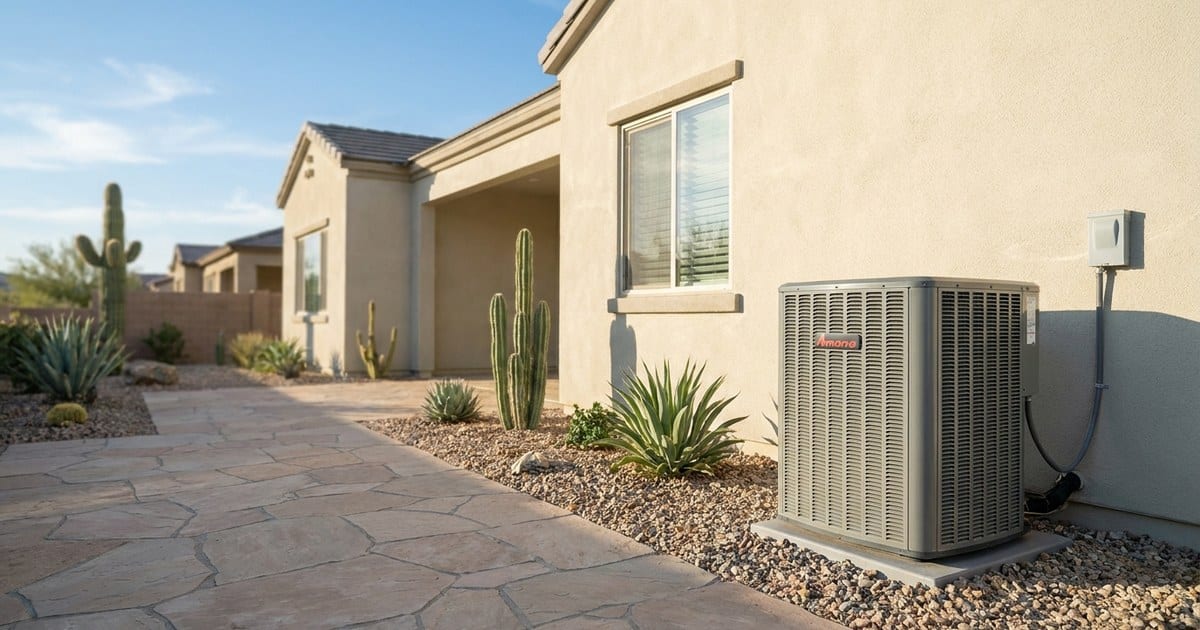

How does AC refrigerant leak detection repair work? It starts with a technician confirming low charge, then locating the leak with electronic detectors, UV dye, or a pressure test. Once found, the leak is repaired or the failed part replaced, the system is evacuated, and recharged to spec. Refrigerant is never “used up,” so a low charge means a leak.
It is a July afternoon in the East Valley. The AC has run for hours, and the house still won’t cool. That slow slide is classic AC cooling loss, and a refrigerant leak is one of its most common causes.
You may be wondering if the system just needs a little more refrigerant. We’ll answer that first: no. In our work with East Valley homeowners, low refrigerant in a system we service almost always means a leak that needs professional attention.
Before you assume the worst, rule out other reasons your AC isn’t blowing cold air. Then read on. This guide to AC refrigerant leak detection repair covers symptoms, safe checks, how leaks get found, health questions, repair steps, cost drivers, and how to decide between fixing and replacing. Our stance is simple: fix the cause, not the symptom.
Why does low refrigerant always mean a leak?
Refrigerant is not fuel. It circulates in a sealed loop, picking up heat inside your home and releasing it outside, and it is never consumed along the way. If the level is low, it escaped somewhere. In our experience servicing East Valley systems, low refrigerant almost always points to a leak that needs professional attention.
That is why “can’t you just top it off?” is the most common question we hear. A top-off treats the gauge, not the hole. The new refrigerant slips out the same way the old charge did. You pay twice, the system runs low in between, and the compressor works harder than it should. Refrigerant that escapes also doesn’t belong in the air, so adding more without a fix is wasteful in every sense.
The local climate makes this show up fast. Systems in Gilbert, Queen Creek, Apache Junction and across the greater East Valley run hard for months. A small loss that might go unnoticed in a mild climate becomes obvious here when the afternoon heat arrives. As a family-owned HVAC company serving the area, we see the same pattern every summer.
Age matters too. Older systems may use R-22, a refrigerant that is no longer made. That affects which repair options make sense and what they cost. We cover it in detail in our piece on how older refrigerant types affect repair costs.
In AC refrigerant leak detection repair, a low charge is a symptom of a leak, and fixing the leak is the only repair that lasts.
What are common refrigerant leak symptoms?
Refrigerant leak symptoms usually build slowly, which is why many homeowners miss them until the heat peaks. Here is what to watch for, and why each sign happens.
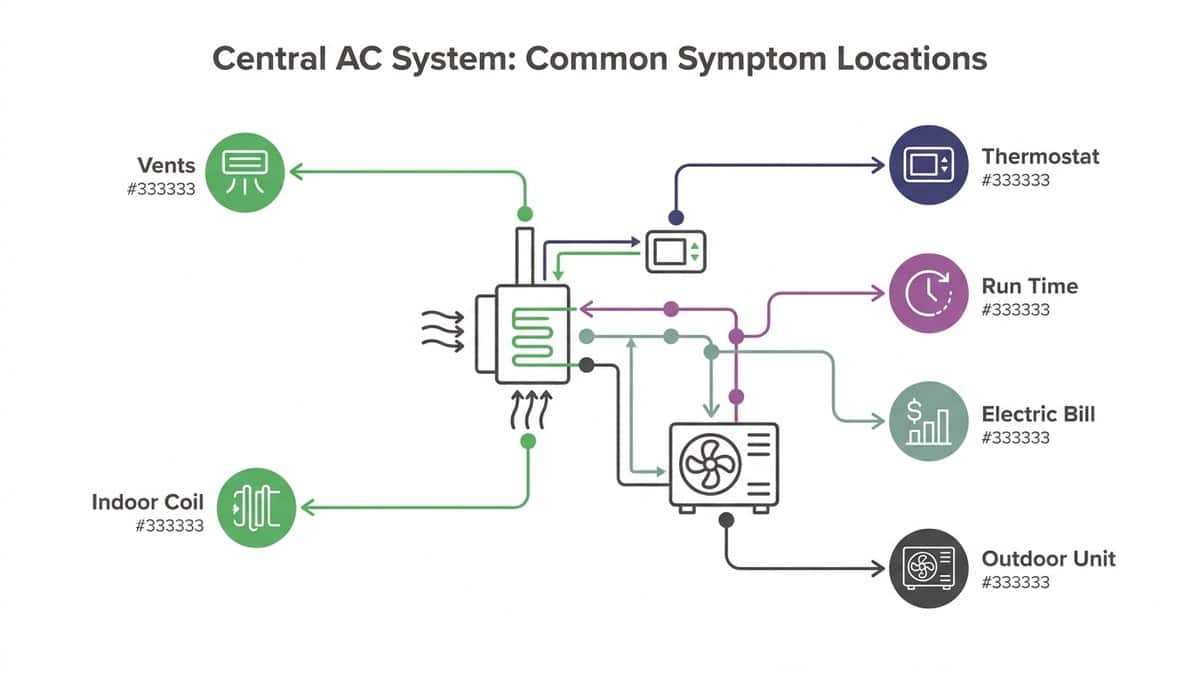
- Warm or weak air from the vents. With less refrigerant in the loop, the indoor coil can’t absorb as much heat from your air.
- A house that won’t reach the thermostat setting. The system keeps running but can’t remove enough heat to finish the job.
- Ice on the indoor coil or refrigerant line. A low charge can drop the coil’s pressure and temperature so far that moisture freezes on it. Ice then blocks airflow and makes cooling worse.
- Longer run times. The system runs more to make up the difference, and it rarely catches up on the hottest days.
- Rising electric bills. Longer run times use more power, so a bill that creeps up with no change in habits is a clue.
- A hissing or bubbling sound near the unit. Refrigerant escaping through a small opening can make noise. Many leaks are silent, so don’t count on hearing one.
- Oily residue on lines or fittings. Oil travels with refrigerant, so a greasy spot on a joint can mark where it is escaping.
Ice deserves special attention. If you see frost on the lines or coil, switch the system off and let it thaw before it runs again. Thawing is the safe first step before anyone looks at the system.
No single sign proves a leak. A clogged filter, a dirty coil or a failing part can cause similar problems. The pattern is what matters. Weak cooling plus ice plus longer run times points strongly toward refrigerant. If the vents blow warm air and you aren’t sure why, AC Blowing Warm Air? Here’s Why & How to Fix It Fast walks through a few quick checks that help you sort out what is simple and what isn’t. That is why AC refrigerant leak detection repair begins with a diagnosis, not an assumption.
When several of these signs show up together, treat it as a leak until a technician proves otherwise.
Can I check for a refrigerant leak myself?
You can spot warning signs, like ice, weak airflow or a dirty filter. You cannot safely confirm or fix a leak yourself. Handling refrigerant requires certification and the right tools, so the next step is a professional diagnosis.
Here is what you can safely do:
- Check the filter. We advise homeowners to check AC filters every month throughout summer to help prevent freeze-ups. A clogged filter starves the coil of air and can mimic a leak.
- Look for ice. Check the indoor coil area and the larger refrigerant line. If you find any, see Quick Solutions When Your AC Freezes Up in Mesa.
- Feel the airflow. Compare how strong the air is at each vent.
- Look at the outdoor unit. Make sure it is running and that leaves, grass or debris aren’t blocking it.
Here is what to leave alone. Don’t add refrigerant from a store-bought can, don’t tape or patch lines, and don’t open any part of the sealed system. Federal rules require certified technicians to handle refrigerant and prohibit releasing it into the air. Even the repair itself is held to a standard. The EPA Section 608 fact sheet for technicians (2016) states that initial and follow-up verification tests of leak repairs are required for appliances that exceed the applicable leak rate. That rule covers larger equipment, but it shows how seriously a repair must be proven, not assumed.
Our team handles AC repair, installation and replacement, and maintenance and tune-ups for homes and businesses. If your quick checks don’t solve the problem, read how to tell whether you need professional AC repair and make the call.
AC refrigerant leak detection repair is certified work: a homeowner can look and listen, but only a technician can confirm and fix.
How does AC refrigerant leak detection work?
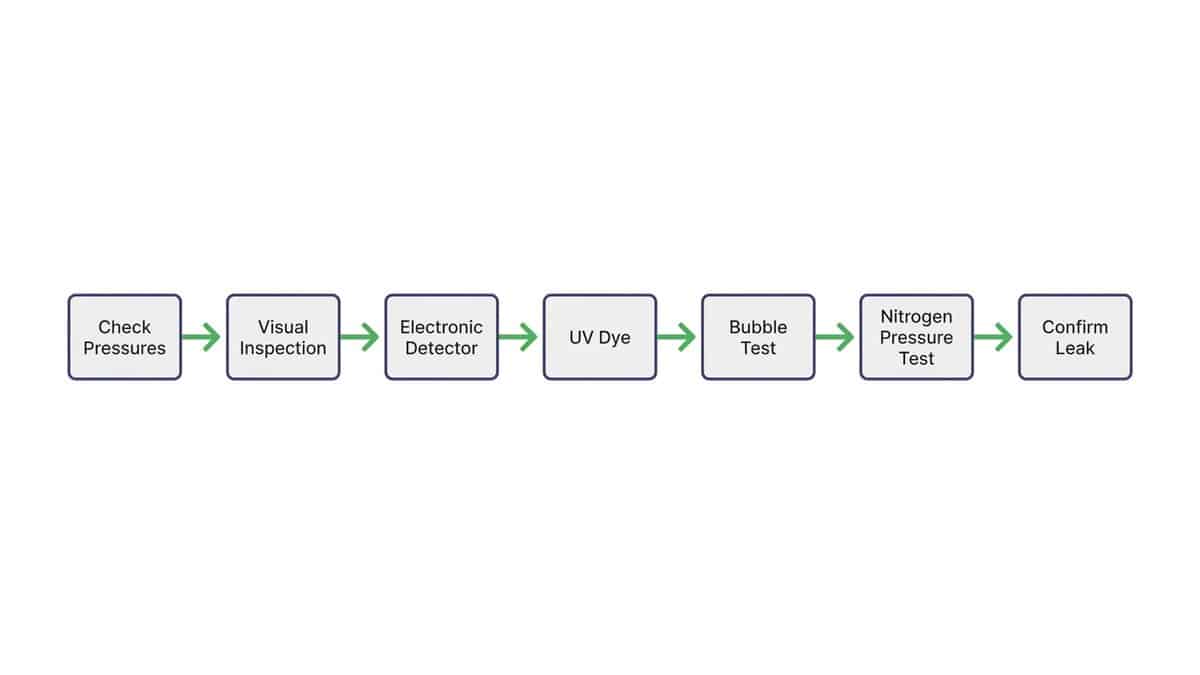
A technician checks pressures and performance first. Then they pinpoint the leak with an electronic detector, UV dye, a soap-bubble test on accessible joints, or by pressurizing the system with nitrogen and monitoring for a drop. These are common methods technicians use, and a good diagnosis often combines more than one.
Good AC refrigerant leak detection repair work starts with finding the leak rather than guessing at it. Our technicians have training and experience across installations, replacements, maintenance and repair, and that background helps them read a system before they recommend anything. Here is the order work typically follows.
Step one: pressures and performance
The technician connects gauges and measures how the system is behaving. Low pressure, poor temperature drop across the coil and ice patterns tell them whether low charge is likely. This step confirms the problem. It does not show where the leak is.
Electronic detectors
A handheld electronic detector senses refrigerant in the air. The technician moves it slowly along coils, joints, fittings and lines. It is quick and sensitive, but air movement and nearby sources can confuse it, so it works best with a patient hand.
UV dye
A small amount of fluorescent dye is added to the system and circulates with the refrigerant. After the system runs, a UV light makes the dye glow at the leak. This is useful for slow leaks that are hard to find in one visit.
Soap-bubble tests
On accessible joints and fittings, a soapy solution forms bubbles where refrigerant escapes. It is simple and low-tech, and it only works where the technician can reach the suspected spot.
Nitrogen pressure testing
When the system is empty or the leak is large, the technician can pressurize it with nitrogen and watch whether the pressure drops. Nitrogen is inert and doesn’t pollute the air, so it is a clean way to prove a leak exists and to test a repair.
Each method has limits, which is why a proper diagnosis beats a guess. Careful diagnosis also keeps the bill honest, because you only pay to fix what is actually broken. Our broader breakdown of AC repair costs in Arizona shows how diagnosis fits into the total.
AC refrigerant leak detection repair rests on a process of confirming, narrowing down and proving, not a single gadget.
Are AC refrigerant leaks dangerous to your health?
Small leaks in a home are usually a system problem more than a health emergency. In a closed, unventilated space, exposure can still irritate the eyes, nose and throat or cause headaches. If you suspect a leak and notice an unusual smell or feel unwell, ventilate, turn the system off, and call a technician.
We want to stay calm and accurate here. A slow leak from a home AC does not usually put a family in danger, and fear isn’t a good basis for a repair decision. Refrigerant also isn’t something to breathe on purpose. Here is a sensible plan:
- Open windows and doors to let fresh air in, especially near the indoor unit or a closet where it is installed.
- Turn the AC off at the thermostat.
- Keep children and pets out of the area if the smell is strong.
- Call a technician. Don’t try to find or fix the leak yourself.
If anyone in the house feels unwell, get fresh air and seek medical advice. That is a good rule for any indoor air concern.
For most homeowners, the larger practical risk is to the equipment. Running with low refrigerant can overheat and damage the compressor, which is the most expensive part of the system. A small leak caught early is usually a much simpler repair than a failed compressor later.
Our approach is owner-led care. We are a family-owned company, and our neighbors across the East Valley are the people we serve. That means we tell you what is happening in plain words and what it means for your family and your home. You’ll get an honest explanation, not a scare.
Treat a suspected leak as a reason to call a professional promptly, not as a reason to panic. Professional AC refrigerant leak detection repair is the right next step whatever the health picture turns out to be.
How is an AC refrigerant leak repaired?
A proper repair confirms the low charge, locates the leak, fixes or replaces the failed part, evacuates the system and recharges it to spec. Topping off alone is not a repair. Here is the sequence a thorough technician follows.
- Confirm. Pressures and performance readings show the system is low on refrigerant.
- Locate. The technician uses the detection methods described above to find the exact source.
- Recover. Where needed, the remaining refrigerant is captured properly rather than vented, in line with federal rules.
- Repair or replace. A loose fitting may be tightened or re-made. A cracked joint can be brazed. A leaking valve or a failed coil section may need replacing.
- Evacuate. The technician pulls a vacuum to remove air and moisture from the sealed loop. Moisture left inside can cause damage later.
- Recharge to spec. The correct refrigerant type and amount go back in, based on the manufacturer’s specification, not a guess.
- Test. The technician rechecks pressures, temperatures and the repair area to confirm the leak is gone.
Why not just add refrigerant? Because topping off skips steps two through four. It leaves the leak in place, so the problem returns, usually at the worst time. A repair that skips evacuation or ignores the charge spec can also reduce efficiency and shorten the life of the equipment.
We offer AC repair, installation and replacement, maintenance and tune-ups, heating repair, and thermostat services. We provide quick repairs, regular maintenance and complete system upgrades for homes and businesses. Because we can do all three, we can recommend honestly in either direction. See our full range of HVAC services for residential and commercial properties across the East Valley.
When the heat is on and the house won’t cool, same-day availability and emergency repair matter. We show up when it counts, and we’ll tell you plainly what we find.
Proper AC refrigerant leak detection repair fixes the leak, restores the correct charge and proves the result.
How much does AC leak repair cost?
Many people searching for leak repair cost Arizona homeowners can trust want a single number. We won’t invent one, because an honest price depends on your system. Leak repair cost depends on leak location, the part involved, refrigerant type, system age, and whether diagnosis plus repair or more work is needed.
Here is how each factor changes the picture:
- Leak location. A leak at an accessible fitting is quicker to reach and fix than one buried inside a coil.
- The part involved. A valve, a joint, a line or a coil are different jobs with different parts and labor.
- Refrigerant type. Newer refrigerants and older ones that are no longer made affect cost and availability. That is part of why age matters.
- System age. An older system may have other worn parts, which can change the sensible choice.
- Scope of work. Some visits are diagnosis plus a simple repair. Others find additional problems that need attention.
Waiting also changes the math. A system run with low refrigerant can damage the compressor, which turns a small repair into a large one. Our look at the cost of emergency AC repair versus preventive maintenance explains why catching problems early usually costs less.
What we can promise is a process. You get a free on-site estimate and transparent pricing before work starts, with no hidden fees. Our owner, Bill Milbourn, built this company on honest work and fair pricing, and that is how the team approaches every estimate. If a part isn’t needed, we won’t put it on the list. Our technicians’ training across installs, replacements, maintenance and repair means we can explain what is necessary and what is optional.
Ask for the estimate in writing, and ask what each line covers. You should understand the leak, the fix and the result before you say yes.
Your price for AC refrigerant leak detection repair depends on where the leak is and what it touches, and you should know it before any work begins.
Should I repair the leak or replace my AC?
It depends on where the leak is, how old the system is, what refrigerant it uses and what the repair costs against the system’s remaining life. A leak at an accessible joint is often worth fixing. A leaking coil on an aging system may not be.
We sell installations, and we’ll still tell you when repair is the better call. Quality over volume is how we work. Here is a simple lens for the decision:
- Age. The older the system, the more likely other parts are close to wearing out too.
- Refrigerant type. Systems that use an older refrigerant no longer made can face higher repair costs and fewer options.
- Leak location. An easy-to-reach joint is a very different repair from a failed evaporator coil.
- Repair history. If you’ve had repeated repairs, each new one buys less.
- Compressor condition. A healthy compressor favors repair. A damaged one often tips the balance. See what a failed compressor means for your repair decision.
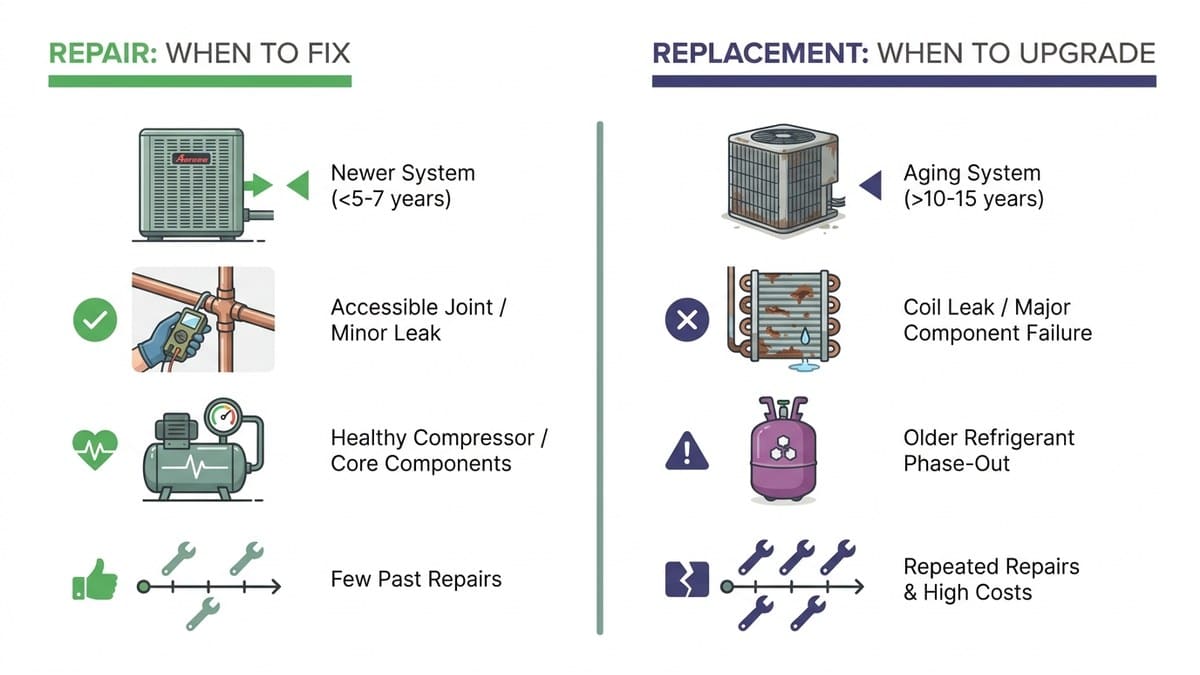
No single factor decides it. A newer system with an accessible leak and a sound compressor is a strong candidate for repair. An aging system with a coil leak and a long repair history may be better served by replacement, especially if the older refrigerant is a factor.
You deserve to see both options in plain terms. We weigh the cost of fixing the leak against the life left in the system, and we’ll tell you honestly if the repair doesn’t make sense. Our repair-versus-replacement decision framework goes deeper if you want to work through it yourself before you call.
The right answer is the one that protects your budget and your comfort, not the one that earns us the bigger invoice.
How do you keep refrigerant leaks from starting?
You can’t prevent every leak, but you can lower the odds and catch problems while they are small. Regular maintenance, monthly filter checks through summer, and catching small problems early help prevent refrigerant leaks and freeze-ups.
Think of it as three habits:
- Check the filter every month in summer. Airflow protects the coil.
- Schedule a tune-up. A technician can spot wear, loose fittings, oil stains and early coil problems before they become leaks. We offer maintenance and tune-ups for this reason.
- Act on small signs. Weaker cooling, a new noise or a bit of ice are cheaper to address early. Review signs your AC needs repair and the red flags not to ignore.
This isn’t about pressure. It’s about giving a system that works hard in the Arizona heat a little attention before it asks for a lot.
Small habits and early attention keep a minor issue from becoming a major one.
What should you do next?
Here’s the short version. In AC refrigerant leak detection repair, low refrigerant means a leak, and a top-off alone is only a patch. Symptoms like weak cooling, ice and longer run times are your cue to get the system checked. A proper repair finds the leak, fixes it, recharges to spec and tests the result.
You don’t have to figure this out alone, and you don’t have to guess whether it is a quick fix or a bigger decision. We are a family-owned team serving Gilbert, Queen Creek, Apache Junction and the greater East Valley. We take care of homeowners and commercial properties under the same standard through our heating and cooling services, and we’ll give you an honest answer about what is needed and what isn’t. Our owner-led approach means you’ll deal with people who live in this community and answer for their work.
If your AC is losing cooling, our East Valley team can find the cause and give you a clear estimate before any work starts.