
You’re standing in the hardware store aisle staring at a wall of air filters. MERV 8, MERV 11, MERV 13. FPR 7, MPR 1500. The box says “hospital-grade filtration” but costs twice as much as the one next to it. You just want to keep your Gilbert home’s air clean without wrecking your AC or wasting money, but every package reads like a foreign language.
What does MERV actually mean, and which rating do you need? MERV stands for Minimum Efficiency Reporting Value: a scale from 1 to 20 that measures how well an air filter captures airborne particles. Most Arizona homes perform best with MERV 8 to MERV 13 filters, balancing air quality with HVAC airflow. Higher isn’t always better; the right rating depends on your system, household needs, and ductwork.
This guide breaks down the three most common residential MERV ratings (8, 11, and 13), explains what each one captures, and helps you match the filter to your home and HVAC system, not the marketing hype. No sales pitch, just the straight answer you came for. Our HVAC services across the East Valley start with honest guidance, and that includes helping you pick the right filter before you buy.
What Is a MERV Rating? (And Why It Matters for Your HVAC System)
MERV stands for Minimum Efficiency Reporting Value. It’s a scale from 1 to 20 developed by ASHRAE (American Society of Heating, Refrigerating and Air-Conditioning Engineers) to measure how well an air filter captures particles of different sizes. The higher the MERV number, the smaller the particles the filter can trap.
Here’s what each tier captures:
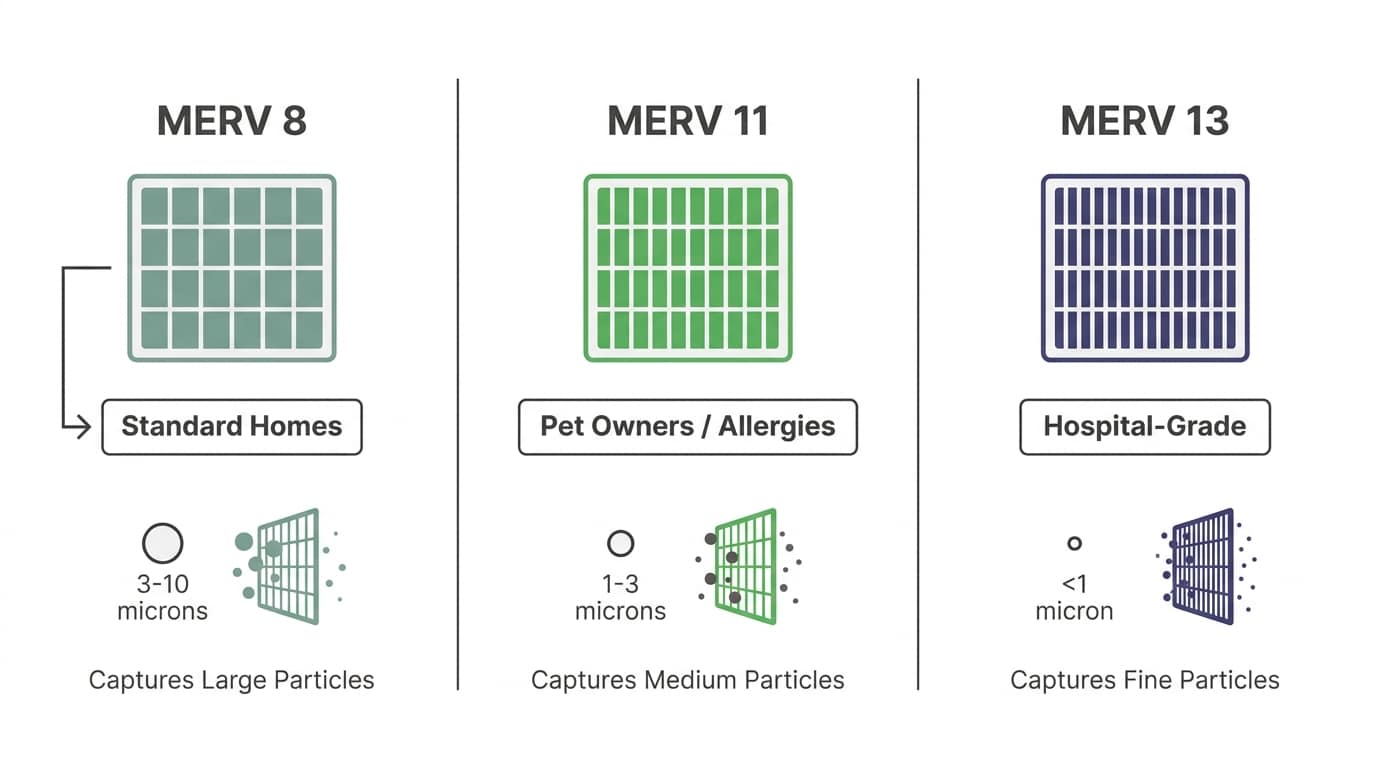
- MERV 1–4: Coarse particles only (dust, lint, pollen larger than 10 microns). These are the basic filters that come with cheap window AC units.
- MERV 5–8: Dust, pollen, mold spores, pet dander (3–10 microns). This is the sweet spot for most homes.
- MERV 9–12: Finer dust, smog, some bacteria, most pet dander (1–3 microns). Good for allergy sufferers and homes with pets.
- MERV 13–16: Smoke, bacteria, virus carriers, particles smaller than 1 micron. Hospital-grade filtration.
But here’s the catch: higher MERV means more airflow resistance. The denser the filter material, the harder your AC’s blower motor has to work to pull air through. If your system wasn’t designed for MERV 13, forcing it to run with a high-efficiency filter can reduce airflow, freeze the evaporator coil, and strain the compressor. We see this every summer in Gilbert and Mesa. Homeowners buy MERV 13 thinking they’re doing the right thing, then call us six weeks later with a frozen coil and weak airflow.
Your HVAC system needs the right balance: a filter that captures what matters (pollen, dust, pet dander) without choking the airflow. That’s why knowing your system’s capacity is just as important as knowing what MERV rating you want. Our air conditioning maintenance plans include airflow assessments to make sure your filter and system are matched.
MERV 8 vs. MERV 11 vs. MERV 13: Which One Do You Actually Need?
Most Arizona homeowners end up choosing between three MERV ratings: 8, 11, or 13. Here’s what each one does, who it’s for, and when it’s overkill.
MERV 8: The Standard Workhorse for Most Arizona Homes
MERV 8 filters capture dust, pollen, lint, and mold spores in the 3–10 micron range. If you don’t have pets, allergies, or respiratory issues, MERV 8 handles everything your home needs. It’s the most common residential filter in Arizona for a reason. It balances air quality with airflow, it’s inexpensive, and it’s available everywhere.
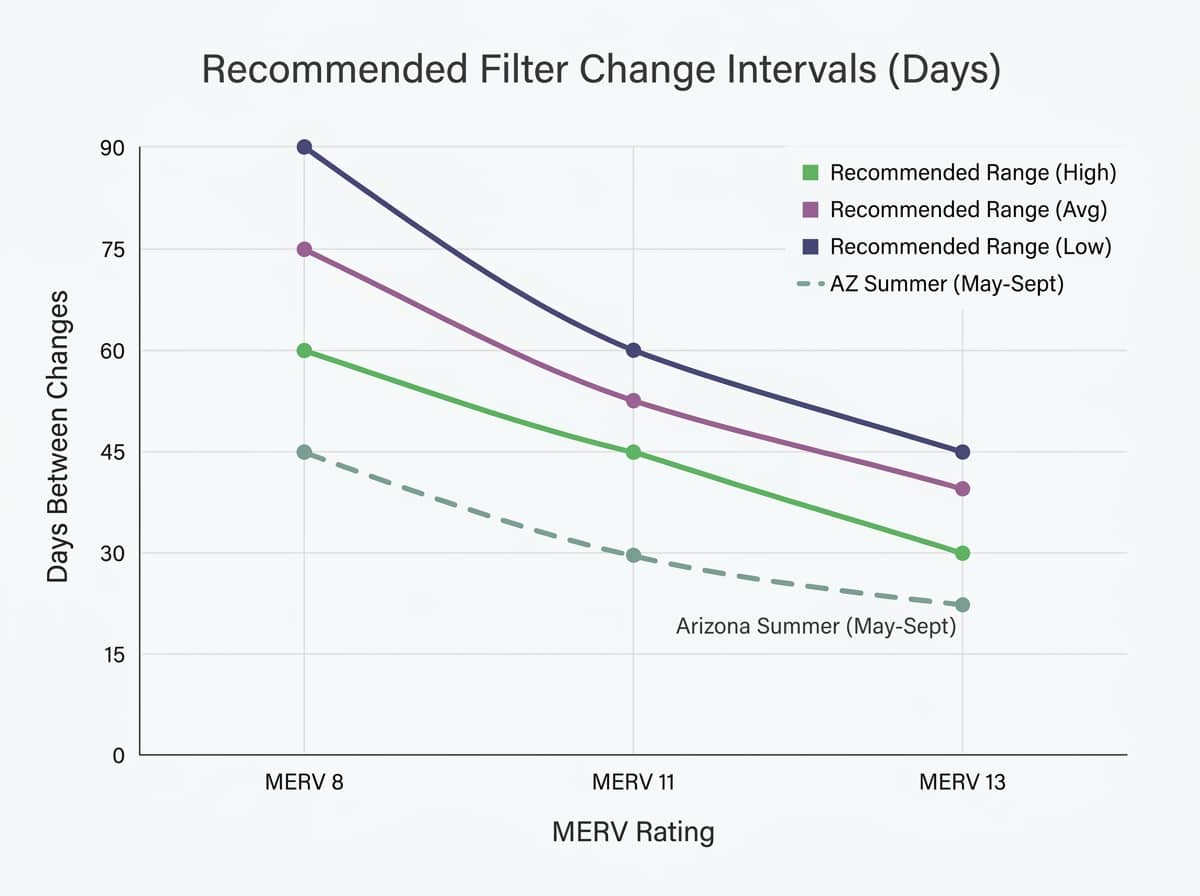
Best for: Standard homes without special air quality needs. Good airflow, minimal strain on the blower motor, and affordable enough to change every 60–90 days without hesitation.
Trade-off: MERV 8 won’t catch fine dust, smoke, or bacteria. If you’re dealing with wildfire smoke season or severe allergies, you’ll want to step up.
In our work with East Valley homeowners, MERV 8 is the baseline we recommend for most older systems (10+ years). It keeps the air clean without forcing the blower to work harder. For detailed seasonal maintenance tips, check out our guide on planning your Arizona AC tune-up.
MERV 11: The Upgrade for Pet Owners and Allergy Sufferers
MERV 11 captures everything MERV 8 does, plus pet dander, smog, and finer dust in the 1–3 micron range. If you have dogs, cats, or family members with mild to moderate allergies, MERV 11 makes a noticeable difference in air quality without significantly restricting airflow.
Best for: Homes with pets, allergy sufferers, or anyone living in dusty Arizona environments (Gilbert, Mesa, Queen Creek). MERV 11 is the filter we install most often because it strikes the balance between air quality and system performance.
Trade-off: Slightly more airflow restriction than MERV 8. Most modern HVAC systems handle MERV 11 without issue, but older systems (especially those with undersized blower motors) may need an airflow check first. EPA guidance on air filtration notes that MERV 11 filters provide significant improvement in capturing common household allergens while remaining compatible with most residential systems.
In our 3,000+ installations across the East Valley, we’ve found that most residential HVAC systems run best on MERV 11. It handles pet dander, pollen, and Arizona dust without choking the AC. For most Gilbert families, MERV 11 is the right call.
MERV 13: Hospital-Grade Filtration (Use with Caution)
MERV 13 filters capture everything MERV 11 does, plus smoke, bacteria, and virus carriers smaller than 1 micron. This is the rating used in hospitals, surgery centers, and commercial buildings with advanced HVAC systems.
Best for: Households with severe allergies, asthma, immunocompromised members, or significant wildfire smoke exposure. MERV 13 makes sense if you have a medical reason to filter out fine particulates and your HVAC system was designed to handle the airflow restriction.
Trade-off: High airflow restriction. Older HVAC systems and undersized blower motors struggle with MERV 13. Forcing a filter your system can’t handle leads to frozen evaporator coils, reduced cooling capacity, and blower motor strain. CDC guidance on ventilation recommends upgrading to MERV 13 in homes with immunocompromised individuals or during wildfire smoke events, provided the HVAC system can handle the increased resistance.
We only recommend MERV 13 after assessing the blower motor and ductwork. A 10-minute static pressure test tells us whether your system can handle the upgrade without performance loss. If you’re considering MERV 13, talk to us before you buy. We’ll make sure your air conditioning system can support it.
How to Choose the Right MERV Rating for Your Home
The right MERV rating isn’t the one with the highest number on the package. It’s the one that fits your household needs, your HVAC system’s capacity, and your budget. Here’s how to decide.
1. Start with your household composition. Do you have pets? Allergy sufferers? Anyone with asthma or respiratory conditions? Smokers? If the answer is no to all of the above, MERV 8 is probably enough. If you have pets or mild allergies, step up to MERV 11. If you have severe allergies, asthma, or immunocompromised family members, MERV 13 makes sense (but only after confirming your system can handle it).
2. Check your HVAC system’s age and design. Older systems (10+ years) were typically designed for MERV 8. Newer high-efficiency systems can handle MERV 11 or even MERV 13, but you should check the owner’s manual or ask your HVAC tech. If you’ve noticed weak airflow, frequent filter clogging, or ice on the indoor coil, you may already be over-filtering.
3. Factor in Arizona-specific air quality challenges. Dust storms, wildfire smoke season, and high pollen counts in the East Valley mean your filter works harder than it would in other climates. MERV 11 handles Arizona dust and pollen without overworking your system. MERV 13 is overkill unless you’re managing severe allergies or smoke exposure (and even then, we recommend a system assessment first).
4. Consider airflow capacity. If your HVAC system struggles with airflow (long run times, uneven cooling, ice buildup), stepping up to a higher MERV can make the problem worse. A clogged MERV 13 filter is worse than a clean MERV 8. Your filter should never force the blower motor to work harder than it was designed to.
In our work with East Valley homeowners, we’ve learned that most systems run best on MERV 11. It strikes the balance between air quality and airflow without the risks of over-filtering. For seasonal maintenance tips and filter change reminders, check out how to prep your AC for Gilbert’s hot summer.
Common MERV Rating Mistakes (And How to Avoid Them)
Here are the top four mistakes we see Arizona homeowners make when buying air filters, and how to avoid them.
Mistake 1: Buying the highest MERV “just to be safe.” The assumption is simple: higher number equals better air quality, so why not go with MERV 13? The problem is airflow restriction. If your system wasn’t designed for MERV 13, you’re forcing the blower motor to work harder, which can freeze the evaporator coil, reduce cooling capacity, and shorten the system’s life. Fix: Match the MERV rating to your system’s specs, not your assumptions. When in doubt, ask your HVAC tech before you upgrade.
Mistake 2: Ignoring filter size and fit. Even the right MERV rating won’t work if the filter doesn’t seal properly in the slot. Air will bypass the filter entirely, which means you’re breathing unfiltered air and wasting money on a filter that isn’t doing its job. Fix: Measure your filter slot before you buy. Use the exact size printed on your old filter (e.g., 16x25x1). “Close enough” doesn’t work.
Mistake 3: Waiting too long to change the filter. A clogged MERV 13 filter creates more airflow restriction than a clean MERV 8. If you upgrade to a higher MERV but keep your old change schedule (every 90 days), you’re making the problem worse. Fix: Change MERV 8 filters every 60–90 days. Change MERV 11–13 filters every 30–60 days. In dusty Arizona spring and summer months, check your filter monthly.
Mistake 4: Assuming FPR or MPR equals MERV. Home Depot uses FPR (Filter Performance Rating), and 3M uses MPR (Microparticle Performance Rating). Neither scale maps directly to MERV. An FPR 10 is not the same as a MERV 10. Fix: Look for the ASHRAE MERV rating on the package, not the store brand label. Updated CDC and industry guidelines emphasize the importance of using standardized MERV ratings when comparing filter performance.
We see homeowners buy MERV 13 filters thinking they’re doing the right thing, then call us six weeks later with a frozen coil. The filter was working too well (it choked the airflow). When in doubt, ask your tech before you upgrade. Our HVAC system resources cover common filter mistakes and system compatibility.
MERV Ratings and Arizona’s Unique Air Quality Challenges
Arizona air is hard on HVAC filters. Dust storms, wildfire smoke, high pollen counts, and extreme AC runtime mean your filter works harder here than it would in most other climates. Here’s how Arizona-specific air quality challenges affect your MERV rating choice.
Dust storms (haboobs). Fine dust infiltrates homes during monsoon season, especially in the East Valley. MERV 11 or higher helps capture the fine particles that MERV 8 lets through, but only if your system can handle the airflow restriction. After a dust storm, check your filter. If it’s visibly clogged, replace it early.
Wildfire smoke. Arizona’s spring and summer wildfire seasons bring smoke from in-state fires and neighboring states. MERV 13 filters capture smoke particles smaller than 1 micron, but only if your HVAC system can handle the increased resistance. During heavy smoke events, MERV 11 is usually enough for most homes without medical air quality needs.
High pollen counts. Desert plants like mesquite, palo verde, and olive trees produce heavy pollen loads in spring. MERV 8 catches most pollen (10+ microns), but allergy sufferers notice a difference with MERV 11. If you’re sneezing indoors in March and April, your filter is the first thing to check.
Extreme AC runtime. Arizona ACs run 6–8 months a year at high load. A restrictive filter (MERV 13 on a system designed for MERV 8) forces the blower to work harder, which drives up energy bills and accelerates wear. Gilbert and Mesa homeowners deal with dust year-round, and many assume they need the highest MERV filter to keep up. But in our 3,000+ installations, we’ve learned that MERV 11 handles Arizona dust and pollen without overworking the system. Research on indoor air quality and respiratory health shows that MERV 11+ filters significantly reduce indoor particulate matter levels in dusty climates.
Arizona air is tough on filters, but that doesn’t mean you need hospital-grade filtration. The right filter keeps your air clean without burning out your AC in the summer heat. For more on managing AC performance during Arizona’s extreme summers, read why summer in Mesa demands fast AC repair.
When to Call a Pro: MERV Ratings and System Compatibility
Most homeowners can handle filter changes on their own, but choosing the right MERV rating for your specific system is a different question. Here’s when you should call a professional before you upgrade.
You want to upgrade to MERV 13 but don’t know if your system can handle it. A static pressure test takes 10 minutes and tells you whether your blower motor and ductwork can support MERV 13 without airflow loss. If your system is borderline, we’ll recommend MERV 11 instead. You get better air quality than MERV 8 without the risks of over-filtering.
You’ve noticed weak airflow, frozen coils, or frequent filter clogging after switching to a higher MERV. These are symptoms of airflow restriction. If your system is struggling with the current filter, stepping back down to MERV 8 or 11 may solve the problem. We’ll measure airflow, check the evaporator coil, and recommend the highest MERV your system can safely run. For diagnostic questions, you can review our guide on whether you really need professional AC repair in Mesa.
Your HVAC system is 10+ years old and you’ve never had a blower motor or ductwork assessment. Older systems were typically designed for MERV 8. If you’re upgrading to MERV 11 or 13, you need to know whether your blower motor has the capacity. A professional assessment prevents the frozen coils and compressor strain we see every summer in Gilbert and Mesa.
You’re installing a new HVAC system and want to design ductwork and filtration together. This is the best time to spec out the MERV rating you want. We can size the blower motor, design the ductwork, and install a filter rack that supports MERV 11 or 13 without airflow loss. Retrofitting a mismatched filter later is harder (and more expensive).
We’re not selling you a filter. We’re making sure the filter you choose works with your system, not against it. A 10-minute assessment can save you hundreds in repair bills and energy costs. Our HVAC tips and updates cover common compatibility issues and seasonal maintenance schedules.
Conclusion
The right air filter isn’t the one with the highest number on the package. It’s the one that fits your system, your household, and your budget. For most Arizona homes, MERV 8 handles standard air quality needs without straining the HVAC system. If you have pets or allergies, MERV 11 is the upgrade that makes a difference. MERV 13 is hospital-grade filtration. Use it only if you have a medical reason and your system can handle the airflow restriction.
Gilbert and Mesa homeowners face dust storms, wildfire smoke, and extreme AC runtime. Your filter works harder here than it would in most climates, but that doesn’t mean you need the most expensive option. In our 3,000+ installations across the East Valley, we’ve seen what happens when homeowners over-filter or under-filter. We’re here to help you get it right (no sales pitch, just straight answers).
Bill and the JLM team live in your community. We’re the neighbors you call when your AC freezes up in July or when you’re standing in the hardware store aisle wondering which filter to buy. We’ll help you match the MERV rating to your system, your household needs, and Arizona’s air quality challenges.