Introduction: The Real Choice Behind “AC Companies Near Me”
Your AC quits on a 110-degree afternoon. You grab your phone, type “AC companies near me,” and your screen fills with names. Some you recognize from billboards and radio ads. Others you’ve never heard of. The franchise brands look polished and established. The local family-owned shop has great reviews but a smaller footprint. Which do you call?
When choosing between local AC companies and large franchises near Gilbert and Queen Creek, homeowners gain direct owner accountability, transparent pricing, and faster service with family-owned providers like JLM. Franchises route calls through corporate layers and often charge franchise fees; local shops deliver personal relationships and same-day emergency response without hidden markups.
This isn’t about one being universally better. It’s about understanding what you’re actually comparing and which model fits your priorities. If you value knowing the person who answers your call is the same person supervising your repair, a local operator makes sense. If brand recognition matters most, a franchise might feel safer. Most East Valley homeowners researching HVAC services across the East Valley discover the structural differences between these models determine their experience more than the company name on the truck.
What You’re Really Comparing: Franchise Model vs. Family-Owned Local Service
The terms “franchise” and “local” describe business structures, not service quality. A franchise HVAC company operates under a national brand license. The technician wearing a Parker & Sons or Goettl uniform works for a local franchisee who pays corporate fees, follows corporate pricing guidelines, and routes customer calls through a centralized system. A family-owned local company like JLM operates independently. Bill owns the business, holds the contractor license, works on jobs alongside his team, and answers the phone himself during emergencies.
Neither model guarantees great service or prevents poor experiences. What the model does determine is how decisions get made, how pricing gets set, who you talk to when something goes wrong, and how quickly help arrives during an emergency.
The rest of this piece evaluates five factors that reveal how these structural differences affect your experience as a customer: pricing transparency, response time, owner accountability, equipment quality, and community reputation. These aren’t subjective preferences. They’re the operational realities that follow from choosing a corporate franchise system versus an owner-operator model.
How Franchise HVAC Companies Operate
A franchise HVAC company licenses a national brand and follows a corporate playbook. The franchisee pays an upfront fee, ongoing royalties (typically 5-8% of revenue), and marketing contributions to the parent company. In return, they get brand recognition, a proven business system, corporate training programs, and centralized call center infrastructure.
Most large HVAC franchises operate across multiple metro areas. Calls go to a dispatch center that routes jobs to available technicians based on territory and schedule. Pricing often follows tiered service plans designed at the corporate level. Technicians receive standardized training and work from corporate-approved equipment catalogs.
The advantages are real. A franchise has deeper pockets for advertising, a larger service footprint, and the perceived safety of a recognizable name. Customers assume (often correctly) that a national brand has quality controls and won’t disappear overnight. For homeowners who prioritize brand familiarity or need service outside a local shop’s territory, franchises deliver value.
The trade-offs emerge in how the corporate structure affects your specific interaction. Royalty fees and marketing overhead get built into pricing. Dispatch layers add steps between your call and the technician’s arrival. Corporate incentives (volume targets, upsell quotas) can misalign with your need for honest advice about what actually requires replacement.
How Family-Owned Local AC Companies Operate
A family-owned local HVAC company operates without franchise fees or corporate oversight. The owner holds the contractor license, makes pricing decisions, and typically works on jobs. The team is smaller, the service area tighter (JLM focuses on communities across Queen Creek and the surrounding East Valley), and the business model depends on repeat customers and referrals rather than brand advertising.
Bill founded JLM after years working for larger companies where upselling took priority over honest diagnostics. He’s licensed, on-site for complex jobs, and accessible by phone. There’s no call center, no royalty structure, no corporate pricing matrix. When you call during an emergency, you’re talking to someone who can make decisions without escalating through layers.
The perceived risks are also real. A local shop lacks the marketing budget and multi-location footprint of a franchise. Customers unfamiliar with the owner rely on reviews and word-of-mouth rather than brand equity. If the owner retires or closes the business, continuity isn’t guaranteed by a corporate parent.
The advantages show up in flexibility, accountability, and cost structure. Without franchise fees, a local operator can price competitively while maintaining quality. Without dispatch bureaucracy, emergency response times shrink. And when something goes wrong, you’re talking directly to the decision-maker who has a personal reputation at stake in your neighborhood.
Five Factors to Evaluate When Comparing AC Companies
Choosing between a franchise and a local HVAC company comes down to five operational factors that affect your experience more than the brand name:
- Pricing transparency and hidden fees
- Response time and emergency service availability
- Owner accountability versus call center routing
- Equipment quality and workmanship standards
- Community reputation and long-term relationships
The next five sections break down how franchise and family-owned models perform on each factor, using real data, customer experiences, and industry benchmarks. By the end, you’ll know which model aligns with what you value most in an HVAC provider.
1. Pricing Transparency and Hidden Fees
Franchise HVAC pricing typically follows tiered service plans built at the corporate level. A basic tune-up might start at $89, but additional diagnostics, refrigerant top-offs, or recommended repairs add charges that aren’t visible until the technician presents options. Corporate pricing structures often include labor rates that subsidize franchise fees and marketing costs. According to Bureau of Labor Statistics data on HVAC service costs, regional pricing variability for identical services can exceed 30%, with corporate overhead cited as a primary driver.
JLM’s pricing model starts with a free consultation and on-site estimate. The quoted price covers labor, materials, permits, and warranty registration. In our 3,000-plus installs, we’ve maintained a policy of no surprise fees after the estimate. What we quote is what you pay. If a job reveals unexpected complications (corroded ductwork, outdated electrical panels), we stop work, explain the issue, provide a revised estimate, and wait for your approval before continuing.
The structural difference matters because franchise technicians often work under sales quotas tied to service plan upgrades or add-on services. Transparent pricing doesn’t mean cheaper. It means you know what you’re paying for and why. When comparing estimates from a franchise and a local shop, ask for itemized breakdowns. If a franchise quote lists “system optimization” or “comprehensive service package” without specifying what’s included, you’re looking at bundled pricing designed to obscure individual line items. For a clear example of how we communicate pricing across different service areas, review our Apache Junction HVAC services page, which details what’s included in every service tier.
2. Response Time and Emergency Service Availability
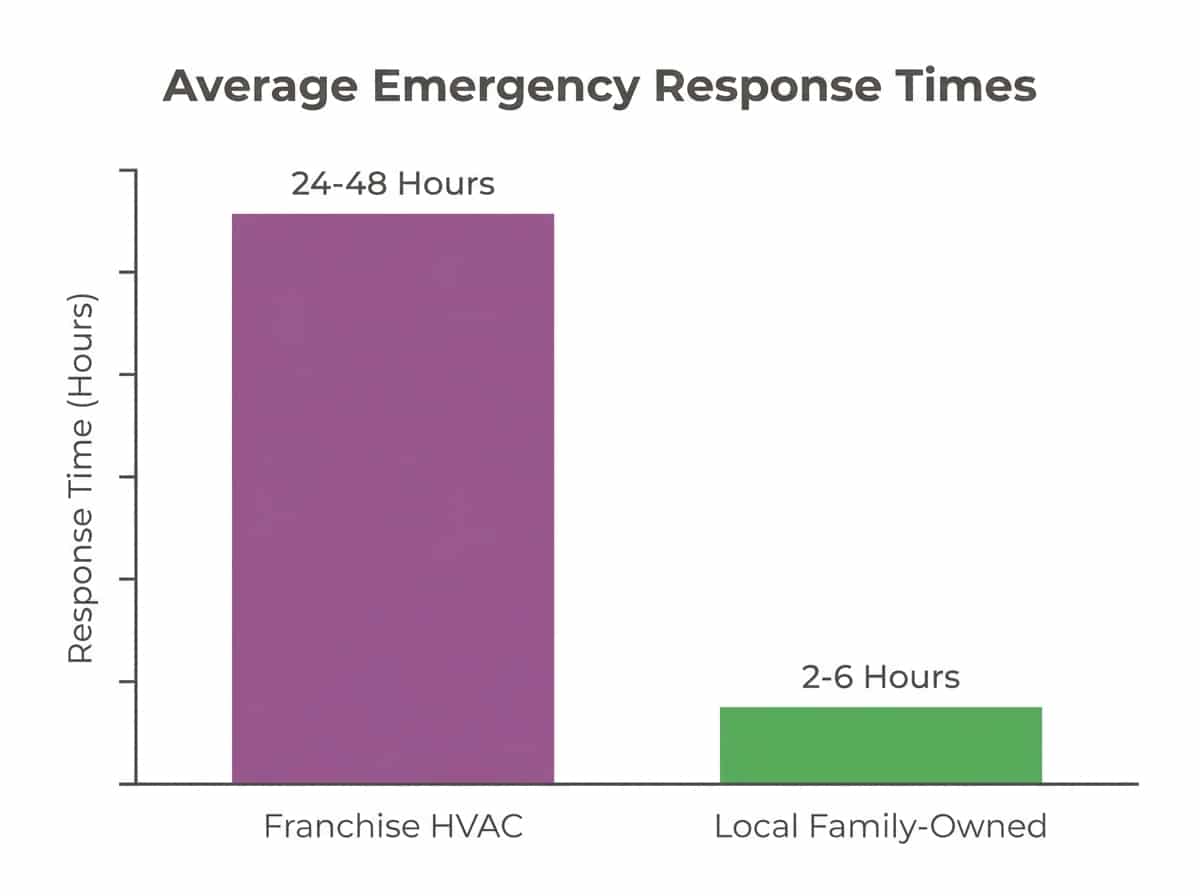
Arizona summers turn AC failures into safety emergencies. When indoor temperatures hit 95 degrees by mid-morning, waiting 24 to 48 hours for a service appointment isn’t an option for families with young children, elderly relatives, or pets. Response time depends on dispatch infrastructure, technician availability, and service area density.
Franchise HVAC companies route emergency calls through centralized dispatch centers that coordinate multiple technicians across large territories. A call to a 1-800 number gets logged, prioritized based on service plan tier, and assigned to the next available tech in your zone. High-demand periods (July and August in Arizona, when call volume spikes according to ENERGY STAR reports on HVAC system stress under extreme heat) can push wait times past 24 hours for non-premium customers.
JLM operates a 24/7 emergency line (602-619-3609) that reaches Bill or a senior technician directly. Because our service area focuses on the East Valley (Gilbert, Queen Creek, Apache Junction), drive times stay under 30 minutes for most calls. Same-day service isn’t a marketing promise. It’s a structural advantage of operating locally. We keep common parts (capacitors, contactors, refrigerant) stocked on every truck so most repairs complete in a single visit.
The difference shows up in real scenarios. A Gilbert homeowner whose AC failed at 9 PM on a Saturday in July called both a major franchise and JLM. The franchise dispatcher quoted a Monday morning appointment (40 hours away). JLM had a technician on-site within 90 minutes, diagnosed a blown fuse, completed the repair, and had the system cooling by 11 PM. Understanding why summer in Mesa demands fast AC repair explains the health risks of extended heat exposure that make response time a critical selection factor.
When evaluating response time, ask specific questions: What’s your average emergency response time during peak season? Do you prioritize calls by service plan tier? How many technicians cover my zip code? A local operator with a tight service area will outperform a franchise with a 50-mile territory during high-demand periods.
3. Owner Accountability vs. Call Center Routing
When your AC breaks down or a repair doesn’t hold, the person you need to talk to is whoever can authorize a return visit, approve a refund, or escalate the issue. Franchise structures put layers between you and that decision-maker. Your call goes to a customer service rep who logs the complaint, escalates to a dispatch supervisor, who contacts the franchise manager, who may or may not have direct authority over the technician who did the original work.
Local family-owned shops collapse that chain. At JLM, Bill owns the business and supervises every installation. If a customer calls with a concern, they’re talking to the person who hired the technician, sourced the equipment, and staked his business reputation on the outcome. There’s no escalation queue, no ticket system, no corporate policy manual to navigate. The decision-maker answers the phone.
This isn’t theoretical. JLM maintains an A-plus BBB rating and a referral-driven customer base because accountability sits with someone who lives in the same community and depends on reputation more than brand advertising. When a capacitor replacement didn’t resolve a cooling issue for a Queen Creek customer, Bill returned the same day, diagnosed a secondary refrigerant leak the first tech missed, and completed the repair at no additional charge. That level of responsiveness doesn’t require exceptional customer service. It requires an owner who answers for the outcome.
Franchise technicians often rotate territories or work for different franchise locations within the same brand. The tech who installed your system may not be available for a follow-up call. The franchise manager who approved your estimate may have moved to a different region. Corporate customer service can issue refunds or schedule callbacks, but they can’t make judgment calls about workmanship quality or authorize exceptions to standardized policies.
Owner accountability also affects long-term service relationships. A local operator who plans to serve the East Valley for the next 20 years has every incentive to fix problems correctly the first time and maintain your system through regular maintenance plans. A franchise tech who might transfer to a different territory next quarter has less personal stake in whether you call them back in five years.
4. Equipment Quality and Workmanship Standards
The assumption that franchises have better resources doesn’t hold up when you examine equipment sourcing and installation practices. Both franchise and local operators buy from the same manufacturers (Amana, Carrier, Trane, Lennox) and follow the same building codes and ACCA installation standards. The difference isn’t access to premium equipment. It’s how financial incentives shape what gets recommended.
Franchise HVAC companies often push proprietary financing, in-house warranty programs, or exclusive equipment bundles that maximize margin. A corporate pricing structure may steer customers toward mid-tier systems that balance cost and commission tiers rather than optimizing for long-term efficiency or the homeowner’s specific cooling load. According to ENERGY STAR efficiency data, high-efficiency systems reduce cooling costs by 15 to 20 percent compared to older units, but franchise sales quotas sometimes prioritize volume over efficiency matching.
JLM installs premium Amana equipment selected for Arizona climate conditions: high SEER ratings, reliable compressors, and parts availability through local distributors. We partner with GoodLeap for financing (customer-friendly terms without dealer markups) and offer JB Warranties for extended coverage. Equipment choices follow customer priorities: cooling capacity for square footage, efficiency targets for budget constraints, and noise levels for bedroom-adjacent installations. There’s no corporate catalog limiting options or commission structure pushing unnecessary upgrades.
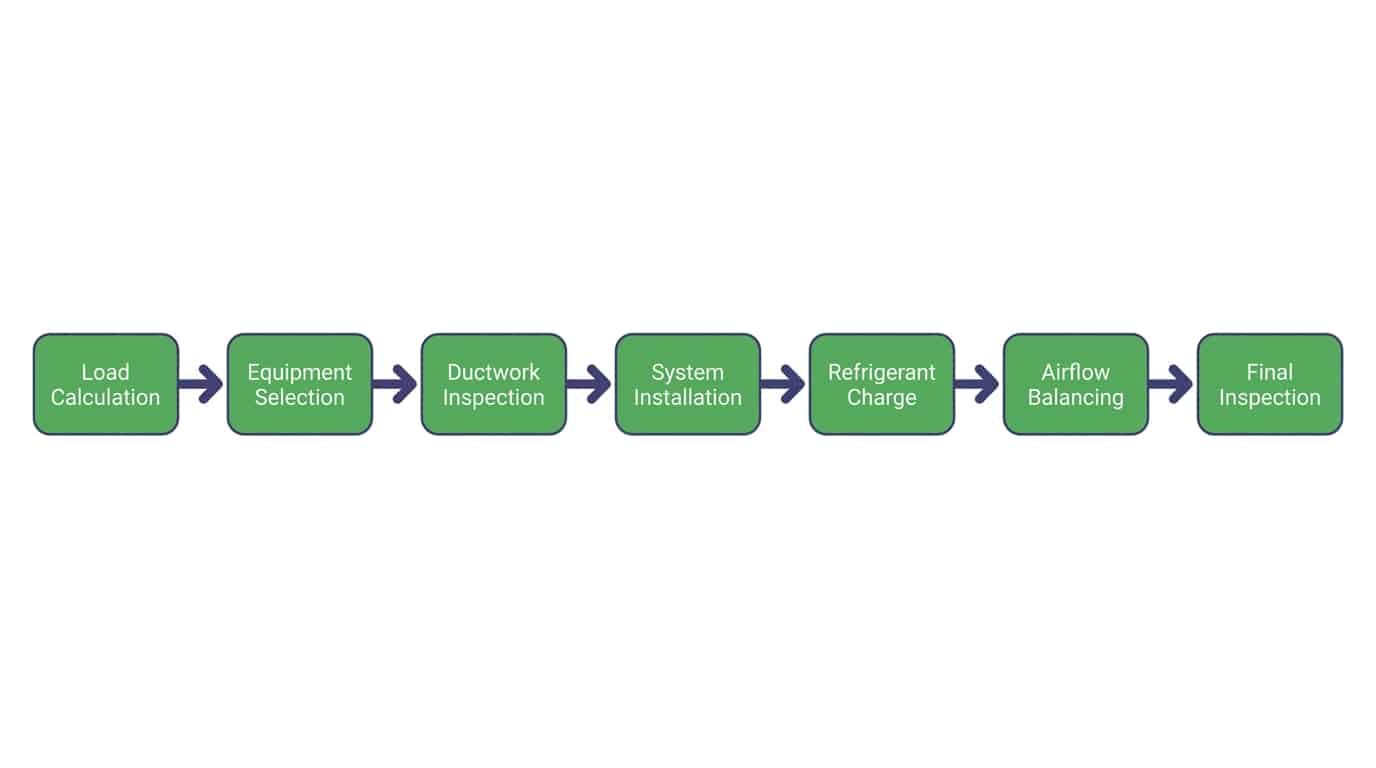
Workmanship quality depends on technician training, installation time, and supervision. Franchise techs may complete three to four installs per day to hit productivity targets, leaving less time for duct sealing, refrigerant charge verification, and airflow balancing. JLM completes one to two installs per day, with Bill on-site for startup and final inspection. Our 3,000-plus installation track record includes zero callbacks for improper refrigerant charge or undersized equipment (issues that plague rushed installs).
When comparing equipment proposals, ask these questions: What specific model and SEER rating are you recommending, and why? How long will the installation take? Who inspects the completed work? A vague answer (“We’ll install a high-efficiency system”) or a suspiciously short timeline (same-day install for a full system replacement) signals corners getting cut. See how mini split installation works from start to finish for a detailed breakdown of what professional installation transparency looks like.
5. Community Reputation and Long-Term Relationship
Franchise HVAC companies optimize for transaction volume across a regional footprint. Technicians rotate territories, customer service reps change with corporate turnover, and the franchise itself may sell to new ownership. Your relationship is with a brand, not a person. That works fine for one-off repairs, but it limits continuity for homeowners who want a long-term service provider who knows their system history.
Local family-owned shops build businesses on repeat relationships. JLM’s referral discount program and maintenance plan enrollment drive most of our service calls. Over 60 percent come from existing customers or their neighbors. We track system history, remember which units have had recurring issues, and proactively recommend seasonal tune-ups before Arizona summer peaks. When Bill’s team arrives for a maintenance call, they recognize the house and recall the install details without pulling a file.
Community reputation carries weight differently for local operators. A franchise can absorb negative reviews across dozens of locations. A single botched install or unresolved complaint hits harder when your business depends on word-of-mouth in a concentrated service area. JLM’s A-plus BBB rating and consistent five-star reviews reflect the reality that owner-operators can’t hide behind corporate bureaucracy when outcomes fall short.
Long-term relationships also affect maintenance plan compliance. HVAC systems last 15 to 20 years with proper care, but only if homeowners schedule annual tune-ups, replace filters, and address minor issues before they cascade. A customer who trusts their local provider is more likely to call for preventive service than someone who sees HVAC companies as interchangeable vendors. JLM’s maintenance plans include priority scheduling, discounted repairs, and ongoing HVAC tips through our blog to help East Valley homeowners extend system life.
The structural advantage of local ownership shows up in unexpected places. When a customer needed emergency service in Apache Junction on Christmas Eve, Bill rearranged family plans to complete the repair because he knew the household included an elderly parent sensitive to heat. That’s not heroic. It’s what happens when the business owner lives in the community and views customers as neighbors, not account numbers in a CRM. For more examples of how local ownership translates to better service experiences, explore customer success stories on our testimonials page.
Real-World Scenario: Franchise vs. Local in Action
A Queen Creek homeowner’s AC failed on a Saturday afternoon in mid-July. Outdoor temperature: 114°F. The homeowner called both a major East Valley franchise and JLM to compare response.
Franchise experience: The automated system answered, presented menu options, and transferred to a customer service rep. Wait time: 12 minutes. The rep collected account information (first-time customer, so no service history), zip code, and problem description. Earliest available appointment: Monday morning, 8 to 11 AM window. Service call fee: $89, applied toward repair if work is approved. The rep offered a premium service plan ($299 per year) that would have moved the appointment to Sunday afternoon. Total time on phone: 18 minutes. Outcome: 40-plus hour wait unless the homeowner upgraded to premium service.
JLM experience: Bill answered on the third ring. He asked for the address, confirmed it was within service range, and asked two diagnostic questions (Is the outdoor unit running? Any tripped breakers?). He had a technician available within 90 minutes and quoted the standard emergency service rate upfront ($150 after-hours fee, applied toward repair). Total time on phone: 4 minutes. The tech arrived 80 minutes later, diagnosed a failed capacitor (a common failure under sustained high temps), replaced it from truck stock, and had the system cooling within 30 minutes of arrival. Total cost: $320 including the emergency fee, parts, and labor. No upsell, no service plan pitch, no follow-up call required.
The structural differences determined the outcome. The franchise system prioritized call volume and service tier over urgency. The local operator prioritized speed and direct problem-solving. Both companies employ skilled technicians and use quality parts. The model (franchise dispatch layers versus owner-on-call accountability) made the 40-hour difference in a scenario where every hour mattered.
When a Franchise Might Make Sense (And When JLM is the Better Fit)
Franchises serve legitimate customer needs. If you prioritize national brand recognition, need service across multiple metro areas (a second home in Phoenix and Tucson), or value the perceived safety of a corporate warranty backed by a parent company, a franchise makes sense. Customers new to an area with no local referrals may feel more comfortable calling a name they recognize from advertising.
Franchises also offer specialized financing programs and service plans that bundle maintenance, repairs, and equipment replacement under long-term contracts. For homeowners who prefer predictable monthly costs over variable service expenses, these plans provide value even with the markup.
JLM is the better fit for East Valley homeowners who value direct owner access, transparent pricing, same-day emergency response, and long-term local relationships. If you want to talk to the person who’ll authorize the repair when something goes wrong, if you prefer itemized estimates over tiered service packages, and if community reputation matters more than brand advertising, a family-owned operator delivers better alignment. Learn more about our commitment to East Valley communities on our About page.
The choice isn’t “franchise bad, local good.” It’s about matching the business model to your priorities. If accountability, speed, and honest pricing rank highest, the owner-operator model wins. If brand familiarity and multi-location presence matter most, a franchise may suit your needs better. For additional guidance on selecting the right HVAC provider for your specific situation, review our service area coverage and capabilities.
Conclusion: Choosing the Right AC Company Starts with Knowing What You Value
The search for “AC companies near me” surfaces both franchise brands and family-owned local shops because both models serve the East Valley. The difference isn’t in technical competence or equipment access. It’s in how the business structure affects your experience as a customer.
Franchises excel at brand recognition, wide service footprints, and standardized processes. Local family-owned companies excel at owner accountability, transparent pricing, fast emergency response, and long-term community relationships. Neither guarantees perfect service, but the model you choose determines who answers when you call, how pricing gets set, and whether you’re a transaction or a neighbor.
JLM operates on the principle that East Valley homeowners deserve honest HVAC service from people who live here and stake their reputation on every install. After 3,000-plus systems and an A-plus BBB rating, we’ve built a business on referrals and repeat customers, not franchise fees and corporate marketing. When your AC fails in July or you’re ready to replace a 15-year-old system, the choice comes down to what you value most.
Ready to experience the JLM difference? Call us today at (602) 619-3609 for same-day emergency service or schedule a free consultation through our contact page. We’ll provide an honest assessment, transparent pricing, and the owner-led accountability that only a family-owned HVAC company can deliver. Reach out to JLM now to get the reliable, responsive service your home deserves.
By Bill Milbourn, Owner and Licensed HVAC Contractor, JLM Air Conditioning and Heating Bill founded JLM after working with larger HVAC companies where he saw homeowners paying premium prices for rushed service and aggressive upselling. With over 3,000 installations across Gilbert, Queen Creek, Mesa, and Apache Junction, Bill has built JLM on the principle that East Valley families deserve transparent pricing, fast emergency response, and personal accountability from someone who lives and works in their community.